Solution:
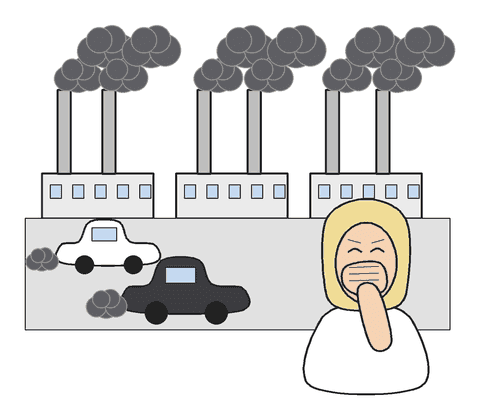
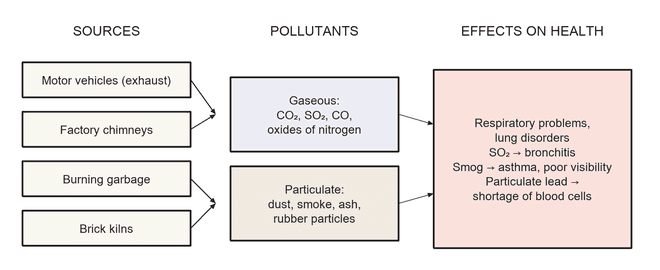
Concept: The picture shows thick smoke from factory chimneys and car exhausts and a person covering her nose and mouth. Air pollution is the spoiling of air quality by harmful gases (carbon dioxide in excess, sulphur dioxide, carbon monoxide, oxides of nitrogen) and particles (dust, smoke, ash, rubber particles). Its main sources are vehicles, factory chimneys, burning garbage and brick kilns.
Step 1 — (i) Name the type of pollution.
Smoke and gases spoiling the air we breathe is air pollution.
Step 2 — (ii) Name one source.
One source is vehicle exhaust; cars, buses and trucks give out carbon monoxide, oxides of nitrogen, sulphur dioxide and particles. Smoke from factory chimneys is another source.
Step 3 — (iii) Explain the effect on health.
Polluted air causes respiratory problems and lung disorders. Sulphur dioxide irritates the air passages and causes bronchitis, smog brings on asthma, and carbon monoxide lowers the oxygen carried by the blood.
Step 4 — (iv) Give one measure to reduce it.
Use CNG (compressed natural gas) or electric vehicles in place of petrol and diesel. Other measures are fitting factory chimneys with filters and electrostatic precipitators and switching off engines at red lights.
Step 5 — (v) Name a gas that depletes the ozone layer.
Chlorofluorocarbons (CFCs), once released from refrigerators, aerosol sprayers and foam packing, set free chlorine high in the atmosphere, which destroys ozone and creates 'ozone holes'.
Watch out: Carbon monoxide pollutes the air but does not deplete ozone; part (v) needs CFCs.
Note: older answers suggest 'use unleaded petrol'; all petrol sold in India has been unleaded since 2000, so that is no longer a new measure.
Therefore, (i) air pollution; (ii) vehicle exhaust (or factory smoke); (iii) respiratory problems such as bronchitis and asthma; (iv) use CNG or electric vehicles; (v) chlorofluorocarbons (CFCs).