
Question 112 marksAsked 2025Easy
What are Vestigial organs? Give one example of a vestigial structure in the human mouth.
Confirming your payment
Sign up now and get 250 free tokens.
Previous Year Questions · Question 11 of 19
What are Vestigial organs? Give one example of a vestigial structure in the human mouth.
Solution:
Concept: Vestigial organs are organs that are of no use (or of very little use) to their possessor but still persist, generation after generation, in a reduced form. They are remnants of organs that did useful work in the ancestors, so they are evidence of evolution.
Step 1 — Define vestigial organs.
Vestigial organs are organs that have ceased to be of any use to their possessor but still persist, generation after generation, in a reduced form. They are remnants of organs that served important functions in the organism's ancestors.
Step 2 — Find one in the human mouth.
The wisdom teeth are the last (third) molars at the back of each jaw. They appear late, at about 17–25 years, are often small, and frequently cannot come out properly because our jaws are shorter than those of our ancestors. We hardly need them for chewing.
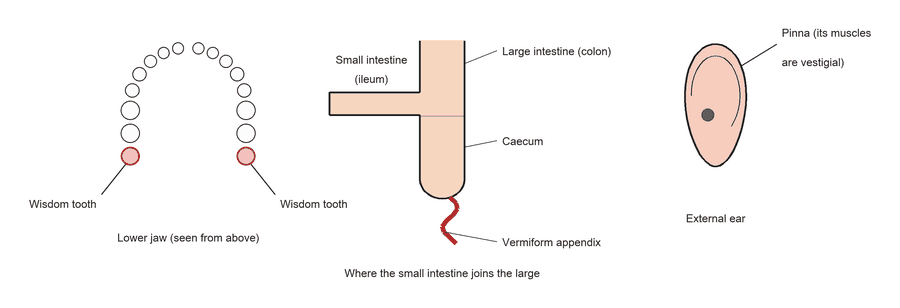
Watch out: The question asks for an example IN THE MOUTH: the appendix and the ear muscles are vestigial too, but they are not in the mouth.
Therefore, vestigial organs are organs that are of no use to their possessor but persist in a reduced form, and the wisdom tooth is a vestigial structure in the human mouth.