
Question 91 markMCQAsked 2025Easy
A scientist wanted to conduct a genetic experiment on mice. He cut the tails of all the mice and made them reproduce. What will be the phenotype of the offsprings?
Confirming your payment
Sign up now and get 250 free tokens.
Previous Year Questions · Question 9 of 19
A scientist wanted to conduct a genetic experiment on mice. He cut the tails of all the mice and made them reproduce. What will be the phenotype of the offsprings?
(A) All the offsprings will be tailless.
(B) There will be a mix of tailed and tailless offsprings.
(C) All the offsprings will have tails.
(D) Tail of the offsprings cannot be predicted.
Answer: (C) All the offsprings will have tails.
Concept: A change made to the body during an animal's life (an acquired character) does not change the genes in its sperms or eggs, so it is not passed on to the offspring.
Step 1 — See what the scientist changed.
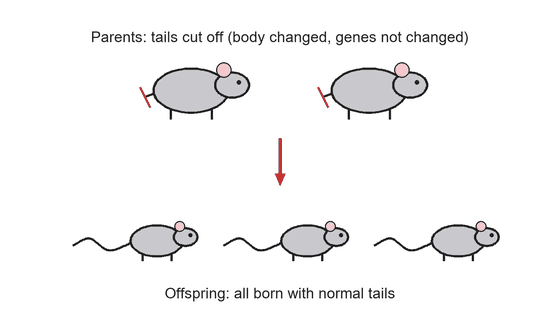
Cutting the tails changes only the bodies of the parent mice. The genes in their sperms and ova still carry the instruction for a normal tail.
Step 2 — Predict the offspring.
The young develop from these unchanged gametes, so every one of them is born with a normal tail.
Step 3 — Link it to the theory.
This is the experiment of August Weismann, who cut the tails of mice generation after generation and still got young with normal tails. It went against Lamarck's idea of inheritance of acquired characters.
Watch out: An injury or a cut is an acquired change of the body, not a change of the genes.
Why the other options are wrong:
Therefore, all the offspring will have tails, option (C).