Solution:
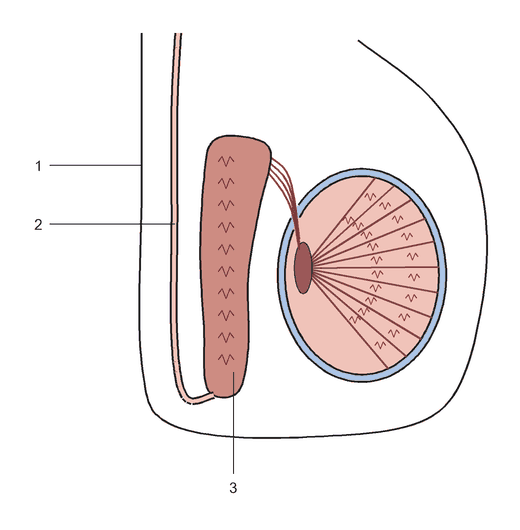
Concept: The figure is a lengthwise section of the testis inside its bag of skin (1). The tube rising along the inner side (2) carries the sperms away, and the long coiled body beside the testis (3) is where they are stored. Each testis has two kinds of working tissue. Its coiled seminiferous tubules make the sperms, and the interstitial (Leydig) cells packed between the tubules make the male hormone testosterone.
Step 1 — Part (i) — label the parts.
The outer bag is the scrotum, the thin tube rising from the lower end of the coiled body is the sperm duct, and the coiled body is the epididymis.
1 — Scrotum (scrotal sac)
2 — Vas deferens (sperm duct)
3 — Epididymis

Step 2 — Part (ii) — where sperms are made.
Sperms are produced in the seminiferous tubules of the testis. The process is called spermatogenesis.
Step 3 — Part (iii) — function of part 1 (scrotum).
The scrotum holds the testes outside the abdominal cavity, where they stay about 2–3 °C cooler than the inside of the body; sperms form properly only at this lower temperature.
Its skin loosens in warm weather (testes hang lower) and tightens in cold weather (testes are drawn up), which helps keep this temperature.
Step 4 — Part (iii) — function of part 3 (epididymis).
The epididymis stores the sperms for some days, and during this time they mature and become able to swim (motile).
Step 5 — Part (iv) — cells that secrete testosterone.
The interstitial cells (Leydig cells), lying between the seminiferous tubules, secrete testosterone.
Step 6 — Part (v) — labelled diagram of a sperm.
Draw the three regions in a line and label each part.

The head carries the acrosome (enzymes that help the sperm get through the layers round the egg) and the nucleus; the middle piece has mitochondria that supply energy; the tail (axial filament) lashes to drive the sperm forward.
Watch out: The epididymis stores and matures sperms; it does not make them.
Therefore, 1 is the scrotum, 2 the vas deferens and 3 the epididymis; sperms are made in the seminiferous tubules, the scrotum keeps the testes 2–3 °C cooler than the body, the epididymis stores and matures the sperms, and testosterone comes from the interstitial (Leydig) cells.