Solution:
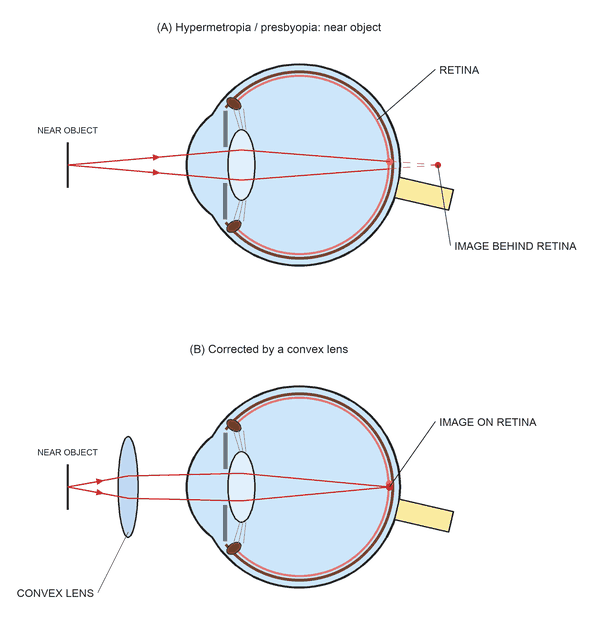
Concept: In hypermetropia (long-sightedness) distant objects are seen clearly but near ones look blurred, because the rays from a near object would meet behind the retina. It is corrected by a convex (converging) lens.
Step 1 — (a) Identify the defect.
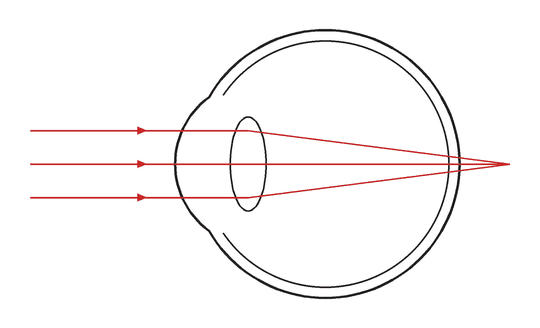
In the diagram the parallel rays have not met when they reach the retina; they would meet behind it, outside the eyeball. This is hypermetropia (long-sightedness).
Step 2 — (b) Give one reason.
The eyeball is too short from front to back (or the lens is too flat).
Step 3 — (c) Name the lens.
A convex (converging) lens bends the rays inwards a little before they enter, so the image forms on the retina; such spectacles have a plus (+) power.
Watch out: Convex corrects hypermetropia; concave corrects myopia.
Therefore, (a) hypermetropia; (b) a shortened eyeball; (c) a convex lens.