Solution:
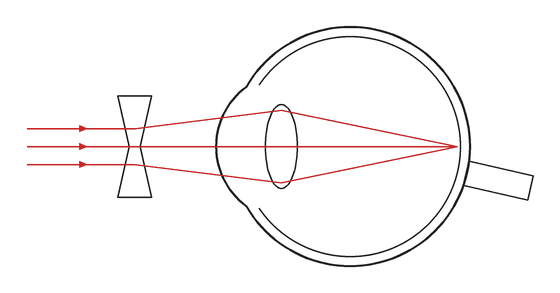
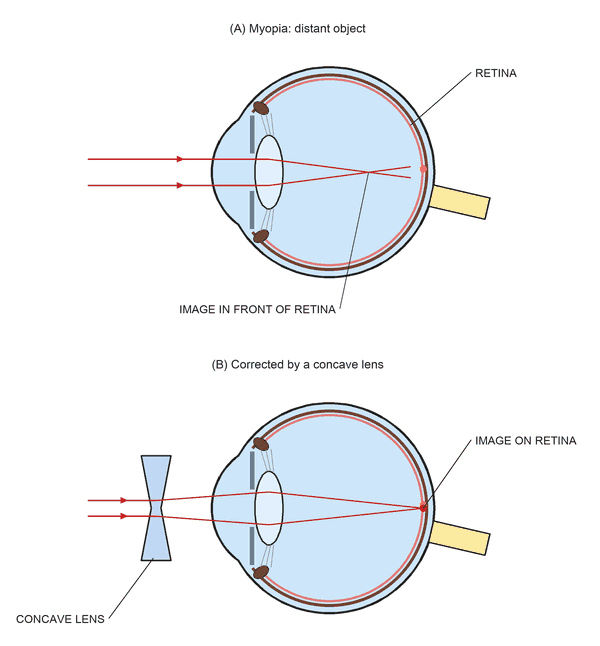
Concept: In myopia (short-sightedness) near objects are seen clearly but distant ones look blurred, because parallel rays from a distant object meet in front of the retina. It is corrected by a concave (diverging) lens.
Step 1 — (i) Name the defect and the lens.
The diagram shows parallel rays from a distant object passing through a concave lens and then focusing exactly on the retina; a concave lens corrects myopia (short-sightedness).
Step 2 — (ii) Give one cause.
The eyeball is too long from front to back (or the lens is too curved).
Step 3 — (iii) Image without the lens.
The image would form in front of the retina, so the distant object would look blurred.
Step 4 — (iv) Name the three layers.
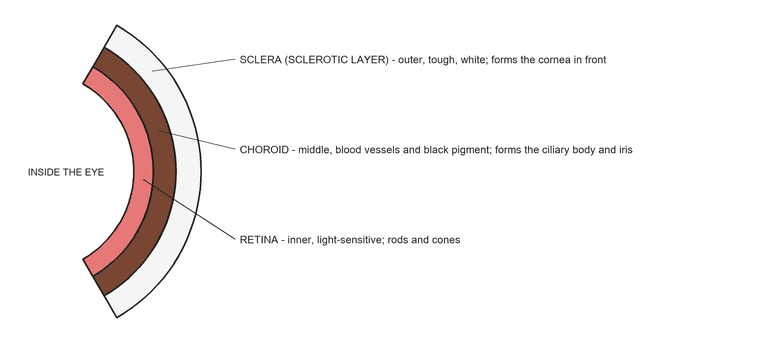
From outside in: sclera (sclerotic layer), choroid and retina.
Step 5 — (v) Draw a neuron.
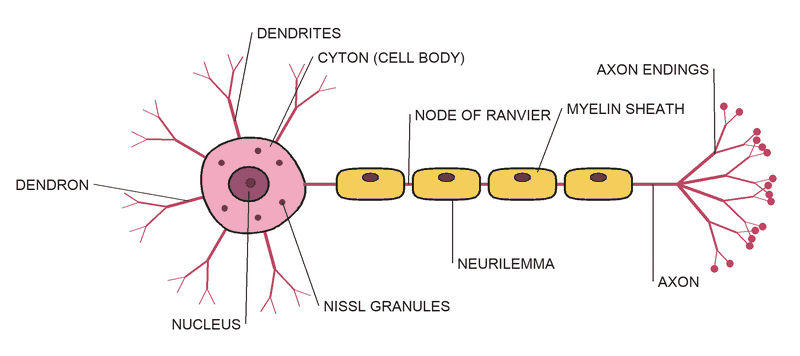
Draw the cyton with its nucleus and Nissl granules, the branched dendrites, and the long axon with its myelin sheath, neurilemma, nodes of Ranvier and axon endings. Dendrites carry impulses towards the cyton; the axon carries them away.
Therefore, (i) myopia, corrected by a concave lens; (ii) an elongated eyeball; (iii) in front of the retina; (iv) sclera, choroid and retina; (v) the labelled neuron as drawn.