Solution:
Concept: In myopia (short-sightedness) near objects are seen clearly but distant ones look blurred, because parallel rays from a distant object meet in front of the retina. It is corrected by a concave (diverging) lens.
Step 1 — (i) Name the defect.
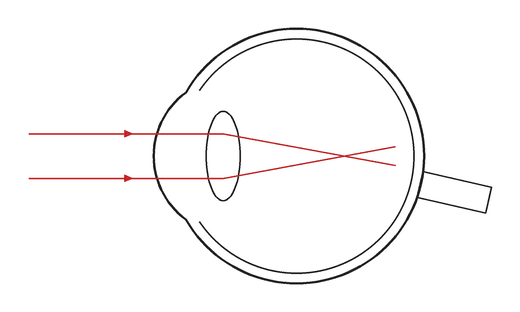
In the diagram, parallel rays from a distant object cross in front of the retina and spread out again before reaching it, so the distant object looks blurred. The defect is myopia (short-sightedness).
Step 2 — (ii) Give two causes.
There are two possible causes of this defect:
-
The eyeball is too long from front to back, so the retina lies too far behind the lens.
-
The lens is too curved (too convex), so it bends the rays too much and they meet too early.
Step 3 — (iii) Name the lens.
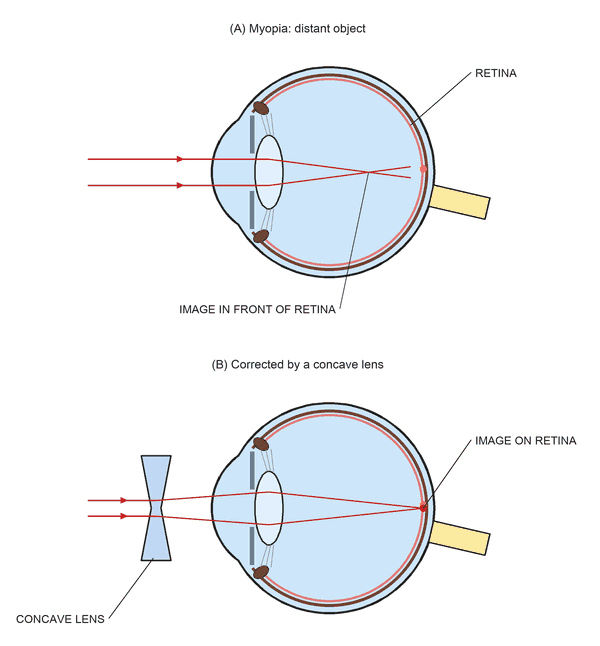
A concave (diverging) lens; such spectacles have a minus (−) power.
Step 4 — (iv) Show the correction.
The concave lens placed in front of the eye spreads the rays a little before they enter. The eye lens then brings them to a focus exactly on the retina, so the distant object is seen clearly. Panel (A) shows the defect, panel (B) the correction.
Watch out: Do not use a convex lens for myopia: it would make the rays meet even earlier.
Therefore, (i) myopia; (ii) an elongated eyeball or a too-curved lens; (iii) a concave lens; (iv) the concave lens spreads the rays so that the image forms on the retina, as drawn.