Solution:
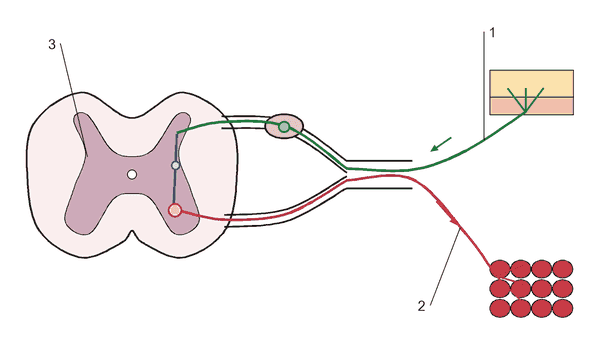
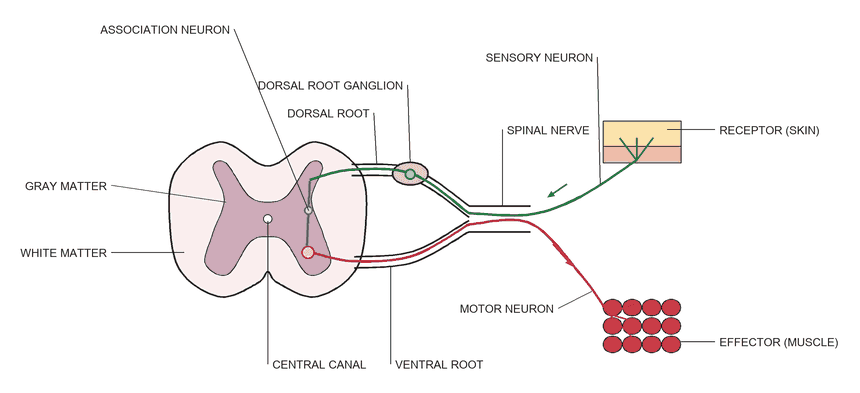
Concept: The diagram shows an impulse entering the spinal cord from a receptor in the skin (1 runs from the receptor) and coming back out to a muscle (2 runs to the muscle). This pathway is the reflex arc of a spinal reflex.
Step 1 — (i) Name and define the phenomenon.
The phenomenon is reflex action (a spinal reflex; the pathway is the reflex arc). A reflex action is an automatic, quick and involuntary response to a stimulus, made without conscious thought. Most simple reflexes are controlled by the spinal cord. Example: the hand is pulled back at once from a hot object.
Step 2 — (ii) Name the point of contact.
The point of contact between two nerve cells is the synapse.
Step 3 — (iii) Name parts 1, 2 and 3.
1 is the sensory neuron (sensory nerve fibre), which carries the impulse from the receptor to the spinal cord. 2 is the motor neuron (motor nerve fibre), which carries the command to the muscle. 3 is the gray matter of the spinal cord.
Step 4 — (iv) Compare the arrangement with the brain.
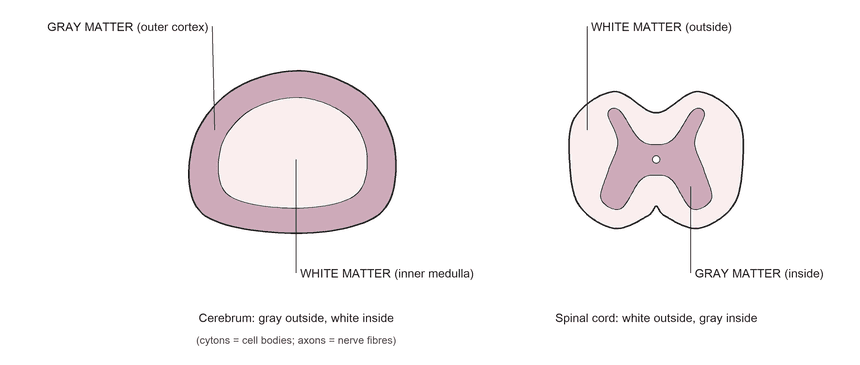
In the spinal cord the gray matter (cell bodies) lies inside and the white matter (axons) outside. In the brain it is the other way round: gray matter forms the outer cortex and white matter lies inside.
Step 5 — (v) Give two ways the spinal cord is protected.
It lies inside the neural canal of the vertebral column (backbone). It is covered by the three meninges, and the cerebrospinal fluid between them cushions it against shocks.
Watch out: 1 ends on the green SENSORY fibre (coming in from the skin) and 2 on the red MOTOR fibre (going out to the muscle).
Therefore, (i) reflex action, an automatic involuntary response to a stimulus; (ii) synapse; (iii) 1 sensory neuron, 2 motor neuron, 3 gray matter; (iv) the spinal cord has gray matter inside and white matter outside, the reverse of the brain; (v) the vertebral column, and the meninges with cerebrospinal fluid.