
Opening your dashboard
Class 9 Maths Chapter 5 Factorisation: Practice Questions
40 questions on Chapter 5, each worked through on its own page with the AI tutor. Class 9 Maths, ICSE 2026-27.
40 questions
1–5 marks · Mixed difficulty
- 11 mark
Question 1
Bloom's level: Remember
Factorisation of an algebraic expression is the reverse process of :
- 21 mark
Question 2
Bloom's level: Remember
is equal to :
- 31 mark
Question 3
Bloom's level: Remember
A trinomial (with integer coefficients) can be factorised by splitting the middle term if the value of is :
- 41 mark
Question 4
Bloom's level: Apply
in the form of factors is :
- 51 mark
Question 5
Bloom's level: Apply
in the form of factors is :
- 61 mark
Question 6
Bloom's level: Apply
in the form of factors is :
- 71 mark
Question 7
Bloom's level: Apply
in the form of factors is :
- 81 mark
Question 8
Bloom's level: Understand
Which of the following expressions can be written as a difference of two squares?
- 91 mark
Question 9
Bloom's level: Understand
Which of the following is a factor of ?
- 101 mark
Question 10
Bloom's level: Analyse
Assertion (A) : The trinomial can be factorised by splitting the middle term.
Reason (R) : For , the value of is 49, which is a perfect square.
- 111 mark
Question 11
Bloom's level: Evaluate
Assertion (A) :
Reason (R) :
- 121 mark
Question 12
Bloom's level: Evaluate
Assertion (A) : is a factor of .
Reason (R) :
- 131 mark
Question 13
Bloom's level: Remember
What is meant by a factor of an algebraic expression? Write all the factors of .
- 142 marks
Question 14
Bloom's level: Understand
Factorise . Explain why the sign between the two terms changes in your answer.
- 152 marks
Question 15
Bloom's level: Apply
Factorise by grouping :
- 162 marks
Question 16
Bloom's level: Apply
Factorise :
- 172 marks
Question 17
Bloom's level: Apply
Using the value of , find which of the trinomials and is factorisable. Factorise that one.
- 182 marks
Question 18
Bloom's level: Apply
Using factorisation, find the value of without squaring either number.
- 192 marks
Question 19
Bloom's level: Understand
Is a difference of two squares? Give a reason. Then factorise completely.
- 202 marks
Question 20
Bloom's level: Understand
Write as a product of two factors. Explain why the second factor cannot be factorised further.
- 212 marks
Question 21
Bloom's level: Analyse
Factorise . Show that grouping the terms in the order they are written does not work, and find a grouping that does.
- 222 marks
Question 22
Bloom's level: Evaluate
Riya factorised as . Check her answer by multiplying out. Is she correct? If not, write the correct factorisation.
- 233 marks
Question 23
Bloom's level: Understand
Factorisation is the reverse of multiplication.
(i) Multiply out .
(ii) Hence write the factors of .
(iii) Explain how multiplication can be used to check a factorisation, and use it to show that is not a factorisation of .
- 243 marks
Question 24
Bloom's level: Understand
Explain what is meant by factorising an expression completely. Then say whether each of the following is complete, and give the complete factorisation where it is not.
(i)
(ii)
(iii)
- 254 marks
Question 25
Bloom's level: Apply
Factorise :
(i)
(ii)
- 264 marks
Question 26
Bloom's level: Analyse
Factorise, showing how you rearrange each expression into the form :
(i)
(ii)
- 274 marks
Question 27
Bloom's level: Analyse
Case study: A square park has side m. In its centre is a square lawn of side m. The strip of the park around the lawn is to be paved.
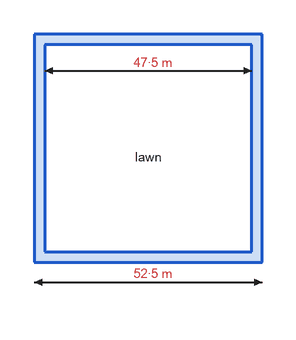
(a) If the park has side m and the lawn has side m, write an expression for the area of the paved strip and factorise it.
(b) Use your factorised form to find the area of the paved strip without squaring or .
(c) The park is enlarged so that its side becomes m, the lawn staying the same. Using factorisation, find by how much the paved area increases, and explain why this increase does not depend on the size of the lawn.
- 284 marks
Question 28
Bloom's level: Analyse
(i) Factorise .
(ii) Factorise completely in two ways — first treating it as a difference of two squares, then as a difference of two cubes. Show that both ways give the same final factors.
- 295 marks
Question 29
Bloom's level: Create
Case study: A carpenter cuts a rectangular board whose area, in cm², is .
(a) Factorise the area by grouping to find expressions for the length and the breadth of the board.
(b) For and , find the length and breadth, and check that both forms of the area give the same value.
(c) Make up a puzzle of your own for a classmate: write a four-term expression whose factors are and , jumble its terms, and show the grouping that recovers the factors.
- 305 marks
Question 30
Bloom's level: Create
(i) Find all positive integer values of for which can be factorised by splitting the middle term. Factorise the trinomial for each value.
(ii) Construct trinomials of the form , where is a positive integer less than 7. Use the test to decide which values of make the trinomial factorisable, and factorise those trinomials.
- 311 mark
Question 31
When is factorised completely, one of the factors is :
- 321 mark
Question 32
The factors of are :
- 331 mark
Question 33
When is written as the product of a linear and a quadratic factor, the quadratic factor is :
- 342 marks
Question 34
By taking out the common factor, express as a product of two or more factors.
- 352 marks
Question 35
Using the method of grouping the terms, express as a product of two binomial factors.
- 363 marks
Question 36
Recognise the first three terms as a perfect square, and hence write the expression as a product of two factors.
- 373 marks
Question 37
Resolve into two linear factors by splitting the middle term, and show every step of your working.
- 384 marks
Question 38
(i) Factorise completely :
(ii) Using the identity , find the value of .
- 394 marks
Question 39
(i) Factorise completely :
(ii) Use the factors to find the value of the expression when .
(iii) Check your answer to part (ii) by substituting directly in the expression.
- 404 marks
Question 40
(i) Factorise completely :
(ii) Use the factors to find the value of .