
Opening your dashboard
Class 9 Biology Chapter 3 Tissues: Plant and Animal Tissues: Practice Questions
44 questions on Chapter 3, each worked through on its own page with the AI tutor. Class 9 Biology, ICSE 2026-27.
44 questions
1–5 marks · Mixed difficulty
- 11 mark
Question 1
Bloom's level: Remember
Under a microscope, the cells of a growing root tip are seen to have :
- 21 mark
Question 2
Bloom's level: Remember
The living cells present in bone are called :
- 31 mark
Question 3
Bloom's level: Remember
The word meristem comes from the Greek word meristos, which means :
- 41 mark
Question 4
Bloom's level: Remember
Stratified epithelium, made of several layers of cells, is found in :
- 51 mark
Question 5
Bloom's level: Understand
Xylem and phloem are called complex tissues because :
- 61 mark
Question 6
Bloom's level: Understand
The cells of epithelial tissue fit tightly together, leaving no space between them. This mainly helps the tissue to :
- 71 mark
Question 7
Bloom's level: Apply
Ropes and mats made from fibres of hemp and linen are very strong. These fibres are made of :
- 81 mark
Question 8
Bloom's level: Apply
A footballer twists his knee and tears the band of tissue that holds his thigh bone to his shin bone. The injured tissue is a :
- 91 mark
Question 9
Bloom's level: Apply
A gardener pinches off the tip of a young plant's main shoot. The shoot stops growing taller because he has removed the :
- 101 mark
Question 10
Bloom's level: Analyse
Assertion (A): Sclerenchyma gives strength to plant parts even though its cells are dead.
Reason (R): The walls of sclerenchyma cells become very thick due to the deposition of lignin.
- 111 mark
Question 11
Bloom's level: Evaluate
Assertion (A): The muscles of the iris of the eye are striated muscles.
Reason (R): Striated muscles are under the control of our will.
- 121 mark
Question 12
Bloom's level: Analyse
Assertion (A): Inside a large animal, a single cell working on its own would achieve very little.
Reason (R): In a many-celled body, groups of similar cells work together as teams, each team doing a particular job.
- 132 marks
Question 13
Bloom's level: Understand
An amoeba does all its life activities within one cell, but a frog has tissues. Explain why a large organism like the frog needs tissues.
- 142 marks
Question 14
Bloom's level: Understand
Tissues are called "teams of workers". Explain this phrase with one example from the human body and one from a plant.
- 152 marks
Question 15
Bloom's level: Apply
A student describes three plant samples :
- P : small cubical cells, dividing actively, taken from a shoot tip
- Q : long, narrow, dead cells with very thick lignified walls
- R : large thin-walled living cells, each with one large vacuole, storing starch
Classify each as meristematic or permanent tissue, and name the tissues Q and R.
- 162 marks
Question 16
Bloom's level: Apply
Name the kind of epithelium you would expect in each place, and give a reason :
(a) the thin lining of a blood vessel
(b) the lining of the stomach, which must pour out digestive juice
- 172 marks
Question 17
Bloom's level: Apply
After a long illness, a person lost a lot of weight. The padding under the skin and around the kidneys became thin, and he felt cold more easily. Name the tissue that has decreased and explain why he feels cold.
- 182 marks
Question 18
Bloom's level: Analyse
Study the description of three muscle fibres :
Feature P Q R Shape Long, cylindrical Spindle-shaped, tapering Branched, relatively short Light and dark bands Present Absent Present Under control of our will Yes No No Identify P, Q and R and give one place in the body where each is found.
- 192 marks
Question 19
Bloom's level: Evaluate
A student writes : "A nerve is a single, very long nerve cell that runs from the brain to the toe." Is the statement correct ? Justify your answer.
- 202 marks
Question 20
Bloom's level: Apply
You see a mosquito on your arm and quickly slap it. Name four kinds of animal tissue that take part in this action and give the role of each.
- 212 marks
Question 21
Bloom's level: Analyse
Parenchyma, collenchyma and sclerenchyma are all supporting tissues, yet they give different kinds of support. Relate the cell wall of each to the kind of support it provides.
- 221 mark
Question 22
Bloom's level: Understand
Distinguish between a simple and a complex permanent tissue, with one example of each.
- 234 marks
Question 23
Bloom's level: Apply
Case: After a road accident, Meena lost a lot of blood and was given a blood transfusion. A week later, a small blister on her healed wound was filled with a clear fluid. Her doctor said that this fluid contains white blood cells but no red blood cells.
(a) Name the liquid part of blood and its three kinds of cells.
(b) Which kind of blood cell protects the body against disease, and which carries oxygen ?
(c) Name the clear fluid that surrounds body cells and explain why it has no red blood cells.
(d) To which group of connective tissue do blood and this fluid belong ?
- 244 marks
Question 24
Bloom's level: Analyse
Case: To harvest fruits early, a farmer removed a complete ring of bark, about cm wide, from the trunk of a fruit tree. The inner wood was left untouched.
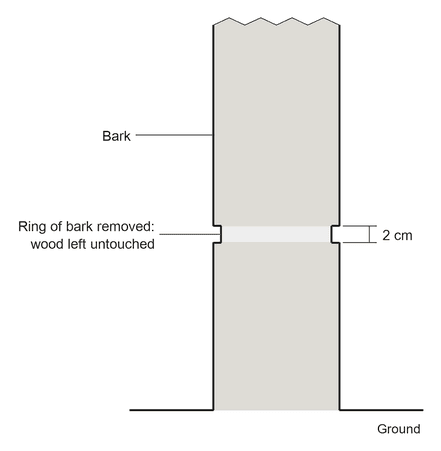
After a few weeks the bark just above the ring became swollen. The leaves stayed fresh, but after some months the tree began to look weak.
(a) Which conducting tissue was removed along with the bark ? Which one was left in the wood ?
(b) Explain why the bark above the ring swelled.
(c) Explain why the leaves stayed fresh at first, but the whole tree became weak later.
- 253 marks
Question 25
Bloom's level: Understand
Explain how the structure of each of these epithelia suits its job :
(a) glandular epithelium
(b) squamous epithelium
(c) stratified epithelium
- 264 marks
Question 26
Bloom's level: Apply
A gardener observes two kinds of growth :
- the trunk of an old mango tree becomes thicker every year;
- a young shoot of the same tree grows taller from its tip.
(a) Name the meristem responsible for each kind of growth and state where it is located.
(b) Give four features of the cells in these regions that suit them for their work.
(c) What happens to the new cells formed by these meristems ?
- 273 marks
Question 27
Bloom's level: Understand
Describe the structure of a neuron, and explain how each of its parts helps in carrying messages through the body.
- 284 marks
Question 28
Bloom's level: Evaluate
Analogies are never perfect, but they can help us understand. Judge each analogy below : say what is good about it and one way in which it fails.
(a) Xylem vessels are like water pipes.
(b) Epithelium is like the tiles on a floor.
(c) Adipose tissue is like a woollen blanket.
- 295 marks
Question 29
Bloom's level: Create
Construct a table for a model of the human arm showing the tissues it contains. Include these parts : the outer skin, the biceps muscle, the bones, the band joining the muscle to the bone, the nerves, and the blood in its vessels.
For each part give (a) the main kind of animal tissue, (b) its sub-type, and (c) one function.
- 305 marks
Question 30
Bloom's level: Create
Construct a flow chart showing the levels of organisation — cell, tissue, organ, organ system and organism — once for a flowering plant and once for a human being. Give a suitable example at every level, and write one line explaining how each level is related to the next.
- 311 mark
Question 31
Which one of the following components of the xylem tissue is made up of living cells ?
- 321 mark
Question 32
The connective tissue that occurs beneath the epidermis of the skin, makes the skin elastic and helps it to withstand pulling strain is the
- 331 mark
Question 33
Assertion (A): Cardiac muscles do not get tired soon.
Reason (R): Cardiac muscles are found only in the walls of the heart.
- 342 marks
Question 34
The tongue contains epithelial cells, nerve cells and muscle cells.
(i) Is the tongue a tissue or an organ ? Give a reason for your answer.
(ii) What is formed when many such parts of the body act together to perform a specific life process ? Give one example.
- 352 marks
Question 35
(i) State two ways in which a cell of a meristematic tissue differs in structure from a cell of parenchyma.
(ii) The apical meristem is located near the tips of roots and stems. Name two other places in a plant where it is found.
- 362 marks
Question 36
Phloem is the food-conducting tissue of a plant.
(i) Name the cells that lie closely associated with the sieve tube cells, and state their function.
(ii) In which directions does food move through the phloem ?
- 372 marks
Question 37
(i) State the three characteristics of a connective tissue.
(ii) To which class of connective tissue do blood and lymph belong ? Name the two functions with which both of them are mainly concerned.
- 384 marks
Question 38
The figure shows three kinds of epithelial tissue, P, Q and R, as seen in section.
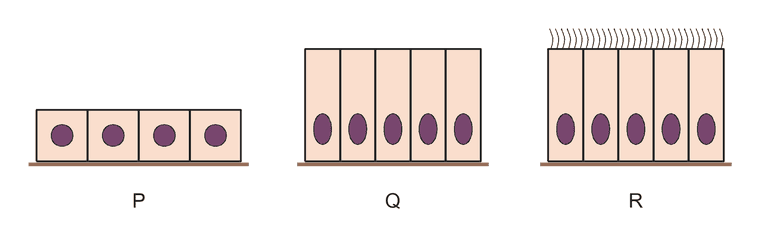
(i) Name the kind of epithelium shown in each of P, Q and R.
(ii) Give one location in the human body each of the tissues P and Q.
(iii) Name the thread-like projections seen at the free ends of the cells of R. State their function and one location of this tissue.
- 394 marks
Question 39
The table compares the three kinds of muscles of the human body. Four entries, numbered 1 to 4, are missing.
Feature Striated muscle Unstriated muscle Cardiac muscle Control Under the control of our will ......1...... Involuntary Light and dark bands Present ......2...... Present Shape of the fibres Long Spindle-shaped, tapering ......3...... One location Arms and legs ......4...... Walls of the heart (i) Write the missing entries 1 to 4.
(ii) Which of the three kinds makes up the largest share of the body weight ? Give two other names of this kind of muscle.
(iii) State two properties of the cardiac muscle that suit it to the work of the heart.
- 403 marks
Question 40
Nervous tissue is made up of specialised elongated cells called neurons.
(i) Draw a neat diagram of a neuron and label any four of its parts.
(ii) What is a nerve ?
(iii) With what is the nervous tissue concerned ?
- 411 mark
Question 41
Class 9 Sample Paper 1 · Section A
What is the function of nerve cells?
- 421 mark
Question 42
Class 9 Sample Paper 2 · Section A
What are sieve cells responsible for?
- 431 mark
Question 43
Class 9 Sample Paper 2 · Section A
Name the following:
Help in the functioning of sieve tube cells.
- 442 marks
Question 44
Class 9 Sample Paper 2 · Section B
Differentiate between parenchyma and collenchyma.