
Opening your dashboard
Class 9 Biology Chapter 12 Skeleton – Movement and Locomotion: Practice Questions
40 questions on Chapter 12, each worked through on its own page with the AI tutor. Class 9 Biology, ICSE 2026-27.
40 questions
1–5 marks · Mixed difficulty
- 11 mark
Question 1
Bloom's level: Remember
The cranium (brain-box) of the human skull is made of :
- 21 mark
Question 2
Bloom's level: Remember
In a long bone, red marrow is found mainly :
- 31 mark
Question 3
Bloom's level: Remember
Gliding joints are found between the :
- 41 mark
Question 4
Bloom's level: Remember
The human body has about 650 muscles. Together they make up nearly :
- 51 mark
Question 5
Bloom's level: Understand
The ribs form a cage around the heart and lungs. This is an example of which function of the skeleton ?
- 61 mark
Question 6
Bloom's level: Understand
Synovial fluid in a knee joint is important mainly because it :
- 71 mark
Question 7
Bloom's level: Understand
Raising the body on the toes is a lever of the second order because :
- 81 mark
Question 8
Bloom's level: Apply
When you curl your fingers to make a fist, the joints between the phalanges of each finger move in one plane only, like the hinge of a door. These are :
- 91 mark
Question 9
Bloom's level: Apply
A footballer fractures the outer of the two long bones of his shank (the part of the leg between knee and ankle). The broken bone is the :
- 101 mark
Question 10
Bloom's level: Analyse
Assertion (A): A broken bone in an elderly person usually takes much longer to rejoin than in a child.
Reason (R): With age, the organic part of bone is reduced and the bones become more fragile.
- 111 mark
Question 11
Bloom's level: Evaluate
Assertion (A): The biceps muscle alone can both bend the arm at the elbow and straighten it again.
Reason (R): Muscles can only contract and relax; they cannot push or lengthen by themselves.
- 121 mark
Question 12
Bloom's level: Analyse
Assertion (A): The patella (knee-cap) is present in the hind limbs but has no matching bone in the forelimbs.
Reason (R): The patella is a bone that develops from a tendon.
- 132 marks
Question 13
Bloom's level: Understand
Classify the following bones by shape into long, short, flat and irregular bones : femur, wrist bones, skull bones, a vertebra, sternum, ankle bones, facial bones, humerus.
- 142 marks
Question 14
Bloom's level: Understand
The knee joint bears the whole weight of the body and moves thousands of times a day, yet it does not normally get dislocated or worn out quickly. Explain how it is protected.
- 152 marks
Question 15
Bloom's level: Understand
Muscles of the eyelids and the diaphragm are said to be both voluntary and involuntary. Explain this, giving an example for each muscle.
- 162 marks
Question 16
Bloom's level: Understand
When you walk, neither your bones alone nor your muscles alone could move you. Explain why the skeleton and the muscles must work together.
- 172 marks
Question 17
Bloom's level: Apply
Using the bones of the limbs, count the number of bones in one complete forelimb and in one complete hind limb. Show your working.
- 182 marks
Question 18
Bloom's level: Apply
A woman's diet has been short of calcium for many months, but her blood calcium level is still normal. Which function of the skeleton explains this? What may happen to her bones if this continues ?
- 192 marks
Question 19
Bloom's level: Apply
The biceps is attached to the lower arm 4 cm from the elbow, and the hand is 36 cm from the elbow.
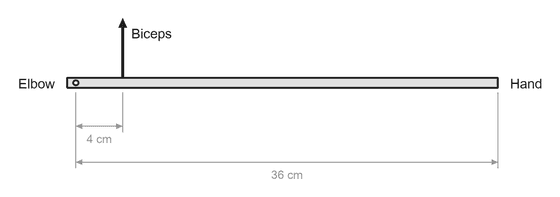
If the biceps shortens by 3 cm, how far does the hand move? Which order of lever is this, and what is the advantage ?
- 202 marks
Question 20
Bloom's level: Apply
A cricket bowler swings his arm round in a full circle at the shoulder, but at the elbow his arm can only bend and straighten. Name the joint at each place and the bones (or parts) that meet there.
- 212 marks
Question 21
Bloom's level: Analyse
Two similar dry bones, each of mass 30 g, are treated differently. Bone X is strongly heated; it becomes brittle and its mass falls to 20 g. Bone Y is kept in dilute hydrochloric acid for a week; it becomes so soft that it can be bent. Analyse what was removed from each bone and what fraction of the bone is inorganic.
- 222 marks
Question 22
Bloom's level: Evaluate
Rohan says, "Movement and locomotion mean the same thing." Evaluate his statement with examples.
- 233 marks
Question 23
Bloom's level: Apply
The vertebral column has five groups of vertebrae.
(a) Write the number of vertebrae in each group and find the total.
(b) In an adult, the sacral and coccygeal vertebrae are fused into one bone each. How many separate bones does the adult vertebral column then have ?
(c) The usual count of 206 bones uses the fused number. What would the total be if the vertebrae were counted individually? On which vertebra does the skull rest ?
- 244 marks
Question 24
Bloom's level: Apply
Case: During a kabaddi match, Arjun twisted his knee badly. The doctor found that one of the ligaments of the knee was torn, and the knee became swollen and unsteady.
(a) Name the bones that meet at the knee joint, and the kind of joint it is.
(b) Explain why a torn ligament makes the knee unsteady.
(c) The knee is a synovial joint. Explain the role of the synovial membrane, synovial fluid and cartilage, and why damage to them makes movement painful.
- 253 marks
Question 25
Bloom's level: Apply
Meera is doing push-ups.
(a) As she pushes her body up, her arms straighten at the elbow. Which muscle contracts? Is it a flexor or an extensor ?
(b) As she lowers herself slowly, her arms bend at the elbow. What actually bends her arms here, and which muscle keeps the lowering slow? Which muscle would bend her arm if she lifted a school bag instead ?
(c) Explain why the arm needs a pair of such muscles, and name the structure that attaches them to the bones.
- 264 marks
Question 26
Bloom's level: Analyse
Case: A physiotherapist explains three movements to a group of students :
- Movement 1 : straightening the arm at the elbow by the triceps to push a door.
- Movement 2 : rising on the toes by pulling up the heel with the calf muscle (gastrocnemius).
- Movement 3 : lifting a water bottle by bending the arm at the elbow with the biceps.
(a) For each movement, identify the fulcrum (F), the weight (W) and the power (P).
(b) Name the order of lever in each case, giving the arrangement of F, W and P.
(c) Which of these levers is best for lifting a large load, and which for quick, wide movement? Explain.
- 274 marks
Question 27
Bloom's level: Analyse
The femur is a long bone with a hollow shaft and spongy ends.
(a) Analyse how this one bone takes part in four different functions of the skeleton.
(b) Why is a long bone hollow rather than a solid rod ?
(c) Which function of the skeleton is the femur not directly concerned with? Name a bone that is.
- 285 marks
Question 28
Bloom's level: Evaluate
Case: Riya wrote three statements in her revision notes :
- "Cartilage is just soft bone, and it is found only in babies."
- "All the muscles of the body are attached to bones."
- "Nails and teeth are very hard, so they must be bones."
(a) Evaluate statement 1 and correct it.
(b) Evaluate statement 2 and correct it with examples.
(c) Evaluate statement 3 and correct it.
- 295 marks
Question 29
Bloom's level: Create
Design a simple working model of the human arm to show how antagonistic muscles and a third-order lever move the lower arm at the elbow.
(a) List the materials and describe how you will make the bones, the joint and the two muscles.
(b) Describe how you will use the model to show bending and straightening of the arm.
(c) State two ways in which your model is different from a real arm.
- 305 marks
Question 30
Bloom's level: Create
Construct a summary table of the human skeleton with two main headings — axial and appendicular. Under each, list its parts with the number of bones in each part, and show that the totals add up to 206.
- 311 mark
Question 31
In which one of the following are the bones correctly matched with their number in the human body ?
- 321 mark
Question 32
On the basis of their shape, the shoulder blade, the sternum and the bones of the skull are placed in the same class of bones. Bones of this class :
- 331 mark
Question 33
Assertion (A): The 11th and 12th pairs of ribs are known as floating ribs.
Reason (R): The 11th and 12th pairs of ribs are not attached to the sternum.
- 342 marks
Question 34
(i) Name the part of a long bone, such as the femur, in which blood cells are formed. Which types of blood cells are formed there ?
(ii) Name the part of the skeleton that protects : (a) the spinal cord, (b) the heart and the lungs.
- 352 marks
Question 35
(i) Name the membrane that covers the external surface of a bone, and state one feature of this membrane.
(ii) State one difference between yellow marrow and red marrow with regard to the blood cells they produce. In which part of a long bone is the red marrow present ?
- 362 marks
Question 36
(i) What is a partially movable joint ? Give one example.
(ii) Name the type of freely movable joint : (a) by which the skull is rotated on the upper end of the axis vertebra, (b) found between the bones of the wrist.
- 372 marks
Question 37
(i) Each muscle usually has two ends. Name them, and state which of the two is drawn out to form a tendon.
(ii) Muscles provide the means of all movements of the body. State two other functions of the muscles.
- 384 marks
Question 38
The figure is a diagrammatic section of a freely movable joint between two bones.
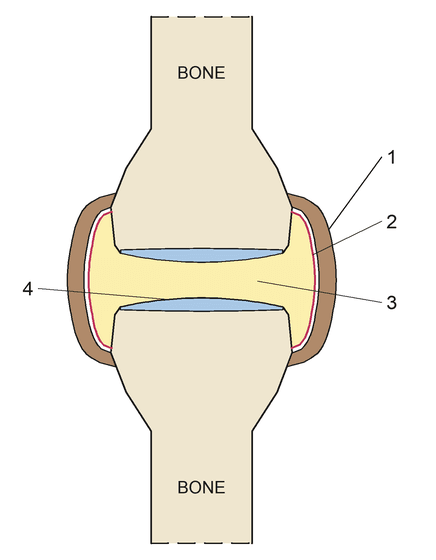
(i) Name the parts numbered 1, 2, 3 and 4.
(ii) State one function each of part 1 and part 3.
(iii) The shoulder joint and the knee joint are both joints of this kind, yet they do not allow the same movement. Name the type to which each of these two joints belongs and state the movement each type allows.
- 394 marks
Question 39
The girdles form a part of the appendicular skeleton.
(i) What are girdles ? Name the two bones that make up the shoulder girdle of each side.
(ii) Name the cavity of the shoulder girdle and the cavity of the hip girdle, and the bone whose head fits into each.
(iii) Name the three bones that are fused to form each hip bone. State how the pelvis of a female differs from that of a male, and the advantage of this difference.
- 404 marks
Question 40
The figure shows three simple levers X, Y and Z. In each, W is the weight, F is the fulcrum and P is the power.
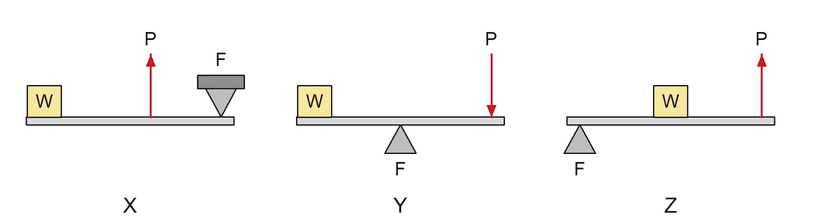
(i) State the order (first, second or third) of each of the levers X, Y and Z.
(ii) For each of the three levers, give one example of its action in the human body and name the muscle that provides the power.
(iii) In the body's example of lever X, the muscle contracts by only a few centimetres, but the hand swings swiftly through a long arc. Which function of the skeleton does this illustrate, and what is gained by it ?