
Opening your dashboard
Class 8 Physics Chapter 4 Energy: Practice Questions
42 questions on Chapter 4, each worked through on its own page with the AI tutor. Class 8 Physics, ICSE 2026-27.
42 questions
1–5 marks · Mixed difficulty
- 11 mark
Question 1
Bloom's level: Remember
The rate of doing work is called :
- 21 mark
Question 2
Bloom's level: Understand
In which of the following is work done, in the language of physics ?
- 31 mark
Question 3
Bloom's level: Apply
A girl pulls a trolley with a horizontal force of 40 N and it moves 1.5 m in the direction of the force. She then holds it still with the same force for 10 s. The total work done by her force is :
- 41 mark
Question 4
Bloom's level: Understand
A stone tied to a string is whirled in a horizontal circle at a steady speed. The work done by the tension in the string on the stone is :
- 51 mark
Question 5
Bloom's level: Apply
A box of mass 4 kg is lifted from the floor on to a shelf 2.5 m high. Taking g = 10 N kg, the gravitational potential energy stored in the box is :
- 61 mark
Question 6
Bloom's level: Apply
Tara throws a ball of mass 0.5 kg that was at rest in her hand; it leaves her hand at 6 m s. How much work has she done on the ball ?
- 71 mark
Question 7
Bloom's level: Analyse
A pendulum bob is pulled aside to its extreme position, where its potential energy (measured from the lowest point) is 0.8 J, and released. Ignoring air friction, what is its kinetic energy when it is at half that height on its way down ?
- 81 mark
Question 8
Bloom's level: Evaluate
Crane A lifts a 500 kg load to a height of 10 m in 20 s. Crane B lifts the same load to the same height in 40 s. Asha says, "Crane B does more work because it works for a longer time." Which is the best judgement ?
- 91 mark
Question 9
Bloom's level: Understand
In which of the following is chemical energy changed into light energy ?
- 101 mark
Question 10
Bloom's level: Understand
Read the Assertion (A) and the Reason (R) and choose the correct option.
Assertion (A): The water at the bottom of a high waterfall is slightly warmer than the water at its top.
Reason (R): On striking the bottom, a part of the kinetic energy of the falling water changes into heat energy.
- 111 mark
Question 11
Bloom's level: Remember
Read the Assertion (A) and the Reason (R) and choose the correct option.
Assertion (A): A compressed spring has kinetic energy.
Reason (R): The work done in compressing a spring is stored in it in the form of potential energy.
- 121 mark
Question 12
Bloom's level: Understand
Read the Assertion (A) and the Reason (R) and choose the correct option.
Assertion (A): When work is done on a body, its energy increases.
Reason (R): Energy is measured in the same unit as work, the joule.
- 132 marks
Question 13
Bloom's level: Remember
(a) State the law of conservation of mechanical energy.
(b) What kind of energy does the bob of a swinging pendulum have at (i) its extreme position, (ii) its mean (lowest) position ?
- 142 marks
Question 14
Bloom's level: Understand
For work to be done, a force must act on a body and must move it or change its size or shape. Use this to decide whether work is done in each case, giving a reason.
(a) A weightlifter holds a barbell steady above his head for 5 seconds.
(b) A girl stretches a rubber string.
(c) A crane lifts a car from a road.
(d) A man pushes a parked truck, but it does not move.
- 152 marks
Question 15
Bloom's level: Apply
Rahul lifts a bucket of water of mass 12 kg from the ground to a balcony 3 m high, and then carries it 10 m along the level balcony. Find the work he does against the force of gravity (a) in lifting the bucket, (b) in carrying it along the balcony. (Take the force of gravity on 1 kg as g = 10 N kg.)
- 162 marks
Question 16
Bloom's level: Understand
Arjun lifts a 2 kg school bag from the floor and places it on a shelf 1.5 m high. How much work does he do ? What happens to (a) Arjun's energy, (b) the energy of the bag ? (Take the force of gravity on 1 kg as g = 10 N kg.)
- 172 marks
Question 17
Bloom's level: Analyse
Three bodies are kept at rest above the ground : A of mass 10 kg at 3 m, B of mass 5 kg at 6 m and C of mass 20 kg at 1 m. Find the potential energy of each. Which has the greatest potential energy ? What does this show ? (Take the force of gravity on 1 kg as g = 10 N kg.)
- 182 marks
Question 18
Bloom's level: Apply
A runner of mass 50 kg speeds up from 2 m s to 5 m s. Find her kinetic energy at each speed and the increase in her kinetic energy.
- 192 marks
Question 19
Bloom's level: Apply
A ball of mass 0.2 kg is dropped from a height of 5 m. Ignoring air friction, find (a) its potential energy at the top, (b) its potential and kinetic energies when it has fallen to a height of 2.5 m, (c) its kinetic energy and speed just before it hits the ground. (Take the force of gravity on 1 kg as g = 10 N kg.)
- 202 marks
Question 20
Bloom's level: Apply
A girl of mass 45 kg climbs a staircase 6 m high in 12 s. Find the work she does against gravity and the power she spends. (Take the force of gravity on 1 kg as g = 10 N kg.)
- 212 marks
Question 21
Bloom's level: Remember
Name any four forms of energy other than mechanical energy. Also name one device that changes electrical energy into heat energy and one that changes sound energy into electrical energy.
- 222 marks
Question 22
Bloom's level: Evaluate
Kabir says, "A 1500 W room heater always uses more electrical energy than a 100 W bulb." Check his claim by comparing the heater used for 10 minutes with the bulb used for 5 hours (in kWh).
- 234 marks
Question 23
Bloom's level: Analyse
A roller-coaster car of mass 200 kg starts from rest at A and runs along the track shown. Ignore friction. (Take the force of gravity on 1 kg as g = 10 N kg.)
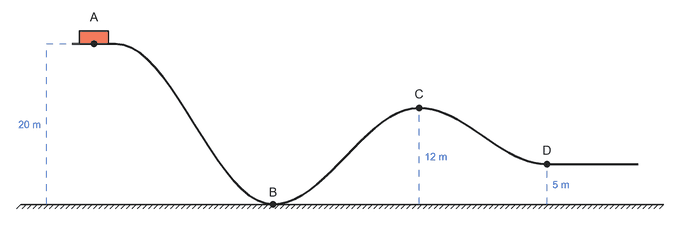
(a) Find the total mechanical energy of the car at A.
(b) Find its kinetic energy and its speed at B.
(c) Find its potential and kinetic energies at C and at D.
(d) Could the car reach the top of a hill 25 m high placed after D ? Give a reason.
- 244 marks
Question 24
Bloom's level: Apply
Case study: At a hydroelectric power station, water stored behind a dam falls through a height of 50 m on to a turbine. Every second, 1000 kg of water falls. (Take the force of gravity on 1 kg as g = 10 N kg.)
(a) Find the potential energy given up by the water falling each second.
(b) Write the chain of energy changes from the water in the dam to the electricity produced.
(c) The station produces J of electrical energy each second. How much energy is not changed into electrical energy each second ? Into what forms does it mostly go, and what is this called ?
- 254 marks
Question 25
Bloom's level: Analyse
Case study: A school must fill an overhead tank with 1000 kg of water, lifting it through 10 m. Two water pumps are offered: pump A fills the tank in 200 s and pump B in 125 s. (Take the force of gravity on 1 kg as g = 10 N kg.)
(a) Find the work done in lifting the water. Is it different for the two pumps ?
(b) Find the power spent by each pump.
(c) On a day of high demand, 2000 kg of water must be lifted through the same height within 5 minutes. Which pump can do it ? Show your working.
- 264 marks
Question 26
Bloom's level: Apply
Case study: In an archery class, Priya pulls back the string of her bow, doing 40 J of work. She then releases an arrow of mass 0.05 kg. Ignore all losses. (Take the force of gravity on 1 kg as g = 10 N kg.)
(a) What kind of energy is stored in the stretched bow, and how much ?
(b) Find the kinetic energy and the speed of the arrow as it leaves the bow.
(c) If the arrow were shot straight upwards, how high would it rise ? In practice it rises less; why ?
- 274 marks
Question 27
Bloom's level: Evaluate
Check these revision notes on the chapter. Say whether each is correct; correct the wrong ones.
-
Work done = force × time.
-
1 J = 1 N × 1 m.
-
The unit of moment of force, N m, may also be written as joule.
-
When the speed of a body is doubled, its kinetic energy is doubled.
-
Power = work done ÷ time taken; its S.I. unit is the watt.
-
A body at rest cannot have any energy.
-
- 285 marks
Question 28
Bloom's level: Create
For a science fair, design a chain-reaction model in which a marble released at the top of a ramp finally makes a small bulb glow or a bell ring. The model must use at least four energy changes. Include :
(a) a short description of each stage of your model,
(b) an energy-conversion diagram naming the form of energy at each stage,
(c) where energy is dissipated in your model, and one way to reduce it.
- 294 marks
Question 29
Bloom's level: Create
Design an experiment, using a tray of soft wet clay (or sand), two stones of different masses, a metre scale and a few iron nails, to show that the gravitational potential energy of a body depends on (i) its mass and (ii) its height. Describe :
(a) how you will measure the 'energy' delivered by a falling stone,
(b) the two parts of the experiment and what you keep the same in each,
(c) the results you expect and your conclusion.
- 303 marks
Question 30
Bloom's level: Analyse
A ball of mass 0.5 kg is dropped from rest. The table shows some of its energies at different heights (air friction is negligible). (Take the force of gravity on 1 kg as g = 10 N kg.)
Height above ground P.E. K.E. 8 m 40 J 0 J 6 m ...... ...... 2 m 10 J ...... 0 m (just before ground) 0 J ...... (a) Fill in the blanks.
(b) What pattern do you find in the sum P.E. + K.E. ? Which law does it show ?
(c) At what height are the P.E. and K.E. equal ?
- 311 mark
Question 31
An archer pulls back the string of a bow and holds it still, ready to shoot an arrow. The energy possessed by the stretched bow is :
- 321 mark
Question 32
A gardener pushes a lawn roller with a force of 50 N along the direction of its motion and does 400 J of work. The distance through which the roller moves is :
- 331 mark
Question 33
An electric motor of power 2 kW works for 5 s. The work done by the motor is :
- 341 mark
Question 34
Fill in the blank :
The energy possessed by fuels such as coal, petrol and cooking gas is called .............. energy.
- 351 mark
Question 35
Write true or false :
A porter standing still on a railway platform with a heavy trunk on his head is doing work on the trunk.
- 362 marks
Question 36
A flower pot of mass 3 kg is kept on the ledge of a balcony 8 m above the ground. (Take the force of gravity on a mass of 1 kg as 10 N, i.e. g = 10 N kg.)
(a) Calculate the gravitational potential energy of the flower pot.
(b) What would its gravitational potential energy be if it were kept on a ledge at half this height ?
- 372 marks
Question 37
State the energy change that takes place in each of the following when it is in use :
(a) a solar cell
(b) a steam engine
- 384 marks
Question 38
(a) Define power. State its S.I. unit.
(b) The motor of a lift raises the lift and its passengers, of total mass 600 kg, through a height of 15 m in 30 s. Calculate (i) the work done by the motor against the force of gravity, (ii) the power spent by the motor in kW. (Take the force of gravity on a mass of 1 kg as 10 N, i.e. g = 10 N kg.)
(c) If a motor of power 4.5 kW is used to do the same work, how much time will it take ?
- 395 marks
Question 39
A coconut of mass 2 kg falls freely from the top of a tree 20 m high. Neglect the friction due to air. (Take the force of gravity on a mass of 1 kg as 10 N, i.e. g = 10 N kg.)
(a) Find the potential energy and the kinetic energy of the coconut at the top of the tree, just before it begins to fall.
(b) Find its potential energy and its kinetic energy when it is at a height of 12 m, at a height of 5 m and just before it strikes the ground. Show all your results, with the total energy at each position, in the form of a table.
(c) Name the law which your table verifies, and state it.
(d) Calculate the speed of the coconut just before it strikes the ground.
- 404 marks
Question 40
(a) A cricket ball of mass 150 g is moving with a speed of 20 m s. Calculate its kinetic energy.
(b) A cyclist and his bicycle have a total mass of 60 kg. Their kinetic energy is 750 J. Calculate the speed of the cyclist.
(c) The cyclist now doubles his speed. What is his kinetic energy now ?
- 411 mark
Question 41
Which of the following is possessed by air in motion ?
- 421 mark
Question 42
Match with the correct option from Column B :
Column A : Water in a dam
Column B : (i) Myopia (ii) No unit (iii) Hydroelectric energy (iv) Insulator (v) Wind energy (vi) Conductor (vii) 4.2 joules