
Opening your dashboard
Class 8 Chemistry Chapter 1 Matter: Practice Questions
45 questions on Chapter 1, each worked through on its own page with the AI tutor. Class 8 Chemistry, ICSE 2026-27.
45 questions
1–5 marks · Mixed difficulty
- 11 mark
Question 1
Bloom's level: Remember
In chemistry, the word matter covers:
- 21 mark
Question 2
Bloom's level: Understand
Which of the following is not matter?
- 31 mark
Question 3
Bloom's level: Remember
The Indian philosopher who first suggested that matter is made of very tiny particles called anu was:
- 41 mark
Question 4
Bloom's level: Apply
In which of the following will the particles spread out (diffuse) the fastest?
- 51 mark
Question 5
Bloom's level: Analyse
Three substances are tested.
- X has no fixed shape, keeps the same volume when poured into a bigger vessel, and can only flow downwards.
- Y keeps its shape and volume and is very rigid.
- Z spreads to fill any closed vessel and is easily compressed.
The order of increasing intermolecular space is:
- 61 mark
Question 6
Bloom's level: Apply
On a very cold winter night, ice crystals (frost) form on a window pane directly from the water vapour in the air, without any liquid water forming first. This change is called:
- 71 mark
Question 7
Bloom's level: Apply
In a closed flask, 2.4 g of magnesium burns completely and combines with 1.6 g of oxygen to form magnesium oxide. The mass of magnesium oxide formed is:
- 81 mark
Question 8
Bloom's level: Understand
Water is heated in an open pan. Once it starts boiling, the burner is kept on. Which statement is correct?
- 91 mark
Question 9
Bloom's level: Apply
A silvery metal melts at about and boils at about . In a room at , this metal is a:
- 101 mark
Question 10
Bloom's level: Understand
Assertion (A): The smell of hot food reaches us from the kitchen faster than the smell of cold food.
Reason (R): The kinetic energy of particles of matter increases with an increase in temperature.
- 111 mark
Question 11
Bloom's level: Evaluate
Assertion (A): A candle burning in open air becomes lighter, so the law of conservation of mass does not hold for burning.
Reason (R): The gaseous products of burning, such as carbon dioxide and water vapour, escape into the air.
- 121 mark
Question 12
Bloom's level: Analyse
Assertion (A): Solids have a definite shape.
Reason (R): Solids have a high density.
- 132 marks
Question 13
Bloom's level: Understand
We cannot see air. Give two everyday observations which show that air is matter, and state which property of matter each observation shows.
- 142 marks
Question 14
Bloom's level: Remember
State what all kinds of matter were believed to be made of by:
(a) the ancient Greek philosophers
(b) the ancient Indian philosophers
- 152 marks
Question 15
Bloom's level: Apply
Two syringes have their nozzles sealed. Syringe P is full of air and syringe Q is full of water. The piston of each is pushed in with the same force. Predict what happens in each case and explain.
- 162 marks
Question 16
Bloom's level: Understand
Chemistry is called the study of matter.
(a) Name the aspects of matter that chemistry studies.
(b) Explain why a goldfish and a steel spoon are both studied as matter.
- 172 marks
Question 17
Bloom's level: Apply
Name the change of state taking place in each case:
(a) A cube of butter placed on hot toast turns runny.
(b) Water droplets appear on the outside of a glass of cold lemonade.
(c) Wet clothes on a line become dry.
(d) A block of camphor kept in a cupboard becomes smaller without leaving any liquid.
- 182 marks
Question 18
Bloom's level: Evaluate
A student writes: "The particles of a solid do not move at all. That is why a solid has a fixed shape."
Judge whether the statement is correct, and rewrite it correctly.
- 192 marks
Question 19
Bloom's level: Understand
(a) Explain why atoms usually combine to form molecules.
(b) Why can we not see these particles even with an ordinary microscope?
- 202 marks
Question 20
Bloom's level: Apply
Classify the following as solids, liquids or gases, and state the property you used for each group:
honey, a brick, steam, mustard oil, carbon dioxide, a copper wire
- 212 marks
Question 21
Bloom's level: Remember
(a) State the three things that the kinetic theory of matter explains.
(b) Name the two states of matter, other than solid, liquid and gas, that have been discovered.
- 222 marks
Question 22
Bloom's level: Analyse
A drop of ink is put into still water in three identical beakers kept at different temperatures. The time taken for the colour to spread evenly is recorded.
Temperature of water Time for even colour 48 minutes 26 minutes 12 minutes (a) What relationship does the data show?
(b) Explain this relationship using the kinetic theory of matter.
- 234 marks
Question 23
Bloom's level: Apply
Meera puts some vinegar in a plastic bottle and some baking soda inside a balloon. She stretches the balloon over the mouth of the bottle without letting the soda fall in, and places the whole set-up on a balance. It reads 250.0 g. She then lifts the balloon so that the baking soda falls into the vinegar. The mixture fizzes and the balloon swells up. The baking soda she used gives off 4.4 g of carbon dioxide.
(a) Write the word equation and the balanced chemical equation for the reaction.
(b) What will the balance read after the fizzing stops, with the balloon still in place? Give a reason.
(c) If Meera then removes the balloon and lets all the gas escape, predict the new reading. Has the law of conservation of mass failed? Explain.
- 244 marks
Question 24
Bloom's level: Analyse
In the school laboratory, Ravi heats a white solid S in a boiling tube fitted with a thermometer and records the temperature every 2 minutes.
Time (min) 0 2 4 6 8 10 12 14 16 18 20 Temperature () 30 55 80 80 80 120 160 200 218 218 218 (a) Find the melting point and the boiling point of S from the table.
(b) State the physical state of S at 6 minutes and at 12 minutes.
(c) Between 4 and 8 minutes the burner is still on, yet the temperature does not rise. Explain why, using the idea of particles.
- 254 marks
Question 25
Bloom's level: Create
Design a model using a flat tray with raised edges and some marbles to show the arrangement and motion of particles in a solid, a liquid and a gas.
(a) Describe how you would set up the tray for each state.
(b) State what the shaking of the tray represents, and how you would show the difference in this between the three states.
(c) Give one way in which your model is not like real matter.
- 263 marks
Question 26
Bloom's level: Analyse
Each observation below seems to break a rule about the states of matter. Explain why it actually does not.
(a) A sponge, which is a solid, can easily be squeezed into a smaller size.
(b) Sugar, which is a solid, can be poured from a packet and takes the shape of the bowl.
(c) The oxygen gas inside a closed steel cylinder has a fixed volume.
- 274 marks
Question 27
Bloom's level: Apply
Use the kinetic theory of matter to explain what happens to the particles in each of these changes:
(a) the wax near the wick of a burning candle melts;
(b) steam from a pressure cooker forms droplets on a cold steel lid;
(c) cooking gas is filled into an LPG cylinder as a liquid.
- 285 marks
Question 28
Bloom's level: Evaluate
Three groups in a class test the law of conservation of mass.
- Group 1 burns 3.0 g of wood shavings in an open dish. The ash left weighs 0.4 g.
- Group 2 burns 1.2 g of magnesium ribbon in an open crucible. The white powder formed weighs 2.0 g.
- Group 3 mixes barium chloride solution and sodium sulphate solution inside a corked flask. The flask and contents weigh 152.6 g before mixing and 152.6 g after.
(a) Which group's result directly verifies the law? Write the balanced equation for its reaction.
(b) Explain why Group 1 found a decrease in mass and Group 2 found an increase.
(c) A student concludes: "Two out of three results disprove the law of conservation of mass." Judge this conclusion and suggest how Groups 1 and 2 could improve their experiments.
- 293 marks
Question 29
Bloom's level: Understand
Using the kinetic theory of matter, explain in steps how a block of ice changes first into water and then into steam on heating, and why the mass stays the same throughout.
- 304 marks
Question 30
Bloom's level: Create
Construct a table that summarises the six processes of interconversion of states of matter: melting, evaporation, condensation, freezing, sublimation and deposition. For each process give:
(a) the change of state,
(b) whether heat is given to or taken from the substance, and what happens to the intermolecular space,
(c) one everyday example of your own (not water boiling in a kettle or ice melting in a glass).
- 311 mark
Question 31
Three boxes X, Y and Z show how the particles are arranged in three samples of the same substance.
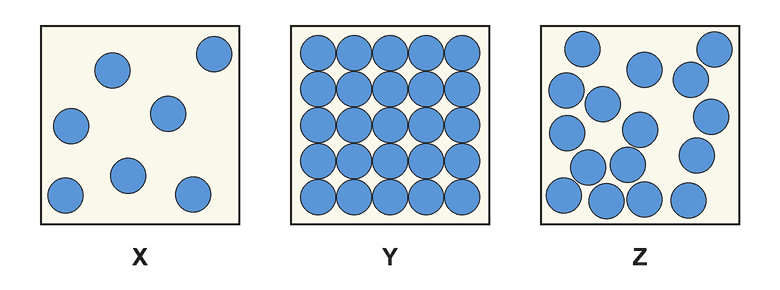
Which box shows the substance in the solid state?
- 321 mark
Question 32
Fill in the blank.
A piece of solid camphor kept in an open dish slowly gets smaller, because it turns straight into vapour without melting first. This change of state is called ________.
- 331 mark
Question 33
Fill in the blank.
Solids, liquids and gases are told apart by differences in their ________ properties, such as shape, volume and the ability to flow.
- 344 marks
Question 34
Name the change of state taking place in each case.
(a) A lump of ghee turns into a liquid in a warm pan.
(b) Water in a kettle turns into steam.
(c) Steam touches a cold steel lid and forms drops of water.
(d) Molten candle wax hardens on a table.
- 355 marks
Question 35
(a) What is matter? Name one thing around you that is not matter.
(b) List any three points (postulates) that the kinetic theory makes about the particles of matter.
(c) An incense stick is lit in one corner of a room. Soon its smell reaches every part of the room. Which postulate of the theory explains this?
- 361 mark
Question 36
Which one of the following has a definite volume but no definite shape ?
- 371 mark
Question 37
Steam coming out of the spout of a kettle changes into tiny drops of water when it touches a cold steel plate. This change of state is called :
- 381 mark
Question 38
10.0 g of calcium carbonate is heated strongly in an open crucible until it breaks up completely into calcium oxide and carbon dioxide. The calcium oxide left in the crucible weighs 5.6 g. The mass of carbon dioxide that has escaped into the air is :
- 391 mark
Question 39
Fill in the blank :
The particles of matter that are formed when two or more atoms combine with one another are called .............. .
- 401 mark
Question 40
Write true or false :
The kinetic energy of the particles of matter decreases when the temperature is raised.
- 412 marks
Question 41
(a) Define matter.
(b) A football weighs a little more when it is pumped full of air than when it is empty. Which characteristic of matter does this observation show for air ?
- 422 marks
Question 42
Give a reason for each of the following :
(a) A large quantity of cooking gas can be filled into a small cylinder.
(b) An iron key keeps its shape when it is moved from a pocket to a table.
- 434 marks
Question 43
A few crystals of iodine are placed in a china dish. The dish is covered with an inverted glass funnel whose stem is closed with a plug of cotton, and is then heated gently.
(a) State what is seen (i) in the dish, (ii) on the cooler inner wall of the funnel.
(b) Name the change of state that takes place (i) in the dish, (ii) on the inner wall of the funnel.
(c) Is the solid collected on the wall of the funnel a new substance ? Give a reason for your answer.
- 444 marks
Question 44
The melting points and boiling points of three substances P, Q and R at normal atmospheric pressure are given in the table.
Substance Melting point Boiling point P −114 °C 78 °C Q 80 °C 218 °C R −219 °C −183 °C (a) State the physical state of each of P, Q and R at a room temperature of 25 °C.
(b) Name the change of state that takes place, and state whether heat is absorbed or given out, when (i) Q at 100 °C is cooled to 60 °C, (ii) P at 25 °C is heated to 100 °C.
(c) Is the chemical composition of P or Q altered in the changes in part (b) ? What name is given to such a change of a substance from one state to another and back again ?
- 455 marks
Question 45
A solution of barium chloride is taken in a conical flask. A small test tube containing a solution of sodium sulphate is lowered into the flask with a thread, without letting the two solutions mix, and the flask is closed with a cork. The closed flask weighs 152.6 g. The flask is then tilted so that the two solutions mix.
(a) What is observed in the flask on mixing ? Write the word equation for the reaction.
(b) What will the closed flask weigh after the reaction ? Name and state the law on which your answer is based.
(c) In this reaction, 2.08 g of barium chloride reacts completely with 1.42 g of sodium sulphate to form 2.33 g of barium sulphate. Calculate the mass of sodium chloride formed.