
Opening your dashboard
Class 8 Biology Chapter 2 Reproduction in Plants: Practice Questions
58 questions on Chapter 2, each worked through on its own page with the AI tutor. Class 8 Biology, ICSE 2026-27.
58 questions
1–5 marks · Mixed difficulty
- 11 mark
Question 1
Bloom's level: Remember
In Chlorella, one cell divides to form four daughter cells. This process is called :
- 21 mark
Question 2
Bloom's level: Remember
Each anther of a stamen contains :
- 31 mark
Question 3
Bloom's level: Remember
In micro-propagation, the explant grows on the nutrient medium into a mass of cells called :
- 41 mark
Question 4
Bloom's level: Remember
Which of the following best describes reproduction in living organisms ?
- 51 mark
Question 5
Bloom's level: Understand
Which of the following is true of sexual reproduction but not of asexual reproduction ?
- 61 mark
Question 6
Bloom's level: Understand
Which one of the following pairs is correctly matched ?
- 71 mark
Question 7
Bloom's level: Understand
A Bryophyllum leaf that falls on moist soil gives rise to several tiny plants because :
- 81 mark
Question 8
Bloom's level: Apply
A bee carries pollen from one flower of a sunflower plant to another flower on the same plant. This is :
- 91 mark
Question 9
Bloom's level: Apply
A plant has small, dull-coloured flowers without scent or nectar. Their long anthers hang out of the flower and shed huge amounts of light, dry pollen. The flowers are most likely pollinated by :
- 101 mark
Question 10
Bloom's level: Analyse
Assertion (A): A whole field of sugarcane grown from cuttings of one plant can be destroyed by a single disease.
Reason (R): Plants produced by vegetative reproduction are genetically identical.
- 111 mark
Question 11
Bloom's level: Evaluate
Assertion (A): Lotus and Trapa (singhara) grow in water, so their flowers are water-pollinated.
Reason (R): The flowers of lotus and Trapa are exposed to the air and are pollinated by insects.
- 121 mark
Question 12
Bloom's level: Analyse
Assertion (A): After fertilisation, the ovary of a flower develops into a fruit.
Reason (R): Insect-pollinated flowers produce sticky pollen grains.
- 131 mark
Question 13
Bloom's level: Understand
A single plant can live its whole life without reproducing. Why, then, is reproduction necessary?
- 142 marks
Question 14
Bloom's level: Understand
Stamens and carpels are called the essential whorls of a flower, while the calyx and corolla are not. Explain why.
- 152 marks
Question 15
Bloom's level: Understand
Pollen grains land on the stigma, but the egg cell lies deep inside the ovule in the ovary. Explain how the male gametes reach the egg cell.
- 161 mark
Question 16
Bloom's level: Understand
Why are the young ones produced by asexual reproduction exact copies of their parent?
- 172 marks
Question 17
Bloom's level: Apply
Mr. Das has one rose bush with beautiful flowers and wants many more bushes exactly like it, without using seeds. Suggest a suitable artificial method and describe how he should carry it out.
- 182 marks
Question 18
Bloom's level: Apply
A farmer has no seeds of sweet potato but has a few sweet potatoes from his last crop. How can he raise new plants, and why will this work?
- 192 marks
Question 19
Bloom's level: Apply
A bacterium divides by binary fission once every 20 minutes. A Chlorella cell divides into four daughter cells once every 8 hours. Starting with one cell of each, how many cells will there be
(i) of the bacterium after 2 hours, and (ii) of Chlorella after 24 hours? (Assume all cells survive.)
- 202 marks
Question 20
Bloom's level: Analyse
A papaya plant in Neha's garden bears only male (staminate) flowers. Can these flowers ever be self-pollinated? Can this plant ever bear fruit? Explain.
- 212 marks
Question 21
Bloom's level: Evaluate
A farmer says, "Growing my banana crop only by vegetative methods is the best choice in every way." Do you agree? Justify with one advantage and one disadvantage.
- 221 mark
Question 22
Bloom's level: Apply
Seema plants a mustard seed and a rose cutting. For each new plant, state whether it came from sexual or asexual reproduction, and how many parents were involved.
- 234 marks
Question 23
Bloom's level: Apply
Case: A flower nursery wants to produce 10,000 identical, disease-free orchid plants within a few months. Orchid seeds are tiny and stay dormant for a long time, so growing them from seed is very slow.
(a) Name the technique the nursery should use, and name the plant part it could start from.
(b) Describe the main steps of this technique.
(c) A small farmer in a remote village wants to use the same technique. Give two reasons why this may be difficult for him.
- 244 marks
Question 24
Bloom's level: Apply
Case: An agricultural scientist has two varieties of rice. Variety X gives a high yield but often falls sick; variety Y gives a low yield but resists disease. She wants a new variety with both good qualities.
(a) Name the process she should use to cross the two varieties.
(b) She chooses X as the female plant. Describe what she must do to its flowers, and why.
(c) Why can she not get this new variety by simply growing more plants of X from its vegetative parts?
- 253 marks
Question 25
Bloom's level: Apply
Meena wants to grow new plants of ginger, onion and lawn grass in her school garden, without using any seeds. For each plant, state :
(a) which part she should plant,
(b) what that part must have for a new plant to grow, and
(c) where on that part the new shoot will come from.
- 264 marks
Question 26
Bloom's level: Analyse
Arjun cut open a flower and recorded :
Part Number Description P 5 Small, green, leaf-like Q 5 Large, red, scented R 10 Thread-like stalk with a sac at the tip S 1 Swollen base, thin middle, sticky top; base holds 12 small round bodies (a) Name the whorls P, Q, R and S. Which of them are the reproductive whorls?
(b) Is this flower bisexual or unisexual? Give the reason from the table.
(c) At most, how many seeds and how many fruits can this flower form? Explain.
- 274 marks
Question 27
Bloom's level: Analyse
Study the following events :
- A pollen tube grows through the style.
- A yeast cell forms a bud.
- Pollen grains are carried to a stigma by a bee.
- A Spirogyra filament breaks into three pieces.
- A male gamete fuses with the egg cell.
- A pollen grain absorbs moisture on the stigma.
- A potato "eye" sprouts into a shoot.
(a) Sort the events into those of asexual and those of sexual reproduction.
(b) Arrange the events of sexual reproduction in the correct order.
(c) Which single event is fertilisation, and what does it produce?
- 284 marks
Question 28
Bloom's level: Evaluate
Tanya drew this flow chart of fertilisation in a flowering plant :
Germination of pollen Pollination Pollen tube grows from the ovary up to the stigma Male gamete fuses with the ovary wall The ovule becomes a fruit
Check her flow chart. Point out every mistake and redraw it correctly.
- 295 marks
Question 29
Bloom's level: Create
Design two imaginary flowers for a garden project :
- Flower 1 must be pollinated by insects.
- Flower 2 must be pollinated by wind.
(a) Construct a table comparing the two designs under: size, colour, scent, nectar, anthers, and pollen.
(b) For two features of each flower, give the reason why it suits its agent.
(c) Suggest one plant that is like each of your designs.
- 305 marks
Question 30
Bloom's level: Create
Construct a classification chart of all the ways plants reproduce that you studied in this chapter.
(a) Start from "Reproduction in plants" and show the two main modes.
(b) Under asexual reproduction, show the methods, including natural and artificial vegetative propagation, with one example for each.
(c) Under sexual reproduction, show the main steps from flower to seed.
- 311 mark
Question 31
Class 8 Sample Paper 1 · Section A
What are the two types of pollination?
- 321 mark
Question 32
Class 8 Sample Paper 1 · Section A
Male reproductive part of a flower is
- 331 mark
Question 33
Class 8 Sample Paper 1 · Section A
Fill in the blank.
Flowers having both male and female reproductive parts in the same flower are called .......... .
- 341 mark
Question 34
Class 8 Sample Paper 1 · Section A
Fill in the blank.
The ovule develops into .......... .
- 352 marks
Question 35
Class 8 Sample Paper 1 · Section B
Define the following:
Fertilization
- 362 marks
Question 36
Class 8 Sample Paper 1 · Section B
Define the following:
Micropropagation
- 372 marks
Question 37
Class 8 Sample Paper 1 · Section B
What are the special features of wind-pollinated flowers?
- 381 mark
Question 38
Class 8 Sample Paper 2 · Section A
What are the different agents of pollination?
- 391 mark
Question 39
Class 8 Sample Paper 2 · Section A
How do insects help in pollination?
- 401 mark
Question 40
Class 8 Sample Paper 2 · Section A
What are the advantages of vegetative reproduction?
- 411 mark
Question 41
Class 8 Sample Paper 2 · Section A
Combining the stem and buds of two best quality plants is called ..........
- 421 mark
Question 42
Class 8 Sample Paper 2 · Section A
Carpel is present in
- 431 mark
Question 43
Class 8 Sample Paper 2 · Section A
Fill in the blank.
Flowers having either male or female reproductive parts are called .......... .
- 441 mark
Question 44
Class 8 Sample Paper 2 · Section A
Fill in the blank.
The ovary develops into .......... .
- 452 marks
Question 45
Class 8 Sample Paper 2 · Section B
Define the following:
Grafting
- 462 marks
Question 46
Class 8 Sample Paper 2 · Section B
Differentiate between sexual reproduction and asexual reproduction.
- 473 marks
Question 47
Class 8 Sample Paper 2 · Section C
Answer the following question from the given diagram.
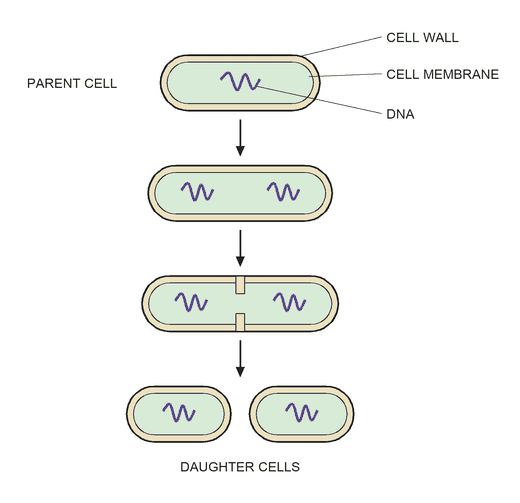
What is shown in the given diagram? Explain.
- 485 marks
Question 48
Class 8 Sample Paper 2 · Section D
Answer the questions from the given diagram.
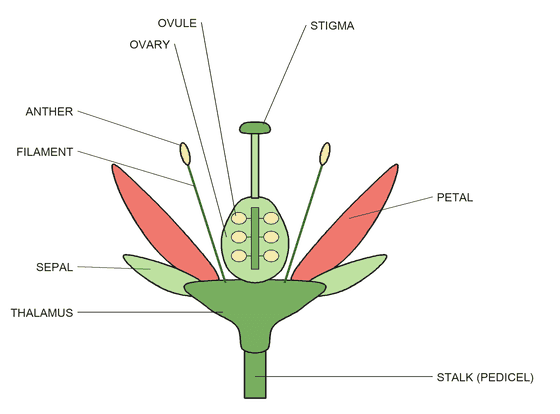
(a) What are the non-reproductive parts of the flower?
(b) Label the pistil and the style on the flower.
(c) What is a bisexual flower? Give an example.
- 491 mark
Question 49
A mature yeast cell forms a small outgrowth on its body. The outgrowth grows, gets detached along with its own nucleus and starts an independent life. This type of asexual reproduction is called :
- 501 mark
Question 50
In the method of grafting, the plant that receives the bud or shoot of the desired variety is called the :
- 511 mark
Question 51
Which one of the following shows the correct order of the events that take place after a pollen grain lands on the stigma of a flower of the same kind ?
- 521 mark
Question 52
Fill in the blank :
Plants such as sweet potato and asparagus can give rise to new plants from their swollen, fleshy .......... that store a large quantity of food.
- 531 mark
Question 53
Write true or false :
When pollen grains from the anther of a flower reach the stigma of another flower on the same plant, the process is called cross-pollination.
- 542 marks
Question 54
Ginger, potato and onion are called modified stems, although the potato and the onion grow under the soil. Give a reason for calling them modified stems. Name the part of the potato from which the new shoots grow.
- 552 marks
Question 55
Plant tissue culture is a useful method of micro-propagation, but it cannot replace the other methods in every situation. State two limitations of this technique.
- 564 marks
Question 56
The diagram shows a flower cut lengthwise, with five of its parts numbered 1 to 5.

(a) Name the parts numbered 1, 2, 3, 4 and 5.
(b) State the function of part 2.
(c) The grains produced in part 3 are carried to part 4. Name this process and state the two types of it.
- 574 marks
Question 57
The diagram shows a carpel some time after a flower has been pollinated. The parts are numbered 1 to 4.

(a) Name the parts numbered 1, 2, 3 and 4.
(b) Name the event in which part 1 absorbs moisture from the stigma and begins to grow into part 2.
(c) Part 2 carries two male gametes into part 4. State what is formed when a male gamete fuses with the egg cell.
- 585 marks
Question 58
The table gives the features of three flowers, P, Q and R. Each flower is pollinated through a different agent.
Flower Size and colour Other features P small, dull long anthers hanging out of the flower; dry, light pollen grains in very large quantity Q large, brightly coloured petals scented; contains nectar; sticky pollen grains R small and light, floats on water male and female flowers borne on separate plants (a) Name the agent of pollination for each of the flowers P, Q and R.
(b) Name one plant in which flowers are pollinated as in R.
(c) Why is it necessary for the flower P to produce a very large quantity of pollen grains ?