
Opening your dashboard
Class 7 Maths Chapter 2 Rational Numbers: Practice Questions
47 questions on Chapter 2, each worked through on its own page with the AI tutor. Class 7 Maths, ICSE 2026-27.
47 questions
1–5 marks · Mixed difficulty
- 11 mark
Question 1
Bloom's level: Remember
A rational number is said to be in standard form when
- 21 mark
Question 2
Bloom's level: Remember
and are integers and . Which of the following is not always an integer?
- 31 mark
Question 3
Bloom's level: Understand
Which of the following is equal to ?
- 41 mark
Question 4
Bloom's level: Apply
On the number line below, every unit is divided into 3 equal parts.

Which rational number does the point P represent?
- 51 mark
Question 5
Bloom's level: Apply
Which of these rational numbers is the greatest?
- 61 mark
Question 6
Bloom's level: Apply
- 71 mark
Question 7
Bloom's level: Apply
- 81 mark
Question 8
Bloom's level: Analyse
is a negative rational number. Which statement is always true?
- 91 mark
Question 9
Bloom's level: Understand
Riya says, "The only rational number lying between and is 0." How many rational numbers actually lie between these two numbers?
- 101 mark
Question 10
Bloom's level: Understand
Assertion (A): is not in standard form.
Reason (R): A rational number is in standard form only when its denominator is positive and its numerator and denominator have no common factor other than 1.
- 111 mark
Question 11
Bloom's level: Evaluate
Assertion (A):
Reason (R): For rational numbers and with positive denominators, when .
- 121 mark
Question 12
Bloom's level: Analyse
Assertion (A):
Reason (R): The product of two negative rational numbers is negative.
- 131 mark
Question 13
Bloom's level: Remember
When is a rational number said to be positive? Give one example of a positive rational number whose numerator and denominator are both negative.
- 141 mark
Question 14
Bloom's level: Remember
Two rational numbers and are marked on a number line, and is on the left of . Which one is greater?
- 152 marks
Question 15
Bloom's level: Understand
Reduce and to standard form. What do you conclude about the two numbers?
- 162 marks
Question 16
Bloom's level: Understand
Explain, step by step, how you would mark on a number line. Between which two integers does it lie?
- 172 marks
Question 17
Bloom's level: Apply
Arrange in ascending order:
- 182 marks
Question 18
Bloom's level: Apply
Using the L.C.M. method, find three rational numbers each of which is greater than but less than .
- 192 marks
Question 19
Bloom's level: Apply
Subtract the sum of and from .
- 202 marks
Question 20
Bloom's level: Analyse
Without making the denominators equal, decide which is greater: or . Explain your reasoning by looking at how far each is from 1.
- 212 marks
Question 21
Bloom's level: Analyse
Points A and B on a number line represent and .
(a) Find the distance AB.
(b) Find the rational number exactly halfway between A and B. Is it positive or negative?
- 221 mark
Question 22
Bloom's level: Understand
and are not integers. Write each as a rational number in standard form, and say why we need rational numbers.
- 234 marks
Question 23
Bloom's level: Apply
Case study — A diver's moves
A diver starts at the surface of the sea (0 m). Heights above the surface are positive and depths below it are negative. She goes down m, then comes up m, and then goes down m.
(a) Where is she after the first two moves?
(b) Where is she after all three moves?
(c) She then rises to m to look at a coral reef. How far did she rise?
- 243 marks
Question 24
Bloom's level: Apply
Work out each bracket on its own, then carry out the division. Write the final answer in standard form.
- 253 marks
Question 25
Bloom's level: Understand
Explain each statement in your own words and support it with an example.
(a) Every integer is a rational number, but not every rational number is an integer.
(b) Zero is a rational number, but it is neither positive nor negative.
(c) A rational number can be written in many equivalent forms, but it has only one standard form.
- 264 marks
Question 26
Bloom's level: Analyse
Case study — Monsoon report
A weather office records how much each month's rainfall differs from the normal amount (in cm). A positive number means above normal and a negative number means below normal.
Month June July August September Difference (cm) (a) Which month was farthest below normal?
(b) Arrange the four differences in ascending order.
(c) Find the total difference for the four months. Was the season as a whole above or below normal, and by how much?
- 274 marks
Question 27
Bloom's level: Evaluate
Meera compared and like this:
"Cross-multiplying, and . Since , ."
(a) Is Meera's conclusion correct? Check by a different method.
(b) What mistake did she make?
(c) Compare the two numbers correctly by cross-multiplication.
- 284 marks
Question 28
Bloom's level: Evaluate
Decide whether each statement is true or false. Give a reason or an example.
(a) Between any two different rational numbers there are infinitely many rational numbers.
(b)
(c) The reciprocal of a negative rational number is negative.
(d)
- 294 marks
Question 29
Bloom's level: Create
Make up three different pairs of rational numbers, each pair with sum , such that:
(a) both numbers of the pair are negative;
(b) one number is positive and the other is negative;
(c) one of the numbers is an integer.
Check each pair by adding.
- 305 marks
Question 30
Bloom's level: Create
(a) Write five rational numbers that lie between and , all with different denominators (in standard form), and arrange them in ascending order.
(b) Show that your smallest number is greater than and your largest number is less than .
(c) Explain how you could find as many more such numbers as you wish.
- 313 marks
Question 31
Find three rational numbers equivalent to .
- 323 marks
Question 32
Arrange the given rational numbers in ascending order :
- 332 marks
Question 33
Write a rational number whose numerator is and whose denominator is . Reduce it to its simplest form.
- 343 marks
Question 34
Express as a rational number with :
(i) denominator 35
(ii) numerator 21
- 354 marks
Question 35
Evaluate :
- 362 marks
Question 36
Fill in the blanks :
(i) in integer form is ............ .
(ii) If , then is ............ .
- 373 marks
Question 37
Subtract the sum of and from the sum of and .
- 381 mark
Question 38
Which of the following is not a rational number ?
- 391 mark
Question 39
Of the rational numbers , , and , the one that lies farthest to the right on the number line is :
- 401 mark
Question 40
Four students each named a rational number that lies between and . Whose number is correct ?
- 412 marks
Question 41
Express each rational number in its standard form :
(a)
(b)
- 422 marks
Question 42
The number line below has every unit divided into 4 equal parts.
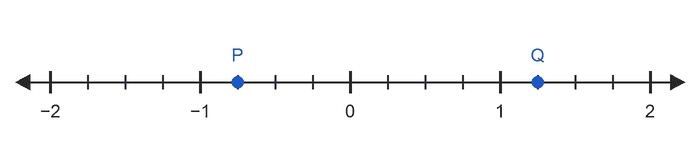
(a) Write the rational numbers represented by the points P and Q.
(b) Which of the two numbers is greater ?
- 432 marks
Question 43
Arrange the rational numbers , , and in ascending order.
- 442 marks
Question 44
Find two rational numbers that lie between and . Write them in the lowest terms and show that each one lies between the given numbers.
- 454 marks
Question 45
Simplify :
(a)
(b)
(c) The product of two rational numbers is . If one of them is , find the other.
- 464 marks
Question 46
The number line below goes from to , and every unit is divided into 3 equal parts.

(a) Write the rational numbers represented by A, B, C and D.
(b) Write these four numbers in descending order.
(c) Find .
- 473 marks
Question 47
Meena had ₹ 960. She spent of it on books and of it on a school bag.
(a) What fraction of her money did she spend in all ?
(b) What fraction of her money is left ?
(c) How much money is left with her ?