
Opening your dashboard
Class 7 Maths Chapter 16 Lines and Angles: Practice Questions
41 questions on Chapter 16, each worked through on its own page with the AI tutor. Class 7 Maths, ICSE 2026-27.
41 questions
1–5 marks · Mixed difficulty
- 11 mark
Question 1
Bloom's level: Remember
A ray has
- 21 mark
Question 2
Bloom's level: Remember
One degree () is equal to
- 31 mark
Question 3
Bloom's level: Understand
An angle measuring is
- 41 mark
Question 4
Bloom's level: Apply
The supplement of is
- 51 mark
Question 5
Bloom's level: Apply
Two straight lines intersect each other. One of the four angles formed is . The other three angles are
- 61 mark
Question 6
Bloom's level: Apply
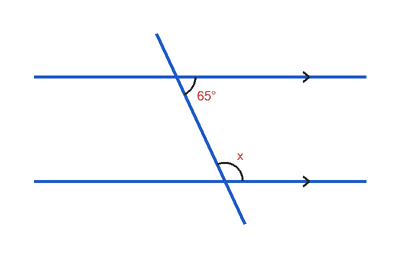
Two parallel lines (shown with arrows) are crossed by a transversal. What is the measure of the angle marked in the figure?
- 71 mark
Question 7
Bloom's level: Understand
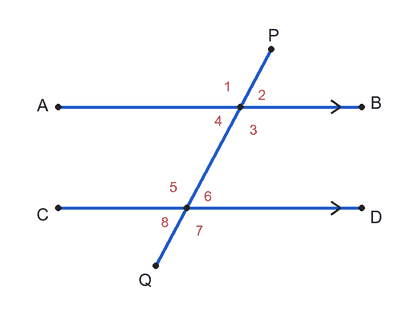
In the figure, AB ∥ CD and PQ is a transversal. The angles and form a pair of
- 81 mark
Question 8
Bloom's level: Analyse
Two lines are cut by a transversal. A pair of co-interior angles measure and . Which conclusion is correct?
- 91 mark
Question 9
Bloom's level: Apply
Four angles about a point are , , and . The largest of these angles is
- 101 mark
Question 10
Bloom's level: Understand
Assertion (A): and are complements of each other.
Reason (R): When the measures of two angles together make one right angle, each angle is called the complement of the other.
- 111 mark
Question 11
Bloom's level: Evaluate
Assertion (A): Every pair of adjacent angles is supplementary.
Reason (R): Adjacent angles have a common vertex and a common arm.
- 121 mark
Question 12
Bloom's level: Understand
Assertion (A): When two parallel lines are cut by a transversal, each pair of corresponding angles is equal.
Reason (R): Parallel lines meet at a point if they are produced far enough.
- 131 mark
Question 13
Bloom's level: Remember
Define collinear points and concurrent lines.
- 141 mark
Question 14
Bloom's level: Remember
Write the range of measure of an acute angle, an obtuse angle and a reflex angle.
- 152 marks
Question 15
Bloom's level: Understand
Explain the difference between a line, a ray and a line segment. Which of them can be measured, and why?
- 162 marks
Question 16
Bloom's level: Apply
Two angles of a garden plot measure and . Find their sum in degrees, minutes and seconds.
- 172 marks
Question 17
Bloom's level: Apply
Meera measured an angle and its complement with a protractor. She found that the angle was larger than its complement by . What were the two measures?
- 182 marks
Question 18
Bloom's level: Apply
Two parallel lines are cut by a transversal. A pair of interior alternate angles measure and . Find and the measure of each angle.
- 192 marks
Question 19
Bloom's level: Analyse
In the figure, is a right angle. Find , and hence the measures of , and .

- 202 marks
Question 20
Bloom's level: Evaluate
Rhea says, "The supplement of an acute angle is always obtuse, and the complement of an acute angle is always acute." Is she correct? Justify each part.
- 212 marks
Question 21
Bloom's level: Understand
What is a transversal? When a transversal cuts two straight lines, how many angles are formed in all, and how many pairs of corresponding angles are there?
- 222 marks
Question 22
Bloom's level: Analyse
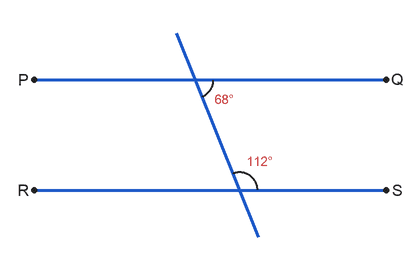
In the figure, a transversal cuts the lines PQ and RS. Is PQ parallel to RS? Give a reason.
- 233 marks
Question 23
Bloom's level: Understand
In the figure, AB ∥ CD and PQ is a transversal.
(a) Name the two pairs of interior alternate angles.
(b) Name the four pairs of corresponding angles.
(c) Explain why .
- 244 marks
Question 24
Bloom's level: Apply
In the figure, AB ∥ CD and the transversal EF meets AB at M and CD at N.

(a) Name the type of the pair of angles and , and find .
(b) Find , and .
(c) Find , and check that .
- 255 marks
Question 25
Bloom's level: Apply
Case study: The 12 numbers on a clock face divide the full turn of into 12 equal parts. Riya studies the angle between the hour hand and the minute hand at different times.
(a) Find the angle between the hands at 3 o'clock and name its type.
(b) Find the smaller angle between the hands at 5 o'clock, name its type, and write its supplement.
(c) At 8 o'clock, find the smaller angle and the reflex angle between the hands. Also find the angle through which the minute hand turns in 20 minutes.
- 265 marks
Question 26
Bloom's level: Analyse
Case study: A straight railway track crosses two straight roads. A surveyor wants to know whether the roads are parallel, using the angles each road makes with the track.
(a) At the first pair of roads, a pair of corresponding angles measure and . What can she conclude? Give the reason.
(b) At a second pair of roads, a pair of co-interior angles measure and . Are these two roads parallel? Explain.
(c) In part (b), the angle cannot change. To what measure must the angle be changed so that the roads become parallel, and by how many degrees must it change?
- 273 marks
Question 27
Bloom's level: Evaluate
Ali says, "Two obtuse angles can be supplementary." Bina says, "Two acute angles can never be supplementary." Judge each statement, giving reasons and an example.
- 284 marks
Question 28
Bloom's level: Analyse
Two straight lines AB and CD intersect at O. and .
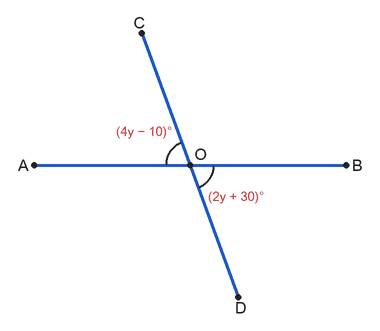
(a) What type of angles are and ? Find .
(b) Find all four angles at O and check that they add up to .
(c) A ray OE bisects . Find .
- 294 marks
Question 29
Bloom's level: Create
You are given a line AB and a point P not on it. Using a ruler and a protractor, design a method to draw a line through P parallel to AB, using a condition of parallelism.
(a) Write the steps of your construction.
(b) Name the condition of parallelism your method uses.
(c) If the angle you copy is , write the measures of all eight angles formed at the two points where your transversal cuts the two lines.
- 304 marks
Question 30
Bloom's level: Create
(a) Frame a word problem about a pair of supplementary angles, in which one angle is described in terms of the other, so that the answer is and .
(b) Solve your problem.
(c) Change your problem so that the two angles become complementary with one angle ; write the new answer.
- 313 marks
Question 31
Fill in the blanks :
(i) An obtuse angle is an angle ______.
(ii) An acute angle is an angle ______.
(iii) A straight angle is an angle ______.
(iv) A reflex angle is an angle ______.
(v) An angle is formed when two line segments have a ______ end point.
(vi) A ray is a part of a straight line that starts from a ______ point and goes on endlessly in one direction.
- 321 mark
Question 32
The sum of the angles and is :
- 331 mark
Question 33
An angle equal to five-sixths of a straight angle is :
- 341 mark
Question 34
A transversal cuts two parallel lines. One of a pair of co-interior angles is . The other angle of the pair is :
- 352 marks
Question 35
Four points , , and are marked on a sheet of paper so that no three of them lie on the same straight line. Write the names of all the line segments obtained by joining pairs of these points. How many of these segments have as an end point ?
- 362 marks
Question 36
Find the angle which is more than its complement. Also find the supplement of that angle.
- 372 marks
Question 37
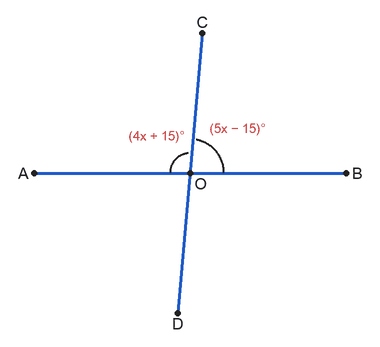
Two straight lines and intersect at . If and , find and the measures of all four angles formed at .
- 382 marks
Question 38
In the figure, the transversal cuts the lines and . The angles are lettered .
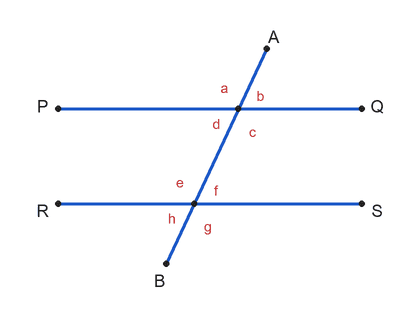
Name the type of each of these pairs of angles :
(i) and (ii) and (iii) and (iv) and
- 393 marks
Question 39
In the figure, and the transversal cuts them at and . and .
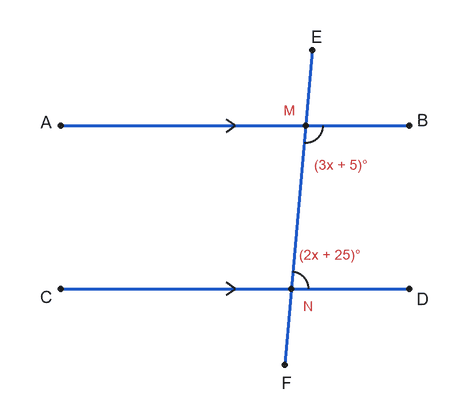
(a) Name the relation between and , and use it to find .
(b) Find the measures of and .
(c) Find and , giving a reason for each.
- 404 marks
Question 40
In the figure, the transversal cuts the lines and at and . and .

(a) Name the pair of angles marked in the figure.
(b) For what value of will be parallel to ? State the condition that you use.
(c) Find the value of each marked angle, and the measure of , which is the angle co-interior to . Show that the lines are also parallel by the co-interior angles test.
- 414 marks
Question 41
In the figure, is a straight line. The rays , and make the angles , , and .
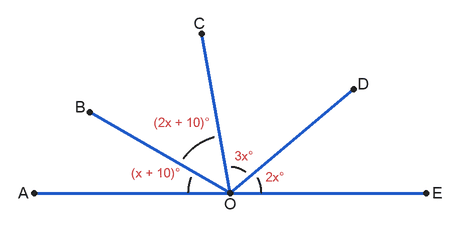
(a) Find the value of .
(b) Find the measure of each of the four angles.
(c) Name two pairs of complementary angles from the figure, and state the type of .