
Opening your dashboard
Class 6 Maths Chapter 18 Symmetry: Practice Questions
40 questions on Chapter 18, each worked through on its own page with the AI tutor. Class 6 Maths, ICSE 2026-27.
40 questions
1–5 marks · Mixed difficulty
- 11 mark
Question 1
Bloom's level: Remember
The line about which a figure is symmetrical is called its :
- 21 mark
Question 2
Bloom's level: Remember
How many lines of symmetry does a kite-shaped figure have?
- 31 mark
Question 3
Bloom's level: Understand
An object is placed 3 cm in front of a plane mirror. Its image is formed :
- 41 mark
Question 4
Bloom's level: Apply
The side lengths of four triangles are given. Which triangle has exactly one line of symmetry?
- 51 mark
Question 5
Bloom's level: Apply
A point P is 2.5 cm from a line AB, and Q is the point symmetric to P with respect to AB. The length of PQ is :
- 61 mark
Question 6
Bloom's level: Understand
Points P and Q are symmetric to each other with respect to a line AB. Then the line AB is :
- 71 mark
Question 7
Bloom's level: Analyse
ABCD is a square and its diagonal AC is drawn, as shown.
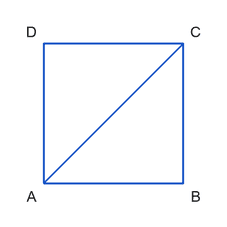
How many lines of symmetry does the whole figure (the square together with AC) have?
- 81 mark
Question 8
Bloom's level: Apply
The line of symmetry for two points A and B, which are 7 cm apart, cuts the segment AB at M. The length AM and the angle at which the line of symmetry cuts AB are :
- 91 mark
Question 9
Bloom's level: Understand
A flat shape can be folded onto itself along exactly two different lines and no others. The shape could be :
- 101 mark
Question 10
Bloom's level: Understand
Assertion (A) : When a figure is folded along its line of symmetry, the two parts of the figure coincide.
Reason (R) : A figure is symmetrical about a line if the part on one side of the line is exactly the mirror image of the part on the other side.
- 111 mark
Question 11
Bloom's level: Evaluate
Assertion (A) : Every line that passes through the centre of a circle is a line of symmetry of the circle.
Reason (R) : A circle has exactly two lines of symmetry.
- 121 mark
Question 12
Bloom's level: Analyse
Assertion (A) : The line of symmetry for two points P and Q is parallel to the line segment PQ.
Reason (R) : P and Q are symmetric with respect to the perpendicular bisector of PQ.
- 131 mark
Question 13
Bloom's level: Remember
What is meant by the line of symmetry of a figure?
- 141 mark
Question 14
Bloom's level: Remember
When are two points P and Q said to be symmetric with respect to a line AB?
- 152 marks
Question 15
Bloom's level: Understand
Sort the capital letters K, T, X, E, S and I into three groups: letters with no line of symmetry, exactly one line of symmetry and exactly two lines of symmetry.
- 162 marks
Question 16
Bloom's level: Apply
A point P is 3.2 cm from a line AB, and the perpendicular from P meets AB at O. Q is the point symmetric to P with respect to AB. Find OQ and PQ, and write the angle between PQ and AB.
- 172 marks
Question 17
Bloom's level: Evaluate
Ravi has to locate the point symmetric to a point P, which is 4 cm from a line AB. He draws PO perpendicular to AB, extends it beyond AB and, with his compass, cuts off OQ = 3 cm. He says Q is the required point. Is he right? Justify your answer.
- 182 marks
Question 18
Bloom's level: Analyse
A rectangle ABCD has length 6 cm and breadth 4 cm. Explain why its diagonal AC is not a line of symmetry, and write the lines that are its lines of symmetry.
- 192 marks
Question 19
Bloom's level: Understand
Explain why the perpendicular bisector of the line segment PQ is the required line of symmetry for the two points P and Q.
- 202 marks
Question 20
Bloom's level: Apply
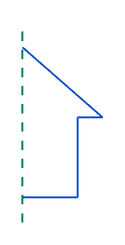
Half of a shape is drawn on one side of a dotted line. Complete the shape so that the dotted line is its line of symmetry.
- 212 marks
Question 21
Bloom's level: Understand
Which of these are symmetrical about a line: a butterfly, the letter F, a human face, a leaf of a mango tree? For one of the symmetrical ones, describe where its line of symmetry lies.
- 222 marks
Question 22
Bloom's level: Apply
A regular polygon with sides has lines of symmetry. Use this to answer:
(a) How many lines of symmetry does a regular pentagon have, and a regular octagon?
(b) A regular polygon has 6 lines of symmetry. How many sides does it have, and what is it called?
- 233 marks
Question 23
Bloom's level: Apply
Draw a line AB and mark a point P 2.8 cm away from it. Using a ruler, a set-square and a compass, locate the point Q that is symmetric to P with respect to AB. Write your steps, and measure PQ.
- 244 marks
Question 24
Bloom's level: Apply
Case study: Two lamp posts P and Q stand 8 m apart in a park. The gardener wants to plant a straight row of trees along a line such that P and Q are mirror images of each other in that line.
(a) What is the special name of this line, with respect to PQ?
(b) A tree T in the row is 5 m from P. How far is it from Q? Give a reason.
(c) Taking 1 cm to represent 1 m, write the steps to construct the line with a ruler and compass. At what distance from P does the row cross PQ?
- 253 marks
Question 25
Bloom's level: Analyse
Study the three designs.
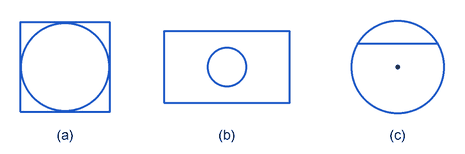
(a) is a square with a circle touching all four sides; (b) is a rectangle (not a square) with a small circle at its centre; (c) is a circle with a chord that is not a diameter.
Find the number of lines of symmetry of each whole design and describe where they lie.
- 264 marks
Question 26
Bloom's level: Analyse
Case study: Mira folds a rectangular sheet of paper once along a vertical crease. While it is folded, she punches one hole 2 cm to the left of the crease.
(a) After unfolding, how many holes are there? Where is the second hole, and what is the distance between the two holes?
(b) What is the crease for the pattern of holes? Give a reason.
(c) She takes a new sheet, folds it along a vertical crease and then along a horizontal crease (so it is folded into four layers), and punches one hole 2 cm from each crease. How many holes are there after unfolding, and how many lines of symmetry does the pattern of holes have?
- 273 marks
Question 27
Bloom's level: Evaluate
Tara makes three claims. Check each claim and correct it where needed.
(a) “A rectangle has 4 lines of symmetry because it has 4 sides.”
(b) “A scalene triangle has no line of symmetry.”
(c) “The letter D has a vertical line of symmetry.”
- 284 marks
Question 28
Bloom's level: Create
Design two simple logos, each made of a circle and one polygon drawn inside it with its corners on the circle:
(a) a logo with exactly one line of symmetry;
(b) a logo with exactly two lines of symmetry.
Draw them, mark the lines of symmetry with dotted lines, and explain why each logo has no other line of symmetry.
- 295 marks
Question 29
Bloom's level: Create
Draw a line and a triangle PQR on one side of it, with P, Q and R at distances 2 cm, 3.5 cm and 1 cm from . Construct the mirror image PQR of the triangle in the line by locating the symmetric point of each corner. Write your steps and state what you notice about the two triangles.
- 303 marks
Question 30
Bloom's level: Apply
Symmetry is found all around us.
(a) A butterfly's body lies along its line of symmetry. A spot on its left wing is 1.8 cm from the body line. Where is the matching spot on the right wing?
(b) A tree stands at the edge of a still lake, and its top is 6 m above the water surface. The water acts like a plane mirror. How far below the water surface does the top of the tree appear in the reflection, and what is the distance between the top and its image?
(c) A word is written on a card in capital letters: TOOT. Does the vertical line through the middle of the word act as a line of symmetry? Give a reason.
- 311 mark
Question 31
Among the capital letters H, I, M, N and S, the number of letters which have a vertical line of symmetry is :
- 321 mark
Question 32
To locate the point symmetric to a point with respect to a line , a student draws , with on . The correct next step is to :
- 331 mark
Question 33
Two identical equilateral triangles are joined along a common side to make a four-sided figure (a rhombus with angles and ).
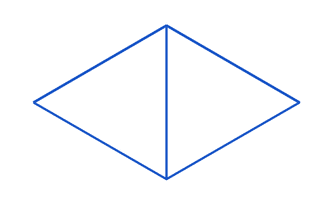
The number of lines of symmetry of this figure is :
- 342 marks
Question 34
Write the number of lines of symmetry of each capital letter :
(a) W (b) H (c) D (d) N
- 352 marks
Question 35
The points and are symmetric with respect to a line , and the segment meets at . If cm, find :
(a) the length of ,
(b) the angle that makes with .
- 362 marks
Question 36
A regular hexagon is a six-sided figure with all sides equal and all angles equal.
(a) How many lines of symmetry does a regular hexagon have ?
(b) Describe where the lines of symmetry lie with respect to the corners (vertices) and the sides of the hexagon.
- 372 marks
Question 37
The figure shows a cross made of five equal squares.

(a) How many lines of symmetry does the cross have ?
(b) Name or describe each of them.
- 383 marks
Question 38
Draw a line cm. Take a point above whose perpendicular distance from is 2.6 cm and whose foot of the perpendicular is 3 cm from .
(a) Construct the point which is symmetric to with respect to , and write the steps of construction.
(b) Measure .
(c) What is the line for the segment ?
- 394 marks
Question 39
(a) Copy and complete the table by writing the number of lines of symmetry of each figure.
Figure Kite Isosceles trapezium Regular pentagon Regular octagon Circle Parallelogram (with unequal adjacent sides and no right angle) Lines of symmetry (b) Which figure of the table has the greatest number of lines of symmetry, and which has none ?
- 404 marks
Question 40
(a) Construct a triangle in which cm and cm. Write the steps of construction.
(b) Construct the line of symmetry of the triangle, and mark the point where it meets .
(c) Measure and , and state how divides .