
Opening your dashboard
Class 12 Physics Chapter 8 Torque on a Current-Carrying Loop - Moving Coil Galvanometer: Practice Questions
92 questions on Chapter 8, each worked through on its own page with the AI tutor. Class 12 Physics, ICSE 2026-27.
92 questions
1–4 marks · Mixed difficulty
- 11 mark
Question 1
A circular loop of wire lies flat on a horizontal table. Seen from above, the current in it flows clockwise. The magnetic dipole moment of the loop points
- 23 marks
Question 2
Two thin circular loops are concentric and coplanar and lie in the plane of the paper. The inner loop has radius and carries clockwise. The outer loop has radius and carries anticlockwise (both as seen by a reader looking at the page). (Hypothetical data.)
(i) Find the magnetic dipole moment of each loop and state its direction.
(ii) Find the magnitude and direction of the net magnetic dipole moment of the pair.
(iii) What current must flow anticlockwise in the outer loop so that the net dipole moment is zero?
- 31 mark
Question 3
A thin ring of radius carries a charge spread uniformly over it. The ring spins with a constant angular speed about its own axis (the line through its centre, perpendicular to its plane). The magnetic dipole moment of the ring is
- 42 marks
Question 4
An electric dipole of moment placed in a uniform electric field is often compared with a current loop of magnetic moment placed in a uniform magnetic field .
(i) Write the torque on each in vector form, and state the orientation in which each torque is maximum.
(ii) State one way in which the two dipoles are alike in a uniform field, other than the form of the torque, and one way in which their sources differ.
- 51 mark
Question 5
A square loop of wire carrying a steady current has magnetic dipole moment of magnitude . The loop is bent along the line joining the mid-points of two opposite sides, so that its two halves become perpendicular to each other. The current is unchanged. The magnitude of the new dipole moment is
- 63 marks
Question 6
A small coil has magnetic dipole moment . It is placed in a uniform magnetic field . (Hypothetical data.)
(i) Find the torque on the coil as a vector, and its magnitude.
(ii) Find the angle between and , and use to check your answer to (i).
(iii) Explain why the -component of makes no contribution to the torque.
- 71 mark
Question 7
A current loop is held with its plane parallel to a uniform magnetic field, and the torque on it is . The loop is then turned about an axis that lies in its plane and is perpendicular to the field. Through what angle must it be turned from the first position for the torque to become ?
- 84 marks
Question 8
A single-turn rectangular loop has vertical sides and horizontal sides . It carries and is free to turn about a vertical axis through its centre. A uniform horizontal field of acts on it, and the normal to the loop makes with the field. (Hypothetical data.) (Take , .)

(i) Find the force on each horizontal side, and explain why these two forces produce no torque.
(ii) Find the force on each vertical side.
(iii) Find the perpendicular distance between the lines of action of the forces in (ii), and hence the torque.
(iv) Check the torque using .
- 91 mark
Question 9
A coil in a uniform magnetic field experiences a torque of when the normal to its plane makes with the field. The greatest torque this coil can experience in the same field with the same current is
- 101 mark
Question 10
In a suspension-type galvanometer, light from a lamp is reflected by a small mirror fixed to the coil onto a scale away. When a current flows, the spot of light moves along the scale. The angle through which the coil has turned is
- 113 marks
Question 11
A pointer-type moving coil galvanometer is to give a full-scale deflection of for a current of . Its hair springs have a combined torsional constant of . The coil frame is and the radial field in the gap is . (Hypothetical data.)
(i) Find the number of turns the coil needs (to the nearest whole number).
(ii) With this whole number of turns, what current now gives full-scale deflection?
(iii) Find the galvanometer constant in per degree.
- 121 mark
Question 12
For a moving coil galvanometer to have a linear scale (), which pair of features is essential?
- 132 marks
Question 13
Over many years, the permanent magnet of a laboratory moving coil galvanometer weakens so that the radial field in the gap falls to of its original value. Everything else is unchanged, and the scale is still marked as it was at first.
(i) A true current of is passed through it. What current will the scale show?
(ii) By what factor has the galvanometer constant changed? How should the readings be corrected?
- 141 mark
Question 14
The galvanometer constant of a moving coil galvanometer does not change when
- 153 marks
Question 15
A centre-zero galvanometer has divisions on each side of zero. Its figure of merit is per division and its coil resistance is . (Hypothetical data.)
(i) Find its current sensitivity in divisions per .
(ii) Find the current and the potential difference across it at full-scale deflection.
(iii) Find its voltage sensitivity in divisions per mV.
- 161 mark
Question 16
Two moving coil galvanometers and have identical coils. The radial field in is times that in , and the springs of have twice the torsional constant of those in . The ratio of the current sensitivity of to that of is
- 171 mark
Question 17
In a lamp-and-scale galvanometer, the scale is moved from to from the mirror. The current sensitivity of the galvanometer, measured as the angle turned by the coil per ,
- 183 marks
Question 18
A sensitive galvanometer of resistance has a current sensitivity of divisions per . (Hypothetical data.)
(i) Find its voltage sensitivity in divisions per mV.
(ii) It is connected directly across a thermocouple of emf and internal resistance . Find the deflection.
(iii) Explain why the deflection is less than (voltage sensitivity) (emf).
- 191 mark
Question 19
The square coil of a galvanometer is replaced by another square coil with the same number of turns of the same wire, but with each side times as long. The magnet and the springs are unchanged, and the resistance of the galvanometer is that of its coil. Its voltage sensitivity becomes
- 203 marks
Question 20
Two galvanometers are available:
- : resistance , current sensitivity divisions per mA;
- : resistance , current sensitivity divisions per mA.
(Hypothetical data.)
(i) Find the voltage sensitivity of each in divisions per mV.
(ii) Each in turn is connected directly to a source of emf and internal resistance . Which gives the larger deflection?
(iii) Each in turn is connected to a source of emf and internal resistance . Which now gives the larger deflection? What general rule do (ii) and (iii) suggest?
- 211 mark
Question 21
For an electron revolving in a circular Bohr orbit, the ratio of its orbital magnetic moment to its orbital angular momentum is (, )
- 222 marks
Question 22
(a) Using , calculate the value of the Bohr magneton.
(b) Find the orbital magnetic moment of an electron in the third Bohr orbit () of a hydrogen atom.
(, , .)
- 231 mark
Question 23
The angle between the orbital angular momentum of an electron in a Bohr orbit and its orbital magnetic moment is
- 243 marks
Question 24
In a hydrogen atom, the electron in the second Bohr orbit () moves in a circle of radius .
(a) Use Bohr's quantisation condition to find the speed of the electron.
(b) Find its orbital magnetic moment.
(c) Express your answer to (b) as a multiple of the Bohr magneton, .
(, , .)
- 251 mark
Question 25
The orbital magnetic moment of the electron in a hydrogen atom is found to be . Taking , the electron is in the orbit with equal to
- 263 marks
Question 26
A small sphere of mass carrying a charge of is whirled on an insulating thread in a horizontal circle of radius , making revolutions per second.
(a) Find the equivalent current of the revolving charge.
(b) Find the magnetic moment of this current loop.
(c) Find the angular momentum of the sphere, and show that the ratio (magnetic moment)/(angular momentum) equals , the same rule that holds for an electron in a Bohr orbit.
(Hypothetical data.)
- 272 marks
Question 27
A student reports that the orbital magnetic moment of the electron in a hydrogen atom (Bohr model) is . Is this value possible? Give a reason. (.)
- 282 marks
Question 28
The electron in the first Bohr orbit of a hydrogen atom has an orbital magnetic moment of . The atom is placed in a uniform magnetic field of .
(a) Find the torque on this orbital magnetic moment when it makes an angle of with the field.
(b) What is the greatest torque it can experience in this field, and for what orientation?
(Hypothetical data.)
- 291 mark
Question 29
A galvanometer of resistance is shunted so that only of the main current passes through the galvanometer. The resistance of the shunt is
- 303 marks
Question 30
A galvanometer of resistance gives full-scale deflection for . It is converted into an ammeter of range –.
(a) Find the shunt resistance and the resistance of the ammeter.
(b) A cell of e.m.f. and negligible internal resistance is connected to a resistor. This ammeter is then put in series in the circuit. What does it read?
(c) By what percentage does the reading differ from the current that flowed before the ammeter was inserted? What property of the ammeter causes this?
(Hypothetical data.)
- 311 mark
Question 31
Two identical galvanometers are converted into ammeters: of range and of range . Both are connected in series in a circuit carrying . The ratio of the deflection of to that of is
- 323 marks
Question 32
A galvanometer is labelled ", full-scale current ". A student uses these values to make an ammeter of range .
(a) What shunt does the student use?
(b) Later it is found that the coil's resistance is really . What current actually gives full-scale deflection with this shunt?
(c) When the ammeter reads , what is the true current?
(Hypothetical data.)
- 331 mark
Question 33
Two identical galvanometers are converted into ammeters: of range and of range . The two ammeters are connected in parallel, and a total current of is passed through the combination. The readings of and are
- 342 marks
Question 34
A galvanometer is connected in a circuit that contains a large resistance, so the main current stays the same throughout. The galvanometer shows a deflection of divisions. When a shunt of is connected across the galvanometer, the deflection falls to divisions. Find the resistance of the galvanometer.
(Hypothetical data.)
- 351 mark
Question 35
A galvanometer of resistance gives full-scale deflection for . It is converted into an ammeter of range . When the ammeter shows full-scale deflection, the power dissipated in the shunt is about
- 363 marks
Question 36
A galvanometer of resistance gives full-scale deflection for .
(a) What shunt converts it into an ammeter of range ?
(b) By mistake, a student connects this shunt in series with the galvanometer, and puts the combination in series with a battery (negligible internal resistance) and a resistor. What current flows through the galvanometer?
(c) What will happen to the instrument? State one other ill effect on the circuit.
(Hypothetical data.)
- 373 marks
Question 37
Two resistors, each of , are connected in series across a supply of negligible internal resistance. The p.d. across one of the resistors is measured, in turn, with
(i) a voltmeter of resistance ,
(ii) a voltmeter of resistance .
(a) What is the true p.d. across each resistor?
(b) Find the reading of each voltmeter.
(c) What do the results show about the resistance a good voltmeter should have?
(Hypothetical data.)
- 383 marks
Question 38
A galvanometer of resistance gives full-scale deflection for . It is made into a three-range voltmeter by connecting resistors , and in series with it, as shown. The ranges are , and .

Find , and .
(Hypothetical data.)
- 391 mark
Question 39
Two identical galvanometers are converted into voltmeters (range ) and (range ). The two voltmeters are connected in series across a supply. The readings of and are
- 403 marks
Question 40
When a resistance of is connected in series with a galvanometer, it becomes a voltmeter of range –. When the series resistance is instead, the range becomes –.
(a) Find the full-scale current of the galvanometer.
(b) Find the resistance of the galvanometer.
(c) What series resistance is needed for a range of –?
(Hypothetical data.)
- 413 marks
Question 41
A galvanometer of resistance gives full-scale deflection for . It is to be made into a voltmeter of range –, and its scale is marked from to .
(a) What series resistance is needed?
(b) By mistake a resistor is fitted instead. What p.d. now gives full-scale deflection?
(c) With this wrong resistor, the meter reads across a resistor. What is the true p.d.?
(Hypothetical data.)
- 421 mark
Question 42
Four voltmeters, each of range –, are made from galvanometers with different full-scale currents (the coil resistances are negligible compared with the series resistances). The voltmeter that disturbs a circuit least when connected is the one made from the galvanometer whose full-scale current is
- 433 marks
Question 43
To measure a resistance , a voltmeter is connected directly across it and an ammeter (of negligible resistance) is connected in series with the cell, as shown. The voltmeter, of resistance , reads and the ammeter reads .
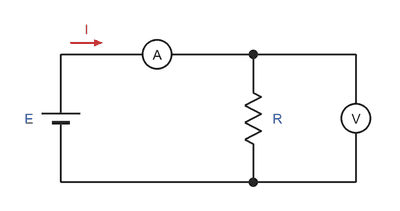
(a) What value of would you get by simply dividing the voltmeter reading by the ammeter reading?
(b) Find the true value of .
(c) Find the percentage error in the value of (a).
(Hypothetical data.)
- 441 mark
Question 44
A voltmeter is made by connecting a high resistance in series with a galvanometer whose coil resistance is negligible compared with . If is replaced by , then
- 452 marks
Question 45
There is no net charge on a current-carrying conductor. Then why does it experience a force in a magnetic field?
- 462 marks
Question 46
A current-carrying circular loop lies on a smooth horizontal plane. Can a uniform magnetic field be set up in such a manner that the loop turns around itself (i.e., turns about the vertical axis)?
- 471 mark
Question 47
A current-carrying wire does not tend to rotate in a magnetic field. What conclusion do you draw from this?
- 482 marks
Question 48
A current-carrying loop free to turn is placed in a uniform magnetic field . What will be its orientation relative to in the equilibrium state?
- 492 marks
Question 49
What is meant by a radial field? Why such a field is necessary in a moving coil galvanometer?
- 502 marks
Question 50
“In a moving coil galvanometer, the coil is suspended using phosphor bronze alloy”. Why?
- 512 marks
Question 51
What is the purpose of the soft iron core used in the moving coil galvanometer?
- 521 mark
Question 52
“The earth’s field does not affect the working of a moving coil galvanometer.” Why?
- 532 marks
Question 53
Which has higher resistance, an ammeter or a voltmeter? Why?
- 542 marks
Question 54
By connecting suitable high resistance in series, two identical galvanometers are converted into (i) a voltmeter and (ii) a millivoltmeter. Which has higher resistance?
- 552 marks
Question 55
By mistake a voltmeter is connected in series and an ammeter is connected in parallel with a resistance in an electrical circuit. What will happen to the instrument?
- 563 marks
Question 56
Through a circular coil of radius 7 cm a current of 10 mA is passed. What is the magnetic dipole moment of the current loop?
- 573 marks
Question 57
A moving coil galvanometer consists of a coil 50 turns having an area of m. The coil is suspended in a radial magnetic field of 0.2 T. The current sensitivity of the galvanometer is to be increased by 50% without changing the area of the coil or the magnetic field. How can this be done?
- 583 marks
Question 58
A moving coil galvanometer has the following specifications. Number of turns is 50. The radial magnetic field in which the coil is placed is 0.1 T. The area of the coil is m and couple per unit twist of the suspension fibre is N m deg. Find the current sensitivity of the galvanometer.
- 593 marks
Question 59
A galvanometer coil is replaced by another coil of diameter of the original diameter with the total number of turns five times the original value. If the same current is passed through both, find the new deflection.
- 603 marks
Question 60
A rectangular coil of 100 turns and dimensions 5 cm × 2 cm carrying a current of 2 A is suspended vertically in a uniform magnetic field of 0.2 T acting normal to the plane of the coil. Find (a) the torque acting on the coil and (b) the force acting on the coil.
- 613 marks
Question 61
A rectangular coil of 50 turns and dimensions 15 cm × 20 cm is placed with the plane parallel to a magnetic field of 0.1 T. Find the torque acting on the coil if a current of 6 A flows through it.
- 623 marks
Question 62
When a current of 12 mA is passed through a moving coil galvanometer it shows an angular deflection of 24 degree. What is its current sensitivity?
- 632 marks
Question 63
State any two differences between a moving coil galvanometer and a tangent galvanometer.
- 642 marks
Question 64
State two factors on which the sensitivity of a moving coil galvanometer depend.
- 652 marks
Question 65
An electric current of A flows in a loop of radius cm. Calculate the magnitude of the magnetic dipole moment of the dipole formed.
- 661 mark
Question 66
What is the purpose of the concave pole pieces in a moving coil galvanometer?
- 671 mark
Question 67
In a moving coil galvanometer, what is meant by a radial magnetic field?
- 681 mark
Question 68
In a moving coil galvanometer, the deflection of the coil is related to electric current by the relation
- 691 mark
Question 69
A circular coil of turns and radius cm is placed in uniform magnetic field of T normal to the plane of the coil. If the current in coil is A, then the torque acting on the coil will be
- 701 mark
Question 70
Two parallel conductors and of equal length carry currents and , respectively, in the same direction. Then
- 711 mark
Question 71
A metallic loop is placed in a magnetic field. If a current is passed through it, then
- 721 mark
Question 72
A closely wound solenoid of turns and area of cross-section carries a current of A. It is suspended through its centre and perpendicular to its length, allowing it to turn in a horizontal plane in a uniform magnetic field tesla making an angle of with the axis of the solenoid. The torque on the solenoid will be
- 731 mark
Question 73
A triangular loop of side carries a current . It is placed in a magnetic field such that the plane of the loop is in the direction of . The torque on the loop is
- 741 mark
Question 74
A one-metre long wire is lying at right angles to the magnetic field. A force of kg wt. is acting on it in a magnetic field of tesla. The current flowing in it will be
- 751 mark
Question 75
Two long conductors, separated by a distance carry current and in the same direction. They exert a force on each other. Now the current in one of them is increased to two times and its direction is reversed. The distance is also increased to . The new value of the force between them is
- 761 mark
Question 76
A straight wire of length metre and carrying a current of ampere is placed in a uniform magnetic field of induction tesla. The magnetic field is perpendicular to the length of the wire. The force of the wire is
- 771 mark
Question 77
Two parallel wires in free space are cm apart and each carries a current of A in the same direction. The force that one wire exerts on the other per metre of length is
- 781 mark
Question 78
A square current-carrying loop is suspended in a uniform magnetic field acting in the plane of the loop. If the force on one arm of the loop is , the net force on the remaining three arms of the loop is
- 791 mark
Question 79
Current is carried in a wire of length . If the wire is turned into a circular coil, the maximum magnitude of torque in a given magnetic field will be
- 801 mark
Question 80
If is magnetic moment and is the magnetic field, then the torque is given by
- 811 mark
Question 81
The relation between voltage sensitivity and current sensitivity of a moving coil galvanometer is (resistance of galvanometer )
- 821 mark
Question 82
What is the shape of the magnet used in moving coil galvanometer to make the magnetic fields radial?
- 831 mark
Question 83
A current flows in a circular coil of radius . If the coil is placed in a uniform magnetic field with its plane parallel to the field, magnitude of the torque that acts on the coil is
- 841 mark
Question 84
A circular coil having turns is made from a wire of length metre. If a current ampere is passed through it and is placed in a magnetic field of tesla, the maximum torque on it is
- 851 mark
Question 85
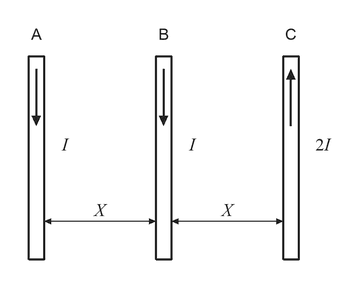
, and are parallel conductors of equal length carrying current , and respectively as shown in the figure. Distance between and is . Distance between and is also . is the force exerted by on and is the force exerted by on . Choose the correct answer.
- 861 mark
Question 86
Two galvanometers and require mA and mA respectively to produce the same deflection of divisions. Then
- 871 mark
Question 87
A circular coil having turns and radius carries a current . It is held in the plane in a magnetic field . The torque on the coil due to the magnetic field is
- 881 mark
Question 88
A rectangular coil (dimension cm cm) with turns carrying a current of A in the clockwise direction is kept centred at the origin and in the - plane. A magnetic field of T is applied along -axis. If the coil is tilted through about -axis, then the torque on the coil is
- 891 mark
Question 89
A square loop is carrying a steady current and the magnitude of its magnetic dipole moment is . If this square loop is changed to a circular loop and it carries the same current, the magnitude of the magnetic dipole moment of circular loop will be
- 901 mark
Question 90
A galvanometer is used in laboratory for detecting the null point in electrical experiment. If, on passing a current of mA, it produces a deflection of , its figure of merit is close to
- 911 mark
Question 91
A charged particle going around in a circle can be considered to be a current loop. A particle of mass carrying charge is moving in a plane with speed under the influence of magnetic field . The magnetic moment of this moving particle is
- 921 mark
Question 92
A loop of flexible wire of irregular shape carrying current is placed in an external magnetic field. Identify the effect of the field on the wire.