
Opening your dashboard
Class 12 Physics Chapter 12 Alternating Current: Practice Questions
144 questions on Chapter 12, each worked through on its own page with the AI tutor. Class 12 Physics, ICSE 2026-27.
144 questions
1–4 marks · Mixed difficulty
- 11 mark
Question 1
Two alternating voltages of the same frequency are given by
Which statement about their phases is correct?
- 23 marks
Question 2
A signal generator is connected to a cathode ray oscilloscope. The time base is set at per division and the vertical sensitivity at per division. One complete wave of the sinusoidal trace occupies horizontal divisions, and the trace rises divisions above and falls divisions below the centre line. At the trace is at the centre line and rising. (Hypothetical data.)
(i) Find the time period, frequency and peak value of the voltage.
(ii) Write the equation of the voltage as a function of time.
(iii) Find the earliest time after at which .
- 31 mark
Question 3
Two sinusoidal currents of frequency flow in two branches of a circuit. The first current reaches its positive peak before the second. The phase difference between the two currents is
- 43 marks
Question 4
A sinusoidal voltage has a peak value of and a frequency of . At its value is and it is increasing.
(i) Write the equation of the voltage in the form , giving the value of with a reason.
(ii) Find the earliest time after at which the voltage reaches its peak value.
(iii) Find the voltage at .
- 51 mark
Question 5
An alternating voltage is , with time period . Which one of the following is the same at and at ?
- 62 marks
Question 6
A capacitor is marked " maximum", meaning that the voltage across it must never exceed , even for an instant.
(i) Can it be connected directly across the (r.m.s.) AC mains? Justify with a calculation.
(ii) What is the highest r.m.s. value of a sinusoidal voltage that may be applied to it?
- 71 mark
Question 7
For a sinusoidal alternating voltage, the magnitude of the instantaneous voltage is greater than its r.m.s. value for what fraction of each cycle?
- 83 marks
Question 8
A sinusoidal current ampere flows through a resistor.
(i) Find the charge that passes through any cross-section of the circuit during one half cycle ( to ).
(ii) Use your answer to find the mean value of the current over this half cycle, and check that it equals .
(iii) What is the net charge that passes in one complete cycle? Hence explain why a moving-coil (DC) ammeter in this circuit reads zero.
- 91 mark
Question 9
The r.m.s. value of a sinusoidal alternating current is . Its average value over one complete cycle and its peak value are, respectively,
- 103 marks
Question 10
Two voltage sources are connected in turn across the same resistor:
- source P gives a sinusoidal voltage of peak value ;
- source Q gives a "square-wave" voltage that stays at for half of each cycle and at for the other half.
(i) Using the definition of r.m.s. value, find the r.m.s. value of each voltage.
(ii) Find the average power in the resistor in each case, and the ratio of the heat produced in equal times.
- 111 mark
Question 11
An ideal inductor and an ideal capacitor have equal reactances at a frequency of . At what frequency will the reactance of the inductor be four times that of the capacitor?
- 123 marks
Question 12
The frequency of an AC source is not known. Its r.m.s. voltage is . When an ideal capacitor is connected across it, an AC milliammeter in series reads . (Hypothetical data.)
(i) Find the frequency of the source.
(ii) The capacitor is replaced by an ideal inductor of across the same source. Find the new current.
(iii) State the phase of the current relative to the source voltage in each case.
- 131 mark
Question 13
An ideal capacitor is connected across a sinusoidal AC source. At the instant when the voltage across the capacitor is at its positive maximum, the current in the circuit is
- 143 marks
Question 14
A student plots two graphs from measurements made with a variable-frequency source. (Hypothetical data.)
- For a coil of negligible resistance, the graph of inductive reactance against frequency is a straight line through the origin passing through the point (, ).
- For a capacitor, the graph of capacitive reactance against is a straight line through the origin passing through the point (, ).
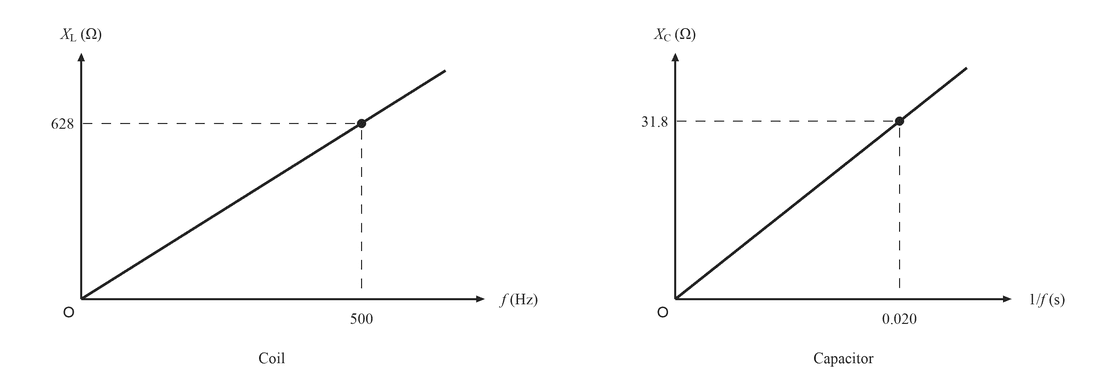
(i) Find the inductance of the coil.
(ii) Find the capacitance of the capacitor.
(iii) Find the reactance of each at .
- 153 marks
Question 15
Two ideal capacitors of and are connected in series across a (r.m.s.), AC source. (Hypothetical data.)
(i) Find the reactance of the combination and the r.m.s. current.
(ii) Find the r.m.s. voltage across each capacitor.
(iii) The two voltages add up exactly to . Explain why simple addition is correct here.
- 161 mark
Question 16
The figure shows the voltage and current phasors for a circuit connected to an AC source. Both phasors rotate anticlockwise.
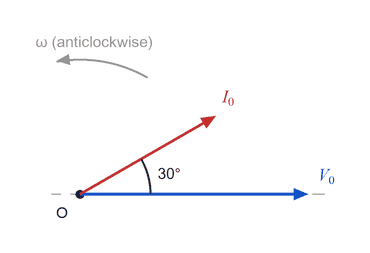
The circuit most likely consists of
- 174 marks
Question 17
A sealed box has two terminals. It is known to contain two components connected in series, chosen from a resistor, an inductor and a capacitor. When an AC voltage volt is applied across the terminals, the current is ampere. (Hypothetical data.)
(i) Which two components are in the box? Give a reason.
(ii) Find the value of each component.
(iii) Draw the phasor diagram of the voltage and current at .
- 181 mark
Question 18
In a series LCR circuit, at a certain instant the current phasor points along the axis of a phasor diagram (phasors rotate anticlockwise). At that instant the phasor of the voltage across the capacitor points along the
- 193 marks
Question 19
Two sinusoidal voltages of the same angular frequency ,
are added by connecting their sources in series.
(i) Using a phasor diagram, find the peak value of the resultant voltage.
(ii) Find the phase angle by which the resultant leads , and write the equation of the resultant voltage.
(iii) Explain why the peak value of the sum is less than .
- 203 marks
Question 20
A resistor of and an ideal inductor of reactance are connected in series to an AC source. The current is ampere. (Hypothetical data.)
(i) Write the equations of the instantaneous voltages across the resistor and across the inductor, and draw their phasors together with the current phasor at .
(ii) Find , and the source voltage at the instant when the current is at its positive peak, and at the instant when the current is zero and increasing.
(iii) Find the peak value of the source voltage. Why is it not equal to the sum of the peak values of and ?
- 211 mark
Question 21
A series LCR circuit is connected to a source whose frequency is lower than the resonant frequency of the circuit. Which statement describes the circuit correctly?
- 223 marks
Question 22
The circuit shows a simple RC phase-shift network used in electronics. The input is (r.m.s.) at , and the output is taken across the resistor. (Hypothetical data.)
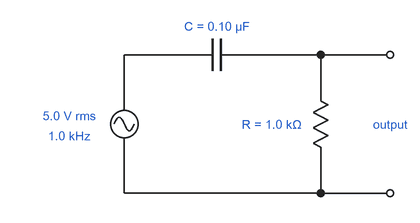
(i) Find the impedance of the network and the r.m.s. current.
(ii) Find the r.m.s. voltages across the capacitor and across the resistor (the output).
(iii) By what angle is the output voltage shifted relative to the input? Does it lead or lag?
- 231 mark
Question 23
On a certain AC source, a coil of resistance and inductive reactance has an impedance of . A resistor of in series with a capacitor of reactance also has an impedance of on the same source. If the coil and the R–C pair are joined in series across this source, the impedance of the whole circuit is
- 241 mark
Question 24
The tuning circuit of a radio has a fixed inductor and a variable capacitor. It can be tuned to any station from to . The ratio of the largest to the smallest capacitance of the variable capacitor is
- 253 marks
Question 25
A series circuit has and and a capacitor of unknown capacitance. It is connected to a variable-frequency source of (r.m.s.). The frequency is adjusted until the ammeter reading is maximum. An AC voltmeter across the capacitor then reads .
(a) Find the current in the circuit.
(b) Find the Q-factor of the circuit.
(c) Find the resonant frequency and the capacitance.
(Hypothetical data.)
- 261 mark
Question 26
In a series circuit the inductance is doubled and the capacitance is halved; the resistance is not changed. Then
- 272 marks
Question 27
A bulb, a capacitor and a coil of variable inductance are joined in series to , mains. The inductance is raised slowly from to by pushing a soft-iron rod into the coil.
(a) At what inductance does the bulb glow brightest?
(b) Describe how the brightness changes as the rod is pushed in. Give a reason.
(Hypothetical data.)
- 283 marks
Question 28
The tuning circuit of a receiver is a series circuit with . It is tuned to a station at , and its bandwidth (the gap between the two half-power frequencies) is .
(a) Find the Q-factor of the circuit.
(b) Find the capacitance at this setting.
(c) Find the resistance of the circuit.
(Hypothetical data.)
- 291 mark
Question 29
A heater (pure resistance) works on , mains. The instantaneous power drawn by the heater
- 303 marks
Question 30
A workshop draws from a supply through a cable of total resistance . Treat the supply as single-phase.
(a) Find the current in the cable when the power factor of the workshop load is , and when it is .
(b) Find the power wasted in the cable in each case.
(c) Why do supply companies charge extra to consumers with a low power factor?
(Hypothetical data.)
- 311 mark
Question 31
A variable resistor is joined in series with an ideal inductor of reactance across a (r.m.s.) AC supply. The average power drawn from the supply is greatest when is
- 322 marks
Question 32
A resistor and a capacitor in series have a power factor of on a supply. Find the power factor of the same combination on a supply.
- 331 mark
Question 33
In an ideal circuit the charge on the capacitor oscillates with period . The energy stored in the capacitor oscillates with period
- 343 marks
Question 34
An ideal circuit has and . The maximum current during the oscillations is .
(a) Find the angular frequency and the frequency of the oscillations.
(b) Find the maximum charge on the capacitor and the maximum p.d. across it.
(c) Find the p.d. across the capacitor at the instant the current is .
(Hypothetical data.)
- 351 mark
Question 35
In an ideal circuit the maximum charge on the capacitor is . At a certain instant the energy stored in the inductor is three times the energy stored in the capacitor. The charge on the capacitor at that instant is
- 362 marks
Question 36
(a) Give two reasons why the oscillations in a real circuit die away.
(b) How does an electronic oscillator keep the oscillations of its (tank) circuit going at a constant amplitude?
- 373 marks
Question 37
An circuit with an air-filled parallel-plate capacitor of oscillates at .
(a) Find the inductance.
(b) The gap between the plates is now completely filled with mica of dielectric constant . Find the new frequency.
(c) Going back to the air-filled capacitor, what capacitor must be added, and how, to make the circuit oscillate at ?
(Hypothetical data.)
- 381 mark
Question 38
An amplifier feeds an loudspeaker through an ideal transformer whose primary has times as many turns as its secondary. The resistance that the amplifier "sees" across the primary is
- 393 marks
Question 39
A transformer steps down to and supplies a resistive load. The primary winding has resistance and the secondary winding . The iron (core) loss is , and the primary current is measured as .
(a) Find the secondary current.
(b) Find the total copper loss.
(c) Find the efficiency of the transformer.
(Hypothetical data.)
- 403 marks
Question 40
A small power station generates at . The power is sent to a village through lines of total resistance , and not more than of the power sent may be lost in the lines.
(a) Find the lowest voltage at which the power must be transmitted.
(b) Find the current in the lines at this voltage and check the line loss.
(c) Find the turns ratio of the ideal transformer needed at the station.
(Hypothetical data.)
- 411 mark
Question 41
A transformer designed for , is connected to a , supply. The peak magnetic flux in its core
- 422 marks
Question 42
The primary of a transformer is connected to a fixed AC voltage. Explain why the primary current increases when more load is switched on in the secondary circuit.
- 431 mark
Question 43
The flux through the coil of an AC generator is , and the peak emf is . At an instant when the flux through the coil is half its maximum value, the magnitude of the induced emf is
- 443 marks
Question 44
A simple AC generator is to give a peak emf of at . Its rectangular coil measures and turns in a uniform field of .
(a) How many turns must the coil have?
(b) Find the r.m.s. emf and write the equation of the emf, taking at .
(c) At what speed, in revolutions per minute, must the coil turn?
(Hypothetical data.)
- 453 marks
Question 45
The coil of a hand-cranked generator turns at revolutions per second and produces an r.m.s. emf of . The coil has a resistance of and is connected to a bulb.
(a) Find the r.m.s. current and the power delivered to the bulb.
(b) Ignoring friction, find the average mechanical power the person must supply and the average torque on the coil.
(c) Why does the handle become harder to turn when the bulb is connected?
(Hypothetical data.)
- 461 mark
Question 46
In a simple AC generator the ends of the coil are connected to the external circuit through slip rings and brushes. The slip rings
- 471 mark
Question 47
What is the average value of the voltage of 230 V, 50 Hz AC supply?
- 482 marks
Question 48
Can we use ordinary moving coil galvanometer for measuring AC?
- 491 mark
Question 49
What is choke?
- 502 marks
Question 50
Explain reactance and impedance?
- 511 mark
Question 51
What is admittance?
- 522 marks
Question 52
Which is preferred for long distance transmission, AC or DC? Why?
- 532 marks
Question 53
A lamp is connected in series with a capacitor. Predict your observations for DC and AC connections. What happen in each case, if the capacity is reduced?
- 541 mark
Question 54
What is the maximum value of power factor?
- 552 marks
Question 55
The frequency of AC passing through a capacitor and a bulb connected in series is increased. What will happen?
- 561 mark
Question 56
The core of a transformer is laminated. Why?
- 572 marks
Question 57
Can we transform DC voltage using transformers?
- 582 marks
Question 58
“The transformer core is surrounded by oil.” Why?
- 592 marks
Question 59
A step up transformer increases the voltage of AC from 230 V to 23000 V. Does this mean that we are creating energy?
- 602 marks
Question 60
Iron-cored transformers are not used at high frequencies. Why?
- 613 marks
Question 61
A sinusoidal voltage is applied to a resistor of resistance. Calculate (i) r.m.s. value of the voltage, (ii) rms value of the current and (iii) power dissipated as heat in watt.
- 623 marks
Question 62
The current through a coil of inductance mH is represented by ampere. Calculate the maximum value of the induced current.
- 633 marks
Question 63
A series circuit contains a resistor of , a capacitor and an ammeter of negligible resistance. It is connected to a source of V– Hz. If the reading of an ammeter is A, calculate the reactance of the capacitor.
- 643 marks
Question 64
A series circuit contains a resistance of , a capacitor and an ammeter of negligible resistance. It is connected to a source of V– Hz. If the reading of an ammeter is A, calculate the reactance of the capacitor.
- 653 marks
Question 65
A resistor, a capacitor of and an inductor are in series with an AC source of frequency Hz. If the current in the circuit is in phase with the voltage, calculate the inductance of the inductor used.
- 663 marks
Question 66
What is the time required for a Hz AC to change its value from zero to the r.m.s. value?
- 673 marks
Question 67
An electric bulb which operates at V DC is connected to an AC supply and glows with its full brightness. What is the peak value of the AC voltage?
- 683 marks
Question 68
A coil of self-inductance mH having negligible resistance is connected to an AC supply of frequency Hz. If the current amplitude is A, what is r.m.s. value of the potential difference across the coil?
- 693 marks
Question 69
Calculate the value of inductance which should be connected in series with a capacitance of and resistance of and AC source of Hz so that the power factor of circuit is unity.
- 703 marks
Question 70
An alternating voltage of V, Hz is applied to a circuit which contains a resistance of in series with an inductor of mH. Find the current and the phase lag.
- 713 marks
Question 71
An electric lamp is joined to V, Hz AC mains. Calculate the inductance and the power factor of the choke required if the lamp takes A on V DC supply.
- 723 marks
Question 72
A V, W lamp is to be run on V, Hz AC mains. Calculate the inductance of the choke required.
- 733 marks
Question 73
A choke of H and a resistance of are connected in series across V, Hz main. Find (i) current in the circuit, (ii) p.d. across , (iii) p.d. across and (iv) phase angle.
- 743 marks
Question 74
An inductance coil takes A and dissipates W when connected to AC supply at V, Hz. Find the power factor.
- 753 marks
Question 75
When a coil is connected to an AC power supply of V, Hz, the power absorbed is W. If the current passing through coil is A, find the resistance and inductance of the coil.
- 763 marks
Question 76
A resistance is connected in series with a capacitor to an alternating voltage of peak value V. The peak current through the circuit is A. Find the phase difference between the current and the voltage.
- 773 marks
Question 77
An series circuit containing resistance , inductance and capacitance gives resonance at the same frequency as a second similar combination , and . If the two circuits are connected in series, show that the whole circuit will resonate with the same frequency .
- 783 marks
Question 78
How much current is drawn by the primary of a transformer which steps down V to V to operate a device with an impedance of ohm?
- 793 marks
Question 79
In an ideal transformer, number of turns in the primary and secondary are and respectively. If the power input to the primary is kW at V, calculate (a) output voltage and (b) current in primary.
- 803 marks
Question 80
A transformer has an efficiency of . It works at kilowatt and V. If the secondary voltage is V. Calculate the primary and secondary currents.
- 813 marks
Question 81
A power transmission line feeds input power at V to a step down transformer having turns in its primary. What should be the number of turns in the secondary to get output power at V?
- 823 marks
Question 82
An AC generator consists of a coil of turns and cross sectional area of , rotating at a constant angular speed of in a uniform magnetic field T. The resistance of the coil is . Calculate (a) maximum current drawn from the generator and (b) maximum power dissipated in the coil.
- 833 marks
Question 83
In Question 35, a generator produces a current of r.m.s. value A at V, the voltage is stepped up to V by an ideal transformer, and the power is transmitted a long distance through a power line of total resistance . If the voltage was not stepped up, what would have been the percentage power loss in the transmission line?
- 843 marks
Question 84
In an AC generator, there are turns of wire each of area and total resistance . The coil rotates in a uniform magnetic field of T at a constant frequency of Hz. (i) What is the induced e.m.f.? (ii) Find the maximum induced current.
- 851 mark
Question 85
What is the value of power factor in a series LCR circuit at resonance?
- 862 marks
Question 86
When an alternating emf, volt is applied to a circuit, the current through it is ampere. Find the (i) phase difference between the emf and the current and (ii) average power consumed by the circuit.
- 872 marks
Question 87
Plot a labelled graph showing variation in impedance of a series LCR circuit with frequency of alternating emf applied to it. What is the minimum value of this impedance?
- 882 marks
Question 88
An ideal inductor does not consume any power, even though both and are non-zero. Explain in brief.
- 892 marks
Question 89
An alternating current of frequency is flowing through an ideal choke coil of self-inductance . If and be the peak values of the voltage and current, find the average power consumed, if any, by the choke coil.
- 903 marks
Question 90
A resistance of and a capacitance of are connected in series with an AC source. The peak value of the current is A. Calculate the average power consumed in the circuit. If the capacitance is removed but the current is kept same, what is the average power consumed in the resistor alone?
- 912 marks
Question 91
An AC circuit with resistance , inductance and capacitance are connected in series. The value of is adjusted for resonance. State any three properties of the circuit which hold true for resonance only.
- 921 mark
Question 92
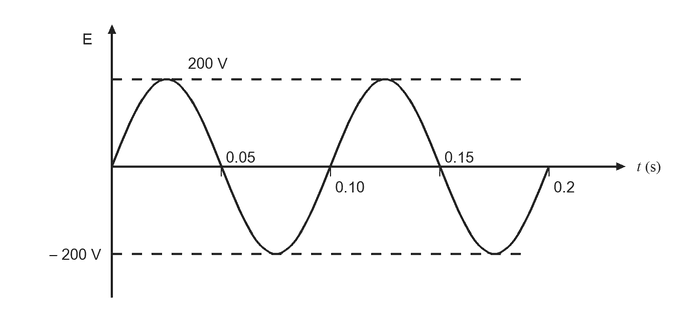
Given a graph of emf generated by an AC generator versus time . What is the frequency of the emf?

- 932 marks
Question 93
When the primary of a transformer is connected to V AC mains, the current in the primary is mA. Find the voltage across the secondary when it delivers mA current through it, assuming the transformer to be an ideal one. State any one type of energy loss in a transformer.
- 941 mark
Question 94
In a graphical variation of emf induced with time for the output of an AC generator, mark the peak value of the emf induced and the time period.
- 951 mark
Question 95
A ohm resistor and a henry inductor are connected in series to an AC source operating at volts, cycle/second. The phase angle between the current and the source voltage is
- 961 mark
Question 96
The resonant frequency of a circuit is . If the capacitance is made times the initial values, then the resonant frequency will become
- 971 mark
Question 97
An LCR series AC circuit is at resonance with each across L, C and R. If the resistance is halved, the respective voltages across L, C and R are
- 981 mark
Question 98
In an LCR series resonant circuit, which one of the following cannot be the expression for the Q-factor?
- 991 mark
Question 99
A light bulb is rated for a supply. The resistance of the bulb and the peak voltage of the source respectively are
- 1001 mark
Question 100
In an AC circuit, the instantaneous e.m.f. and current are given by ; . In one cycle of AC, the average power consumed by the circuit and the wattless current are respectively
- 1011 mark
Question 101
A series LCR circuit resonates at . If the capacitor is , the inductance used is approximately
- 1021 mark
Question 102
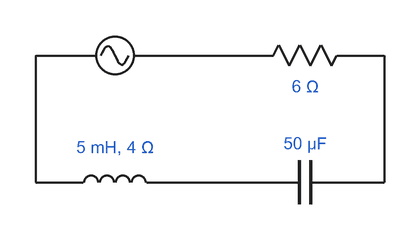
In the circuit shown in the given figure, AC source has voltage volts with . The amplitude of the current will be nearest to
- 1031 mark
Question 103
When a DC voltage of is applied to a coil of self-inductance , a current of flows through it. But by replacing DC source with AC source of , the current in the coil is reduced to . Then the frequency of AC supply is
- 1041 mark
Question 104
The quality factor of LCR circuit having resistance (R) and inductance (L) at resonance frequency () is given by
- 1051 mark
Question 105
Power factor is maximum in an LCR circuit when
- 1061 mark
Question 106
In an AC circuit the reactance of a coil is times its resistance, the phase difference between the voltage across the coil to the current through the coil will be
- 1071 mark
Question 107
The capacity of a pure capacitor is farad. In DC circuits, its effective resistance will be
- 1081 mark
Question 108
A pure inductance coil of is connected to an AC source of . The rms current in the coil is
- 1091 mark
Question 109
A resistance of ohm and an inductance of millihenry are connected in series in a cycles/second AC circuit. The impedance of this combination is very nearly
- 1101 mark
Question 110
The coil of choke in a circuit
- 1111 mark
Question 111
The inductive reactance of an inductor of henry at frequency is
- 1121 mark
Question 112
An oscillator circuit consists of an inductance of and a capacitor of . The resonant frequency of the circuit is nearly
- 1131 mark
Question 113
The power factor of an AC circuit having resistance (R) and inductance (L) connected in series and an angular velocity is
- 1141 mark
Question 114
A LCR series AC circuit is tuned to resonance. The impedance of the circuit is now
- 1151 mark
Question 115
A henry inductor is connected across a – AC source. The current in the inductor will be very nearly
- 1161 mark
Question 116
An inductor of inductance L and resistor of Resistance R, are joined in series and connected by a source of frequency . Power dissipated in the circuit is
- 1171 mark
Question 117
In AC circuit of capacitance the current from potential is
- 1181 mark
Question 118
A coil of resistance and inductance is connected to an AC source of frequency . Phase angle between potential and current will be
- 1191 mark
Question 119
Radio frequency choke uses core of
- 1201 mark
Question 120
A Volt AC is applied across an RC (series) network. The rms voltage across the resistance is Volt, then the potential across the capacitance would be
- 1211 mark
Question 121
In an LCR series AC circuit, the voltage across each of the components, L, C and R is . The voltage across the LC combination will be
- 1221 mark
Question 122
An inductance of , a capacitance of and a resistance of are connected in series with an AC source , . The phase angle of the circuit is
- 1231 mark
Question 123
The current in series LCR circuit will be maximum when is
- 1241 mark
Question 124
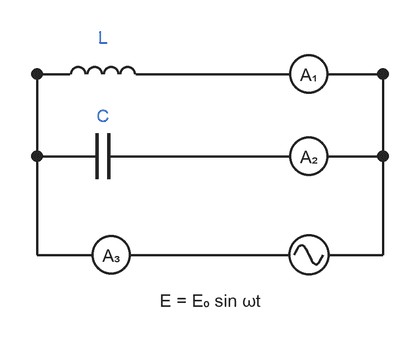
An inductor L and a capacitor C are connected in the circuit as shown in the figure. The frequency of the power supply is equal to the resonant frequency of the circuit. Which ammeter will read zero ampere?
- 1251 mark
Question 125
Which of the following components of an LCR circuit, with an AC supply, dissipates energy?
- 1261 mark
Question 126
In a circuit L, C and R are connected in series with an alternating voltage source of frequency . The current leads the voltage by . The value of C is
- 1271 mark
Question 127
A series AC circuit containing an inductor (), a capacitor () and a resistor () is driven by an AC source of . The energy dissipated in the circuit in is
- 1281 mark
Question 128
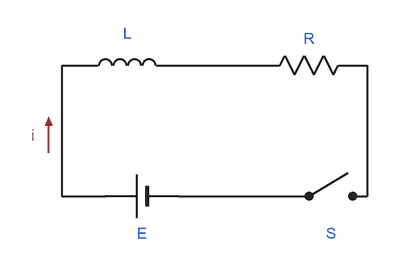
Consider the LR circuit shown in the figure. If the switch S is closed at then the amount of charge that passes through the battery between and is
- 1291 mark
Question 129
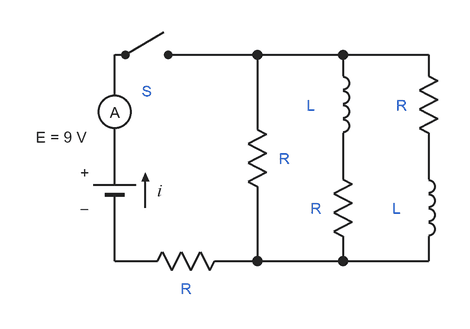
The given figure shows a circuit that contains four identical resistors with resistance , two identical inductors with inductance and an ideal battery with emf . The current '' just after the switch 'S' is closed will be
- 1301 mark
Question 130
An LCR circuit contains resistance of and a supply of at angular frequency. If only capacitance is removed from the circuit, current lags behind the voltage by . If on the other hand, only inductor is removed the current leads by with the applied voltage. The rms current flowing in the circuit will be
- 1311 mark
Question 131
An AC current is given by . A hot wire ammeter will give a reading
- 1321 mark
Question 132
What happens to the inductive reactance and the current in a purely inductive circuit if the frequency is halved?
- 1331 mark
Question 133
In a series LCR resonance circuit, if we change the resistance only, from a lower to higher value
- 1341 mark
Question 134
An AC source rated , , is connected to a resistor. The time taken by the current to change from its maximum to the rms value is
- 1351 mark
Question 135
In a series LCR circuit, the inductive reactance () is and the capacitive reactance () is . The resistance (R) in the circuit is . The power factor of the circuit is
- 1361 mark
Question 136
For a series LCR circuit with , and connected across – AC supply, the phase angle between current and supplied voltage and the nature of the circuit is
- 1371 mark
Question 137
Statement I: The ferromagnetic property depends on temperature. At high temperature, ferromagnet becomes paramagnet.
Statement II: At high temperature, the domain wall area of a ferromagnetic substance increases.
In the light of the above statements, choose the most appropriate answer from the options given below.
- 1381 mark
Question 138
For the given circuit as shown, the current through the battery when the key is closed and the steady state has been reached is

- 1391 mark
Question 139
A series LCR circuit driven by of frequency of contains a resistance , an inductor of inductive reactance and an unknown capacitor. The value of capacitance to maximise the average power should be (take )
- 1401 mark
Question 140
In an AC circuit, an inductor, a capacitor and a resistor are connected in series with . Impedance of this circuit is
- 1411 mark
Question 141
A series LCR circuit containing inductor, capacitor and resistor is connected to variable frequency AC source. The angular frequencies of the source at which power transferred to the circuit is half the power at the resonant angular frequency are likely to be
- 1421 mark
Question 142
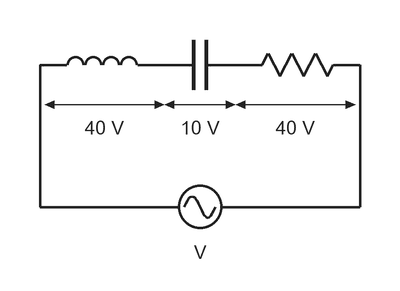
An inductor of inductance L, a capacitor of capacitance C and a resistor of resistance '' are connected in series to an AC source of potential difference '' volts as shown in the given figure. Potential difference across L, C and R is , and , respectively. The amplitude of current flowing through LCR series circuit is . The impedance of the circuit is
- 1431 mark
Question 143
The given figure shows a graph of emf E generated by an AC generator versus time. What is the frequency of the emf?
- 1441 mark
Question 144
An AC generator generating emf of is connected to a series combination of capacitor, inductor and resistor. What is the frequency of AC?