
Opening your dashboard
Class 12 Physics Chapter 10 Properties of Magnetic Substances: Practice Questions
95 questions on Chapter 10, each worked through on its own page with the AI tutor. Class 12 Physics, ICSE 2026-27.
95 questions
1–4 marks · Mixed difficulty
- 11 mark
Question 1
An electron moves in a circular orbit of radius with angular speed , and its orbital magnetic moment is . If the radius of the orbit were doubled while the angular speed stayed the same, the orbital magnetic moment would become
- 23 marks
Question 2
(i) An electron (charge , mass ) revolves with speed in a circular orbit of radius . Show that its orbital magnetic moment and its orbital angular momentum are related by
and calculate the value of .
(ii) In the Bohr model, the smallest orbital angular momentum is . Find the orbital magnetic moment of an electron with this angular momentum. (This value is called the Bohr magneton.)
(Take , , .)
- 32 marks
Question 3
In a simple model of the hydrogen atom, the electron moves round the nucleus at in a circular orbit of radius .
(i) Find the equivalent current of the orbiting electron.
(ii) Find the magnetic field that this current produces at the nucleus.
(Take , .)
- 41 mark
Question 4
Protons and neutrons in the nucleus also have magnetic moments, yet these are neglected when the magnetic properties of materials are explained. The reason is that
- 52 marks
Question 5
Solutions of three salts, all of the same fairly high concentration, are tested with a strong electromagnet. The number of unpaired electrons in the metal ion of each salt is given below.
Salt Metal ion Unpaired electrons zinc sulphate 0 copper sulphate 1 iron(III) chloride 5 (i) Using the electron theory of magnetism, state whether each solution is attracted or repelled by the magnet.
(ii) Which solution is attracted most strongly? Give a reason.
- 63 marks
Question 6
An atom has a permanent magnetic moment of . It is placed in a uniform magnetic field of .
(i) Find the difference in potential energy between the atom's moment pointing along the field and pointing opposite to it.
(ii) Compare this with the typical thermal energy of an atom at and at .
(iii) Use the results to explain why a paramagnetic sample shows only a small magnetisation at room temperature.
(Take .)
- 71 mark
Question 7
A long solenoid carries a constant current. A soft iron rod is then slid into it to form a core, the current being kept the same. Which quantity at the centre of the solenoid stays unchanged?
- 81 mark
Question 8
In a ferrite sample placed in a magnetising field, the magnetic intensity is and the intensity of magnetisation is , in the same direction. The magnetic induction in the sample is about (take ) (Hypothetical data.)
- 92 marks
Question 9
A long solenoid has turns per metre. With an air core and a current of , a probe at its centre reads . A soft iron core is then inserted and, with the same current, the magnetic induction in the core is found to be . (Hypothetical data.)
(i) Find the magnetic intensity at the centre, with and without the core.
(ii) Find the intensity of magnetisation of the core.
(Take .)
- 103 marks
Question 10
A toroid has a core of ferrite with inner radius and outer radius . It is wound uniformly with turns carrying a current of . Take the susceptibility of the ferrite as and constant. (Hypothetical data.)
(i) Find the magnetic intensity at the inner edge and at the outer edge of the core.
(ii) By what percentage is at the inner edge larger than at the outer edge?
(iii) Find the intensity of magnetisation and the magnetic induction at the mean radius of the core.
(Take .)
- 111 mark
Question 11
Which pair of quantities has the same SI unit?
- 123 marks
Question 12
A bar magnet is long, has a cross-sectional area of , and is uniformly magnetised along its length with intensity of magnetisation . (Hypothetical data.)
(i) Find its magnetic moment and pole strength.
(ii) The magnet is cut into two equal halves by a cut across its length. Find the magnetic moment, pole strength and intensity of magnetisation of each half.
(iii) Repeat (ii) if, instead, the magnet is cut into two equal halves along its length.
- 133 marks
Question 13
A long cylindrical rod is uniformly magnetised along its axis with intensity of magnetisation . (Hypothetical data.)
(i) Using the idea of Amperian (atomic) currents, explain why the rod behaves like a current flowing round its curved surface, with no net current inside.
(ii) Show that the current flowing round the surface, per unit length of the rod, is equal to .
(iii) A solenoid with turns per metre is to have the same magnetic moment as this rod, length for length, with the same cross-section. What current must it carry?
- 141 mark
Question 14
For a material in which is proportional to , a graph of magnetic induction (y-axis) against magnetic intensity (x-axis) is a straight line through the origin. Its slope is
- 151 mark
Question 15
Four students report the relative permeability and the susceptibility of four materials. Which report cannot be correct?
- 163 marks
Question 16
A transformer core is a toroid of silicon steel with mean circumference , wound uniformly with turns. The core must carry a magnetic induction of . Take the relative permeability of the steel as at this induction. (Hypothetical data.)
(i) Find the magnetic intensity needed in the core and the current in the winding.
(ii) What current would the same winding need to produce with no core (air inside)?
(iii) Find the intensity of magnetisation of the steel in part (i), and compare it with the found in part (ii).
(Take .)
- 171 mark
Question 17
Two long thin rods, one of aluminium () and one of bismuth (), are placed along a uniform magnetising field of . The magnetic induction inside the aluminium rod exceeds that inside the bismuth rod by about (take )
- 183 marks
Question 18
A long solenoid with turns per metre and a cross-sectional area of carries a current of . A long iron rod of cross-sectional area and relative permeability is placed along its axis, so that air fills the rest of the cross-section. (Hypothetical data.)
(i) Find the magnetic flux through the cross-section of the solenoid before the rod is inserted.
(ii) Find the flux through the rod and through the surrounding air after the rod is inserted.
(iii) What fraction of the total flux now passes through the rod? How does this explain the statement that lines of induction "prefer" iron to air?
(Take .)
- 193 marks
Question 19
(i) For a material with susceptibility in a magnetising field , show that the fraction of the magnetic induction that is due to the magnetisation of the material is .
(ii) Evaluate this fraction for a soft iron sample with and for aluminium with .
- 201 mark
Question 20
In a diamagnetic atom, two electrons move in identical orbits in opposite senses, so their orbital moments cancel. A uniform magnetic field is applied perpendicular to the orbits. Consider the electron whose orbital magnetic moment points along . According to the electron theory, this electron
- 211 mark
Question 21
A patient lies in a hospital scanner whose uniform magnetic field is . Body tissue is mostly water, a diamagnetic substance with susceptibility . For a long column of tissue lying along the field, the magnetic induction inside it differs from by about
- 222 marks
Question 22
It is often said that every substance is diamagnetic, yet only some substances, such as bismuth, copper and water, are classed as diamagnetic. Explain this, using the electron theory of magnetism.
- 231 mark
Question 23
A bismuth sample is placed in a uniform magnetic field and acquires a small magnetisation . The field is now reversed in direction and doubled in strength. The magnetisation of the sample
- 241 mark
Question 24
The susceptibility of a paramagnetic salt obeys Curie's law. A graph of (on the -axis) against (on the -axis), where is the absolute temperature, is
- 251 mark
Question 25
Liquid oxygen (boiling point ) is a paramagnetic liquid. A thin stream of it is poured slowly through the narrow gap between the pole pieces of a strong electromagnet. What is seen?
- 263 marks
Question 26
A paramagnetic salt contains magnetic ions per cubic metre. Each ion has a permanent magnetic moment of . At room temperature its susceptibility is . The salt is placed in a magnetising field . Find
(a) the largest magnetisation the salt could ever have (all moments parallel),
(b) its actual magnetisation in this field,
(c) the fraction of the largest value that is actually reached. What does this tell you about the alignment of the ionic moments?
(Hypothetical data.)
- 272 marks
Question 27
According to Curie's law, the magnetisation of a paramagnetic sample in a fixed field is . Taken at face value, this says grows without limit as . Explain why this cannot happen, and state what is actually observed at very low temperatures or in very strong fields.
- 283 marks
Question 28
The susceptibility of a paramagnetic powder was measured at three temperatures:
(K) 100 200 300 (Hypothetical data.)
(a) Show that the powder obeys Curie's law.
(b) Find its Curie constant.
(c) At what temperature will its susceptibility be ?
- 293 marks
Question 29
A long solenoid carries a steady current. With air inside it, the magnetic induction at its centre is . The solenoid is then filled with a concentrated salt solution and, with the same current, the induction at the centre becomes . (Hypothetical data.) Find
(a) the susceptibility of the solution, and say whether it is diamagnetic or paramagnetic,
(b) its relative permeability,
(c) the intensity of magnetisation of the solution.
()
- 303 marks
Question 30
Above its Curie point a ferromagnetic alloy behaves as a paramagnet, and its susceptibility follows . For an alloy with Curie point , the susceptibility at is . (Hypothetical data.)
(a) Find the constant .
(b) Find the susceptibility at .
(c) Why can this formula not be used at ?
- 311 mark
Question 31
A piece of gadolinium is strongly attracted by a magnet on a cold morning at , but only feebly attracted by the same magnet on a hot afternoon at . The best explanation is that
- 321 mark
Question 32
Which one observation shows that a specimen is ferromagnetic and not paramagnetic?
- 332 marks
Question 33
Two identical soft-iron nails hang side by side from the N-pole of a bar magnet, each held by its head. Their free lower ends are seen to spread apart. Explain why. Would the free ends still spread apart if the nails were hung from the S-pole instead? Give a reason.
- 342 marks
Question 34
The atoms of both paramagnetic and ferromagnetic substances carry permanent magnetic moments. Yet the susceptibility of a paramagnetic substance is of the order of to , while that of a ferromagnetic substance runs into thousands. Explain the difference.
- 352 marks
Question 35
In a temperature-controlled soldering iron, a small permanent magnet on the switch arm holds the heater switch closed by attracting a disc of ferromagnetic alloy fixed to the hot tip. The alloy has a Curie point of . (Hypothetical data.)
(a) Explain how this arrangement keeps the tip close to .
(b) A user wants a tip that stays near . What change would you make, and why?
- 364 marks
Question 36
The figure shows an idealised – loop (a parallelogram) for the silicon-steel core of a transformer. The coordinates of the corners are marked on it ( in , in ). (Hypothetical data.)
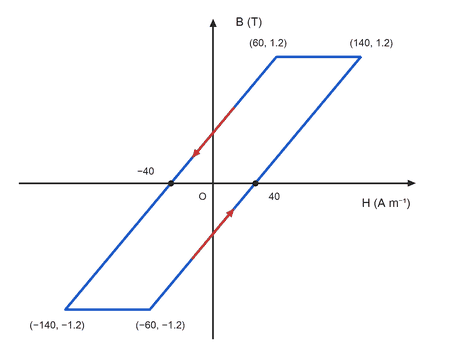
(a) Write down the coercivity of the steel, and find its retentivity (the value of when on the way down from saturation).
(b) Find the energy dissipated as heat per cubic metre of the core in one cycle.
(c) A carbon steel gives a loop of the same height and the same parallelogram shape, but its coercivity is . How many times greater is its loss per cycle?
- 371 mark
Question 37
The area enclosed by the – hysteresis loop of a ferromagnetic specimen ( in tesla, in ) is measured in
- 383 marks
Question 38
A steel screwdriver has become magnetised. It is placed inside a coil carrying an alternating current, and the current is then reduced slowly and smoothly to zero. The screwdriver is found to be demagnetised. Using hysteresis loops, explain
(a) why switching off a steady (d.c.) current in the coil would have left the screwdriver magnetised,
(b) why slowly reducing the alternating current demagnetises it.
- 391 mark
Question 39
The core of a transformer working on a supply produces of heat by hysteresis in one hour. The same transformer is used on a supply, the core being taken round the same hysteresis loop. The heat produced by hysteresis in one hour is now
- 401 mark
Question 40
A ferromagnetic specimen is taken through a complete cycle of magnetisation and its – loop is drawn with along the -axis and along the -axis. In which sense is the loop traced, and why?
- 413 marks
Question 41
A ring of carbon steel is wound with a magnetising coil. When the steel is saturated with . When is then reduced to zero, falls to . (Hypothetical data.) Find
(a) the magnetisation at saturation,
(b) the magnetisation left when ,
(c) the percentage of the saturation magnetisation that the steel retains.
()
- 421 mark
Question 42
An engineer wants to reduce the energy lost by hysteresis in the core of a transformer. Which change will do this?
- 431 mark
Question 43
The table gives the retentivity and coercivity of four magnetic materials. (Hypothetical data.)
Material (T) () P 1.4 50 Q 0.05 30 R 0.6 900 S 1.2 Which material is best for making a permanent magnet?
- 443 marks
Question 44
The coil of an electromagnet has turns, a resistance of and carries . The magnetic field in its core must be doubled. The core is far from saturation, so its permeability may be taken as constant. Two plans are suggested:
Plan P: keep the same coil and double the current.
Plan Q: rewind the same length of core with turns of the same wire (so the resistance doubles) and keep the current at .
(Hypothetical data.)
(a) Find the power wasted as heat in the coil at present.
(b) Show that both plans double the field, and find the power wasted in each.
(c) Which plan would you choose, and why?
- 451 mark
Question 45
An electromagnet has turns and carries a current of . It is rewound with turns over the same length of the same core, and the current is reduced to . Assuming the core is far from saturation (constant permeability), the magnetic field in the core becomes
- 462 marks
Question 46
At a recycling plant, iron and steel cans are lifted out of mixed waste by a crane magnet and dropped into a separate bin.
(a) Give two reasons why an electromagnet, and not a permanent magnet, is used on the crane.
(b) A small cupboard door, on the other hand, is held shut by a permanent magnet catch. Why is an electromagnet not used there?
- 471 mark
Question 47
Flexible magnetic strips, such as those that seal refrigerator doors, can be bent into any shape. They are made by
- 483 marks
Question 48
Choose the most suitable material from soft iron, silicon (transformer) steel and cobalt steel for each of the following, giving one reason in each case:
(a) the core of a mains transformer,
(b) the core of the electromagnet in an electric bell,
(c) the permanent magnet of a moving-coil galvanometer.
- 491 mark
Question 49
What will happen to a bismuth cylinder if it is suspended in a strong magnetic field? Why?
- 501 mark
Question 50
Why does a paramagnetic sample display greater magnetisation (for the same magnetising field) when cooled?
- 511 mark
Question 51
Would the maximum possible magnetisation of a paramagnetic sample be of the same order of magnitude as the magnetisation of a ferromagnet?
- 521 mark
Question 52
Alnico is preferred for making permanent magnet. Why?
- 531 mark
Question 53
What are lines of magnetic intensity?
- 541 mark
Question 54
What are lines of magnetisation and lines of induction?
- 551 mark
Question 55
When a ferromagnetic material is placed in a magnetic field, the flux density inside the material is greater than that outside. Why?
- 561 mark
Question 56
State Curie's law.
- 571 mark
Question 57
What is the general formula of the material used in the cores of transformers?
- 581 mark
Question 58
Why is diamagnetism, almost independent of temperature?
- 591 mark
Question 59
If a toroid uses bismuth for its core, will the field in the core be (slightly) greater or (slightly) less than when the core is empty?
- 601 mark
Question 60
Is the permeability of a ferromagnetic material independent of the magnetic field?
- 611 mark
Question 61
The hysteresis loop of a soft iron piece has a much smaller area than that of a carbon steel piece. If the material is to go through repeated cycles of magnetisation, which piece will dissipate greater heat?
- 621 mark
Question 62
What kind of ferromagnetic material is used for coating magnetic tapes in a cassette player or for building memory stores in a modern computer?
- 631 mark
Question 63
A certain region of space is to be shielded from magnetic fields. Suggest a method.
- 641 mark
Question 64
An iron bar magnet is heated to 1000°C and then cooled in a magnetic field free space. Will it retain magnetism?
- 653 marks
Question 65
A magnetised needle of magnetic moment is placed 30° with the direction of uniform magnetic field of magnitude . Calculate the torque acting on the needle
- 663 marks
Question 66
A compass needle whose magnetic moment is is pointing geographical north at a certain place, where the horizontal component of Earth's magnetic field is , experience a torque . What is the declination of the place?
- 673 marks
Question 67
A bar placed in a uniform magnetic field of strength 0.3 T with its axis at 30° to the field, experiences a torque of 0.06 N m. What is the magnetic moment of the bar magnet?
- 683 marks
Question 68
A needle made of bismuth is suspended freely in a magnetic field. What is the angle which the needle makes with the magnetic field? Why?
- 693 marks
Question 69
The susceptibility of a paramagnetic substance placed in a magnetic field of is . Calculate the intensity of magnetism.
- 702 marks
Question 70
How can paramagnetic and diamagnetic materials be distinguished by studying their behaviour in a magnetic field?
- 711 mark
Question 71
What is the S.I. unit of permeability?
- 721 mark
Question 72
Define magnetic permeability.
- 732 marks
Question 73
How does the magnetic permeability differ for dia, para and ferromagnetic materials?
- 742 marks
Question 74
State how the magnetic susceptibility of a ferromagnetic material changes when it is heated.
- 751 mark
Question 75
The relative permeability is represented by and the susceptibility is denoted by for a magnetic substance. Then for a paramagnetic substance,
- 761 mark
Question 76
A small rod of bismuth is suspended freely between the poles of a strong electromagnet. It is found to arrange itself at right angles to the magnetic field. This observation establishes that bismuth is
- 771 mark
Question 77
A diamagnetic material in a magnetic field moves
- 781 mark
Question 78
The magnetic susceptibility is negative for
- 791 mark
Question 79
Curie's law can be written as
- 801 mark
Question 80
A superconductor exhibits perfect
- 811 mark
Question 81
Curie's temperature is the temperature above which
- 821 mark
Question 82
The material suitable for making electromagnet should have
- 831 mark
Question 83
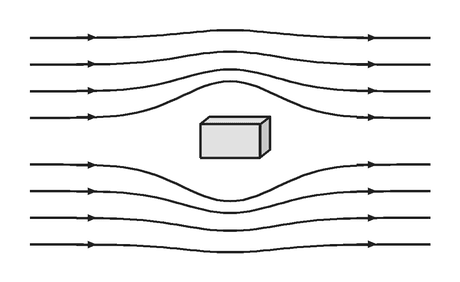
The given figure represents material which is
- 841 mark
Question 84
A bar magnet has coercivity . It is desired to demagnetise it by inserting it inside a solenoid cm long and having turns. The current that should be sent through the solenoid is
- 851 mark
Question 85
A bar magnet is demagnetised by inserting it inside a solenoid of length m, turns and carrying a current of A. The coercivity of the bar magnet is
- 861 mark
Question 86
A thin diamagnetic rod is placed vertically between the poles of an electromagnet. When the current in the electromagnet is switched on, then the diamagnetic rod is pushed up, out of the horizontal magnetic field. Hence the rod gains gravitational potential energy. The work required to do this comes from
- 871 mark
Question 87
A paramagnetic substance in the form of a cube with sides cm has a magnetic dipole moment of J/T when a magnetic intensity of A/m is applied. Its magnetic susceptibility is
- 881 mark
Question 88
A paramagnetic material has atoms/m³. Its magnetic susceptibility at temperature K is . Its susceptibility at K is
- 891 mark
Question 89
The given figure gives experimentally measured vs variation in a ferromagnetic material. The retentivity, coercivity and saturation, respectively, of the material are

- 901 mark
Question 90
Magnetic materials used for making permanent magnets (P) and magnets in a transformer (T) have different properties. Of the following, which property matches for the type of magnet required?
- 911 mark
Question 91
A perfectly diamagnetic sphere has a small spherical cavity at its centre, which is filled with a paramagnetic substance P as shown in the given figure. The whole system is placed in a uniform magnetic field . Then the field inside the paramagnetic substance is

- 921 mark
Question 92
A paramagnetic sample shows a net magnetisation of A/m when it is placed in an external magnetic field of T at a temperature of K. When the sample is placed in an external magnetic field of T, at a temperature of K, then the magnetisation will be
- 931 mark
Question 93
An iron rod of susceptibility is subjected to a magnetising field of . The permeability of the material of the rod is ()
- 941 mark
Question 94
A soft ferromagnetic material is placed in an external magnetic field. The magnetic domains
- 951 mark
Question 95
The magnetic susceptibility of a material of a rod is . Permeability in vacuum is H/m. Absolute permeability of the material of the rod is