
Opening your dashboard
Class 12 Maths Chapter 25 Bayes' Theorem and Probability Distribution: Practice Questions
81 questions on Chapter 25, each worked through on its own page with the AI tutor. Class 12 Maths, ICSE 2026-27.
81 questions
1–4 marks · Mixed difficulty
- 11 mark
Question 1
Before a cricket match, the two captains toss a fair coin. From past records, a certain team wins a match with probability when it wins the toss and with probability when it loses the toss. (Hypothetical data.) The probability that this team wins its next match is
- 21 mark
Question 2
, , form a partition of a sample space with , , . For an event , , and . Then is
- 31 mark
Question 3
An online store finds that of its orders are paid by UPI, by card and by cash on delivery. The fractions of these orders that are later returned are , and respectively. (Hypothetical data.) The probability that an order chosen at random is returned is
- 43 marks
Question 4
In a school football penalty shoot-out, a striker aims to the left, to the right or at the centre of the goal with probabilities , and respectively. Independently of the striker, the goalkeeper always dives, to the left or to the right with probability each. If the keeper dives to the same side as the shot, the keeper saves it with probability ; if the keeper dives to the wrong side, or the shot is at the centre, it is a goal. Assume every shot is on target. (Hypothetical data.)
Find the probability that a penalty is a goal.
- 53 marks
Question 5
At a school fair, sealed envelopes are kept in a box; of them contain a gift voucher. Students come one at a time, and each takes one envelope at random and keeps it.
(i) Using the theorem of total probability, find the probability that the second student gets a voucher.
(ii) Is the second student at a disadvantage compared with the first? Give a reason.
- 63 marks
Question 6
(i) form a partition of a sample space with for each , and is any event. Let and be the smallest and the largest of the numbers . Prove that .
(ii) A school has three sections whose pass rates in a test were , and , but the number of students in each section is not known. A student is chosen at random from the whole school. Using part (i), decide whether the probability that this student passed can be , and whether it can be .
- 72 marks
Question 7
A shop has rooftop solar panels. On a sunny day the panels meet the shop's full electricity load with probability ; on a cloudy day, with probability . In a certain month, of the days are sunny and the rest are cloudy. (Hypothetical data.) Find the probability that on a day chosen at random from that month the panels meet the full load.
- 83 marks
Question 8
The tree diagram shows the events , , , which form a partition of a sample space, and an event with its complement . The letters , and stand for unknown probabilities.
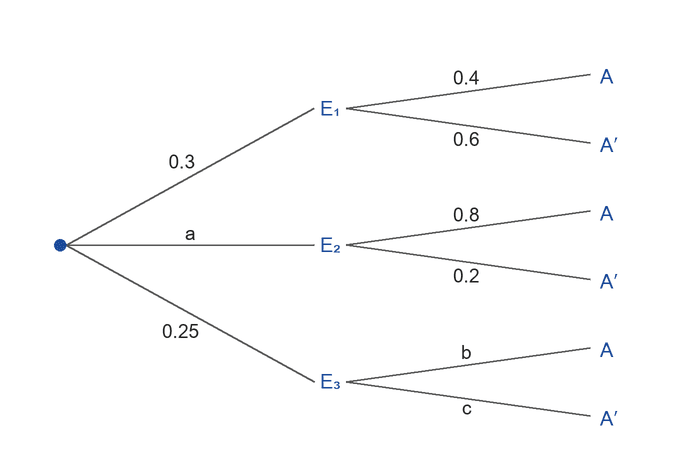
It is given that .
(i) Find .
(ii) Find and .
(iii) Find .
- 94 marks
Question 9
An integer is chosen at random from . Then an integer is chosen at random from .
(i) Find the probability that .
(ii) Find the probability that is even.
- 101 mark
Question 10
In a hill town, it rains on of the days in a season. A weather app forecasts rain on of the days on which it actually rains, and also on of the days on which it does not rain. (Hypothetical data.) On a day for which the app forecasts rain, the probability that it actually rains is
- 114 marks
Question 11
In a certain mailbox, of incoming e-mails are spam. A filter moves of spam e-mails to the spam folder, but it also wrongly moves of genuine e-mails there. Every other e-mail stays in the inbox. (Hypothetical data.)
(i) An e-mail picked at random from the spam folder is examined. Find the probability that it is genuine.
(ii) An e-mail picked at random from the inbox is examined. Find the probability that it is spam.
- 121 mark
Question 12
Assume that one-third of all twin pairs are identical and the rest are fraternal. Identical twins are always of the same sex, both girls or both boys with probability each. For fraternal twins, each child is a girl or a boy with probability , independently of the other. A twin pair is known to be two girls. The probability that the twins are identical is
- 131 mark
Question 13
and are mutually exclusive and exhaustive events, and is an event with and . If , then is
- 142 marks
Question 14
form a partition of a sample space, each with positive probability, and is an event such that , where . Show that for every , and state what this means about the event .
- 154 marks
Question 15
A shop sends its parcels through three courier companies , and , which carry , and of the parcels respectively. The fractions of parcels delivered late by , and are , and respectively. (Hypothetical data.)
(i) A customer complains that a parcel arrived late. Find, for each company, the probability that it carried the parcel, and state which company or companies are most likely to have carried it.
(ii) A parcel is known to have arrived on time. Find the probability that it was carried by .
- 161 mark
Question 16
, , form a partition of a sample space with , , . For an event , . Then is
- 173 marks
Question 17
A transmitter sends the digit with probability and the digit with probability . Because of noise, a that is sent is received as with probability , and a that is sent is received as with probability . (Hypothetical data.)
(i) Find the probability that a is received.
(ii) If a is received, find the probability that a was sent.
- 184 marks
Question 18
A coach is unsure whether a new basketball player is a "strong" shooter, who scores each free throw with probability , or an "average" shooter, who scores each free throw with probability . Before watching, the coach thinks the two are equally likely. Free throws are independent. The player then scores on all of the first free throws.
(i) Find the probability that the player is a strong shooter.
(ii) Find the probability that the player scores on the th free throw as well.
- 191 mark
Question 19
Raju thinks his phone is in his school bag with probability and left behind in the classroom with probability . If the phone is in the bag, a search of the bag finds it with probability . He searches the bag and does not find the phone. The probability that the phone is in the classroom is
- 201 mark
Question 20
and are mutually exclusive and exhaustive events with . For an event , and . Then is
- 213 marks
Question 21
A fruit seller buys all of the stall's mangoes from two orchards, and . Of the mangoes from , are sweet; of those from , are sweet. Altogether, of the seller's mangoes are sweet. (Hypothetical data.)
(i) What fraction of the seller's mangoes come from orchard ?
(ii) A mango bought at random turns out not to be sweet. Find the probability that it came from orchard .
- 221 mark
Question 22
On a music app, of the songs played for a user come from the user's liked list. The user skips of the liked songs and of the other songs. (Hypothetical data.) A song is skipped. The probability that it came from the liked list is
- 234 marks
Question 23
At a school fair game there are three closed boxes, numbered , , , and a prize is placed in one of them at random. Riya chooses box . The organiser, who knows where the prize is, then opens one of the other two boxes that is empty; if both of them are empty, the organiser chooses between them at random. The organiser opens box .
(i) Find the probability that the organiser opens box .
(ii) Given that the organiser opened box , find the probability that the prize is in box and the probability that it is in box .
(iii) Riya may now keep box or switch to box . Which should she do? Give a reason.
- 244 marks
Question 24
Mohan rolls a fair die once and then tosses a fair coin as many times as the number shown on the die.
(i) Find the probability that he gets exactly one head.
(ii) Given that he got exactly one head, find the probability that the die showed . Which number(s) on the die are then the most likely?
- 253 marks
Question 25
(i) and are mutually exclusive and exhaustive events with positive probabilities, and is an event with and . Use Bayes' theorem to show that
(ii) Before an observation, and are in the ratio . The event is times as likely under as under . Find .
- 261 mark
Question 26
Two fair spinners are spun together. Each spinner shows one of the numbers , , , all three equally likely. Let be the product of the two numbers shown. Then is
- 271 mark
Question 27
Three people enter a lift on the ground floor of a building that has a first and a second floor above it. Each of them gets out at the first floor or at the second floor, each floor equally likely, independently of the others. Let be the number of floors at which the lift stops to let someone out. Then is
- 281 mark
Question 28
A caretaker has similar-looking keys, and exactly one of them opens the store-room lock. The caretaker tries the keys one by one in random order, keeping aside each key that fails. Let be the number of keys the caretaker tries up to and including the one that opens the lock. Then is
- 291 mark
Question 29
A random variable takes the values with
where is a constant. The value of is
- 301 mark
Question 30
The table below is the probability distribution of a random variable , where is a constant.
0 1 2 The set of all possible values of is
- 311 mark
Question 31
A random variable takes only the values , and its distribution is symmetric about , that is, for every . If and , then is
- 322 marks
Question 32
Riya and Kabir walk into a room with chairs in a row and sit on two of them, every pair of chairs being equally likely. Let be the number of empty chairs between them.
(i) Find the probability distribution of .
(ii) Find the probability that they do not sit next to each other.
- 332 marks
Question 33
At a school fete, a prize wheel is divided into four sectors whose angles at the centre are , , and . Landing on them wins ₹0, ₹10, ₹20 and ₹50 respectively. The wheel is spun once and is equally likely to stop at any angle. Let be the prize (in ₹).
(i) Find the probability distribution of .
(ii) Find the probability of winning at least ₹20.
- 343 marks
Question 34
Aanya practises basketball free throws. Each throw scores with probability , independently of the others. She stops as soon as she scores, or after throws, whichever comes first. Let be the number of throws she takes.
(i) Find the probability distribution of .
(ii) Find the probability that she scores at least once.
- 353 marks
Question 35
For a member chosen at random from a gym, let be the number of days in a week on which the member works out. The table gives (Hypothetical data).
1 2 3 4 5 0.10 0.30 0.65 0.90 1 (i) Find the probability distribution of .
(ii) Find .
(iii) Find .
- 363 marks
Question 36
The probability graph shows the distribution of , the number of books a member of a town library borrows on a visit (Hypothetical data). The bar for has been left out.
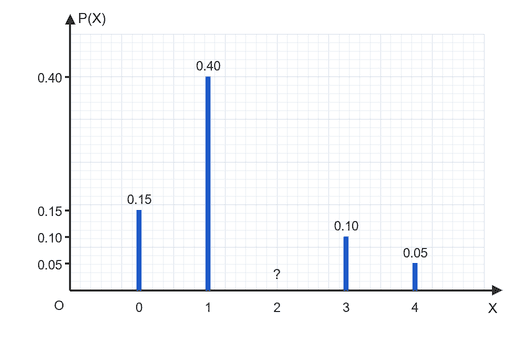
(i) Find .
(ii) Find the probability that a member borrows at least books.
(iii) Given that a member borrows at least one book, find the probability that the member borrows exactly one.
- 373 marks
Question 37
During the monsoon in a hill town, the probability of rain on a Saturday is . If it rains on Saturday, the probability of rain on Sunday is ; if Saturday is dry, the probability of rain on Sunday is . Let be the number of days of that weekend on which it rains.
(i) Find the probability distribution of .
(ii) Find the probability that it rains on at least one of the two days.
- 384 marks
Question 38
A school has three projectors, one in each of three classrooms. On a given morning they are in working order with probabilities , and respectively, independently of one another. Let be the number of projectors in working order that morning.
(i) Find the probability distribution of .
(ii) Find the probability that at least two projectors are in working order.
- 391 mark
Question 39
A junior archer's arrow lands in the zone worth points with probability , the -point zone with probability , the -point zone with probability , and outside all scoring zones ( points) with probability . The expected number of points per arrow is
- 401 mark
Question 40
The table shows the probability distribution of a random variable , whose mean is .
0 1 2 3 0.1 0.3 The value of is
- 411 mark
Question 41
In a board game, a spinner gives a value with the distribution below, and the player then gains points (a negative is a loss).
1 2 3 4 0.2 0.3 0.4 0.1 The expected value of is
- 421 mark
Question 42
The probability graph shows the distribution of , the number of goals a school football team scores in a match (Hypothetical data).
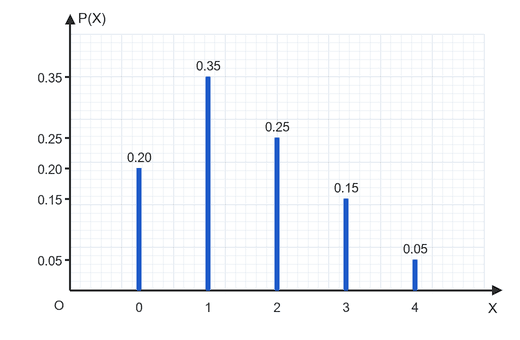
The mean number of goals per match is
- 434 marks
Question 43
In a test, each multiple-choice question has options with exactly one correct. A correct answer earns marks and a wrong answer mark. A student guesses all questions of a section at random, independently. Let be the student's total score for the section.
(i) Find the probability distribution of .
(ii) Find the expected score .
- 444 marks
Question 44
Three friends leave identical-looking tiffin boxes at the school canteen. The canteen helper hands the three boxes back to them at random, one box each. Let be the number of friends who get back their own box.
(i) Find the probability distribution of .
(ii) Explain why can never be .
(iii) Find the mean of .
- 453 marks
Question 45
A company sells a one-year protection plan for a mobile phone. If the phone is damaged during the year (probability ), the company pays ₹15,000; otherwise it pays nothing (Hypothetical data).
(i) Find the company's expected payout per plan.
(ii) What should the price of the plan be so that the company's expected profit per plan is ₹200?
(iii) At that price, find the expected profit per plan if the probability of damage rises to .
- 463 marks
Question 46
Meher can drive to work by the main road or by the bypass. Her travel times (in minutes) have the following distributions (Hypothetical data).
Main road: time 20 30 45 Probability 0.5 0.3 0.2 Bypass: time 25 35 Probability 0.8 0.2 (i) Find the expected travel time by each route.
(ii) Which route is quicker on average, and by how much?
(iii) By which route is she more likely to reach within minutes?
- 473 marks
Question 47
To save testing kits, a laboratory mixes the blood samples of two people and tests the mixture once. If the mixture tests negative, both people are clear and only test is used. If it tests positive, each person is then tested separately, so tests are used in all. Each person, independently, has the infection with probability . Assume every test is accurate. Let be the number of tests used for a pair.
(i) Find the probability distribution of and its mean.
(ii) Find the expected number of tests needed for people (in pairs), and compare it with testing everyone separately.
- 484 marks
Question 48
A bakery makes fresh cream cakes every morning at a cost of ₹250 each and sells them at ₹400 each. Cakes not sold by closing time are thrown away. The daily demand has the distribution below (Hypothetical data).
Demand 1 2 3 0.2 0.5 0.3 (i) Find the expected daily profit if the bakery makes cakes a day.
(ii) Find the expected daily profit if it makes cakes a day.
(iii) Which of the two is the better choice?
- 493 marks
Question 49
A random variable takes the values with , where is a constant.
(i) Show that and that .
(ii) Hence find if .
- 503 marks
Question 50
From past results, a student's grade point in a unit test has the distribution below, where is a constant (Hypothetical data).
Grade point 10 8 6 0 0.5 0.1 (i) Find the possible values of , and write in terms of .
(ii) Find the least value of for which .
(iii) Find the greatest possible value of .
- 512 marks
Question 51
The random variable has a probability distribution of the following form, where '' is some number
Determine the value of ''.
- 521 mark
Question 52
State whether the following statement is True or False.
Another name for the mean of a probability distribution is expected value.
- 531 mark
Question 53
State whether the following statement is True or False.
The probability distribution of a random variable is given as under:
where is a constant. The value of is .
- 541 mark
Question 54
State whether the following statement is True or False.
The following is a probability distribution of a random variable.
0 1 2 0.4 0.4 0.2 - 551 mark
Question 55
State whether the following statement is True or False.
The following is a probability distribution for a random variable. If false, give reason.
0 1 2 3 4 0.1 0.5 0.2 0.3 - 561 mark
Question 56
State whether the following statement is True or False.
A contractor has to construct a house. The probability that the labour may go on strike is 0.65. If there is no strike, the probability that the construction may be completed on time is 0.80. The probability that the construction will be completed on time if there is a strike is 0.32. The probability that the construction will be completed on time is 0.599.
- 571 mark
Question 57
In the following question, a statement of Assertion (A) is followed by a statement of Reason (R). Choose your correct option.
Assertion: A shopkeeper sells three types of flower seeds , , . They are sold in the form of a mixture where the proportion of these seeds are 4 : 4 : 2 respectively. The germination ratio of the three types of seeds are 45%, 60% and 35% respectively. The probability that a randomly chosen seed will germinate is .
Reason: For any two events and , .
- 581 mark
Question 58
In the following question, a statement of Assertion (A) is followed by a statement of Reason (R). Choose your correct option.
Assertion: Probability that speaks truth is . A coin is tossed. reports that a head appears. The probability actually, there was a head is .
Reason: If is the sample space and and are mutually exclusive and exhaustive events associated with a random experiment and if is any event which occurs with , then
- 591 mark
Question 59
In the following question, a statement of Assertion (A) is followed by a statement of Reason (R). Choose your correct option.
Assertion: Let denote the number of hours a student studies at home on a particular day.
The value of .
Reason: For a discrete random variable taking values with probabilities , and .
- 601 mark
Question 60
In the following question, a statement of Assertion (A) is followed by a statement of Reason (R). Choose your correct option.
Assertion: Let be the sample space and let and be two mutually exclusive and exhaustive events associated with a random experiment. If is an event associated which occurs with or , then .
Reason: If a random variable can take infinitely many values, then it is called discrete variable.
- 611 mark
Question 61
A pandemic has been spreading all over the world. The probabilities are 0.7 that there will be a lockdown, 0.8 that the pandemic is controlled in one month if there is a lockdown and 0.3 that it is controlled in one month if there is no lockdown. The probability that the pandemic will be controlled in one month is:
- 621 mark
Question 62
A person is known to speak the truth in 3 out of 4 occasions. If he throws a die and reports that it is six, then the probability that it is actually six is
- 631 mark
Question 63
A pack of cards has one card missing. Two cards are drawn randomly and are found to be spades. The probability that the missing card is not a spade is
- 641 mark
Question 64
Meera visits only one of the two temples and in her locality. Probability that she visits temple is . If she visits temple , is the probability that she meets her friend, whereas it is if she visits temple . Meera met her friend at one of the two temples. The probability that she met her at temple is:
- 651 mark
Question 65
If three balls are drawn one by one without replacement from a bag containing 5 white and 4 red balls, then the probability distribution of the number of white balls drawn is:
- 661 mark
Question 66
There are two bags, Bag-1 contains 4 white and 6 black balls and Bag-2 contains 5 white and 5 black balls. A die is rolled, if it shows a number divisible by 3, a ball is drawn from Bag-1, else a ball is drawn from Bag-2. If the ball drawn is not black in colour, the probability that it was not drawn from Bag-2 is
- 671 mark
Question 67
Suppose that there is a chance for a newly constructed building to collapse, whether the design is faulty or not. The chance that the design is faulty is 10%. The chance that the building collapses is 95% if the design is faulty, otherwise it is 45%. If it is seen that the building has collapsed, then what is the probability that it is due to faulty design?
- 681 mark
Question 68
An observed event can occur after one of the three events , , . If , and , , , what is the probability of after observing ?
- 691 mark
Question 69
Let be a discrete random variable. The probability distribution of is given below:
30 10 Then will be:
- 701 mark
Question 70
The probability distribution of a random variable is:
0 1 2 3 4 0.1 0.1 where is some unknown constant. The probability that the random variable takes the value 2 is:
- 711 mark
Question 71
A random variable has the following probability distribution:
0 1 2 3 4 5 6 7 0 The value of is equal to:
- 721 mark
Question 72
The probability distribution of random variable with two missing probabilities and is given below:
1 2 3 4 5 It is further given that and . Consider the following statements:
(1) (2)
Which of the statements given above is/are correct?
- 731 mark
Question 73
A and B are two students. Their chances of solving a problem correctly are and , respectively. If the probability of their making a common error is and they obtain the same answer, then the probability of their answer to be correct, is:
- 741 mark
Question 74
Bag I contains 3 red, 4 black and 3 white balls. Bag II contains 2 red, 5 black and 2 white balls. A ball is transferred from Bag I to Bag II and then a ball is drawn from Bag II. The ball so drawn is to be found to be black in colour. Then the probability that the transferred ball is red, is:
- 751 mark
Question 75
Events and form a partition of the sample space , is any event such that , and , then is
- 761 mark
Question 76
An urn contains 5 red and 2 green balls. A ball is drawn at random from the urn. If the drawn ball is green, then a red ball is added to the urn and if the drawn ball is red, then a green ball is added to the urn. The original ball is not returned to the urn. Now a second ball is drawn at random from it. The probability that the second ball is red, is:
- 771 mark
Question 77
In a chess tournament, assume that your probability of winning a game is 0.3 against level 1 players, 0.4 against level 2 players and 0.5 against level 3 players. It is further assumed that among the players, 50% are at level 1, 25% are at level 2 and the remaining are at level 3. Suppose that you win the game. Then the probability that you had played with level 1 player is
- 781 mark
Question 78
A man speaks truth 2 out of 3 times. He picks one of the natural numbers in the set and reports that it is even. The probability that it is actually even, is:
- 791 mark
Question 79
There are two coins, one unbiased with probability of getting heads and the other one is biased with probability of getting heads. A coin is selected at random and tossed. It shows heads up. The probability that the unbiased coin was selected is
- 801 mark
Question 80
In a group of 400 people, 160 are smokers and non-vegetarian; 100 are smokers and vegetarian and the remaining 140 are non-smokers and vegetarian. Their chance of getting a particular chest disorder are 35%, 20% and 10% respectively. A person is chosen from the group at random and is found to be suffering from the chest disorder. The probability that the selected person is a smoker and non-vegetarian is:
- 811 mark
Question 81
By Bayes' theorem, which one of the following probabilities is calculated?