Confirming your payment

Skip to content

Sign up now and get .

Opening your dashboard

Class 12 Maths Chapter 21 Three-Dimensional Geometry - 2: Straight Line in Space: Practice Questions

50 questions on Chapter 21, each worked through on its own page with the AI tutor. Class 12 Maths, ICSE 2026-27.

50 questions

1–4 marks · Mixed difficulty

  1. 1

    Question 1

    Which of the following points lies on the line x−23=y+1−2=z−45\dfrac{x-2}{3} = \dfrac{y+1}{-2} = \dfrac{z-4}{5}?

    MCQEasy
    1 mark
  2. 2

    Question 2

    The Cartesian equations of the line through the point (2,−1,5)(2, -1, 5) and parallel to the yy-axis are

    MCQEasy
    1 mark
  3. 3

    Question 3

    Which of the following does not represent a straight line in space? (ss and tt are real parameters.)

    MCQEasy
    1 mark
  4. 4

    Question 4

    The direction cosines of the line 3x=2y=−6z3x = 2y = -6z are (up to sign)

    MCQMedium
    1 mark
  5. 5

    Question 5

    A line is given by the two equations x=2y+3x = 2y + 3 and z=4−yz = 4 - y. Write its equations in the symmetric form x−x1a=y−y1b=z−z1c\dfrac{x - x_1}{a} = \dfrac{y - y_1}{b} = \dfrac{z - z_1}{c} and hence its vector equation. Does the point (7,2,2)(7, 2, 2) lie on this line?

    Easy
    2 marks
  6. 6

    Question 6

    Find the points on the line x−21=y+12=z−3−2\dfrac{x-2}{1} = \dfrac{y+1}{2} = \dfrac{z-3}{-2} which are at a distance of 353\sqrt{5} units from the point A(5,2,3)A(5, 2, 3).

    Medium
    3 marks
  7. 7

    Question 7

    The vertices of a triangle are A(1,−2,3)A(1, -2, 3), B(3,4,−1)B(3, 4, -1) and C(−1,0,5)C(-1, 0, 5). Find the Cartesian equations of the median through AA, and verify that the centroid of the triangle lies on it.

    Easy
    3 marks
  8. 8

    Question 8

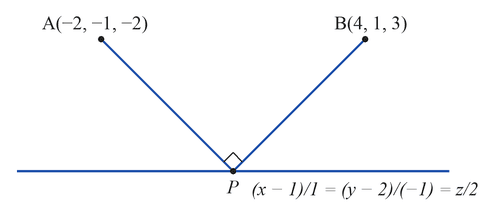
    A(−2,−1,−2)A(-2, -1, -2) and B(4,1,3)B(4, 1, 3) are two points. Find the points PP on the line x−11=y−2−1=z2\dfrac{x-1}{1} = \dfrac{y-2}{-1} = \dfrac{z}{2} for which ∠APB=90∘\angle APB = 90^\circ.

    Class 12 Maths Three-Dimensional Geometry - 2: Straight Line in Space

    Medium
    3 marks
  9. 9

    Question 9

    (Hypothetical data.) In a model of a hill ropeway, the lower station is at the origin O(0,0,0)O(0, 0, 0) and the upper station is at T(600,800,500)T(600, 800, 500), all in metres, with the zz-axis vertical. The cable is taken as a straight line.

    (i) Find the Cartesian equations of the cable line OTOT.

    (ii) Find the length of the cable.

    (iii) Find the coordinates of the cabin when it is 300300 m above the lower station, and its distance along the cable from OO.

    Medium
    3 marks
  10. 10

    Question 10

    For the line r⃗=a⃗+λb⃗\vec{r} = \vec{a} + \lambda\vec{b}, the value λ=2\lambda = 2 gives the point (5,1,7)(5, 1, 7) and the value λ=−1\lambda = -1 gives the point (−1,4,−2)(-1, 4, -2). Then

    MCQMedium
    1 mark
  11. 11

    Question 11

    The line x=3−2tx = 3 - 2t, y=1+ty = 1 + t, z=4tz = 4t (t∈Rt \in R) has the vector equation

    MCQEasy
    1 mark
  12. 12

    Question 12

    PP and QQ are the points of the line r⃗=(i^−2j^+3k^)+λ(2i^−j^+2k^)\vec{r} = (\hat{i} - 2\hat{j} + 3\hat{k}) + \lambda(2\hat{i} - \hat{j} + 2\hat{k}) given by λ=1\lambda = 1 and λ=4\lambda = 4. The distance PQPQ is

    MCQEasy
    1 mark
  13. 13

    Question 13

    (i) Show that r⃗=(1−t)a⃗+tb⃗\vec{r} = (1 - t)\vec{a} + t\vec{b}, t∈Rt \in R, is the line through the points AA and BB with position vectors a⃗\vec{a} and b⃗\vec{b}.

    (ii) For A(1,2,−1)A(1, 2, -1) and B(3,−2,5)B(3, -2, 5), find the point given by t=13t = \dfrac{1}{3} and the ratio in which it divides ABAB.

    (iii) Find the point given by t=−12t = -\dfrac{1}{2} and state where it lies with respect to AA and BB.

    Medium
    3 marks
  14. 14

    Question 14

    (Hypothetical data.) A small particle moves in a straight line with constant velocity. At time t=0t = 0 s it is at A(2,−1,3)A(2, -1, 3) and at t=2t = 2 s it is at B(6,1,7)B(6, 1, 7), coordinates in metres.

    (i) Write the vector equation of its path in the form r⃗=a⃗+tv⃗\vec{r} = \vec{a} + t\vec{v}, with tt in seconds.

    (ii) Find its position at t=5t = 5 s.

    (iii) At what time is it 2121 m from AA, and where is it then?

    Easy
    3 marks
  15. 15

    Question 15

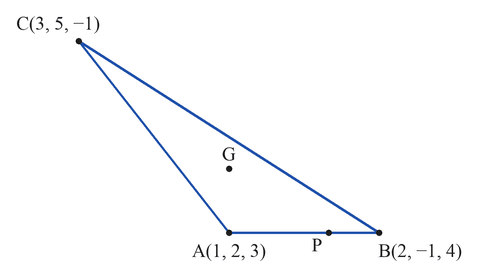
    The vertices of △ABC\triangle ABC are A(1,2,3)A(1, 2, 3), B(2,−1,4)B(2, -1, 4) and C(3,5,−1)C(3, 5, -1).

    Class 12 Maths Three-Dimensional Geometry - 2: Straight Line in Space

    Find the vector and Cartesian equations of the line through the centroid GG parallel to BCBC. Show that this line passes through the point PP of ABAB for which AP:PB=2:1AP : PB = 2 : 1.

    Medium
    3 marks
  16. 16

    Question 16

    Find the vector and Cartesian equations of the image of the line r⃗=(i^+2j^−k^)+λ(2i^−j^+3k^)\vec{r} = (\hat{i} + 2\hat{j} - \hat{k}) + \lambda(2\hat{i} - \hat{j} + 3\hat{k}) in the point P(1,0,2)P(1, 0, 2) (that is, every point QQ of the line is reflected to the point Q′Q' for which PP is the mid-point of QQ′QQ').

    Medium
    3 marks
  17. 17

    Question 17

    (Hypothetical data.) A laser pointer at L(1,2,0)L(1, 2, 0) sends a beam that passes through the point M(3,3,2)M(3, 3, 2) (coordinates in metres). The beam starts at LL and travels only in the direction from LL towards MM.

    (i) Write a vector equation of the beam, stating the values the parameter may take.

    (ii) Three small targets are placed at T(7,5,6)T(7, 5, 6), U(−1,1,−2)U(-1, 1, -2) and V(5,4,3)V(5, 4, 3). Which of them does the beam hit? Give reasons.

    Medium
    3 marks
  18. 18

    Question 18

    The lines x−23=y+1−2=z−46\dfrac{x-2}{3} = \dfrac{y+1}{-2} = \dfrac{z-4}{6} and 5−x3=y−72=z+1−6\dfrac{5-x}{3} = \dfrac{y-7}{2} = \dfrac{z+1}{-6} are

    MCQEasy
    1 mark
  19. 19

    Question 19

    The angle between the lines r⃗=(i^+j^)+λ(i^−j^)\vec{r} = (\hat{i} + \hat{j}) + \lambda(\hat{i} - \hat{j}) and x−11=y0=z+21\dfrac{x-1}{1} = \dfrac{y}{0} = \dfrac{z+2}{1} is

    MCQEasy
    1 mark
  20. 20

    Question 20

    The angle between the lines r⃗=(1+2λ)i^+(2−λ)j^+(3+2λ)k^\vec{r} = (1 + 2\lambda)\hat{i} + (2 - \lambda)\hat{j} + (3 + 2\lambda)\hat{k} and r⃗=(4−μ)i^+2μ j^+(1+2μ)k^\vec{r} = (4 - \mu)\hat{i} + 2\mu\,\hat{j} + (1 + 2\mu)\hat{k} is

    MCQEasy
    1 mark
  21. 21

    Question 21

    For each pair, state whether the lines are parallel, perpendicular or neither. Give a reason.

    (i) x−12=y+2−4=z6\dfrac{x-1}{2} = \dfrac{y+2}{-4} = \dfrac{z}{6} and x−1=y−32=z+1−3\dfrac{x}{-1} = \dfrac{y-3}{2} = \dfrac{z+1}{-3}

    (ii) r⃗=(2i^−k^)+λ(3i^+j^−2k^)\vec{r} = (2\hat{i} - \hat{k}) + \lambda(3\hat{i} + \hat{j} - 2\hat{k}) and r⃗=(i^+j^+k^)+μ(2i^−4j^+k^)\vec{r} = (\hat{i} + \hat{j} + \hat{k}) + \mu(2\hat{i} - 4\hat{j} + \hat{k})

    (iii) x+31=y−11=z−20\dfrac{x+3}{1} = \dfrac{y-1}{1} = \dfrac{z-2}{0} and r⃗=(i^−k^)+t(i^+2j^+2k^)\vec{r} = (\hat{i} - \hat{k}) + t(\hat{i} + 2\hat{j} + 2\hat{k})

    Medium
    3 marks
  22. 22

    Question 22

    A(1,1,0)A(1, 1, 0), B(3,2,2)B(3, 2, 2), C(4,2,1)C(4, 2, 1) and D(2,1,−1)D(2, 1, -1) are the vertices of a quadrilateral ABCDABCD.

    Class 12 Maths Three-Dimensional Geometry - 2: Straight Line in Space

    (i) Show that ABCDABCD is a rectangle.

    (ii) Find the Cartesian equations of the diagonals ACAC and BDBD, and the acute angle between them.

    Medium
    3 marks
  23. 23

    Question 23

    A line L1L_1 makes angles 45∘45^\circ, 60∘60^\circ and 120∘120^\circ with the positive xx-, yy- and zz-axes, and a line L2L_2 makes angles 60∘60^\circ, 60∘60^\circ and 45∘45^\circ with them.

    (i) Verify that such lines can exist.

    (ii) Find the angle between L1L_1 and L2L_2.

    Medium
    3 marks
  24. 24

    Question 24

    Find the values of pp for which the angle between the lines r⃗=(i^+2j^)+λ(i^+j^)\vec{r} = (\hat{i} + 2\hat{j}) + \lambda(\hat{i} + \hat{j}) and r⃗=(2i^−j^+k^)+μ(i^+pk^)\vec{r} = (2\hat{i} - \hat{j} + \hat{k}) + \mu(\hat{i} + p\hat{k}) is π3\dfrac{\pi}{3}.

    Medium
    3 marks
  25. 25

    Question 25

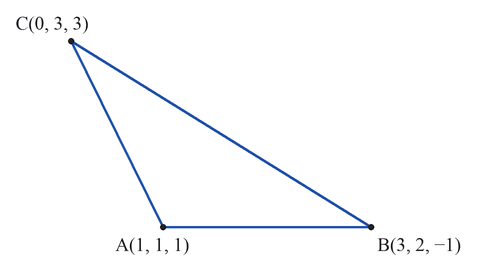
    The vertices of △ABC\triangle ABC are A(1,1,1)A(1, 1, 1), B(3,2,−1)B(3, 2, -1) and C(0,3,3)C(0, 3, 3).

    Class 12 Maths Three-Dimensional Geometry - 2: Straight Line in Space

    (i) Write the vector equations of the lines ABAB and ACAC.

    (ii) Find the angle between the lines ABAB and ACAC.

    (iii) Find ∠BAC\angle BAC of the triangle, and explain why it is not the same as the answer to (ii).

    Medium
    4 marks
  26. 26

    Question 26

    Two non-parallel lines are r⃗=a⃗1+λb⃗1\vec{r} = \vec{a}_1 + \lambda\vec{b}_1 and r⃗=a⃗2+μb⃗2\vec{r} = \vec{a}_2 + \mu\vec{b}_2. They intersect if and only if

    MCQEasy
    1 mark
  27. 27

    Question 27

    The lines x−12=y+2−1=z−33\dfrac{x - 1}{2} = \dfrac{y + 2}{-1} = \dfrac{z - 3}{3} and x−5−4=y+42=z−9−6\dfrac{x - 5}{-4} = \dfrac{y + 4}{2} = \dfrac{z - 9}{-6} are

    MCQEasy
    1 mark
  28. 28

    Question 28

    The lines x−12=y+13=z−14\dfrac{x - 1}{2} = \dfrac{y + 1}{3} = \dfrac{z - 1}{4} and x−31=y−k2=z−71\dfrac{x - 3}{1} = \dfrac{y - k}{2} = \dfrac{z - 7}{1} intersect. The value of kk is

    MCQEasy
    1 mark
  29. 29

    Question 29

    The line x−22=y+3−3=z−14\dfrac{x - 2}{2} = \dfrac{y + 3}{-3} = \dfrac{z - 1}{4} meets the zz-axis at the point

    MCQEasy
    1 mark
  30. 30

    Question 30

    The lines x−1k=y−22=z−33\dfrac{x - 1}{k} = \dfrac{y - 2}{2} = \dfrac{z - 3}{3} and x−23=y−3k=z−12\dfrac{x - 2}{3} = \dfrac{y - 3}{k} = \dfrac{z - 1}{2} are coplanar when kk equals

    MCQMedium
    1 mark
  31. 31

    Question 31

    a⃗\vec{a} and b⃗\vec{b} are two non-zero, non-parallel vectors. Prove that the lines r⃗=a⃗+λb⃗\vec{r} = \vec{a} + \lambda\vec{b} and r⃗=b⃗+μa⃗\vec{r} = \vec{b} + \mu\vec{a} are coplanar.

    Medium
    2 marks
  32. 32

    Question 32

    Find the value of pp for which the lines r⃗=(i^−j^+pk^)+λ(i^+2j^−k^)\vec{r} = (\hat{i} - \hat{j} + p\hat{k}) + \lambda(\hat{i} + 2\hat{j} - \hat{k}) and r⃗=(i^+2j^+k^)+μ(2i^+j^+k^)\vec{r} = (\hat{i} + 2\hat{j} + \hat{k}) + \mu(2\hat{i} + \hat{j} + \hat{k}) intersect. For this value, find their point of intersection.

    Medium
    4 marks
  33. 33

    Question 33

    The points are A(1,2,0)A(1, 2, 0), B(3,3,1)B(3, 3, 1), C(0,1,2)C(0, 1, 2) and D(2,−1,3)D(2, -1, 3). Show that the lines ABAB and CDCD are skew, and hence that the four points AA, BB, CC, DD do not lie in one plane.

    Medium
    3 marks
  34. 34

    Question 34

    Show that the three lines

    x1=y−11=z−21,x−52=y−1=z−51,x1=y+13=z−5−2\dfrac{x}{1} = \dfrac{y - 1}{1} = \dfrac{z - 2}{1}, \qquad \dfrac{x - 5}{2} = \dfrac{y}{-1} = \dfrac{z - 5}{1}, \qquad \dfrac{x}{1} = \dfrac{y + 1}{3} = \dfrac{z - 5}{-2}

    pass through one common point, and find that point.

    Medium
    3 marks
  35. 35

    Question 35

    A(−1,3,−1)A(-1, 3, -1), B(4,−2,9)B(4, -2, 9), C(3,5,1)C(3, 5, 1) and D(0,−1,4)D(0, -1, 4) are four points. Show that the lines ABAB and CDCD intersect at a point XX. Find XX and the ratios in which XX divides the segments ABAB and CDCD.

    Medium
    4 marks
  36. 36

    Question 36

    Show that the lines x−21=y+12=z−3−1\dfrac{x - 2}{1} = \dfrac{y + 1}{2} = \dfrac{z - 3}{-1} and x−12=y−2−1=z−11\dfrac{x - 1}{2} = \dfrac{y - 2}{-1} = \dfrac{z - 1}{1} intersect at a point PP. Find the equations of the line through PP that bisects the acute angle between the two lines.

    Medium
    4 marks
  37. 37

    Question 37

    Find the equations of the line which is parallel to the vector i^−3k^\hat{i} - 3\hat{k} and intersects both the lines x−11=y1=z+11\dfrac{x - 1}{1} = \dfrac{y}{1} = \dfrac{z + 1}{1} and x1=y−2−1=z−12\dfrac{x}{1} = \dfrac{y - 2}{-1} = \dfrac{z - 1}{2}.

    Medium
    4 marks
  38. 38

    Question 38

    The shortest distance between the xx-axis and the line x=1x = 1, y−23=z+14\dfrac{y - 2}{3} = \dfrac{z + 1}{4} is

    MCQEasy
    1 mark
  39. 39

    Question 39

    Lines L1:x−12=y+11, z=3L_1 : \dfrac{x - 1}{2} = \dfrac{y + 1}{1},\ z = 3 and L2:x+21=y−4−3, z=−1L_2 : \dfrac{x + 2}{1} = \dfrac{y - 4}{-3},\ z = -1 are given. The shortest distance between L1L_1 and L2L_2 is

    MCQEasy
    1 mark
  40. 40

    Question 40

    A cube of side 22 units has one vertex at the origin OO and three edges along the positive coordinate axes. P(2,2,2)P(2, 2, 2) is the opposite vertex, and ABAB is the edge from A(2,0,0)A(2, 0, 0) to B(2,0,2)B(2, 0, 2). The shortest distance between the lines OPOP and ABAB is

    MCQMedium
    1 mark
  41. 41

    Question 41

    Which of the following pairs of lines is a pair of skew lines?

    MCQMedium
    1 mark
  42. 42

    Question 42

    The distance between the parallel lines r⃗=a⃗1+λb⃗\vec{r} = \vec{a}_1 + \lambda\vec{b} and r⃗=a⃗2+μb⃗\vec{r} = \vec{a}_2 + \mu\vec{b} is

    MCQEasy
    1 mark
  43. 43

    Question 43

    A(1,0,0)A(1, 0, 0), B(0,1,0)B(0, 1, 0), C(0,0,1)C(0, 0, 1) and D(1,1,1)D(1, 1, 1) are the vertices of a tetrahedron. Find the shortest distance between the opposite edges ABAB and CDCD, and show that these edges are perpendicular.

    Medium
    3 marks
  44. 44

    Question 44

    Find the values of kk for which the shortest distance between the lines x−12=y+12=z−21\dfrac{x - 1}{2} = \dfrac{y + 1}{2} = \dfrac{z - 2}{1} and x−k3=y−12=z+12\dfrac{x - k}{3} = \dfrac{y - 1}{2} = \dfrac{z + 1}{2} is 22 units.

    Medium
    3 marks
  45. 45

    Question 45

    In a factory, two long straight pipes are fixed in space. Taking a corner of the hall as origin and the unit of length as 11 m, one pipe runs along the line r⃗=(i^+2k^)+λ(2i^+3j^+2k^)\vec{r} = (\hat{i} + 2\hat{k}) + \lambda(2\hat{i} + 3\hat{j} + 2\hat{k}) and the other along r⃗=(4i^+j^+7k^)+μ(i^+2j^+2k^)\vec{r} = (4\hat{i} + \hat{j} + 7\hat{k}) + \mu(\hat{i} + 2\hat{j} + 2\hat{k}). Treating the pipes as lines, find the length of the shortest straight pipe that can connect them. (Hypothetical data.)

    Medium
    3 marks
  46. 46

    Question 46

    Show that the lines x−12=y+1−2=z−21\dfrac{x - 1}{2} = \dfrac{y + 1}{-2} = \dfrac{z - 2}{1} and x−3−4=y−54=z+2−2\dfrac{x - 3}{-4} = \dfrac{y - 5}{4} = \dfrac{z + 2}{-2} are parallel. Find the distance between them, and the equations of the line that is parallel to both and lies midway between them.

    Medium
    4 marks
  47. 47

    Question 47

    A room is 66 m long, 44 m wide and 33 m high. Take one floor corner as origin OO, with the xx-axis along the length, the yy-axis along the width and the zz-axis vertically up. A light strip runs along the floor diagonal from OO to (6,4,0)(6, 4, 0), and another along the diagonal of the back wall y=4y = 4 from (0,4,0)(0, 4, 0) to (6,4,3)(6, 4, 3). Find the shortest distance between the lines of the two strips, correct to two decimal places. (Hypothetical data.)

    Medium
    4 marks
  48. 48

    Question 48

    The perpendicular distance of the point P(5,7,12)P(5, 7, 12) from the yy-axis is

    MCQEasy
    1 mark
  49. 49

    Question 49

    Find the point on the line x−12=y+2−1=z2\dfrac{x - 1}{2} = \dfrac{y + 2}{-1} = \dfrac{z}{2} which is equidistant from the points P(4,1,1)P(4, 1, 1) and Q(0,−1,3)Q(0, -1, 3).

    Medium
    3 marks
  50. 50

    Question 50

    The image of the point P(1,3,−1)P(1, 3, -1) in a line LL is the point Q(3,−1,5)Q(3, -1, 5). If LL passes through A(3,3,3)A(3, 3, 3), find the equations of LL.

    Medium
    3 marks