Confirming your payment

Skip to content

Sign up now and get .

Opening your dashboard

Class 12 Maths Chapter 19 Vector or Cross Product: Practice Questions

121 questions on Chapter 19, each worked through on its own page with the AI tutor. Class 12 Maths, ICSE 2026-27.

121 questions

1–4 marks · Mixed difficulty

  1. 1

    Question 1

    (i^+j^)×(i^−j^)(\hat{i} + \hat{j}) \times (\hat{i} - \hat{j}) is equal to

    MCQEasy
    1 mark
  2. 2

    Question 2

    Using only the distributive law and the products of i^,j^,k^\hat{i}, \hat{j}, \hat{k} (no determinant), find (i^−2j^)×(3j^+k^)(\hat{i} - 2\hat{j}) \times (3\hat{j} + \hat{k}). Then check your answer by the determinant method.

    Easy
    2 marks
  3. 3

    Question 3

    Which of the following ordered triads of vectors is right-handed?

    MCQEasy
    1 mark
  4. 4

    Question 4

    If ∣a⃗∣=4|\vec{a}| = 4, ∣b⃗∣=3|\vec{b}| = 3 and the angle between a⃗\vec{a} and b⃗\vec{b} is 150∘150^\circ, then ∣a⃗×b⃗∣|\vec{a} \times \vec{b}| is

    MCQEasy
    1 mark
  5. 5

    Question 5

    If a⃗×b⃗=i^−2j^+2k^\vec{a} \times \vec{b} = \hat{i} - 2\hat{j} + 2\hat{k}, then (2b⃗)×(3a⃗)(2\vec{b}) \times (3\vec{a}) is

    MCQEasy
    1 mark
  6. 6

    Question 6

    a⃗\vec{a} is a non-zero vector such that a⃗×b⃗=0⃗\vec{a} \times \vec{b} = \vec{0} and a⃗×c⃗=0⃗\vec{a} \times \vec{c} = \vec{0}. Prove that b⃗×c⃗=0⃗\vec{b} \times \vec{c} = \vec{0}.

    Easy
    2 marks
  7. 7

    Question 7

    Which of the following statements is true for all vectors a⃗,b⃗,c⃗\vec{a}, \vec{b}, \vec{c}?

    MCQEasy
    1 mark
  8. 8

    Question 8

    State whether each statement is true or false for non-zero vectors a⃗\vec{a} and b⃗\vec{b}. Give a reason or a counter-example.

    (i) If ∣a⃗×b⃗∣=∣a⃗∣ ∣b⃗∣|\vec{a} \times \vec{b}| = |\vec{a}|\,|\vec{b}|, then a⃗⊥b⃗\vec{a} \perp \vec{b}.

    (ii) a⃗×b⃗\vec{a} \times \vec{b} is parallel to a⃗−b⃗\vec{a} - \vec{b}.

    (iii) a⃗×(a⃗×b⃗)=0⃗\vec{a} \times (\vec{a} \times \vec{b}) = \vec{0}.

    Medium
    3 marks
  9. 9

    Question 9

    For what value of xx does the vector (xi^+2j^+k^)×(i^−j^+3k^)(x\hat{i} + 2\hat{j} + \hat{k}) \times (\hat{i} - \hat{j} + 3\hat{k}) have no k^\hat{k}-component?

    MCQEasy
    1 mark
  10. 10

    Question 10

    Find the real numbers pp and qq for which

    (pi^+2j^+qk^)×(i^−j^+k^)=5i^+2j^−3k^(p\hat{i} + 2\hat{j} + q\hat{k}) \times (\hat{i} - \hat{j} + \hat{k}) = 5\hat{i} + 2\hat{j} - 3\hat{k}

    Medium
    3 marks
  11. 11

    Question 11

    If a⃗×i^=j^−k^\vec{a} \times \hat{i} = \hat{j} - \hat{k}, then a⃗\vec{a} could be

    MCQMedium
    1 mark
  12. 12

    Question 12

    (i) Explain why there is no vector r⃗\vec{r} such that r⃗×(i^+j^+k^)=i^+j^\vec{r} \times (\hat{i} + \hat{j} + \hat{k}) = \hat{i} + \hat{j}.

    (ii) Find all vectors r⃗\vec{r} such that r⃗×(i^+j^+k^)=j^−k^\vec{r} \times (\hat{i} + \hat{j} + \hat{k}) = \hat{j} - \hat{k}.

    Medium
    4 marks
  13. 13

    Question 13

    Let a⃗=i^+k^\vec{a} = \hat{i} + \hat{k}. Find the vector b⃗\vec{b} of least magnitude such that a⃗×b⃗=j^\vec{a} \times \vec{b} = \hat{j}, and find that least magnitude.

    Medium
    3 marks
  14. 14

    Question 14

    If ∣a⃗∣=3|\vec{a}| = 3 and ∣b⃗∣=4|\vec{b}| = 4, which of the following values can ∣a⃗×b⃗∣|\vec{a} \times \vec{b}| not take?

    MCQEasy
    1 mark
  15. 15

    Question 15

    ∣a⃗∣=3|\vec{a}| = 3, ∣b⃗∣=5|\vec{b}| = 5 and ∣a⃗+b⃗∣=7|\vec{a} + \vec{b}| = 7. Find the angle between a⃗\vec{a} and b⃗\vec{b}, and hence find ∣a⃗×b⃗∣|\vec{a} \times \vec{b}|.

    Medium
    3 marks
  16. 16

    Question 16

    a⃗\vec{a} and b⃗\vec{b} are unit vectors with an acute angle between them, and ∣a⃗×b⃗∣=35|\vec{a} \times \vec{b}| = \dfrac{3}{5}. Then ∣a⃗−b⃗∣|\vec{a} - \vec{b}| is

    MCQMedium
    1 mark
  17. 17

    Question 17

    a⃗,b⃗,c⃗\vec{a}, \vec{b}, \vec{c} are mutually perpendicular unit vectors forming a right-handed triad (so a⃗×b⃗=c⃗\vec{a} \times \vec{b} = \vec{c}). Express (2a⃗−b⃗)×(a⃗+3c⃗)(2\vec{a} - \vec{b}) \times (\vec{a} + 3\vec{c}) in terms of a⃗,b⃗,c⃗\vec{a}, \vec{b}, \vec{c} and find its magnitude.

    Medium
    3 marks
  18. 18

    Question 18

    Let a⃗=i^+j^\vec{a} = \hat{i} + \hat{j} and b⃗=j^+k^\vec{b} = \hat{j} + \hat{k}.

    (i) Find the unit vector n^\hat{n} such that a⃗,b⃗,n^\vec{a}, \vec{b}, \hat{n} (in this order) form a right-handed system with n^\hat{n} perpendicular to both a⃗\vec{a} and b⃗\vec{b}.

    (ii) Which unit vector must replace n^\hat{n} if the order of the first two vectors is changed to b⃗,a⃗\vec{b}, \vec{a}?

    Medium
    3 marks
  19. 19

    Question 19

    (i) Show that for two vectors in the XYXY-plane, a⃗=a1i^+a2j^\vec{a} = a_1\hat{i} + a_2\hat{j} and b⃗=b1i^+b2j^\vec{b} = b_1\hat{i} + b_2\hat{j},

    a⃗×b⃗=(a1b2−a2b1) k^\vec{a} \times \vec{b} = (a_1 b_2 - a_2 b_1)\,\hat{k}

    (ii) For a⃗=3i^+j^\vec{a} = 3\hat{i} + \hat{j} and b⃗=−2i^+4j^\vec{b} = -2\hat{i} + 4\hat{j}, find a⃗×b⃗\vec{a} \times \vec{b}. Is the turn from a⃗\vec{a} to b⃗\vec{b} (through the angle between them) clockwise or anticlockwise when viewed from above the XYXY-plane? Give a reason.

    Medium
    3 marks
  20. 20

    Question 20

    a^\hat{a} and b^\hat{b} are unit vectors in the XYXY-plane making angles AA and BB with the positive XX-axis, where 0<B<A<π0 < B < A < \pi. By finding b^×a^\hat{b} \times \hat{a} in two ways, prove that

    sin⁡(A−B)=sin⁡Acos⁡B−cos⁡Asin⁡B\sin(A - B) = \sin A \cos B - \cos A \sin B

    Medium
    3 marks
  21. 21

    Question 21

    If a⃗×b⃗=2i^−j^+2k^\vec{a} \times \vec{b} = 2\hat{i} - \hat{j} + 2\hat{k}, then the area of the triangle with adjacent sides a⃗\vec{a} and b⃗\vec{b} is

    MCQEasy
    1 mark
  22. 22

    Question 22

    (i) Prove that a⃗×(b⃗+λa⃗)=a⃗×b⃗\vec{a} \times (\vec{b} + \lambda\vec{a}) = \vec{a} \times \vec{b} for every scalar λ\lambda, and interpret this in terms of the area of a parallelogram.

    (ii) Hence, without a second determinant, find the area of the parallelogram with adjacent sides a⃗=i^−j^+2k^\vec{a} = \hat{i} - \hat{j} + 2\hat{k} and b⃗−2a⃗\vec{b} - 2\vec{a}, where b⃗=2i^+k^\vec{b} = 2\hat{i} + \hat{k}.

    Medium
    3 marks
  23. 23

    Question 23

    OO is the origin and A(1,2,2)A(1, 2, 2), B(k,0,1)B(k, 0, 1) are two points.

    Class 12 Maths Vector or Cross Product

    Find the value(s) of kk for which the area of triangle OABOAB is 32\dfrac{3}{2} square units.

    Medium
    3 marks
  24. 24

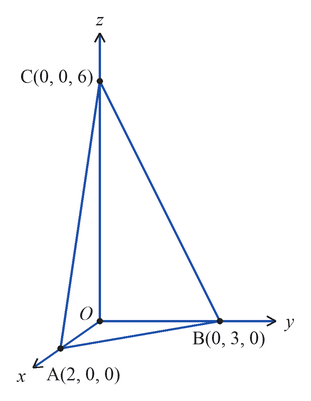
    Question 24

    A plane cuts the coordinate axes at A(2,0,0)A(2, 0, 0), B(0,3,0)B(0, 3, 0) and C(0,0,6)C(0, 0, 6). The area of △ABC\triangle ABC is

    Class 12 Maths Vector or Cross Product

    MCQMedium
    1 mark
  25. 25

    Question 25

    p⃗\vec{p} and q⃗\vec{q} are vectors with ∣p⃗∣=2|\vec{p}| = 2, ∣q⃗∣=3|\vec{q}| = 3 and the angle between them π6\dfrac{\pi}{6}. The area of the parallelogram whose adjacent sides are 3p⃗+2q⃗3\vec{p} + 2\vec{q} and p⃗−q⃗\vec{p} - \vec{q} is

    MCQMedium
    1 mark
  26. 26

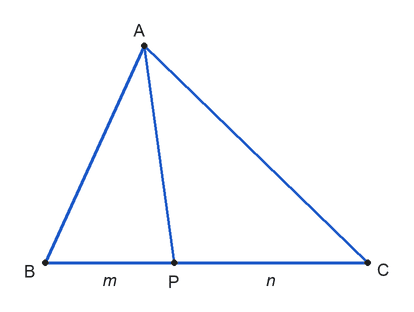
    Question 26

    In △ABC\triangle ABC, the point PP on BCBC divides it in the ratio BP:PC=m:nBP : PC = m : n. Using vectors, prove that

    area of △ABParea of △APC=mn\frac{\text{area of } \triangle ABP}{\text{area of } \triangle APC} = \frac{m}{n}

    Hence, if BP:PC=2:3BP : PC = 2 : 3 and the area of △ABC\triangle ABC is 2020 sq units, find the area of △ABP\triangle ABP.

    Class 12 Maths Vector or Cross Product

    Medium
    4 marks
  27. 27

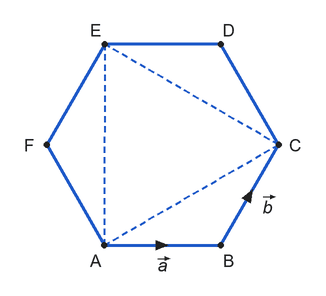
    Question 27

    ABCDEFABCDEF is a regular hexagon with AB→=a⃗\overrightarrow{AB} = \vec{a} and BC→=b⃗\overrightarrow{BC} = \vec{b}. The area of △ACE\triangle ACE is

    Class 12 Maths Vector or Cross Product

    MCQMedium
    1 mark
  28. 28

    Question 28

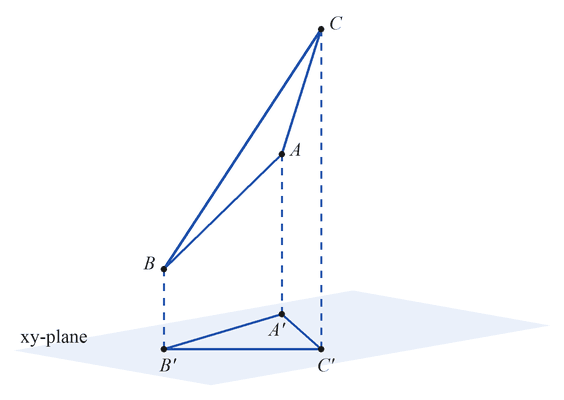
    The vertices of a triangle are A(1,0,2)A(1, 0, 2), B(3,1,1)B(3, 1, 1) and C(2,3,4)C(2, 3, 4).

    (i) Find the vector area 12(AB→×AC→)\dfrac{1}{2}\left(\overrightarrow{AB} \times \overrightarrow{AC}\right) and the area of △ABC\triangle ABC.

    (ii) A′A', B′B', C′C' are the feet of the perpendiculars from AA, BB, CC to the xyxy-plane. Find the area of △A′B′C′\triangle A'B'C' and show that it equals the k^\hat{k}-component of the vector area found in (i).
    Class 12 Maths Vector or Cross Product

    Medium
    4 marks
  29. 29

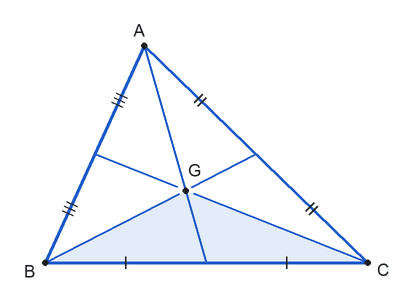
    Question 29

    GG is the centroid of △ABC\triangle ABC. Using vectors, prove that the area of △GBC\triangle GBC is one-third of the area of △ABC\triangle ABC.

    Class 12 Maths Vector or Cross Product

    Medium
    3 marks
  30. 30

    Question 30

    The vertices of a triangle are A(1,0,0)A(1, 0, 0), B(0,1,0)B(0, 1, 0) and C(t,t,1)C(t, t, 1), where tt is a real number.

    Class 12 Maths Vector or Cross Product

    Find the area of △ABC\triangle ABC in terms of tt. Hence find the value of tt for which the area is least, and the least area.

    Medium
    3 marks
  31. 31

    Question 31

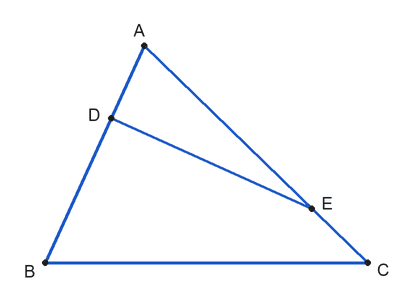
    In △ABC\triangle ABC, DD is the point on ABAB with AD=13ABAD = \dfrac{1}{3}AB and EE is the point on ACAC with AE=34ACAE = \dfrac{3}{4}AC. The area of △ADE\triangle ADE is what fraction of the area of △ABC\triangle ABC?

    Class 12 Maths Vector or Cross Product

    MCQEasy
    1 mark
  32. 32

    Question 32

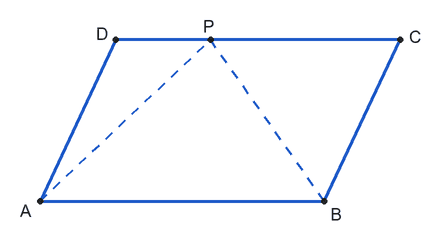
    ABCDABCD is a parallelogram and PP is any point on the side CDCD. Using vectors, prove that the area of △APB\triangle APB is half the area of the parallelogram ABCDABCD.

    Class 12 Maths Vector or Cross Product

    Medium
    3 marks
  33. 33

    Question 33

    a⃗\vec{a} and b⃗\vec{b} are non-collinear vectors. The area of the triangle whose vertices have position vectors a⃗\vec{a}, b⃗\vec{b} and 2a⃗+3b⃗2\vec{a} + 3\vec{b} is

    MCQMedium
    1 mark
  34. 34

    Question 34

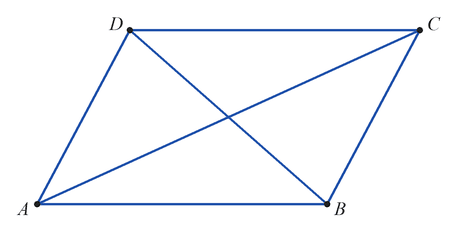
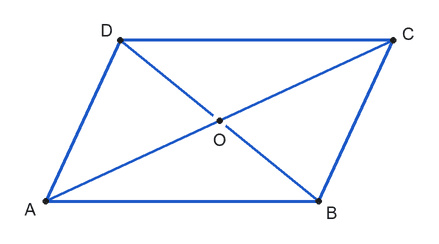
    The diagonals of a parallelogram ABCDABCD meet at OO. Using vectors, prove that the diagonals divide the parallelogram into four triangles of equal area.
    Class 12 Maths Vector or Cross Product

    Medium
    2 marks
  35. 35

    Question 35

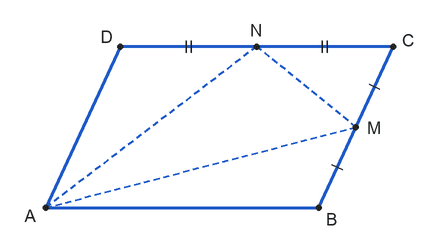
    In a parallelogram ABCDABCD, MM is the midpoint of BCBC and NN is the midpoint of CDCD. The area of △AMN\triangle AMN is what fraction of the area of ABCDABCD?

    Class 12 Maths Vector or Cross Product

    MCQMedium
    1 mark
  36. 36

    Question 36

    A force F⃗=2i^+j^−k^\vec{F} = 2\hat{i} + \hat{j} - \hat{k} acts through the point P(1,2,3)P(1, 2, 3). Its moment about the point A(1,−1,2)A(1, -1, 2) is

    MCQMedium
    1 mark
  37. 37

    Question 37

    (Hypothetical data.) A mechanic tightens a bolt with a spanner. Taking the bolt as origin, the hand is at r⃗=0.2 i^\vec{r} = 0.2\,\hat{i} m from the bolt and pushes with a force F⃗=30i^+40j^\vec{F} = 30\hat{i} + 40\hat{j} N. The magnitude of the torque r⃗×F⃗\vec{r} \times \vec{F} about the bolt is

    MCQEasy
    1 mark
  38. 38

    Question 38

    A force F⃗=3i^+2j^−k^\vec{F} = 3\hat{i} + 2\hat{j} - \hat{k} acts at the point A(1,0,2)A(1, 0, 2) and an equal and opposite force −F⃗-\vec{F} acts at the point B(2,−1,1)B(2, -1, 1).

    (i) Find the total moment of the two forces about the origin.

    (ii) Show that the total moment about any point QQ is the same.

    Medium
    3 marks
  39. 39

    Question 39

    Using the vector product, find λ\lambda and μ\mu if the points A(2,−1,3)A(2, -1, 3), B(4,3,−1)B(4, 3, -1) and C(λ,μ,5)C(\lambda, \mu, 5) are collinear.

    Medium
    3 marks
  40. 40

    Question 40

    a⃗\vec{a} and b⃗\vec{b} are non-collinear vectors. The points with position vectors 2a⃗−b⃗2\vec{a} - \vec{b}, a⃗+b⃗\vec{a} + \vec{b} and λa⃗+4b⃗\lambda\vec{a} + 4\vec{b} are collinear. The value of λ\lambda is

    MCQMedium
    1 mark
  41. 41

    Question 41

    A line LL passes through A(1,2,−1)A(1, 2, -1) and is parallel to b⃗=2i^−j^+3k^\vec{b} = 2\hat{i} - \hat{j} + 3\hat{k}. A point PP lies on LL exactly when AP→×b⃗=0⃗\overrightarrow{AP} \times \vec{b} = \vec{0}.

    (i) Using this test, decide whether Q(5,0,6)Q(5, 0, 6) lies on LL.

    (ii) Find the point of LL whose xx-coordinate is 77.

    Medium
    3 marks
  42. 42

    Question 42

    (Hypothetical data.) A particle with charge q=2×10⁻⁶q = 2 \times 10^{-6} C moves with velocity v⃗=(3i^+4j^)×104\vec{v} = (3\hat{i} + 4\hat{j}) \times 10^{4} m/s through a magnetic field B⃗=0.2 k^\vec{B} = 0.2\,\hat{k} T. The magnetic force on it is F⃗=q(v⃗×B⃗)\vec{F} = q\left(\vec{v} \times \vec{B}\right).

    (i) Find F⃗\vec{F} and its magnitude.

    (ii) Show that F⃗\vec{F} is perpendicular to v⃗\vec{v}, and state what this means for the work done by the force.

    Medium
    3 marks
  43. 43

    Question 43

    (Hypothetical data.) A flat triangular roof panel has corners A(0,0,3)A(0, 0, 3), B(4,0,3)B(4, 0, 3) and C(0,3,5)C(0, 3, 5), in metres, with k^\hat{k} pointing vertically upwards. A sensor must be mounted along the unit vector perpendicular to the panel that points upwards. This unit vector is

    MCQMedium
    1 mark
  44. 44

    Question 44

    (Hypothetical data.) A rigid body rotates about an axis through the origin with angular velocity ω⃗=2i^−j^+2k^\vec{\omega} = 2\hat{i} - \hat{j} + 2\hat{k} rad/s. The velocity of a point of the body with position vector r⃗\vec{r} is v⃗=ω⃗×r⃗\vec{v} = \vec{\omega} \times \vec{r}. Find the velocity and the speed of the point r⃗=i^+2j^−2k^\vec{r} = \hat{i} + 2\hat{j} - 2\hat{k} (in metres), and verify that v⃗\vec{v} is perpendicular to both ω⃗\vec{\omega} and r⃗\vec{r}.

    Medium
    3 marks
  45. 45

    Question 45

    A force F⃗≠0⃗\vec{F} \ne \vec{0} acts through a point PP. Its moments about two different points AA and BB are equal. Prove that ABAB is parallel to F⃗\vec{F}.

    Medium
    2 marks
  46. 46

    Question 46

    Fill in the blank:

    The area of a parallelogram whose diagonals are 2i^2\hat{i} and −3k^-3\hat{k} is __________ square units.

    Easy
    1 mark
  47. 47

    Question 47

    Fill in the blank:

    The value of λ\lambda for which the vectors 2i^−λj^+k^2\hat{i} - \lambda\hat{j} + \hat{k} and i^+2j^−k^\hat{i} + 2\hat{j} - \hat{k} are orthogonal is __________.

    Easy
    1 mark
  48. 48

    Question 48

    Find the area of the parallelogram whose diagonals are i^−3j^+k^\hat{i} - 3\hat{j} + \hat{k} and i^+j^+k^\hat{i} + \hat{j} + \hat{k}.

    Easy
    1 mark
  49. 49

    Question 49

    If a⃗\vec{a} and b⃗\vec{b} are two non-zero vectors such that ∣a⃗×b⃗∣=a⃗⋅b⃗\left|\vec{a} \times \vec{b}\right| = \vec{a} \cdot \vec{b}, find the angle between a⃗\vec{a} and b⃗\vec{b}.

    Easy
    1 mark
  50. 50

    Question 50

    Find a vector of magnitude 21 units in the direction opposite to that of AB→\overrightarrow{AB}, where AA and BB are the points A(2,1,3)A(2, 1, 3) and B(8,−1,0)B(8, -1, 0), respectively.

    Easy
    1 mark
  51. 51

    Question 51

    Find the magnitude of vector a⃗\vec{a} given by a⃗=(i^+3j^−2k^)×(−i^+3k^)\vec{a} = (\hat{i} + 3\hat{j} - 2\hat{k}) \times (-\hat{i} + 3\hat{k}).

    Easy
    1 mark
  52. 52

    Question 52

    Find the value of (k^×j^)⋅i^+j^⋅k^(\hat{k} \times \hat{j}) \cdot \hat{i} + \hat{j} \cdot \hat{k}.

    Easy
    1 mark
  53. 53

    Question 53

    Fill in the blank:

    If a⃗=7i^+j^−4k^\vec{a} = 7\hat{i} + \hat{j} - 4\hat{k} and b⃗=2i^+6j^+3k^\vec{b} = 2\hat{i} + 6\hat{j} + 3\hat{k}, then the projection of a⃗\vec{a} on b⃗\vec{b} is __________.

    Easy
    1 mark
  54. 54

    Question 54

    Write a unit vector perpendicular to both the vectors a⃗=i^+j^+k^\vec{a} = \hat{i} + \hat{j} + \hat{k} and b⃗=i^+j^\vec{b} = \hat{i} + \hat{j}.

    Easy
    1 mark
  55. 55

    Question 55

    If a⃗\vec{a} and b⃗\vec{b} are unit vectors, then what is the angle between a⃗\vec{a} and b⃗\vec{b} so that 2 a⃗−b⃗\sqrt{2}\,\vec{a} - \vec{b} is a unit vector?

    Medium
    1 mark
  56. 56

    Question 56

    Fill in the blank:

    If ∣a⃗×b⃗∣2+∣a⃗⋅b⃗∣2=400\left|\vec{a} \times \vec{b}\right|^2 + \left|\vec{a} \cdot \vec{b}\right|^2 = 400 and ∣a⃗∣=5|\vec{a}| = 5, then ∣b⃗∣=|\vec{b}| = __________.

    Easy
    1 mark
  57. 57

    Question 57

    Write the position vector of the point which divides the join of points with position vectors 3a⃗−2b⃗3\vec{a} - 2\vec{b} and 2a⃗+3b⃗2\vec{a} + 3\vec{b} in the ratio 2:12 : 1.

    Easy
    1 mark
  58. 58

    Question 58

    State whether the following statement is true or false:

    The vector whose initial and terminal points are (−2,4,7)(-2, 4, 7) and (3,−2,8)(3, -2, 8), respectively is 5i^−6j^+k^5\hat{i} - 6\hat{j} + \hat{k}.

    Easy
    1 mark
  59. 59

    Question 59

    State whether the following statement is true or false:

    The value of λ\lambda for which the vectors 2i^−3j^+4k^2\hat{i} - 3\hat{j} + 4\hat{k} and 4i^−6j^+λk^4\hat{i} - 6\hat{j} + \lambda\hat{k} are parallel is 6.

    Easy
    1 mark
  60. 60

    Question 60

    State whether the following statement is true or false:

    If a,b,ca, b, c are the direction ratios of a vector r⃗\vec{r}, then a2+b2+c2=1a^2 + b^2 + c^2 = 1.

    Easy
    1 mark
  61. 61

    Question 61

    State whether the following statement is true or false:

    If a⃗\vec{a} and b⃗\vec{b} are adjacent sides of a rhombus, then a⃗⋅b⃗=0\vec{a} \cdot \vec{b} = 0.

    Easy
    1 mark
  62. 62

    Question 62

    State whether the following statement is true or false:

    If ∣a⃗+b⃗∣=∣a⃗−b⃗∣\left|\vec{a} + \vec{b}\right| = \left|\vec{a} - \vec{b}\right|, then the vectors a⃗\vec{a} and b⃗\vec{b} are orthogonal.

    Easy
    1 mark
  63. 63

    Question 63

    State whether the following statement is true or false:

    The formula (a⃗+b⃗)2=a⃗ 2+b⃗ 2+2a⃗×b⃗(\vec{a} + \vec{b})^2 = \vec{a}^{\,2} + \vec{b}^{\,2} + 2\vec{a} \times \vec{b} is valid for non-zero vectors a⃗\vec{a} and b⃗\vec{b}.

    Easy
    1 mark
  64. 64

    Question 64

    In the following question, a statement of Assertion (A) is followed by a statement of Reason (R). Choose the correct option.

    Assertion (A): (a⃗+b⃗)2+(b⃗−a⃗)2=2(a2+b2)(\vec{a} + \vec{b})^2 + (\vec{b} - \vec{a})^2 = 2(a^2 + b^2).

    Reason (R): Dot product of any two vectors is commutative.

    MCQEasy
    1 mark
  65. 65

    Question 65

    In the following question, a statement of Assertion (A) is followed by a statement of Reason (R). Choose the correct option.

    Assertion (A): (b⃗⋅c⃗) a⃗(\vec{b} \cdot \vec{c})\,\vec{a} is a scalar quantity.

    Reason (R): Dot product of two vectors is a scalar quantity.

    MCQEasy
    1 mark
  66. 66

    Question 66

    In the following question, a statement of Assertion (A) is followed by a statement of Reason (R). Choose the correct option.

    Assertion (A): For two non-zero vectors a⃗\vec{a} and b⃗\vec{b}, a⃗⋅b⃗=b⃗⋅a⃗\vec{a} \cdot \vec{b} = \vec{b} \cdot \vec{a}.

    Reason (R): For two non-zero vectors a⃗\vec{a} and b⃗\vec{b}, a⃗×b⃗=b⃗×a⃗\vec{a} \times \vec{b} = \vec{b} \times \vec{a}.

    MCQEasy
    1 mark
  67. 67

    Question 67

    In the following question, a statement of Assertion (A) is followed by a statement of Reason (R). Choose the correct option.

    Assertion (A): The vectors a⃗=6i^+2j^−8k^\vec{a} = 6\hat{i} + 2\hat{j} - 8\hat{k}, b⃗=10i^−2j^−6k^\vec{b} = 10\hat{i} - 2\hat{j} - 6\hat{k}, c⃗=4i^−4j^+2k^\vec{c} = 4\hat{i} - 4\hat{j} + 2\hat{k} represent the sides of a right-angled triangle.

    Reason (R): Three non-zero vectors of which none of two are collinear form a triangle if their resultant is zero vector or sum of any two vectors is equal to the third.

    MCQMedium
    1 mark
  68. 68

    Question 68

    In the following question, a statement of Assertion (A) is followed by a statement of Reason (R). Choose the correct option.

    Assertion (A): If ∣a⃗∣=2|\vec{a}| = 2, ∣b⃗∣=7|\vec{b}| = 7 and a⃗×b⃗=3i^+2j^+6k^\vec{a} \times \vec{b} = 3\hat{i} + 2\hat{j} + 6\hat{k}, then the angle between a⃗\vec{a} and b⃗\vec{b} is π6\dfrac{\pi}{6}.

    Reason (R): If θ\theta be the angle between two vectors a⃗\vec{a} and b⃗\vec{b}, then sin⁡θ=∣a⃗×b⃗∣∣a⃗∣∣b⃗∣\sin\theta = \dfrac{\left|\vec{a} \times \vec{b}\right|}{|\vec{a}||\vec{b}|}.

    MCQMedium
    1 mark
  69. 69

    Question 69

    Satellite path correction (space science): A satellite is intended to move along a vector v1⃗=3i^+4j^+5k^\vec{v_1} = 3\hat{i} + 4\hat{j} + 5\hat{k}, but due to gravitational influence, it moves along v2⃗=6i^+8j^+10k^\vec{v_2} = 6\hat{i} + 8\hat{j} + 10\hat{k}.

    Based on the above information, answer the following questions:

    (i) Are the intended and actual paths aligned?

    (A) No, they are perpendicular. (B) Yes, because v2⃗=2v1⃗\vec{v_2} = 2\vec{v_1}. They are parallel. (C) No, the dot product is zero. (D) Yes, because they have equal magnitudes.

    (ii) What is the angle between v1⃗\vec{v_1} and v2⃗\vec{v_2}?

    (A) 90∘90^\circ (B) 45∘45^\circ (C) 60∘60^\circ (D) 0∘0^\circ

    (iii) What is the unit vector in the direction of v1⃗\vec{v_1}?

    (A) 3i^+4j^+5k^50\dfrac{3\hat{i} + 4\hat{j} + 5\hat{k}}{\sqrt{50}} (B) 3i^+4j^+5k^30\dfrac{3\hat{i} + 4\hat{j} + 5\hat{k}}{\sqrt{30}} (C) 3i^+4j^+5k^35\dfrac{3\hat{i} + 4\hat{j} + 5\hat{k}}{\sqrt{35}} (D) 3i^+4j^+5k^45\dfrac{3\hat{i} + 4\hat{j} + 5\hat{k}}{\sqrt{45}}

    Easy
    3 marks
  70. 70

    Question 70

    Cricket ball trajectory: In a cricket match, a batter hits the ball from point B(0,0,0)B(0, 0, 0) in the direction of v⃗=10i^+20j^+15k^\vec{v} = 10\hat{i} + 20\hat{j} + 15\hat{k}. A fielder is positioned at point F(20,40,30)F(20, 40, 30) and wants to know if they are aligned with the ball's trajectory to attempt a catch.

    Based on the above information, answer the following questions:

    (i) What is the position vector BF→\overrightarrow{BF}?

    (A) 20i^+40j^+30k^20\hat{i} + 40\hat{j} + 30\hat{k} (B) 10i^+20j^+15k^10\hat{i} + 20\hat{j} + 15\hat{k} (C) 5i^+10j^+10k^5\hat{i} + 10\hat{j} + 10\hat{k} (D) 15i^+30j^+25k^15\hat{i} + 30\hat{j} + 25\hat{k}

    (ii) Is the ball heading directly toward the fielder?

    (A) Yes, both vectors have same magnitude. (B) No, they are perpendicular. (C) Yes, BF→\overrightarrow{BF} is a scalar multiple of v⃗\vec{v}. (D) No, the dot product is zero.

    (iii) How far will the ball travel before reaching the fielder?

    (A) 2500\sqrt{2500} (B) 2800\sqrt{2800} (C) 1600\sqrt{1600} (D) 2900\sqrt{2900}

    Easy
    3 marks
  71. 71

    Question 71

    The magnitude of the vector 6i^−2j^+3k^6\hat{i} - 2\hat{j} + 3\hat{k} is

    MCQEasy
    1 mark
  72. 72

    Question 72

    If i^,j^,k^\hat{i}, \hat{j}, \hat{k} are unit vectors along three mutually perpendicular directions, then

    MCQEasy
    1 mark
  73. 73

    Question 73

    If r⃗=xi^+yj^+zk^\vec{r} = x\hat{i} + y\hat{j} + z\hat{k}, then what is r⃗⋅(i^+j^+k^)\vec{r} \cdot (\hat{i} + \hat{j} + \hat{k}) equal to?

    MCQEasy
    1 mark
  74. 74

    Question 74

    If a⃗=αi^+βj^\vec{a} = \alpha\hat{i} + \beta\hat{j} and b⃗=αi^−βj^\vec{b} = \alpha\hat{i} - \beta\hat{j} is perpendicular, where α≠β\alpha \ne \beta, then α+β\alpha + \beta is equal to

    MCQEasy
    1 mark
  75. 75

    Question 75

    If a⃗\vec{a} and b⃗\vec{b} are two non-zero vectors and if ∣a⃗×b⃗∣=∣a⃗⋅b⃗∣\left|\vec{a} \times \vec{b}\right| = \left|\vec{a} \cdot \vec{b}\right|, then the angle between a⃗\vec{a} and b⃗\vec{b} is equal to

    MCQEasy
    1 mark
  76. 76

    Question 76

    A unit vector along the vector 4i^−3k^4\hat{i} - 3\hat{k} is

    MCQEasy
    1 mark
  77. 77

    Question 77

    If a⃗\vec{a} and b⃗\vec{b} are vectors such that ∣a⃗∣=2|\vec{a}| = 2, ∣b⃗∣=7|\vec{b}| = 7 and a⃗×b⃗=3i^+2j^+6k^\vec{a} \times \vec{b} = 3\hat{i} + 2\hat{j} + 6\hat{k}, then what is the acute angle between a⃗\vec{a} and b⃗\vec{b}?

    MCQEasy
    1 mark
  78. 78

    Question 78

    Consider the following statements:

    1. Dot product over vector addition is distributive.

    2. Cross product over vector addition is distributive.

    3. Cross product of vector is associative.

    Which of the above statement is/are correct?

    MCQEasy
    1 mark
  79. 79

    Question 79

    If x⃗=(2,3,3)\vec{x} = (2, 3, \sqrt{3}), then a unit vector in the direction of x⃗\vec{x} is

    MCQEasy
    1 mark
  80. 80

    Question 80

    If ∣a⃗∣=3|\vec{a}| = 3, ∣b⃗∣=23|\vec{b}| = \dfrac{\sqrt{2}}{3} and a⃗×b⃗\vec{a} \times \vec{b} is a unit vector, then the angle between a⃗\vec{a} and b⃗\vec{b} will be

    MCQEasy
    1 mark
  81. 81

    Question 81

    If ∣u⃗∣=3|\vec{u}| = 3, ∣v⃗∣=2|\vec{v}| = 2 and ∣u⃗×v⃗∣=3\left|\vec{u} \times \vec{v}\right| = 3, then the angle between u⃗\vec{u} and v⃗\vec{v} is equal to

    MCQEasy
    1 mark
  82. 82

    Question 82

    If ABCDABCD is a parallelogram and ACAC and BDBD are its diagonals, then AC→+BD→\overrightarrow{AC} + \overrightarrow{BD} is

    Class 12 Maths Vector or Cross Product

    MCQEasy
    1 mark
  83. 83

    Question 83

    If a⃗+b⃗=i^\vec{a} + \vec{b} = \hat{i} and a⃗=2i^−2j^+2k^\vec{a} = 2\hat{i} - 2\hat{j} + 2\hat{k}, then ∣b⃗∣|\vec{b}| equals

    MCQEasy
    1 mark
  84. 84

    Question 84

    If the position vectors of points AA and BB are 3i^−2j^+k^3\hat{i} - 2\hat{j} + \hat{k} and 2i^+4j^−3k^2\hat{i} + 4\hat{j} - 3\hat{k}, respectively, then what is the length of AB→\overrightarrow{AB}?

    MCQEasy
    1 mark
  85. 85

    Question 85

    ABCDABCD is a rhombus, whose diagonals intersect at EE, then EA→+EB→+EC→+ED→\overrightarrow{EA} + \overrightarrow{EB} + \overrightarrow{EC} + \overrightarrow{ED} equals

    MCQEasy
    1 mark
  86. 86

    Question 86

    If a⃗+b⃗+c⃗=0⃗\vec{a} + \vec{b} + \vec{c} = \vec{0}, ∣a⃗∣=37|\vec{a}| = \sqrt{37}, ∣b⃗∣=3|\vec{b}| = 3 and ∣c⃗∣=4|\vec{c}| = 4, then angle between b⃗\vec{b} and c⃗\vec{c} is

    MCQEasy
    1 mark
  87. 87

    Question 87

    If α,β,γ\alpha, \beta, \gamma are the angles made by a vector with the coordinate axes, then sin⁡2α+sin⁡2β+sin⁡2γ=\sin^2\alpha + \sin^2\beta + \sin^2\gamma = __________.

    MCQEasy
    1 mark
  88. 88

    Question 88

    Let P(1,2,3)P(1, 2, 3) and Q(−1,−2,−3)Q(-1, -2, -3) be two points and let OO be the origin, then ∣PQ→+OP→∣=\left|\overrightarrow{PQ} + \overrightarrow{OP}\right| = __________.

    MCQEasy
    1 mark
  89. 89

    Question 89

    Let AB→=i^+2j^−2k^\overrightarrow{AB} = \hat{i} + 2\hat{j} - 2\hat{k} and AC→=i^−j^+k^\overrightarrow{AC} = \hat{i} - \hat{j} + \hat{k}, then the area of △ABC\triangle ABC is

    Class 12 Maths Vector or Cross Product

    MCQEasy
    1 mark
  90. 90

    Question 90

    If a⃗\vec{a} and b⃗\vec{b} are two unit vectors and if π4\dfrac{\pi}{4} is the angle between a⃗\vec{a} and b⃗\vec{b}, then (a⃗+(a⃗⋅b⃗)b⃗)⋅(a⃗−(a⃗⋅b⃗)b⃗)\left(\vec{a} + (\vec{a} \cdot \vec{b})\vec{b}\right) \cdot \left(\vec{a} - (\vec{a} \cdot \vec{b})\vec{b}\right) is equal to

    MCQEasy
    1 mark
  91. 91

    Question 91

    If 4i^+j^−3k^4\hat{i} + \hat{j} - 3\hat{k} and pi^+qj^−2k^p\hat{i} + q\hat{j} - 2\hat{k} are collinear vectors, then what are the possible values of pp and qq, respectively?

    MCQEasy
    1 mark
  92. 92

    Question 92

    If ∣a⃗∣=2|\vec{a}| = 2, ∣b⃗∣=3|\vec{b}| = 3 and the angle between a⃗\vec{a} and b⃗\vec{b} is 120∘120^\circ, then the length of the vector ∣12a⃗−13b⃗∣2\left|\dfrac{1}{2}\vec{a} - \dfrac{1}{3}\vec{b}\right|^2 is

    MCQEasy
    1 mark
  93. 93

    Question 93

    The value of λ\lambda, for which the vectors 3i^−6j^+k^3\hat{i} - 6\hat{j} + \hat{k} and 2i^−4j^+λk^2\hat{i} - 4\hat{j} + \lambda\hat{k} are parallel is

    MCQEasy
    1 mark
  94. 94

    Question 94

    The angle between two vectors a⃗\vec{a} and b⃗\vec{b} with magnitudes 3\sqrt{3} and 44, respectively and a⃗⋅b⃗=23\vec{a} \cdot \vec{b} = 2\sqrt{3} is

    MCQEasy
    1 mark
  95. 95

    Question 95

    If the vectors xi^−3j^+7k^x\hat{i} - 3\hat{j} + 7\hat{k} and i^+yj^−zk^\hat{i} + y\hat{j} - z\hat{k} are collinear, then the value of xy2z\dfrac{xy^2}{z} is equal to

    MCQEasy
    1 mark
  96. 96

    Question 96

    The position vectors of points PP and QQ are p⃗\vec{p} and q⃗\vec{q}, respectively. The point RR divides line segment PQPQ in the ratio 3:13 : 1 and SS is the mid-point of line segment PRPR. The position vector of SS is

    MCQEasy
    1 mark
  97. 97

    Question 97

    If θ\theta is the angle between two vectors a⃗\vec{a} and b⃗\vec{b} and a⃗⋅b⃗≥0\vec{a} \cdot \vec{b} \ge 0 only, then

    MCQEasy
    1 mark
  98. 98

    Question 98

    If value of (i^×j^)⋅j^+(j^×i^)⋅k^(\hat{i} \times \hat{j}) \cdot \hat{j} + (\hat{j} \times \hat{i}) \cdot \hat{k} is

    MCQEasy
    1 mark
  99. 99

    Question 99

    The vectors a⃗=2i^−j^+k^\vec{a} = 2\hat{i} - \hat{j} + \hat{k}, b⃗=i^−3j^−5k^\vec{b} = \hat{i} - 3\hat{j} - 5\hat{k} and c⃗=−3i^+4j^+4k^\vec{c} = -3\hat{i} + 4\hat{j} + 4\hat{k} represent the sides of

    MCQEasy
    1 mark
  100. 100

    Question 100

    Two vectors a⃗=a1i^+a2j^+a3k^\vec{a} = a_1\hat{i} + a_2\hat{j} + a_3\hat{k} and b⃗=b1i^+b2j^+b3k^\vec{b} = b_1\hat{i} + b_2\hat{j} + b_3\hat{k} are collinear if

    MCQEasy
    1 mark
  101. 101

    Question 101

    Let a⃗=2i^+3j^−4k^\vec{a} = 2\hat{i} + 3\hat{j} - 4\hat{k}, b⃗=i^+j^−k^\vec{b} = \hat{i} + \hat{j} - \hat{k}, c⃗=−i^+2j^+3k^\vec{c} = -\hat{i} + 2\hat{j} + 3\hat{k}, d⃗=i^+j^+k^\vec{d} = \hat{i} + \hat{j} + \hat{k}, then (a⃗×b⃗)⋅(c⃗×d⃗)=(\vec{a} \times \vec{b}) \cdot (\vec{c} \times \vec{d}) =

    MCQEasy
    1 mark
  102. 102

    Question 102

    If (a⃗−b⃗)⋅(a⃗+b⃗)=27(\vec{a} - \vec{b}) \cdot (\vec{a} + \vec{b}) = 27 and ∣a⃗∣=2∣b⃗∣|\vec{a}| = 2|\vec{b}|, then ∣b⃗∣|\vec{b}| is

    MCQEasy
    1 mark
  103. 103

    Question 103

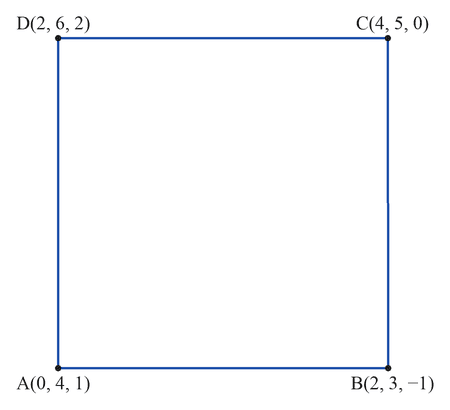
    The area of the quadrilateral ABCDABCD where A(0,4,1)A(0, 4, 1), B(2,3,−1)B(2, 3, -1), C(4,5,0)C(4, 5, 0) and D(2,6,2)D(2, 6, 2) is equal to

    Class 12 Maths Vector or Cross Product

    MCQMedium
    1 mark
  104. 104

    Question 104

    Let the vectors a⃗,b⃗,c⃗\vec{a}, \vec{b}, \vec{c} be such that ∣a⃗∣=2|\vec{a}| = 2, ∣b⃗∣=4|\vec{b}| = 4 and ∣c⃗∣=4|\vec{c}| = 4. If the projection of b⃗\vec{b} on a⃗\vec{a} is equal to the projection of c⃗\vec{c} on a⃗\vec{a} and b⃗\vec{b} is perpendicular to c⃗\vec{c}, then the value of ∣a⃗+b⃗−c⃗∣\left|\vec{a} + \vec{b} - \vec{c}\right| is __________.

    MCQMedium
    1 mark
  105. 105

    Question 105

    If the vectors AB→=3i^+4k^\overrightarrow{AB} = 3\hat{i} + 4\hat{k} and AC→=5i^−2j^+4k^\overrightarrow{AC} = 5\hat{i} - 2\hat{j} + 4\hat{k} are the sides of a triangle ABCABC, then the length of the median through AA is

    Class 12 Maths Vector or Cross Product

    MCQEasy
    1 mark
  106. 106

    Question 106

    If ∣a⃗∣=10|\vec{a}| = 10, ∣b⃗∣=2|\vec{b}| = 2 and a⃗⋅b⃗=12\vec{a} \cdot \vec{b} = 12, then the value of ∣a⃗×b⃗∣\left|\vec{a} \times \vec{b}\right| is

    MCQEasy
    1 mark
  107. 107

    Question 107

    The projection vector of a⃗\vec{a} on b⃗\vec{b} is

    MCQEasy
    1 mark
  108. 108

    Question 108

    For any two vectors a⃗\vec{a} and b⃗\vec{b}, which of the following statements is always true?

    MCQEasy
    1 mark
  109. 109

    Question 109

    A unit vector in XYXY plane making an angle 45∘45^\circ with i^+j^\hat{i} + \hat{j} and an angle 60∘60^\circ with 3i^−4j^3\hat{i} - 4\hat{j} is

    MCQMedium
    1 mark
  110. 110

    Question 110

    If a⃗,b⃗\vec{a}, \vec{b} and c⃗\vec{c} are three vectors such that a⃗+b⃗+c⃗=0⃗\vec{a} + \vec{b} + \vec{c} = \vec{0}, where a⃗\vec{a} and b⃗\vec{b} are unit vectors and ∣c⃗∣=2|\vec{c}| = 2, then the angle between the vectors b⃗\vec{b} and c⃗\vec{c} is

    MCQEasy
    1 mark
  111. 111

    Question 111

    If a⃗,b⃗\vec{a}, \vec{b} and c⃗\vec{c} are three vectors such that a⃗+b⃗+c⃗=0⃗\vec{a} + \vec{b} + \vec{c} = \vec{0} and ∣a⃗∣=2|\vec{a}| = 2, ∣b⃗∣=3|\vec{b}| = 3 and ∣c⃗∣=5|\vec{c}| = 5, then the value of a⃗⋅b⃗+b⃗⋅c⃗+c⃗⋅a⃗\vec{a} \cdot \vec{b} + \vec{b} \cdot \vec{c} + \vec{c} \cdot \vec{a} is

    MCQEasy
    1 mark
  112. 112

    Question 112

    If a⃗,b⃗\vec{a}, \vec{b} and c⃗\vec{c} are unit vectors such that a⃗+b⃗+c⃗=0⃗\vec{a} + \vec{b} + \vec{c} = \vec{0}, then the value of a⃗⋅b⃗+b⃗⋅c⃗+c⃗⋅a⃗\vec{a} \cdot \vec{b} + \vec{b} \cdot \vec{c} + \vec{c} \cdot \vec{a} is

    MCQEasy
    1 mark
  113. 113

    Question 113

    If a⃗=i^+2j^+k^\vec{a} = \hat{i} + 2\hat{j} + \hat{k}, b⃗=i^−j^+4k^\vec{b} = \hat{i} - \hat{j} + 4\hat{k} and c⃗=i^+j^+k^\vec{c} = \hat{i} + \hat{j} + \hat{k} are such that a⃗+λb⃗\vec{a} + \lambda\vec{b} is perpendicular to c⃗\vec{c}, then the value of λ\lambda is

    MCQEasy
    1 mark
  114. 114

    Question 114

    Let a⃗\vec{a} be any vector such that ∣a⃗∣=a|\vec{a}| = a. The value of ∣a⃗×i^∣2+∣a⃗×j^∣2+∣a⃗×k^∣2\left|\vec{a} \times \hat{i}\right|^2 + \left|\vec{a} \times \hat{j}\right|^2 + \left|\vec{a} \times \hat{k}\right|^2 is

    MCQEasy
    1 mark
  115. 115

    Question 115

    If a⃗\vec{a} is a non-zero vector such that its projection on the vectors 2i^−j^+2k^2\hat{i} - \hat{j} + 2\hat{k}, i^+2j^−2k^\hat{i} + 2\hat{j} - 2\hat{k} and k^\hat{k} are equal, then a unit vector along a⃗\vec{a} is

    MCQMedium
    1 mark
  116. 116

    Question 116

    Let a⃗\vec{a} and b⃗\vec{b} be two unit vectors. Let θ\theta be the angle between a⃗\vec{a} and b⃗\vec{b}. If θ≠0\theta \ne 0 or π\pi, then ∣a⃗−(a⃗⋅b⃗)b⃗∣2\left|\vec{a} - (\vec{a} \cdot \vec{b})\vec{b}\right|^2 is equal to

    MCQEasy
    1 mark
  117. 117

    Question 117

    The unit vector perpendicular to each of the vectors a⃗+b⃗\vec{a} + \vec{b} and a⃗−b⃗\vec{a} - \vec{b}, where a⃗=i^+j^+k^\vec{a} = \hat{i} + \hat{j} + \hat{k} and b⃗=i^+2j^+3k^\vec{b} = \hat{i} + 2\hat{j} + 3\hat{k} is

    MCQEasy
    1 mark
  118. 118

    Question 118

    The number of vectors of unit length perpendicular to the vectors a⃗=2i^+j^+2k^\vec{a} = 2\hat{i} + \hat{j} + 2\hat{k} and b⃗=j^+k^\vec{b} = \hat{j} + \hat{k} is

    MCQEasy
    1 mark
  119. 119

    Question 119

    Let A(3,0,−1)A(3, 0, -1), B(2,10,6)B(2, 10, 6) and C(1,2,1)C(1, 2, 1) be the vertices of a triangle and MM be the mid-point of ACAC. If GG divides BMBM in the ratio 2:12 : 1, then cos⁡(∠GOA)\cos(\angle GOA), OO being the origin, is equal to

    Class 12 Maths Vector or Cross Product

    MCQMedium
    1 mark
  120. 120

    Question 120

    If ∣a⃗∣=16|\vec{a}| = 16, ∣b⃗∣=4|\vec{b}| = 4, then ∣a⃗×b⃗∣2+∣a⃗⋅b⃗∣2=\sqrt{\left|\vec{a} \times \vec{b}\right|^2 + \left|\vec{a} \cdot \vec{b}\right|^2} = __________.

    MCQEasy
    1 mark
  121. 121

    Question 121

    If a⃗,b⃗,c⃗\vec{a}, \vec{b}, \vec{c} are three vectors such that a⃗×b⃗=c⃗\vec{a} \times \vec{b} = \vec{c} and b⃗×c⃗=a⃗\vec{b} \times \vec{c} = \vec{a}, then

    MCQEasy
    1 mark