Confirming your payment

Skip to content

Sign up now and get .

Opening your dashboard

Class 12 Maths Chapter 18 Scalar or Dot Product: Practice Questions

48 questions on Chapter 18, each worked through on its own page with the AI tutor. Class 12 Maths, ICSE 2026-27.

48 questions

1–4 marks · Mixed difficulty

  1. 1

    Question 1

    Let a⃗\vec{a}, b⃗\vec{b}, c⃗\vec{c} be any three vectors. Which of the following expressions is not defined?

    MCQEasy
    1 mark
  2. 2

    Question 2

    If ∣a⃗∣=2|\vec{a}| = 2, ∣b⃗∣=3|\vec{b}| = 3 and the angle between a⃗\vec{a} and b⃗\vec{b} is 2π3\dfrac{2\pi}{3}, then (3a⃗+2b⃗)⋅(a⃗−4b⃗)(3\vec{a} + 2\vec{b}) \cdot (\vec{a} - 4\vec{b}) equals

    MCQMedium
    1 mark
  3. 3

    Question 3

    Two vectors a⃗\vec{a} and b⃗\vec{b} have magnitudes 55 and 22 respectively; the angle between them is not given.

    (i) Find the greatest and the least possible values of a⃗⋅b⃗\vec{a} \cdot \vec{b}.

    (ii) Show that (a⃗+b⃗)⋅(a⃗−b⃗)(\vec{a} + \vec{b}) \cdot (\vec{a} - \vec{b}) has the same value whatever the angle between a⃗\vec{a} and b⃗\vec{b}, and find this value.

    Easy
    2 marks
  4. 4

    Question 4

    If a^\hat{a} is a unit vector and (x⃗−a^)⋅(x⃗+a^)=15(\vec{x} - \hat{a}) \cdot (\vec{x} + \hat{a}) = 15, then ∣x⃗∣|\vec{x}| equals

    MCQEasy
    1 mark
  5. 5

    Question 5

    Vectors a⃗\vec{a}, b⃗\vec{b}, c⃗\vec{c} satisfy

    ∣a⃗∣=2,∣b⃗∣=1,∣c⃗∣=3,a⃗⋅b⃗=1,b⃗⋅c⃗=−1,c⃗⋅a⃗=2|\vec{a}| = 2,\quad |\vec{b}| = 1,\quad |\vec{c}| = 3,\quad \vec{a} \cdot \vec{b} = 1,\quad \vec{b} \cdot \vec{c} = -1,\quad \vec{c} \cdot \vec{a} = 2

    Find ∣a⃗−2b⃗+c⃗∣|\vec{a} - 2\vec{b} + \vec{c}|.

    Medium
    3 marks
  6. 6

    Question 6

    If a⃗\vec{a} and b⃗\vec{b} are non-zero vectors such that a⃗⋅b⃗=∣a⃗∣ ∣b⃗∣\vec{a} \cdot \vec{b} = |\vec{a}|\,|\vec{b}|, then

    MCQEasy
    1 mark
  7. 7

    Question 7

    For any three vectors a⃗\vec{a}, b⃗\vec{b}, c⃗\vec{c}, prove that

    ∣a⃗+b⃗∣2+∣b⃗+c⃗∣2+∣c⃗+a⃗∣2=∣a⃗∣2+∣b⃗∣2+∣c⃗∣2+∣a⃗+b⃗+c⃗∣2|\vec{a} + \vec{b}|^2 + |\vec{b} + \vec{c}|^2 + |\vec{c} + \vec{a}|^2 = |\vec{a}|^2 + |\vec{b}|^2 + |\vec{c}|^2 + |\vec{a} + \vec{b} + \vec{c}|^2

    Medium
    2 marks
  8. 8

    Question 8

    If a⃗\vec{a} and b⃗\vec{b} are vectors such that a⃗⋅r⃗=b⃗⋅r⃗\vec{a} \cdot \vec{r} = \vec{b} \cdot \vec{r} for every vector r⃗\vec{r}, prove that a⃗=b⃗\vec{a} = \vec{b}.

    Medium
    2 marks
  9. 9

    Question 9

    If a^\hat{a}, b^\hat{b}, c^\hat{c} are unit vectors, then the greatest possible value of

    ∣a^−b^∣2+∣b^−c^∣2+∣c^−a^∣2|\hat{a} - \hat{b}|^2 + |\hat{b} - \hat{c}|^2 + |\hat{c} - \hat{a}|^2

    is

    MCQMedium
    1 mark
  10. 10

    Question 10

    Vectors a⃗\vec{a} and b⃗\vec{b} are such that ∣a⃗∣=2|\vec{a}| = 2, ∣b⃗∣=1|\vec{b}| = 1 and a⃗⋅b⃗=1\vec{a} \cdot \vec{b} = 1.

    (i) Express ∣a⃗+tb⃗∣2|\vec{a} + t\vec{b}|^2 as a quadratic in the real number tt.

    (ii) Find the value of tt for which ∣a⃗+tb⃗∣|\vec{a} + t\vec{b}| is least, and the least value.

    (iii) Find the values of tt for which ∣a⃗+tb⃗∣=∣a⃗∣|\vec{a} + t\vec{b}| = |\vec{a}|.

    Medium
    3 marks
  11. 11

    Question 11

    If a⃗=2i^+3j^−k^\vec{a} = 2\hat{i} + 3\hat{j} - \hat{k} and b⃗=i^−j^+k^\vec{b} = \hat{i} - \hat{j} + \hat{k}, then (a⃗+b⃗)⋅(a⃗−b⃗)(\vec{a} + \vec{b}) \cdot (\vec{a} - \vec{b}) equals

    MCQEasy
    1 mark
  12. 12

    Question 12

    The angle between the vectors i^+j^\hat{i} + \hat{j} and j^+k^\hat{j} + \hat{k} is

    MCQEasy
    1 mark
  13. 13

    Question 13

    Which of the following vectors is perpendicular to 2i^−3j^+k^2\hat{i} - 3\hat{j} + \hat{k}?

    MCQEasy
    1 mark
  14. 14

    Question 14

    If θ\theta is the angle between the non-zero vectors a⃗\vec{a} and b⃗\vec{b}, then the angle between −a⃗-\vec{a} and 3b⃗3\vec{b} is

    MCQEasy
    1 mark
  15. 15

    Question 15

    The vectors xi^+2j^+k^x\hat{i} + 2\hat{j} + \hat{k} and i^−xj^+xk^\hat{i} - x\hat{j} + x\hat{k}, where xx is real, are

    MCQMedium
    1 mark
  16. 16

    Question 16

    Show that there is no real value of λ\lambda for which the vectors λi^+j^+2k^\lambda\hat{i} + \hat{j} + 2\hat{k} and λi^−λj^+k^\lambda\hat{i} - \lambda\hat{j} + \hat{k} are perpendicular.

    Easy
    2 marks
  17. 17

    Question 17

    Find the value(s) of λ\lambda for which the angle between the vectors i^+j^\hat{i} + \hat{j} and i^+λj^\hat{i} + \lambda\hat{j} is π3\dfrac{\pi}{3}.

    Medium
    3 marks
  18. 18

    Question 18

    Find the unit vectors that lie in the xyxy-plane and are perpendicular to the vector 3i^−4j^+k^3\hat{i} - 4\hat{j} + \hat{k}.

    Easy
    2 marks
  19. 19

    Question 19

    Find the vectors of magnitude 6\sqrt{6} that are perpendicular to both i^+j^+k^\hat{i} + \hat{j} + \hat{k} and i^−j^\hat{i} - \hat{j}.

    Medium
    3 marks
  20. 20

    Question 20

    Vectors a⃗\vec{a} and b⃗\vec{b} satisfy ∣a⃗∣=3|\vec{a}| = 3, ∣b⃗∣=4|\vec{b}| = 4 and ∣a⃗−b⃗∣=13|\vec{a} - \vec{b}| = \sqrt{13}.

    (i) Find the angle between a⃗\vec{a} and b⃗\vec{b}.

    (ii) Find ∣a⃗+b⃗∣|\vec{a} + \vec{b}|.

    Medium
    3 marks
  21. 21

    Question 21

    Non-zero vectors a⃗\vec{a} and b⃗\vec{b} are such that ∣b⃗∣=2∣a⃗∣|\vec{b}| = 2|\vec{a}| and a⃗+b⃗\vec{a} + \vec{b} is perpendicular to a⃗\vec{a}.

    (i) Find the angle between a⃗\vec{a} and b⃗\vec{b}.

    (ii) Find ∣a⃗+b⃗∣|\vec{a} + \vec{b}| in terms of ∣a⃗∣|\vec{a}|.

    (iii) Find the angle between a⃗+b⃗\vec{a} + \vec{b} and b⃗\vec{b}.

    Medium
    3 marks
  22. 22

    Question 22

    For any three vectors a⃗\vec{a}, b⃗\vec{b}, c⃗\vec{c}, prove that the vector (b⃗⋅c⃗) a⃗−(a⃗⋅c⃗) b⃗(\vec{b} \cdot \vec{c})\,\vec{a} - (\vec{a} \cdot \vec{c})\,\vec{b} is either the zero vector or perpendicular to c⃗\vec{c}.

    Medium
    2 marks
  23. 23

    Question 23

    A cube has one vertex at the origin OO and its three edges through OO along the positive xx-, yy- and zz-axes, each of length ss.

    (i) Find the angle between the diagonal of the cube from OO to the opposite vertex (s,s,s)(s, s, s) and the diagonal of the bottom face from OO to (s,s,0)(s, s, 0).

    (ii) Find the acute angle between the two diagonals of the cube: one from OO to (s,s,s)(s, s, s) and the other from (s,0,0)(s, 0, 0) to (0,s,s)(0, s, s).

    Medium
    3 marks
  24. 24

    Question 24

    Vectors a⃗\vec{a} and b⃗\vec{b} are such that ∣a⃗∣=2|\vec{a}| = 2, ∣b⃗∣=3|\vec{b}| = 3 and a⃗⋅b⃗=−3\vec{a} \cdot \vec{b} = -3.

    (i) Find the angle between a⃗\vec{a} and b⃗\vec{b}.

    (ii) Find ∣a⃗+b⃗∣|\vec{a} + \vec{b}|.

    (iii) Find ∣2a⃗−b⃗∣|2\vec{a} - \vec{b}|.

    (iv) Find the real number tt for which a⃗+b⃗\vec{a} + \vec{b} is perpendicular to a⃗+tb⃗\vec{a} + t\vec{b}.

    Medium
    4 marks
  25. 25

    Question 25

    a^\hat{a}, b^\hat{b}, c^\hat{c} are unit vectors such that a^\hat{a} is perpendicular to b^\hat{b}, and c^\hat{c} makes an angle of π3\dfrac{\pi}{3} with each of a^\hat{a} and b^\hat{b}.

    (i) Find ∣a^+b^+c^∣|\hat{a} + \hat{b} + \hat{c}|.

    (ii) Find the angle between c^\hat{c} and a^+b^\hat{a} + \hat{b}.

    (iii) Show that a^+b^−c^\hat{a} + \hat{b} - \hat{c} is perpendicular to c^\hat{c}.

    (iv) Find the angle between a^+b^+c^\hat{a} + \hat{b} + \hat{c} and c^\hat{c}.

    Medium
    4 marks
  26. 26

    Question 26

    The scalar projection of a⃗=i^−3j^+2k^\vec{a} = \hat{i} - 3\hat{j} + 2\hat{k} on b⃗=2i^+j^−2k^\vec{b} = 2\hat{i} + \hat{j} - 2\hat{k} is

    MCQEasy
    1 mark
  27. 27

    Question 27

    a⃗\vec{a} and b⃗\vec{b} are non-zero vectors with a⃗⋅b⃗≠0\vec{a} \cdot \vec{b} \ne 0. If the projection of a⃗\vec{a} on b⃗\vec{b} is equal to the projection of b⃗\vec{b} on a⃗\vec{a}, then

    MCQEasy
    1 mark
  28. 28

    Question 28

    The projection of a⃗=2i^+3j^−6k^\vec{a} = 2\hat{i} + 3\hat{j} - 6\hat{k} on the vector PQ→\overrightarrow{PQ}, where PP is (3,4,2)(3, 4, 2) and QQ is (5,6,3)(5, 6, 3), is

    MCQEasy
    1 mark
  29. 29

    Question 29

    If ∣a⃗∣=6|\vec{a}| = 6 and the angle between a⃗\vec{a} and b⃗\vec{b} is 2π3\dfrac{2\pi}{3}, then the projection of a⃗\vec{a} on b⃗\vec{b} is

    MCQEasy
    1 mark
  30. 30

    Question 30

    Let b⃗=2i^−2j^+k^\vec{b} = 2\hat{i} - 2\hat{j} + \hat{k}. If the vector projection of a⃗\vec{a} on b⃗\vec{b} is 4i^−4j^+2k^4\hat{i} - 4\hat{j} + 2\hat{k}, then a⃗⋅b⃗\vec{a} \cdot \vec{b} is

    MCQMedium
    1 mark
  31. 31

    Question 31

    Show that the projection of a vector a⃗\vec{a} on any vector can never be greater than ∣a⃗∣|\vec{a}|. Hence find the greatest value of the projection of a⃗=2i^−j^+2k^\vec{a} = 2\hat{i} - \hat{j} + 2\hat{k} on a unit vector, and the unit vector for which it occurs.

    Medium
    2 marks
  32. 32

    Question 32

    A line passes through the point A(2,−1,1)A(2, -1, 1) and is parallel to the vector b⃗=i^+2j^+2k^\vec{b} = \hat{i} + 2\hat{j} + 2\hat{k}. Using the projection of AP→\overrightarrow{AP} on b⃗\vec{b}, find the perpendicular distance of the point P(1,2,3)P(1, 2, 3) from this line.

    Medium
    3 marks
  33. 33

    Question 33

    The scalar projection of a non-zero vector a⃗\vec{a} on a vector b⃗\vec{b} is −12∣a⃗∣-\dfrac{1}{2}|\vec{a}|. The angle between a⃗\vec{a} and b⃗\vec{b} is

    MCQEasy
    1 mark
  34. 34

    Question 34

    The angle between two vectors a⃗\vec{a} and b⃗\vec{b} is π3\dfrac{\pi}{3}. The projection of a⃗\vec{a} on b⃗\vec{b} is 33 and the projection of b⃗\vec{b} on a⃗\vec{a} is 44. Find ∣a⃗∣|\vec{a}|, ∣b⃗∣|\vec{b}| and a⃗⋅b⃗\vec{a} \cdot \vec{b}.

    Medium
    3 marks
  35. 35

    Question 35

    a⃗\vec{a}, b⃗\vec{b}, c⃗\vec{c} are three mutually perpendicular unit vectors. Find the projection of the vector 2a⃗+3b⃗−c⃗2\vec{a} + 3\vec{b} - \vec{c} on the vector a⃗+b⃗+c⃗\vec{a} + \vec{b} + \vec{c}.

    Medium
    2 marks
  36. 36

    Question 36

    The scalar projections of a vector r⃗\vec{r} on i^\hat{i}, j^\hat{j} and k^\hat{k} are 22, −3-3 and 66 respectively. Then ∣r⃗∣|\vec{r}| is

    MCQEasy
    1 mark
  37. 37

    Question 37

    The projection of a⃗\vec{a} on b⃗\vec{b} is 44. The projection of 3a⃗3\vec{a} on 2b⃗2\vec{b} is

    MCQEasy
    1 mark
  38. 38

    Question 38

    A force of magnitude 66 N acts along the vector 2i^−j^+2k^2\hat{i} - \hat{j} + 2\hat{k}. It moves a particle from the point A(2,1,1)A(2, 1, 1) to the point B(5,2,3)B(5, 2, 3), distances being in metres. The work done by the force is

    MCQMedium
    1 mark
  39. 39

    Question 39

    A constant force F⃗=3i^+λj^+k^\vec{F} = 3\hat{i} + \lambda\hat{j} + \hat{k} moves a particle from P(1,−1,2)P(1, -1, 2) to Q(3,2,−1)Q(3, 2, -1). If the work done by the force is zero, find λ\lambda and state what this means about the force and the displacement.

    Medium
    2 marks
  40. 40

    Question 40

    A constant force F⃗=2i^+3j^−k^\vec{F} = 2\hat{i} + 3\hat{j} - \hat{k} moves a particle along the sides of a triangle from A(1,0,0)A(1, 0, 0) to B(0,2,1)B(0, 2, 1), then to C(2,1,3)C(2, 1, 3) and back to AA. Find the work done along each side and the total work done. Explain the result.

    Medium
    3 marks
  41. 41

    Question 41

    (Hypothetical data.) A crate of weight 5050 N is pushed up a ramp from the point A(0,0,0)A(0, 0, 0) to the point B(4,3,2)B(4, 3, 2), distances in metres, with k^\hat{k} pointing vertically upwards. The work done on the crate by its weight (the force of gravity) is

    MCQEasy
    1 mark
  42. 42

    Question 42

    (Hypothetical data.) A boat is towed along a straight canal by a rope from the towpath. Taking i^\hat{i} along the canal and j^\hat{j} across it, the pull of the rope is T⃗=480i^+140j^\vec{T} = 480\hat{i} + 140\hat{j} newtons. The boat moves 5050 m along the canal, so its displacement is d⃗=50i^\vec{d} = 50\hat{i} m.

    (i) Find the work done by the pull.

    (ii) Find the part of the pull that acts along the canal, and the angle the rope makes with the canal.

    Medium
    2 marks
  43. 43

    Question 43

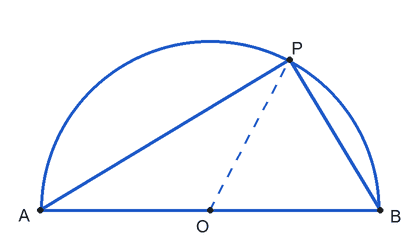
    ABAB is a diameter of a circle with centre OO. A point PP, different from AA and BB, is such that ∠APB=90∘\angle APB = 90^\circ. Using vectors, prove that PP lies on the circle. (This is the converse of the result that the angle in a semicircle is a right angle.)
    Class 12 Maths Scalar or Dot Product

    Medium
    3 marks
  44. 44

    Question 44

    Using vectors, prove that if two medians of a triangle are equal in length, then the triangle is isosceles.

    Medium
    3 marks
  45. 45

    Question 45

    Using the scalar product, prove that the diagonals of a rhombus are perpendicular to each other.

    Medium
    2 marks
  46. 46

    Question 46

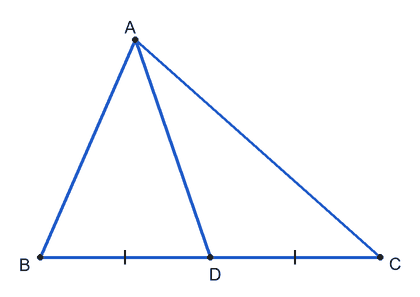
    In △ABC\triangle ABC, DD is the midpoint of BCBC. Using vectors, prove that AB2+AC2=2(AD2+BD2)AB^2 + AC^2 = 2\left(AD^2 + BD^2\right).

    Class 12 Maths Scalar or Dot Product

    Medium
    3 marks
  47. 47

    Question 47

    ABCDABCD is a rectangle and PP is any point. Using vectors, prove that PA2+PC2=PB2+PD2PA^2 + PC^2 = PB^2 + PD^2.

    Class 12 Maths Scalar or Dot Product

    Medium
    4 marks
  48. 48

    Question 48

    In △ABC\triangle ABC with BC=aBC = a, CA=bCA = b and AB=cAB = c, use the scalar product to prove that a=bcos⁡C+ccos⁡Ba = b\cos C + c\cos B.

    Class 12 Maths Scalar or Dot Product

    Medium
    3 marks