
Opening your dashboard
Class 12 Chemistry Chapter 6 General Principles and Processes of Isolation of Elements: Practice Questions
150 questions on Chapter 6, each worked through on its own page with the AI tutor. Class 12 Chemistry, ICSE 2026-27.
150 questions
1–4 marks · Mixed difficulty
- 11 mark
Question 1
A metal X occurs in two minerals. Mineral P contains 72% of X but is found only in small, scattered deposits deep underground, and getting X from it needs costly chemical steps. Mineral Q contains 48% of X, is found in large deposits near the surface, and X can be extracted from it cheaply. (Hypothetical data.) Which statement is correct?
- 23 marks
Question 2
Iron pyrites () is a plentiful mineral of iron, yet iron is not extracted from it.
(a) Calculate the percentage of iron by mass in and in haematite, . (Fe = 56, S = 32, O = 16)
(b) Give two reasons why iron pyrites is not used as an ore of iron.
- 32 marks
Question 3
Write the chemical formula of each of the following minerals and classify it as an oxide, carbonate, sulphide or halide mineral.
(a) Cassiterite
(b) Cerussite
(c) Cinnabar
(d) Horn silver
- 41 mark
Question 4
Arrange the following copper minerals in decreasing order of the percentage of copper by mass: cuprite (), copper glance (), malachite () and copper pyrites (). (Cu = 63.5, Fe = 56, S = 32, C = 12, O = 16, H = 1)
- 53 marks
Question 5
A sample of bauxite contains 40.8% by mass; the rest is gangue. (Hypothetical data.) (Al = 27, O = 16)
(a) Calculate the mass of in 1.00 tonne of this bauxite.
(b) Calculate the mass of aluminium that this alumina could give.
(c) If the whole process recovers only 95% of the aluminium, how much aluminium is obtained per tonne of bauxite?
- 61 mark
Question 6
A white mineral dissolves in dilute hydrochloric acid with brisk effervescence of a gas that turns lime water milky. When the mineral is heated strongly, it leaves a residue that is yellow while hot and white when cold. The mineral is
- 73 marks
Question 7
Three iron minerals A, B and C are tested.
- A is black and is strongly attracted by a magnet.
- B is a reddish ore that leaves a red-brown streak when rubbed on unglazed porcelain.
- C gives effervescence of carbon dioxide with warm dilute hydrochloric acid.
(a) Identify A, B and C, giving their chemical formulae.
(b) State the oxidation state(s) of iron in A.
- 81 mark
Question 8
In froth flotation a collector such as sodium ethyl xanthate is added. The xanthate ion has a polar (ionic) head and a non-polar hydrocarbon tail. How does it help the sulphide particles rise with the froth?
- 92 marks
Question 9
Bauxite is not concentrated by froth flotation. Explain why, and name the method used to concentrate it.
- 104 marks
Question 10
A copper ore contains 1.2% copper, present as copper pyrites. 500 kg of the ore is concentrated by froth flotation, and 20.0 kg of concentrate containing 27.0% copper is obtained. (Hypothetical data.)
(a) Calculate the mass of copper in the ore taken.
(b) Calculate the mass of copper in the concentrate.
(c) Calculate the percentage of the copper that is recovered in the concentrate.
(d) Calculate the percentage of copper left in the waste (tailings).
- 111 mark
Question 11
A tin ore contains cassiterite (, density about 7.0 g cm⁻³) mixed only with sand (silica, density 2.65 g cm⁻³). Neither substance is magnetic. The most suitable method of concentrating this ore is
- 121 mark
Question 12
4.42 g of pure malachite, , is calcined until there is no further change in mass. The mass of the residue is (Cu = 63.5, C = 12, O = 16, H = 1)
- 133 marks
Question 13
In a lead works, 717 kg of concentrated galena (PbS) is roasted completely in excess air. (Hypothetical data.) (Pb = 207, S = 32, O = 16, H = 1)
(a) Write the balanced equation for the roasting.
(b) Calculate the volume of sulphur dioxide formed, measured at S.T.P.
(c) If all this sulphur dioxide is used to make sulphuric acid, what mass of can be obtained?
- 142 marks
Question 14
A roasted ore contains 6.0% silica () by mass as its only gangue. It is smelted with limestone as flux. (Hypothetical data.) (Ca = 40, Si = 28, C = 12, O = 16)
(a) Write the equation for the formation of slag.
(b) Calculate the minimum mass of pure limestone needed per tonne of the ore.
- 153 marks
Question 15
Siderite () is heated strongly.
(a) Write the equation when it is heated in the absence of air.
(b) Write the equation when it is heated in a current of air.
(c) In which case does iron change its oxidation state? Name the oxidising agent.
- 161 mark
Question 16
A concentrate containing 302 kg of is reduced with coke at a high temperature, the carbon being oxidised to carbon monoxide. The minimum mass of carbon needed is (Sn = 119, C = 12, O = 16)
- 173 marks
Question 17
The table gives values, in kJ per mole of , for two reactions at two temperatures. (Hypothetical data for metal M.)
Reaction 1000 K 1500 K −500 −400 −400 −490 (a) Write the equation for the reduction of MO by carbon and show how its is obtained from the two values.
(b) Calculate for this reduction at 1000 K and at 1500 K.
(c) At which of the two temperatures can carbon reduce MO? What does this mean for the positions of the two lines on an Ellingham diagram?
- 181 mark
Question 18
On an Ellingham diagram, the line for becomes noticeably steeper above about 630 K. This is because above this temperature
- 193 marks
Question 19
For the two reactions of carbon and carbon monoxide (per mole of , T in kelvin):
: kJ
: kJ
(a) Calculate the temperature at which the two Ellingham lines cross.
(b) Which is the better reducing agent above this temperature, carbon or carbon monoxide? Give a reason.
(c) Explain why the line for C → CO slopes downward.
- 202 marks
Question 20
For the reaction , kJ and kJ K⁻¹ per mole of . Assume they do not change with temperature.
(a) Calculate the temperature above which silver oxide is no longer stable.
(b) What does this tell you about obtaining silver from its oxide?
- 211 mark
Question 21
An Ellingham diagram shows that the reduction of a metal oxide by carbon monoxide should be feasible at 750 K. In a trial at 750 K, however, no metal is formed even after several hours. (Hypothetical case.) The best explanation is that
- 221 mark
Question 22
Scrap iron is added separately to dilute solutions of four salts. From which solution can iron not recover the metal?
( values: V, V, V, V, V)
- 233 marks
Question 23
For the electrolysis of molten magnesium chloride,
kJ mol⁻¹ at the temperature of the cell. (Hypothetical data.) (F = 96500 C mol⁻¹)
(a) How many electrons are transferred per formula unit of ?
(b) Calculate the minimum voltage that must be applied to bring about this electrolysis.
(c) Why must at least this voltage be applied?
- 241 mark
Question 24
A charge of 9650 C is passed through molten calcium chloride. The mass of calcium deposited at the cathode is (Ca = 40, Cl = 35.5, F = 96500 C mol⁻¹)
- 254 marks
Question 25
Leach solutions from low-grade ores contain metal ions in water. Using V, V and V (F = 96500 C mol⁻¹):
(a) Write the ionic equations for the reduction of and of by hydrogen gas.
(b) Calculate for each reaction.
(c) Calculate for each reaction.
(d) Which metal can be recovered from its solution in this way? Give a reason.
- 261 mark
Question 26
Serpeck's process, rather than Bayer's process, is chosen for purifying bauxite when the main impurity in the bauxite is
- 271 mark
Question 27
In the Hall–Héroult cell, the graphite anode rods have to be replaced from time to time. This is because the anodes
- 283 marks
Question 28
A Hall–Héroult cell is run at a steady current of 150 kA for 24 hours. The current efficiency is 90%. (Hypothetical data.) Calculate the mass of aluminium produced by this cell in one day. (Al = 27, F = 96500 C mol⁻¹)
- 292 marks
Question 29
Bauxite usually contains iron(III) oxide and silica as impurities. Explain why the bauxite must be purified to pure alumina before electrolysis, instead of electrolysing the crude ore and purifying the aluminium afterwards.
- 302 marks
Question 30
A sample of bauxite contains 55% by mass. (Hypothetical data.) Calculate the minimum mass of this bauxite needed to produce 1.00 tonne of aluminium, assuming all the alumina in it is converted into the metal. (Al = 27, O = 16)
- 311 mark
Question 31
The gas present in the largest proportion in the hot gases leaving the top of a blast furnace is
- 321 mark
Question 32
Coke, rather than coal, is used as the fuel and reducing agent in a blast furnace mainly because coke
- 333 marks
Question 33
A blast furnace produces 1.00 tonne of pig iron containing 95% iron by mass. The haematite ore used contains 80% . (Hypothetical data.) Assume all the iron comes from reduced by carbon monoxide. Calculate
(a) the mass of reduced,
(b) the mass of ore needed,
(c) the mass of carbon monoxide used.
(Fe = 56, O = 16, C = 12)
- 342 marks
Question 34
The air blown into a blast furnace is first preheated to well above 1000 K in tall stoves. Give two reasons why a hot blast is used instead of cold air.
- 354 marks
Question 35
Pig iron from a blast furnace contains about 4% carbon, along with small amounts of silicon, manganese, phosphorus and sulphur.
(a) How does carbon get into the iron?
(b) How do silicon and phosphorus get into the iron? Give an equation for each.
(c) Why is pig iron not used to make a part such as a car axle?
(d) What must be done to pig iron to make it suitable for such a part?
- 361 mark
Question 36
In the extraction of zinc, zinc oxide is reduced by coke at about 1673 K. Zinc has a low boiling point. In this process the zinc is obtained
- 372 marks
Question 37
In the electrolytic extraction of zinc, roasted zinc ore is leached with dilute sulphuric acid. Before electrolysis, the zinc sulphate solution is stirred with zinc dust to remove cadmium sulphate present in it.
(a) Write the equation for the reaction.
(b) Explain why the cadmium must be removed before the electrolysis. (: V, V)
- 383 marks
Question 38
Copper pyrites, , is the main ore of copper. During its extraction, all the sulphur ends up as sulphur dioxide.
(a) Calculate the percentage of copper in pure .
(b) Calculate the mass of formed from 1.00 tonne of pure .
(c) Why do modern copper smelters not release this gas into the air, and what is it usually used for?
(Cu = 63.5, Fe = 56, S = 32, O = 16)
- 391 mark
Question 39
In the cyanide process, silver is recovered from sodium dicyanoargentate(I) solution by adding zinc dust. What is the minimum mass of zinc needed to recover 21.6 g of silver? (Ag = 108, Zn = 65)
- 402 marks
Question 40
Copper is recovered from low-grade ores by leaching them with dilute sulphuric acid and then adding scrap iron to the copper(II) sulphate solution obtained.
(a) Write the equation for the recovery of copper.
(b) Using values, explain why scrap iron can be used. (: V, V)
- 411 mark
Question 41
Chromatographic methods of refining are most useful for elements that
- 421 mark
Question 42
In Hoope's three-layer process for refining aluminium, the bottom layer is impure aluminium to which copper is added. The copper is added mainly to
- 433 marks
Question 43
A small pilot cell for the electrolytic refining of copper is run at 250 A for 12 hours. The current efficiency is 95%. Calculate the mass of pure copper deposited on the cathode. (Cu = 63.5, F = 96500 C mol⁻¹)
- 442 marks
Question 44
In the electrolytic refining of copper, the electrolyte is copper(II) sulphate solution to which some dilute sulphuric acid is added. Give two reasons for adding the acid.
- 453 marks
Question 45
A rod of impure germanium is purified by zone refining.
(a) Why do the impurities move along with the molten zone?
(b) Why is the heater passed along the rod several times, and why is one end of the rod finally cut off?
(c) Why is the process carried out in an inert gas or in vacuum?
- 461 mark
Question 46
Aluminium conducts electricity only about 60% as well as copper, yet it is used for long overhead power lines. The main reason is that aluminium
- 471 mark
Question 47
Stainless steel does not rust easily because it contains
- 483 marks
Question 48
Iron sheets are protected from rusting either by galvanising (coating with zinc) or by tin-plating. (: V, V, V)
(a) Why does galvanised iron not rust even when the zinc coating is scratched?
(b) Why does tin-plated iron rust quickly once the tin coating is scratched?
(c) Why are food cans tin-plated rather than galvanised?
- 493 marks
Question 49
Choose the most suitable commercial form of iron (cast iron, wrought iron or steel) for each of the following, and give one property that makes it suitable.
(a) The core of an electromagnet
(b) A manhole cover or a gas-stove burner
(c) Railway tracks and bridge girders
- 501 mark
Question 50
Silver bromide is used in photographic film because it
- 512 marks
Question 51
Give a balanced equation for the preparation of in the laboratory.
- 522 marks
Question 52
Give balanced chemical equation for the reaction between Zn and sodium argentocyanide solution.
- 532 marks
Question 53
Give the equations for the conversion of argentite () to metallic Ag.
- 542 marks
Question 54
Give the balanced equations for the conversion of argentite () to metallic Ag.
- 551 mark
Question 55
Purification of Al by electrolytic refining is called:
- 562 marks
Question 56
Fill up the blanks:
In electrolytic refining the impure metal is made ______ while a thin sheet of pure metal is used as ______.
- 571 mark
Question 57
Which of the oxide groups among the following cannot be reduced by carbon?
- 581 mark
Question 58
Extraction of zinc from zinc blende is achieved by
- 591 mark
Question 59
The substance used as froth stabilisers in froth-flotation process is
- 601 mark
Question 60
Which method of purification is represented by the following equation?
- 611 mark
Question 61
In the electrolysis of alumina to obtain aluminium metal, cryolite is added mainly to
- 621 mark
Question 62
Calcination is the process in which:
- 631 mark
Question 63
In Goldschmidt aluminothermic process which of the following reducing agents is used.
- 641 mark
Question 64
Sulfide ores are common for the metals
- 651 mark
Question 65
The carbon-based reduction method is NOT used for the extraction of
(A) Tin from
(B) Iron from
(C) Aluminium from
(D) Magnesium from
- 661 mark
Question 66
Which one of the following ores is known as Malachite:
- 671 mark
Question 67
The form of iron obtained from blast furnace is:
- 681 mark
Question 68
Which one of the following ores is best concentrated by froth-flotation method?
- 691 mark
Question 69
Upon heating with , the reagent(s) that give copper metal is/are?
(A)
(B)
(C)
(D)
- 701 mark
Question 70
Calamine is an ore of:
- 711 mark
Question 71
The metal that cannot be obtained by electrolysis of an aqueous solution of its salts is:
- 721 mark
Question 72
In the context of the Hall-Heroult process for the extraction of Al, which of the following statements is false?
- 731 mark
Question 73
In the isolation of metals, calcination process usually results in:
- 741 mark
Question 74
Which one of the following ores is best concentrated by froth flotation method?
- 751 mark
Question 75
Extraction of copper by smelting uses silica as an additive to remove:
- 761 mark
Question 76
Extraction of copper from copper pyrite () involves
(A) crushing followed by concentration of the ore by froth-flotation
(B) removal of iron as slag
(C) self-reduction step to produce 'blister copper' following evolution of
(D) refining of 'blister copper' by carbon reduction
- 771 mark
Question 77
In the extraction of copper from its sulphide ore, metal is finally obtained by the oxidation of cuprous sulphide with:
- 781 mark
Question 78
In the leaching method, bauxite ore is digested with a concentrated solution of NaOH that produces 'X'. When gas is passed through the aqueous solution of 'X', a hydrated compound 'Y' is precipitated. 'X' and 'Y' respectively are.
- 791 mark
Question 79
The one that is not a carbonate ore is:
- 801 mark
Question 80
Match the ores (column A) with the metals (column B):
(Column A) (Column B) (I) Siderite (p) Zinc (II) Kaolinite (q) Copper (III) Malachite (r) Iron (IV) Calamine (s) Aluminium - 811 mark
Question 81
The ore that contains both iron and copper is:
- 821 mark
Question 82
The idea of froth flotation method came from a person X and this method is related to the process Y of ores. X and Y respectively, are:
- 831 mark
Question 83
The correct statement is:
- 841 mark
Question 84
The correct statement is:
- 851 mark
Question 85
The ore that contains the metal in the form of fluoride is:
- 861 mark
Question 86
Assertion: For the extraction of iron, haematite ore is used.
Reason: Haematite is a carbonate ore of iron.
- 871 mark
Question 87
With respect to an ore, Ellingham diagram helps to predict the feasibility of its
- 881 mark
Question 88
The Mond process is used for the:
- 891 mark
Question 89
In the Hall-Heroult process, aluminium is formed at the cathode. The cathode is made out of:
- 901 mark
Question 90
The pair that does NOT require calcination is:
- 911 mark
Question 91
The reaction that does NOT define calcination is:
- 921 mark
Question 92
Hall-Heroult's process is given by:
- 931 mark
Question 93
The electrolytes usually used in the electroplating of gold and silver, respectively, are;
- 941 mark
Question 94
The correct statement regarding the given Ellingham diagram is:
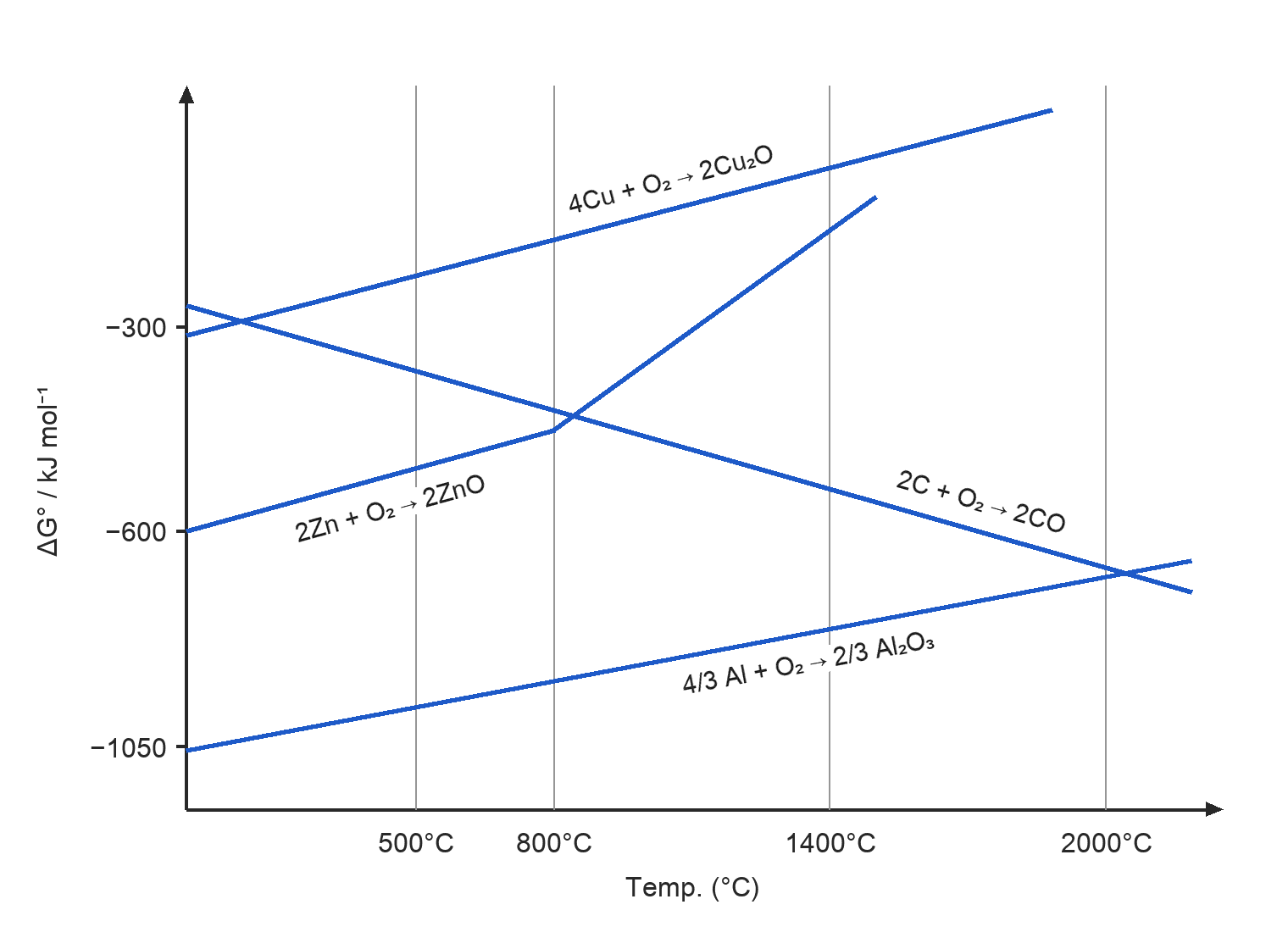
- 951 mark
Question 95
Match the refining methods (Column I) with metals (Column II).
Column I (Refining methods) Column II (Metals) (A) Liquation (i) Zr (B) Zone Refining (ii) Ni (C) Mond Process (iii) Sn (D) Van Arkel Method (iv) Ga - 961 mark
Question 96
Calamine, malachite, magnetite and cryolite, respectively, are
- 971 mark
Question 97
The cyanide process of gold extraction involves leaching out gold from its ore with in the presence of Q in water to form R. Subsequently, R is treated with T to obtain Au and Z. Choose the Correct option(s)
(a) Q is
(b) T is Zn
(c) Z is
(d) R is
- 981 mark
Question 98
The INCORRECT statement is:
- 991 mark
Question 99
For a reaction, , the free energy change is plotted as a function of temperature. The temperature below which the oxide is stable could be inferred from the plot as the point at which:
- 1001 mark
Question 100
An Ellingham diagram provides information about:
- 1011 mark
Question 101
Among statements (1)-(4), the correct ones are:
(1) Lime stone is decomposed to CaO during the extraction of iron from its oxides.
(2) In the extraction of silver, silver is extracted as an anionic complex.
(3) Nickel is purified by Mond's process.
(4) Zr and Ti are purified by Van Arkel method.
- 1021 mark
Question 102
According to the following diagram, A reduces when the temperature is:
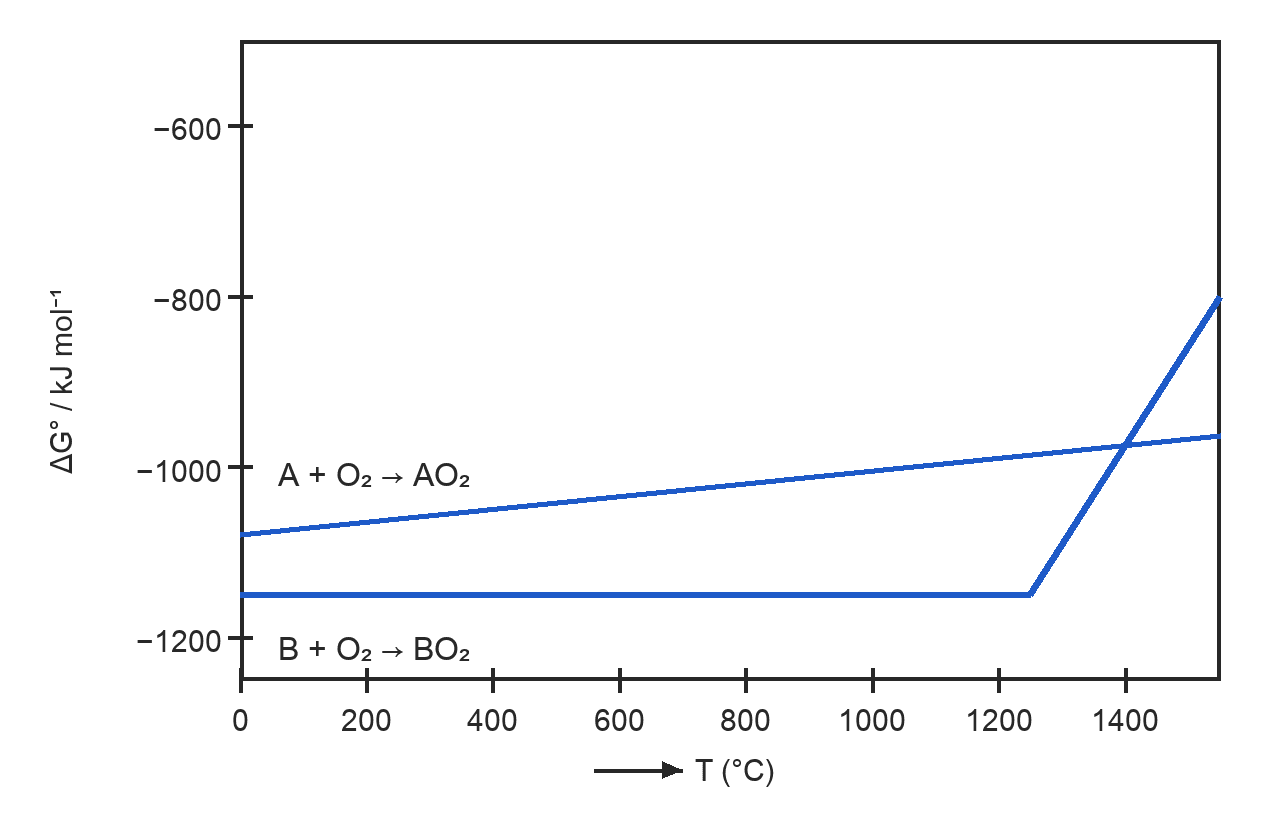
- 1031 mark
Question 103
The element that can be refined by distillation is :
- 1041 mark
Question 104
Among the reactions (i)-(iv), the reaction(s) that does/do not occur in the blast furnace during the extraction of iron is/are:
(i)
(ii)
(iii)
(iv)
- 1051 mark
Question 105
The refining method used when the metal and the impurities having low and high melting temperatures respectively, is:
- 1061 mark
Question 106
Boron and silicon of very high purity can be obtained through:
- 1071 mark
Question 107
Which among the following statement(s) is(are) true for the extraction of aluminium from bauxite?
(a) Hydrated precipitates, when is bubbled through a solution of sodium aluminate.
(b) Addition of lowers the melting point of alumina.
(c) is evolved at the anode during electrolysis.
(d) The cathode is a steel vessel with a lining of carbon.
- 1081 mark
Question 108
Calamine and Malachite, respectively, are the ores of.
- 1091 mark
Question 109
Match List-I with List-II
List-I (Name of ore/mineral) List-II (Chemical formula) (A) Calamine (i) ZnS (B) Malachite (ii) (C) Siderite (iii) (D) Sphalerite (iv) Choose the most appropriate answer from the options given below:
- 1101 mark
Question 110
Sulphide ion is soft base and its ores are common for metals.
(i) Pb
(ii) Al
(iii) Ag
(iv) Mg
Choose the correct answer from the options given below:
- 1111 mark
Question 111
Given below are two statements.
Statement I: The choice of reducing agents for metals extraction can be made by using Ellingham diagram, a plot of ΔG vs temperature.
Statement II: The value of ΔS increases from left to right in Ellingham diagram.
In the light of the above statements, choose the most appropriate answer from the options given below:
- 1121 mark
Question 112
In the leaching of alumina from bauxite, the ore expected to leach out in the process by reacting with NaOH is:
- 1131 mark
Question 113
Match List I with List II: (Both having metallurgical terms)
List I List II (A) Concentration of Ag ore (i) Reverberatory Furnace (B) Blast furnace (ii) (C) Blister copper (iii) Leaching with dilute NaCN solution (D) Froth flotation method (iv) Sulfide ores Choose the Correct answer from the options given below:
- 1141 mark
Question 114
Consider two chemical reactions (A) and (B) that take place during metallurgical process:
(A)
(B)
The correct option of names given to them respectively is:
- 1151 mark
Question 115
The chemical that is added to reduce the melting point of the reaction mixture during the extraction of aluminium is
- 1161 mark
Question 116
Ellingham diagram is a graphical representation of:
- 1171 mark
Question 117
Which of the following ore is concentrated using group I cyanide salt?
- 1181 mark
Question 118
Given below are two statements, one is labelled as Assertion (A) and the other is labelled as Reason (R).
Assertion (A): Aluminium is extracted from bauxite by the electrolysis of molten mixture of with cryolite.
Reason (R): The oxidation state of Al in cryolite is +3.
In the light of the above statements, choose the most appropriate answer from the options given below:
- 1191 mark
Question 119
Which refining process is generally used in the purification of low melting metal?
- 1201 mark
Question 120
Match List I with List II.
List I List II (A) Sodium Carbonate (i) Deacon (B) Titanium (ii) Castner-Kellner (C) Chlorine (iii) Van-Arkel (D) Sodium hydroxide (iv) Solvay Choose the Correct answer from the options given below:
- 1211 mark
Question 121
The correct statement(s) related to the metal extraction processes is(are)
(a) A mixture of PbS and PbO undergoes self-reduction to produce Pb and .
(b) In the extraction process of copper from copper pyrites, silica is added to produce copper silicate.
(c) Partial oxidation of sulphide ore of copper by roasting, followed by self-reduction produces blister copper.
(d) In cyanide process, zinc powder is utilized to precipitate gold from
- 1221 mark
Question 122
The electrochemical extraction of Al from bauxite ore involves:
(a) The reaction of with coke (C) at a temperature >250°C
(b) The neutralisation of aluminate solution by passing gas to precipitate hydrated alumina ()
(c) The dissolution of in hot aqueous NaOH
(d) The electrolysis of mixed with to give Al and
- 1231 mark
Question 123
Which of the following comes out as slag in metallurgy of Cu ?
- 1241 mark
Question 124
Statement I: Pig iron can be obtained from cast iron
Statement II: Cast iron has least carbon content.
- 1251 mark
Question 125
Liquation refining is based on:
- 1261 mark
Question 126
Which of the following is not extracted from its sulphide ore?
- 1271 mark
Question 127
Which of the following elements is present as the impurity to the maximum extent in the pig iron?
- 1281 mark
Question 128
The following reactions take place in the blast furnace in the preparation of impure iron. Identify the reaction pertaining to the formation of the slag.
- 1291 mark
Question 129
Which of the following pairs of metals is purified by van Arkel method?
- 1301 mark
Question 130
Which one of the following is a mineral of iron?
- 1311 mark
Question 131
In the extraction of copper from its sulphide ore, the metal is finally obtained by the reduction of cuprous oxide with:
- 1321 mark
Question 132
Identify the alloy containing a non-metal as a constituent in it.
- 1331 mark
Question 133
Aluminium is extracted from alumina () by electrolysis of a molten mixture of
- 1341 mark
Question 134
If the for a given reaction has a negative value then which of the following gives the correct relationships for the values of and ?
- 1351 mark
Question 135
The metal oxide which cannot be reduced to metal by carbon is
- 1361 mark
Question 136
The electrode potential for:
and
are +0.15 V and +0.50 V respectively. The value of will be
- 1371 mark
Question 137
In the metallurgy of aluminium:
- 1381 mark
Question 138
The pair of compounds that can exist together is:
- 1391 mark
Question 139
In electrorefining of copper some gold is deposited at
- 1401 mark
Question 140
“Metals are usually not found as nitrates in their ores”.
Out of the following two [(i) and (ii)] reasons which is/are true for the above observation?
(i) Metal nitrates are highly unstable.
(ii) Metal nitrates are highly soluble in water.
- 1411 mark
Question 141
In the extraction of copper from its sulphide ore, the metal finally obtained by the reduction of cuprous oxide with :
- 1421 mark
Question 142
vs plot in Ellingham’s diagram slopes downward for the reaction:
- 1431 mark
Question 143
Match items of Column I with the items of Column II and assign the correct code:
Column-I Column-II (1) Cyanide process (i) Ultrapure Ge (2) Froth flotation process (ii) Dressing of ZnS (3) Electrolytic reduction (iii) Extraction of Al (4) Zone refining (iv) Extraction of Au (v) Purification of Ni Code:
- 1441 mark
Question 144
Extraction of gold and silver involves leaching with ion. Silver is later recovered by
- 1451 mark
Question 145
Considering Ellingham diagram, which of the following metals can be used to reduce alumina?
- 1461 mark
Question 146
Which one is malachite from the following?
- 1471 mark
Question 147
Identify the incorrect statement.
- 1481 mark
Question 148
Identify the correct statement from the following:
- 1491 mark
Question 149
Which one of the following methods can be used to obtain highly pure metal which is liquid at room temperature?
- 1501 mark
Question 150
Match List-I with List-II.
List-I (Ores) List-II (Composition) (p) Haematite (i) (q) Magnetite (ii) (r) Calamine (iii) (s) Kaolinite (iv) Choose the correct answer from the options given below: