
Opening your dashboard
Class 12 Chemistry Chapter 5 Surface Chemistry: Practice Questions
99 questions on Chapter 5, each worked through on its own page with the AI tutor. Class 12 Chemistry, ICSE 2026-27.
99 questions
1–4 marks · Mixed difficulty
- 11 mark
Question 1
A solid takes up a substance from its surroundings. Which observation shows that the process is adsorption and not absorption?
- 22 marks
Question 2
Explain why the particles on the surface of a solid can attract and hold molecules of a gas, while the particles in the interior cannot. Why is adsorption therefore called a surface phenomenon?
- 31 mark
Question 3
For the adsorption of a gas on a solid, kJ mol⁻¹ and J K⁻¹ mol⁻¹. Assuming that and do not change with temperature, the adsorption is spontaneous only below about (Hypothetical data.)
- 42 marks
Question 4
Powdered charcoal is shaken with a dilute solution of methylene blue (a blue dye) and the mixture is filtered. The filtrate is much paler than the original solution.
(a) Name the adsorbate and the adsorbent.
(b) On shaking for longer, the colour of the solution stops fading at a pale shade instead of becoming colourless. Explain why.
- 52 marks
Question 5
A little activated charcoal is placed in a closed flask of a gas at room temperature. The pressure of the gas falls and then becomes steady. When the flask is warmed, the pressure rises again. Explain both observations. What do they show about the sign of for the adsorption?
- 61 mark
Question 6
A gas is adsorbed on a solid with an enthalpy of adsorption of about kJ mol⁻¹. It forms several layers and is completely removed when the pressure is lowered at the same temperature. Which further property is expected for this adsorption?
- 73 marks
Question 7
A cube of charcoal of edge cm is crushed into tiny cubes, each of edge m ( cm). (Hypothetical example.)
(a) Calculate the total surface area before and after crushing.
(b) By what factor has the surface area increased?
(c) How will this affect the amount of a gas that the charcoal can adsorb? Give a reason.
- 82 marks
Question 8
Nitrogen is adsorbed in large amounts on charcoal at K but hardly at all at K. On the other hand, nitrogen is chemisorbed on iron to an appreciable extent only at high temperatures (about K) and hardly at all at K. Explain both observations.
- 91 mark
Question 9
Gas masks filled with activated charcoal protect against chlorine (critical temperature K) and phosgene, (critical temperature K), but give almost no protection against carbon monoxide. The best reason is that carbon monoxide
- 102 marks
Question 10
(a) Charcoal is activated by heating it in superheated steam or in a vacuum at a high temperature. Why does this increase its adsorbing power?
(b) Why is a bed of charcoal ground into an extremely fine dust sometimes less effective for adsorbing a gas than a bed of small granules?
- 113 marks
Question 11
A L flask contains ammonia at atm and K. g of activated charcoal is introduced and the flask is kept at K. At equilibrium the pressure of ammonia is atm. Neglecting the volume of the charcoal, calculate (a) the number of moles of ammonia adsorbed, (b) its mass, and (c) the extent of adsorption in mg g⁻¹. ( L atm K⁻¹ mol⁻¹; Hypothetical data.)
- 124 marks
Question 12
Water from a factory contains mg L⁻¹ of an organic pollutant. Activated carbon removes the pollutant according to the Freundlich equation
where is in mg of pollutant per g of carbon and is the equilibrium concentration in mg L⁻¹. A L batch of the water is to be treated until the concentration falls to mg L⁻¹. (Hypothetical data.)
(a) What mass of pollutant must be removed?
(b) What is at the end of the treatment?
(c) Calculate the mass of activated carbon needed.
(d) Why is calculated at mg L⁻¹ and not at mg L⁻¹?
- 131 mark
Question 13
In some Dewar (vacuum) flasks a little activated charcoal is placed in the evacuated space between the double walls. Its purpose is to
- 142 marks
Question 14
Sodium chloride solution is titrated with silver nitrate solution using a few drops of fluorescein as indicator. The solution is greenish-yellow during the titration, and at the end point the precipitate turns pink. Explain the colour change in terms of adsorption.
- 151 mark
Question 15
For the adsorption of a gas on a solid, a plot of against is a straight line of slope . If the equilibrium pressure is raised from bar to bar at the same temperature, becomes
- 161 mark
Question 16
Which of the following is an example of homogeneous catalysis?
- 173 marks
Question 17
When acidified potassium permanganate solution is added to warm oxalic acid solution, the first few drops are decolourised slowly, but later drops are decolourised almost at once:
(a) Name this type of catalysis and identify the catalyst.
(b) Describe how the rate of the reaction changes from start to finish, and explain each stage.
(c) How could the slow start be avoided?
- 181 mark
Question 18
A small amount of acetanilide is added to hydrogen peroxide solution sold in shops so that the peroxide does not decompose during storage. Acetanilide acts here as
- 193 marks
Question 19
Ethyl ethanoate is hydrolysed very slowly by pure water, but much faster when a little dilute hydrochloric acid is added:
(a) Is the catalysis by hydrochloric acid homogeneous or heterogeneous? Give a reason.
(b) How do the ions speed up the reaction, and why is the acid not used up?
(c) Even without hydrochloric acid, the hydrolysis speeds up slightly as it proceeds. Explain.
- 201 mark
Question 20
Air bubbled through sodium arsenite solution does not oxidise it, and air bubbled through sodium sulphite solution oxidises it quickly. When air is bubbled through a solution containing both salts, both are oxidised. This is an example of
- 213 marks
Question 21
A catalyst lowers the activation energy of a reaction by kJ mol⁻¹ without changing the pre-exponential factor . Using the Arrhenius equation, calculate how many times faster the catalysed reaction is (a) at K and (b) at K. (c) Comment on your answers. ( J K⁻¹ mol⁻¹)
- 223 marks
Question 22
In a car's catalytic converter, carbon monoxide is oxidised on a finely divided platinum surface:
(a) Using the adsorption theory of heterogeneous catalysis, describe the steps by which this reaction takes place on the platinum surface.
(b) Why is the platinum spread as a very thin, finely divided layer on a support rather than used as a solid block?
- 231 mark
Question 23
Cars fitted with catalytic converters must not use petrol containing lead compounds. This is because lead
- 243 marks
Question 24
The decomposition of hydrogen peroxide in solution is catalysed by iodide ions:
It is believed to take place in two steps through the hypoiodite ion, .
(a) Write the two steps.
(b) Show that the iodide ion is a catalyst and name the intermediate.
(c) Which theory of catalysis does this mechanism illustrate, and how does it explain the faster rate?
- 251 mark
Question 25
Which industrial process is correctly paired with the catalyst used in it?
- 261 mark
Question 26
The enzyme lactase hydrolyses lactose (milk sugar) into glucose and galactose, but it has no action on sucrose, although sucrose is also a disaccharide that can be hydrolysed. Which characteristic of enzymes does this show?
- 272 marks
Question 27
For each change below, name the enzyme that catalyses it and write the balanced equation.
(a) Maltose is hydrolysed to glucose during the brewing of beer with yeast.
(b) Urea is hydrolysed to ammonia and carbon dioxide by an enzyme obtained from soyabean.
- 283 marks
Question 28
(a) Write the two steps of the Michaelis–Menten mechanism for an enzyme-catalysed reaction and state which step is slow.
(b) When the substrate concentration is raised, the rate of an enzyme-catalysed reaction increases at first but then becomes constant. Explain this with the help of the mechanism.
- 291 mark
Question 29
Hydrogen cyanide is highly poisonous to living cells even in very small amounts. Which statement best explains its action in terms of enzyme catalysis?
- 301 mark
Question 30
Consider three colloidal systems in water: (1) a gold sol, (2) a starch sol, and (3) sodium dodecyl sulphate solution above its critical micelle concentration. They are, in that order,
- 312 marks
Question 31
For each of the following colloidal systems, name the dispersed phase, the dispersion medium and the type of colloid.
(a) Whipped cream
(b) Ruby-red glass
(c) The fine mist from a perfume spray
(d) Paint
- 323 marks
Question 32
Sodium dodecyl sulphate, , is a common detergent.
(a) Why is it called an associated colloid?
(b) Describe how the dodecyl sulphate ions are arranged in a micelle in water.
(c) What is the sign of the charge on the surface of such a micelle? Give a reason.
- 333 marks
Question 33
(Hypothetical data.) A gold sol contains spherical gold particles of diameter 10 nm. The density of gold is 19.3 g cm⁻³ and its molar mass is 197 g mol⁻¹ ( = 6.022 × 10²³ mol⁻¹).
(a) Calculate the volume of one particle.
(b) Calculate the approximate number of gold atoms in one particle.
(c) What type of colloid (based on the type of particles) does this show the gold sol to be?
- 341 mark
Question 34
A cube of a solid of edge 1 cm is divided into tiny cubes of edge 10 nm, which is in the colloidal range. By what factor does the total surface area increase?
- 351 mark
Question 35
A few drops of a solution of phenolphthalein in alcohol are poured into a large volume of water with stirring. The liquid turns milky, and the milky liquid passes unchanged through filter paper. This method of making a colloid is called
- 363 marks
Question 36
A protein sol contains sodium chloride and urea as impurities. It is purified by electrodialysis.
(a) Why is electrodialysis faster than ordinary dialysis for removing sodium chloride?
(b) Will the electric field speed up the removal of urea also? Give a reason.
(c) Why must the water outside the membrane be renewed continuously?
- 372 marks
Question 37
In Bredig's arc method a colloidal sol of a metal is made by striking an electric arc between metal electrodes held under water.
(a) Why is a trace of potassium hydroxide added to the water?
(b) Why is the vessel surrounded by ice?
- 381 mark
Question 38
Which of the following prepares a sol by breaking bigger particles down to colloidal size (a dispersion method) rather than by building particles up from ions or molecules (a condensation method)?
- 392 marks
Question 39
A gold sol can be made by warming a dilute solution of gold(III) chloride with formaldehyde, which is oxidised to formic acid.
(a) Write the balanced equation for the reaction.
(b) Identify the oxidising agent and the reducing agent, and name the type of method (dispersion or condensation) used.
- 403 marks
Question 40
(Hypothetical data.) Two 20 mL samples of the same sol were coagulated separately. The least volumes needed were 2.0 mL of 1.0 M NaCl for the first sample and 0.50 mL of 0.010 M for the second.
(a) Calculate the flocculation value of each electrolyte (in millimoles per litre of sol).
(b) How many times greater is the coagulating power of than that of NaCl for this sol?
(c) Is the sol positively or negatively charged? Give a reason.
- 411 mark
Question 41
A colloidal solution and a true solution containing the same mass of solute per litre are compared. The colloidal solution shows a much smaller lowering of freezing point. The main reason is that
- 422 marks
Question 42
A freshly made gold sol is red. When a little sodium chloride solution is added, the sol turns blue before the gold finally settles.
(a) Why does the colour change from red to blue?
(b) Why does sodium chloride cause this change?
- 433 marks
Question 43
(a) Describe the electrical double layer around a colloidal particle.
(b) What is meant by zeta potential?
(c) Explain, in terms of the zeta potential, why adding an electrolyte coagulates a lyophobic sol.
- 441 mark
Question 44
A gelatin sol is not coagulated by adding a small amount of sodium chloride. Which treatment will coagulate it most effectively?
- 451 mark
Question 45
A little oil-soluble red dye is stirred into a sample of an emulsion. Under a microscope, small red droplets are seen spread through a colourless continuous liquid. The emulsion is
- 463 marks
Question 46
(a) How does a sodium soap stabilise an emulsion of oil in water?
(b) A calcium soap is used instead of a sodium soap. What type of emulsion is now favoured?
(c) Name two methods of demulsification.
- 471 mark
Question 47
In which pair are both substances water-in-oil emulsions?
- 482 marks
Question 48
In tanning, animal hides are soaked in a solution of tannin, which makes the leather hard and stops it from rotting.
(a) What kind of coagulation takes place in tanning? Explain in terms of the charges involved.
(b) Why is the hide hardened by this process?
- 493 marks
Question 49
In some sewage-treatment plants, dirty water is passed slowly through tanks fitted with metal electrodes connected to a high voltage.
(a) The dirt particles in sewage water are colloidal and negatively charged. At which electrode do they collect?
(b) Why do they settle down as sludge at that electrode?
(c) Name the property of colloids used here and give one use of the sludge.
- 502 marks
Question 50
Give one example of homogeneously catalysed reaction and name the catalyst. Explain with an equation.
- 512 marks
Question 51
Explain why high pressure is used in the manufacture of ammonia by Haber's process, state the law or principle in reference to colloidal state of matter
- 522 marks
Question 52
Match the following; purification of colloids:
(a) Dialysis (b) Glycine
(c) Arrhenius (d) PHBV
- 531 mark
Question 53
Select the correct alternative from the choices given:
- 541 mark
Question 54
Select and write the correct alternative from the choices given below:
Assertion: Colloidal solutions are stable but colloidal particles do not settle down.
Reason: Brownian movement counters the force of gravity acting on colloidal particles
- 551 mark
Question 55
According to Freundlich adsorption isotherm, which of the following is correct?
- 561 mark
Question 56
The coagulating power of electrolytes having ions , and for arsenic sulphide sol increases in the order
- 571 mark
Question 57
Which of the following curves is in according to Freundlich adsorption isotherm?

- 581 mark
Question 58
3 g activated charcoal was added to 50 mL of acetic acid solution (0.06 N) in a flask. After an hour it was filtered and the strength of the filtrate was found to be 0.042 N. Amount of acetic acid adsorbed (per gram of charcoal) is:
- 591 mark
Question 59
In which one of the following properties, physisorption and chemisorption resemble each other?
- 601 mark
Question 60
For a linear plot of log (x/m) versus log p in a Freundlich adsorption isotherm, which of the following statement is correct? (k and n are constants)
- 611 mark
Question 61
The process which is responsible for the formation of delta at a place where rivers meet the sea is
- 621 mark
Question 62
Tyndall effect is observed only when following conditions are satisfied:
(i) The diameter of the dispersed particles is much smaller than the wavelength of the light used.
(ii) The diameter of the dispersed particle is not much smaller than the wavelength of the light used.
(iii) The refractive indices of the dispersed phase and dispersion medium are almost similar in magnitude.
(iv) The refractive indices of the dispersed phase and dispersion medium differ greatly in magnitude.
- 631 mark
Question 63
A gas undergoes physical adsorption on a surface and follows the given Freundlich adsorption isotherm equation
Adsorption of the gas increases with:
- 641 mark
Question 64
An example of solid sol is:
- 651 mark
Question 65
For coagulation of arsenious sulphide sol, which one of the following salt solution will be most effective?
- 661 mark
Question 66
Adsorption of a gas follows Freundlich adsorption isotherm. x is the mass of the gas adsorbed on mass m of the adsorbent. The plot of versus log p is shown in the graph. is proportional to:

- 671 mark
Question 67
Among the following, the false statement is:
- 681 mark
Question 68
As per Hardy-Schulze formulation, the flocculation values of the following for ferric hydroxide sol are in the order:
- 691 mark
Question 69
Which of the following is used for the preparation of colloids?
- 701 mark
Question 70
Amongst the following statements regarding adsorption, those that are valid are:
(i) ΔH becomes less negative as adsorption proceeds.
(ii) On a given adsorbent, ammonia is adsorbed more than nitrogen gas.
(iii) On adsorption, the residual force acting along the surface of the adsorbent increases.
(iv) With increase in temperature, the equilibrium concentration of adsorbate increases.
- 711 mark
Question 71
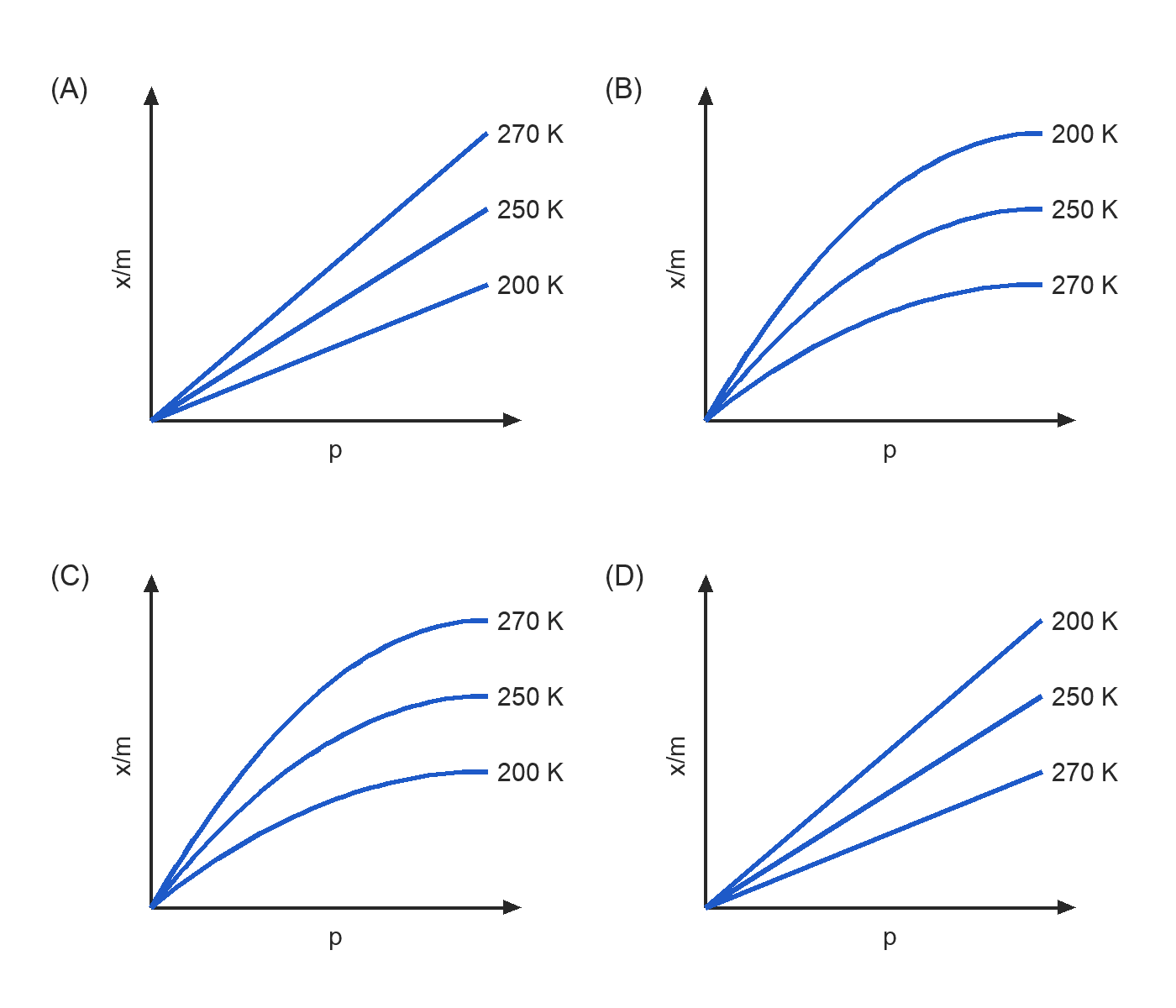
Adsorption of a gas follows Freundlich adsorption isotherm. If x is the mass of the gas adsorbed on mass m of the adsorbent, the correct plot of versus p is:
- 721 mark
Question 72
Match the following:
(i) Foam (A) smoke (ii) Gel (B) cell fluid (iii) Aerosol (C) jellies (iv) Emulsion (D) rubber (E) froth (F) milk - 731 mark
Question 73
A sample of red ink (a colloidal suspension) is prepared by mixing eosin dye, egg white, HCHO and water. The component which ensures stability of the ink sample is:
- 741 mark
Question 74
Krafft temperature is the temperature:
- 751 mark
Question 75
For Freundlich adsorption isotherm, a plot of log (x/m) (y-axis) and log p (x-axis) gives a straight line. The intercepts and slope for the line is 0.4771 and 2 respectively. The mass of gas, adsorbed per gram of adsorbent if the initial pressure is 0.04 atm is ______ × 10⁻⁴ g. (log 3 = 0.4771)
- 761 mark
Question 76
The flocculation value of HCl for arsenic sulphide sol is 30 mmol L⁻¹. If is used for the flocculation of arsenic sulphide, the amount, in grams, of in 250 mL required for the above purpose is ______. (molecular mass of = 98 g/mol)
- 771 mark
Question 77
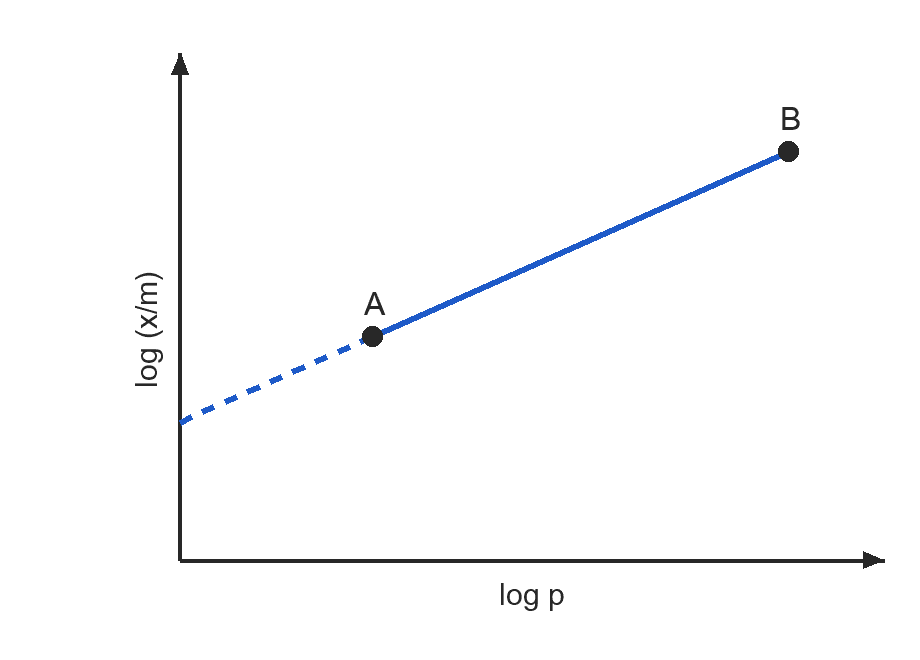
In Freundlich adsorption isotherm, slope of AB line is:
- 781 mark
Question 78
Most suitable salt which can be used for efficient clotting of blood will be:
- 791 mark
Question 79
In Freundlich isotherm at moderate pressure, the extent of adsorption is directly proportional to . The value of x is:
- 801 mark
Question 80
Which one of the following statement is FALSE for hydrophilic sols?
- 811 mark
Question 81
The charge on the colloidal CdS sol and Sol are respectively:
- 821 mark
Question 82
Match List I with List II.
List-I (Example of colloids) List-II (Classification) (A) Cheese (i) dispersion of liquid in liquid (B) Pumice stone (ii) dispersion of liquid in gas (C) Hair cream (iii) dispersion of gas in solid (D) Cloud (iv) dispersion of liquid in solid Choose the most appropriate answer from the options given below.
- 831 mark
Question 83
Tyndall effect is more effectively shown by:
- 841 mark
Question 84
Lyophilic sols are more stable than lyophobic sols because
- 851 mark
Question 85
gas adsorbs on charcoal following Freundlich adsorption isotherm. For a given amount of charcoal, the mass of adsorbed becomes 64 times when the pressure of is doubled. The value of n in the Freundlich isotherm equation is ...... × 10⁻² (Round off to the nearest integer)
- 861 mark
Question 86
is adsorbed on 1 g charcoal at 0°C following the Freundlich adsorption isotherm. 10.0 mL of is adsorbed at 100 mm of Hg, whereas 15.0 mL is adsorbed at 200 mm of Hg. The volume of adsorbed at 300 mm of Hg is 10ˣ mL. The value of x is ______ × 10⁻².
- 871 mark
Question 87
3.12 g of oxygen is adsorbed on 1.2 g of platinum metal. The volume of oxygen adsorbed per gram of the adsorbent at 1 atm and 300 K in L is ______. [R = 0.0821 L atm K⁻¹ mol⁻¹]
- 881 mark
Question 88
The protecting power of lyophilic colloidal sol is expressed in terms of
- 891 mark
Question 89
In Freundlich adsorption isotherm, the value of is
- 901 mark
Question 90
Which one of the following statements is incorrect about enzyme catalysis?
- 911 mark
Question 91
Which of the following statement is correct for the spontaneous adsorption of a gas?
- 921 mark
Question 92
Which property of colloids is independent of the charge on colloidal particles?
- 931 mark
Question 93
The correct ascending order of adsorption of the following gases on the same mass of charcoal at the same temperature and pressure is
- 941 mark
Question 94
The coagulation values in millimoles per litre of electrolytes used for the coagulation of are given
I. (NaCl) = 52, II. () = 0.69, III. () = 0.22.
Correct order of their coagulating power is
- 951 mark
Question 95
On which of the following properties does the coagulating power of an ion depend?
- 961 mark
Question 96
Which mixture of the solutions will lead to the formation of negatively charged colloidal sol?
(A) 50 mL of 0.1 M + 50 mL of 0.1 M KI
(B) 50 mL of 1 M + 50 mL of 1.5 M KI
(C) 50 mL of 1 M + 50 mL of 2 M KI
(D) 50 mL of 2 M + 50 mL of 1.5 M KI
- 971 mark
Question 97
Measuring zeta potential is useful in determining which property of colloidal solution
- 981 mark
Question 98
In which of the following sol the colloidal particles are with negative charge?
- 991 mark
Question 99
The right option for the statement "Tyndall effect is exhibited by", is: