
Opening your dashboard
Class 12 Chemistry Chapter 4 Chemical Kinetics: Practice Questions
133 questions on Chapter 4, each worked through on its own page with the AI tutor. Class 12 Chemistry, ICSE 2026-27.
133 questions
1–4 marks · Mixed difficulty
- 11 mark
Question 1
For the reaction
ammonia is used up at the rate of mol L⁻¹ s⁻¹. The rate of formation of water vapour is
- 22 marks
Question 2
Distinguish between the average rate and the instantaneous rate of a reaction. How is the instantaneous rate found from a graph of the concentration of a reactant against time?
- 33 marks
Question 3
Sulphur dioxide is oxidised in a closed L vessel:
In the first s, mol of is formed. Calculate, for this interval, (a) the average rate of formation of in mol L⁻¹ s⁻¹, (b) the average rate of disappearance of , and (c) the average rate of the reaction. (Hypothetical data.)
- 42 marks
Question 4
At constant temperature, the rate of most reactions falls as the reaction proceeds, but the rate constant does not change. Explain why.
- 53 marks
Question 5
Pure nitrosyl chloride is heated in a closed vessel of fixed volume at a constant high temperature:
The initial pressure is kPa. After s the total pressure is kPa. Calculate (a) the partial pressure of at s, (b) the average rate of disappearance of in kPa s⁻¹, and (c) the average rate of the reaction. (Hypothetical data.)
- 61 mark
Question 6
Granulated zinc reacts with dilute hydrochloric acid at room temperature:
Which change will not alter the initial rate of evolution of hydrogen? (Assume the acid is always in excess.)
- 72 marks
Question 7
State what is meant by the active mass of a substance. What is the active mass of g of oxygen gas present in a mL vessel?
- 82 marks
Question 8
In acidic solution hydrogen peroxide oxidises iodide ions:
Under the conditions used, the rate law is found to be rate . Write the rate expression that the law of mass action would predict from the balanced equation, and explain why the two expressions differ.
- 91 mark
Question 9
The rate law of a reaction is rate . Keeping and the temperature unchanged, by what factor must be increased to make the rate times as large?
- 102 marks
Question 10
The reaction X + Y → Z takes place in aqueous solution and follows the rate law rate . At a certain moment, an equal volume of water (at the same temperature) is added to the reaction mixture. How are (a) the rate of the reaction and (b) the rate constant affected? Give reasons.
- 111 mark
Question 11
Carbon burns in oxygen: . Applying the law of mass action, the rate expression is written as
- 121 mark
Question 12
A reaction A → products is of first order. A graph of the rate of reaction (on the -axis) against (on the -axis) at constant temperature is
- 133 marks
Question 13
Bromomethane is hydrolysed by hydroxide ions:
The rate law is rate with L mol⁻¹ s⁻¹. In one experiment M and M. (Hypothetical data.)
(a) Explain why the reaction behaves as a first-order reaction in this experiment.
(b) Calculate the pseudo first-order rate constant.
(c) Calculate the half-life of bromomethane under these conditions.
- 141 mark
Question 14
For a reaction A → products, a graph of against is a straight line with slope and intercept on the axis (rate in mol L⁻¹ s⁻¹, in mol L⁻¹). The rate constant is
- 153 marks
Question 15
A reaction A + B + C → products is studied. Explain how the isolation method is used to find the order of the reaction with respect to each reactant, and how the overall order is then obtained.
- 163 marks
Question 16
The concentration of a reactant A was measured during a reaction at constant temperature. (Hypothetical data.)
Time / min 0 10 20 30 / mol L⁻¹ 0.500 0.420 0.340 0.260 (a) Show that the reaction is of zero order and not of first order.
(b) Calculate the rate constant.
(c) Find the time at which A will be used up completely.
- 171 mark
Question 17
The decomposition of ozone, , follows the rate law rate . Which statement is correct?
- 181 mark
Question 18
A first-order reaction has s⁻¹. What percentage of the reactant has decomposed after s?
- 193 marks
Question 19
For a zero-order reaction A → products, derive the integrated rate equation and show that . A zero-order reaction has mol L⁻¹ min⁻¹. Its initial concentration is M. Find (a) its half-life and (b) the time taken for the concentration to fall to M.
- 203 marks
Question 20
The first-order decomposition of hydrogen peroxide in solution is followed by titrating equal volumes of the reaction mixture against a standard solution. The titre is mL at the start and mL after min. (Hypothetical data.)
(a) Calculate the rate constant.
(b) After how long will the titre be mL?
(log 1.25 = 0.0969, log 5 = 0.699)
- 213 marks
Question 21
A first-order reaction A → products has min⁻¹ and M. Calculate (a) the instantaneous rate at the start, (b) the instantaneous rate after min, and (c) the average rate over the first min. (Hypothetical data.)
- 221 mark
Question 22
For a first-order reaction, a plot of against time is a straight line of slope min⁻¹. The half-life of the reaction is
- 231 mark
Question 23
For a first-order reaction, which of the following does not depend on the initial concentration of the reactant?
- 241 mark
Question 24
Treat the gas-phase reaction below as a single elementary step.
Which statement about this step is correct?
- 251 mark
Question 25
Each reaction below is listed with its experimentally found rate law. Which one cannot be an elementary reaction as written?
- 263 marks
Question 26
Each of the following is an elementary step. For each, state its molecularity and write its rate law.
(i)
(ii)
(iii)
- 272 marks
Question 27
The molecularity of a reaction step is always a whole number such as 1, 2 or 3, but the order of a reaction can be zero or a fraction. Explain why, and give one example of a reaction whose order is a fraction.
- 282 marks
Question 28
In polluted air, nitrogen monoxide reacts with ozone in a single elementary step:
At one moment mol L⁻¹, mol L⁻¹ and the rate of this step is mol L⁻¹ s⁻¹. (Hypothetical data.)
(a) State the molecularity of the step and write its rate law.
(b) Calculate the rate constant, with its units.
- 291 mark
Question 29
A reaction has an activation energy of 75.0 kJ mol⁻¹. According to collision theory, what fraction of collisions at 298 K have energy equal to or greater than ? (R = 8.314 J K⁻¹ mol⁻¹)
- 302 marks
Question 30
In the gas-phase reaction , many collisions between Cl atoms and HI molecules have more than enough energy, yet they do not give products. Explain why, and state how collision theory allows for this.
- 313 marks
Question 31
A reaction R → P takes place in two steps through an intermediate I. The energies (kJ mol⁻¹), measured from the reactants, are: reactants 0, first transition state +85, intermediate I +30, second transition state +70, products −20. (Hypothetical data.)
(a) Which step is rate-determining? Give a reason.
(b) State the activation energy of the overall reaction and its enthalpy change.
(c) Once formed, is I more likely to change into products or back into reactants? Explain.
- 321 mark
Question 32
How does the Maxwell–Boltzmann distribution curve of molecular kinetic energies for a gas change when its temperature is raised?
- 333 marks
Question 33
According to collision theory the rate constant of a bimolecular reaction is .
(a) Which part of this expression corresponds to the pre-exponential factor A of the Arrhenius equation? State what each symbol in it means.
(b) Which term changes most when the temperature is raised? Explain briefly.
(c) Which term does a catalyst change, and how?
- 341 mark
Question 34
A gaseous reaction mixture is compressed to half its volume at constant temperature, and the reaction becomes faster. Which statement explains this?
- 352 marks
Question 35
When silver nitrate solution is added to sodium chloride solution, a white precipitate of AgCl forms at once. A mixture of hydrogen and oxygen, on the other hand, can be kept at room temperature for years without forming water, although that reaction is highly spontaneous. Explain the difference in terms of activation energy.
- 361 mark
Question 36
The combination of two methyl radicals, , has an activation energy of almost zero. According to the Arrhenius equation, what happens to its rate constant when the temperature is raised?
- 372 marks
Question 37
The rate of a reaction catalysed by an enzyme of the human body increases as the temperature is raised up to about 37 °C, but falls when the temperature is raised much further. Does this contradict the Arrhenius equation? Explain.
- 381 mark
Question 38
For a second-order reaction, the pre-exponential factor A in the Arrhenius equation has the units:
- 393 marks
Question 39
The rate constant of a reaction doubles when the temperature is raised from 290 K to 300 K.
(a) Calculate the activation energy of the reaction.
(b) To what temperature must the reaction mixture be heated, starting from 290 K, for the rate constant to become four times its value at 290 K?
(c) Explain why the answer to (b) is not simply 310 K.
(R = 8.314 J K⁻¹ mol⁻¹, log 2 = 0.301)
- 401 mark
Question 40
Two reactions X and Y have equal rate constants at 300 K. The activation energy of X is larger than that of Y. What is true of their rate constants at 350 K?
- 413 marks
Question 41
The rate constant of a first-order reaction varies with temperature according to
where k is in s⁻¹ and T in kelvin.
(a) Calculate the activation energy of the reaction.
(b) State the value of the pre-exponential factor A.
(c) Calculate the rate constant and the half-life at 500 K.
(R = 8.314 J K⁻¹ mol⁻¹)
- 421 mark
Question 42
Below about 500 K, the reaction is believed to occur in two steps:
Step 1 (slow):
Step 2 (fast):
The rate law for the overall reaction is:
- 433 marks
Question 43
For the reaction , the experimental rate law is rate = .
(a) A student concludes that the reaction must be a single termolecular step. Is this conclusion justified? Give a reason.
(b) The following mechanism has been proposed:
Step 1 (fast equilibrium):
Step 2 (slow):
Show that this mechanism also gives the observed rate law.
- 441 mark
Question 44
The decomposition of hydrogen peroxide in the presence of iodide ions, , takes place in two steps:
Step 1 (slow):
Step 2 (fast):
Which statement is correct?
- 452 marks
Question 45
Distinguish between a reaction intermediate and an activated complex (transition state), giving two points of difference.
- 461 mark
Question 46
In basic solution, hypochlorite ions oxidise iodide ions: . The proposed mechanism is:
Step 1 (fast equilibrium):
Step 2 (slow):
Step 3 (fast):
The rate law predicted by this mechanism is:
- 474 marks
Question 47
In the stratosphere, chlorine atoms released from CFCs destroy ozone by the two elementary steps:
Step 1:
Step 2:
(a) Write the equation for the overall reaction.
(b) Identify the catalyst and the intermediate in this mechanism.
(c) State the molecularity of each step.
(d) Explain why a single chlorine atom can destroy thousands of ozone molecules.
- 482 marks
Question 48
Show that the time required for the completion of 75% of a reaction of first order is twice the time required for the completion of 50% of the reaction.
- 493 marks
Question 49
(i) Fill in the blanks:
For a first order reaction, the unit of rate is .................. and that of rate constant is ............. .
(ii) Complete the following statement by selecting the correct alternative from the choices given:
75% of a first order reaction was completed in 32 minutes. When was 50% of the reaction completed?
(a) 24 minutes (b) 16 minutes (c) 8 minutes (d) 4 minutes
(iii) What is meant by promoter? Give an example.
- 503 marks
Question 50
(i) Complete the following statement by selecting the correct alternative from the choices given:
In a plot of log Vs 1/T, the slope is:
(a) (b) (c) (d)
(ii) Give one example (equation) of a homogeneously catalysed reaction and name the catalyst.
- 513 marks
Question 51
(i) Complete the following statements by selecting the correct alternative from the choices given:
The half life period of a first order reaction is 20 minutes. The time required for the concentration of the reactant to change from 0.16 M to 0.02 M is
(1) 80 minutes (2) 60 minutes (3) 40 minutes (4) 20 minutes
(ii) Identify the order of reaction from each following units of rate constant (k):
(a) mol L⁻¹ sec⁻¹
(b) mol⁻¹ L sec⁻¹
- 521 mark
Question 52
A first order reaction is 50% complete in 69.3 minutes. Time required for 90% completion for this reaction is
- 531 mark
Question 53
The time for half life period of a certain reaction is 1 hour. When the initial concentration of the reactant 'A' is 2.0 mol L⁻¹, how much time does it take for its concentration to come from 0.50 to 0.25 mol L⁻¹ if it is a zero order reaction?
- 541 mark
Question 54
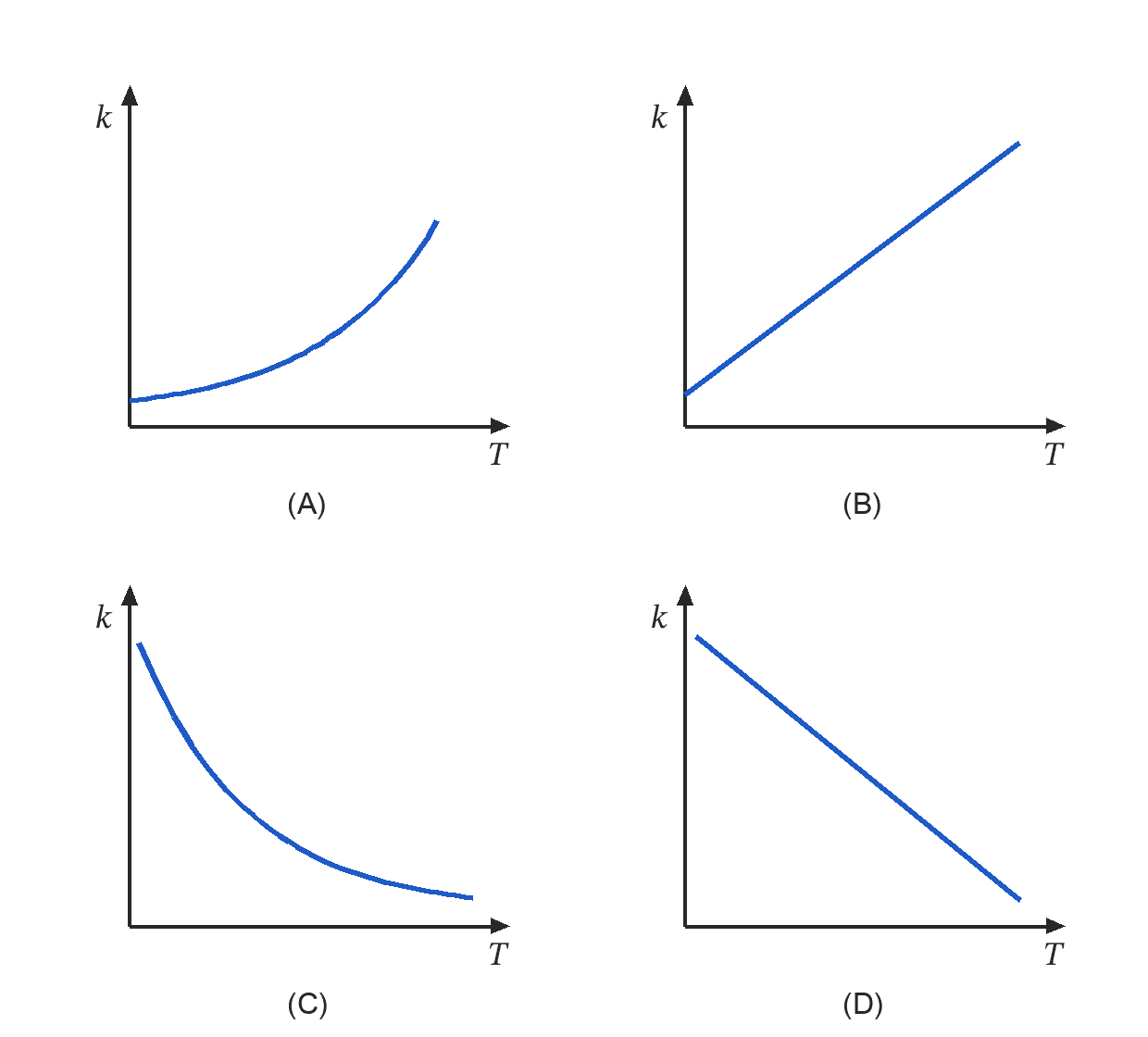
Plots showing the variation of the rate constant (k) with temperature (T) are given below. The plot that follows Arrhenius equation is
- 551 mark
Question 55
For the reaction
The relation between , , is
- 561 mark
Question 56
The rate of a chemical reaction doubles for every 10°C rise of temperature. If the temperature is raised by 50°C, the rate of the reaction increases by about
- 571 mark
Question 57
A reactant (A) forms two products:
If , then and are related as
- 581 mark
Question 58
Which one of the following is wrong about molecularity of a reaction?
- 591 mark
Question 59
For first order reaction, rate constant
- 601 mark
Question 60
For a first order reaction, , the concentration of A changes from 0.1 M to 0.025 M in 40 minutes. The rate of reaction when the concentration of A is 0.01 M is
- 611 mark
Question 61
The rate of a reaction doubles when its temperature changes from 300 K to 310 K. Activation energy of such a reaction will be (R = 8.314 J K⁻¹ mol⁻¹ and log 2 = 0.301)
- 621 mark
Question 62
In the reaction,
the time taken for 75% reaction of P is twice the time taken for 50% reaction of P. The concentration of Q varies with reaction time as shown in the figure. The overall order of the reaction is

- 631 mark
Question 63
For the non-stoichiometric reaction:
the following kinetic data were obtained in three separate experiments, all at 298 K.
Initial concentration [A] Initial concentration [B] Initial rate of formation of C (mol L⁻¹ s⁻¹) 0.1 M 0.1 M 0.1 M 0.2 M 0.2 M 0.1 M The rate law for the formation of C is
- 641 mark
Question 64
For the elementary reaction , the rate of disappearance of M increases by a factor of 8 upon doubling the concentration of M. The order of the reaction with respect to M is
- 651 mark
Question 65
Higher order (> 3) reactions are rare due to
- 661 mark
Question 66
In dilute aqueous , the complex diaquadioxalatoferrate(II) is oxidized by . For this reaction, the ratio of the rate of change of to the rate of change of is ______.
- 671 mark
Question 67
Decomposition of follows a first order reaction. In fifty minutes, the concentration of decreases from 0.5 to 0.125 M in one such decomposition. When the concentration of reaches 0.05 M, the rate of formation of will be
- 681 mark
Question 68
According to the Arrhenius equation,
(A) a high activation energy usually implies a fast reaction.
(B) rate constant increases with increase in temperature. This is due to a greater number of collisions whose energy exceeds the activation energy.
(C) higher the magnitude of activation energy, stronger is the temperature dependence of the rate constant.
(D) the pre-exponential factor is a measure of the rate at which collisions occur, irrespective of their energy.
- 691 mark
Question 69
Two reactions R₁ and R₂ have identical pre-exponents factors. Activation energy of R₁ exceeds that of R₂ by 10 kJ mol⁻¹. If and are rate constants for reactions R₁ and R₂ respectively at 300 K, then ln () is equal to (R = 8.314 J mol⁻¹ K⁻¹)
- 701 mark
Question 70
Which of the following statement is incorrect?
- 711 mark
Question 71
In a bimolecular reaction, the steric factor P was experimentally determined to be 4.5. The correct option(s) among the following is(are)
(A) experimentally determined value of frequency factor is higher than that predicted by Arrhenius equation
(B) the value of frequency factor predicted by Arrhenius equation is higher than that determined experimentally
(C) the activation energy of the reaction is unaffected by the value of steric factor
(D) since P = 4.5, the reaction will not proceed unless an effective catalyst is used.
- 721 mark
Question 72
The half-life of C¹⁴ is 5760 year. For a 200 mg sample of C¹⁴, the time taken to change to 25 mg is
- 731 mark
Question 73
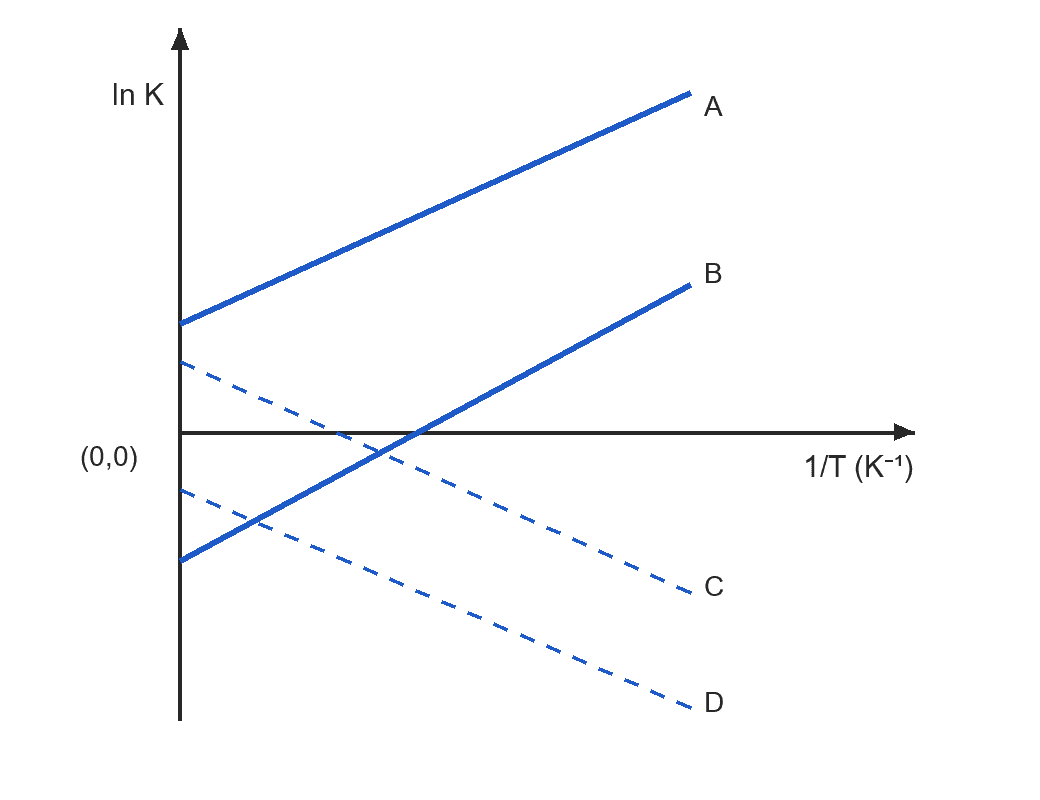
Which of the following lines correctly show the temperature dependence of equilibrium constant, K, for an exothermic reaction?
- 741 mark
Question 74
At 518°C, the rate of decomposition of a sample of gaseous acetaldehyde, initially at a pressure of 363 torr, was 1.00 torr s⁻¹ when 5% had reacted and 0.5 torr s⁻¹ when 33% had reacted. The order of the reaction is
- 751 mark
Question 75
Consider the following reversible reaction,
The activation energy of the backward reaction exceeds that of the forward reaction by 2RT (in J mol⁻¹). If the pre-exponential factor of the forward reaction is 4 times that of the reverse reaction, the absolute value of ΔG° (in J mol⁻¹) for the reaction at 300 K is ______.
(Given: ln (2) = 0.7, RT = 2500 J mol⁻¹ at 300 K and G is the Gibbs energy)
- 761 mark
Question 76
For a first order reaction at constant volume and 300 K, the total pressure at the beginning (t = 0) and at time t are and , respectively. Initially, only A is present with concentration , and is the time required for the partial pressure of A to reach 1/3rd of its initial value. The correct option(s) is (are) (assume that all these gases behave as ideal gases):
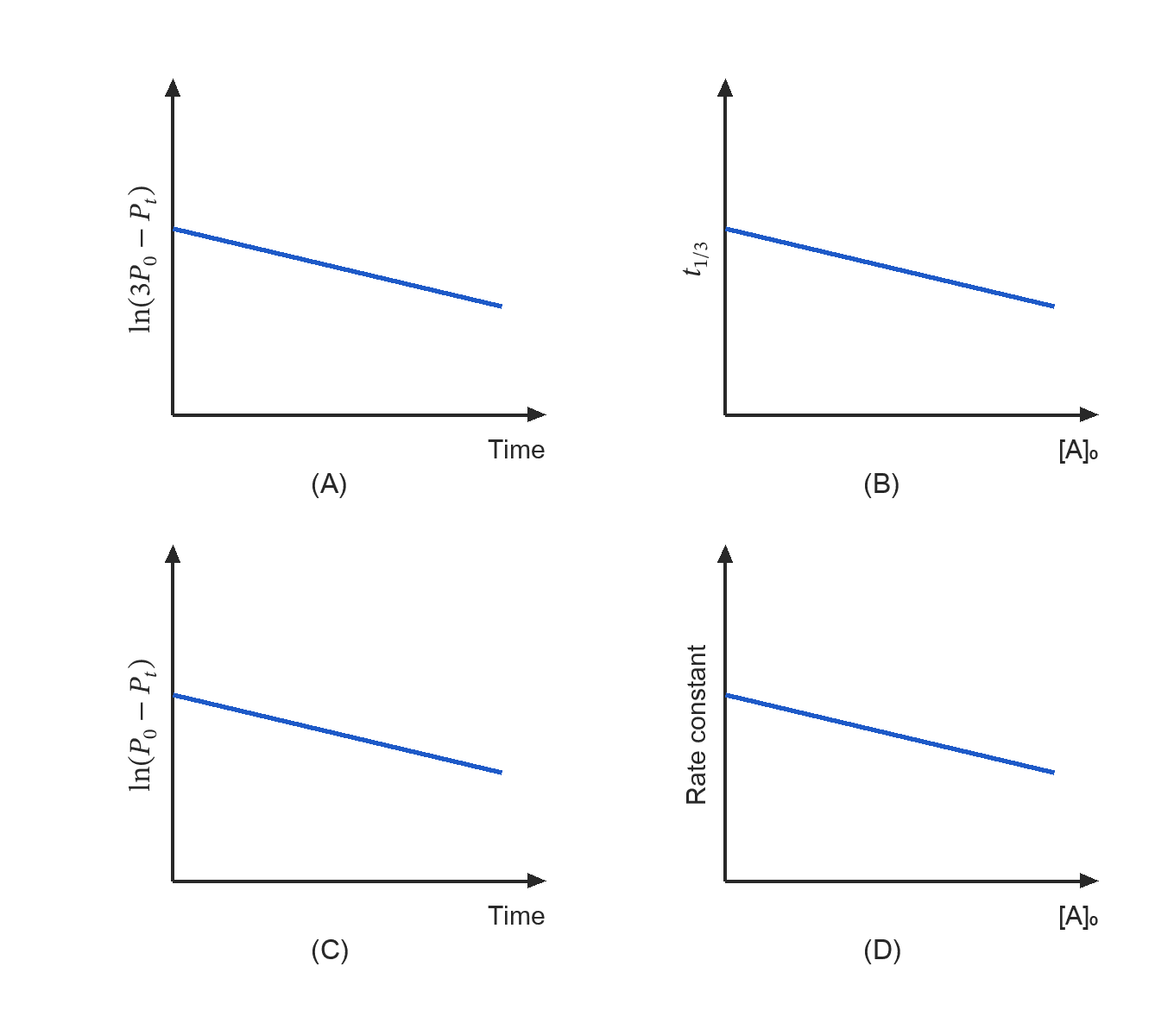
(A) Graph (A)
(B) Graph (B)
(C) Graph (C)
(D) Graph (D)
- 771 mark
Question 77
Decomposition of X exhibits a rate constant of 0.05 µg/year. How many years are required for the decomposition of 5 µg of X into 2.5 µg?
- 781 mark
Question 78
The reaction 2X → B is a zeroth order reaction. If the initial concentration of X is 0.2 M, the half-life is 6 h. When the initial concentration of X is 0.5 M, the time required to reach its final concentration of 0.2 M will be:
- 791 mark
Question 79
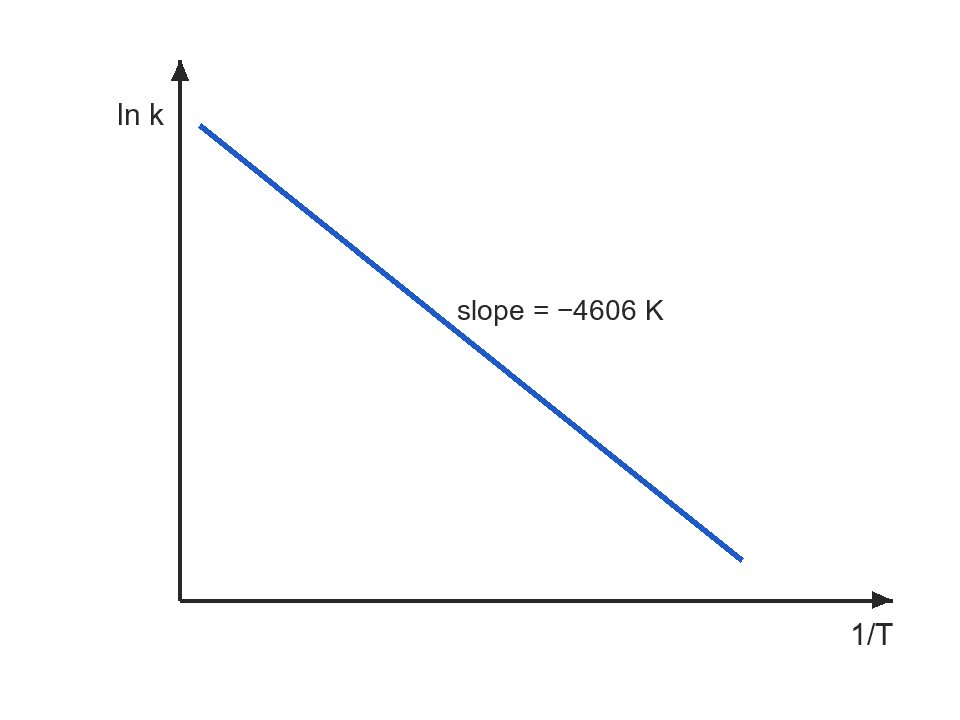
For a reaction, consider the plot of ln k versus 1/T given in the figure. If the rate constant of this reaction at 400 K is 10⁻⁵ s⁻¹, then the rate constant at 500 K is:
- 801 mark
Question 80
The given plots represent the variation of the concentration of a reactant R with time for two different reactions (i) and (ii). The respective orders of the reactions are:

- 811 mark
Question 81
For the reaction , the values of initial rate at different reactant concentrations are given in the table below. The rate law for the reaction is:
[A] (mol L⁻¹) [B] (mol L⁻¹) Initial Rate (mol L⁻¹ s⁻¹) 0.05 0.05 0.045 0.10 0.05 0.090 0.20 0.10 0.72 - 821 mark
Question 82
required for a reaction is produced by the decomposition of in as per the equation
The initial concentration of is 3.00 mol L⁻¹ and it is 2.75 mol L⁻¹ after 30 minutes. The rate of formation of is:
- 831 mark
Question 83
For the reaction of H₂ with I₂, the rate constant is 2.5 × 10⁻⁴ dm³ mol⁻¹ s⁻¹ at 327°C and 1.0 dm³ mol⁻¹ s⁻¹ at 527°C. The activation energy for the reaction, in kJ mol⁻¹ is:
- 841 mark
Question 84
For the reaction, 2A + B → products, when the concentrations of A and B both were doubled, the rate of the reaction increased from 0.3 mol L⁻¹ s⁻¹ to 2.4 mol L⁻¹ s⁻¹. When the concentration of A alone is doubled, the rate increased from 0.3 mol L⁻¹ s⁻¹ to 0.6 mol L⁻¹ s⁻¹. Which one of the following statement is correct?
- 851 mark
Question 85
For an elementary chemical reaction, . The expression for is
- 861 mark
Question 86
For a reaction scheme , if the rate of formation of B is set to be zero, then the concentration of B is given by:
- 871 mark
Question 87
Consider the kinetic data given in the following table for the reaction, .
Experiment [A] (mol dm⁻³) [B] (mol dm⁻³) [C] (mol dm⁻³) Rate of reaction (mol dm⁻³ s⁻¹) 1 0.2 0.1 0.1 2 0.2 0.2 0.1 3 0.2 0.1 0.2 4 0.3 0.1 0.1 The rate of the reaction for [A] = 0.15 mol dm⁻³, [B] = 0.25 mol dm⁻³ and [C] = 0.15 mol dm⁻³ is found to be Y × 10⁻⁵ mol dm⁻³ s⁻¹. The value of Y is ______.
- 881 mark
Question 88
The decomposition reaction,
is started in a closed cylinder under isothermal isochoric condition at an initial pressure of 1 atm. After Y × 10³ s, the pressure inside the cylinder is found to be 1.45 atm. If the rate constant of the reaction is 5 × 10⁻⁴ s⁻¹, assuming ideal gas behaviour, the value of Y is ______.
- 891 mark
Question 89
For the reaction
the observed rate expression is, rate . The rate expression of the reverse reaction is:
- 901 mark
Question 90
The rate of a certain biochemical reaction at physiological temperature (T) occurs 10⁶ times faster with enzyme than without. The change in the activation energy upon adding enzyme is:
- 911 mark
Question 91
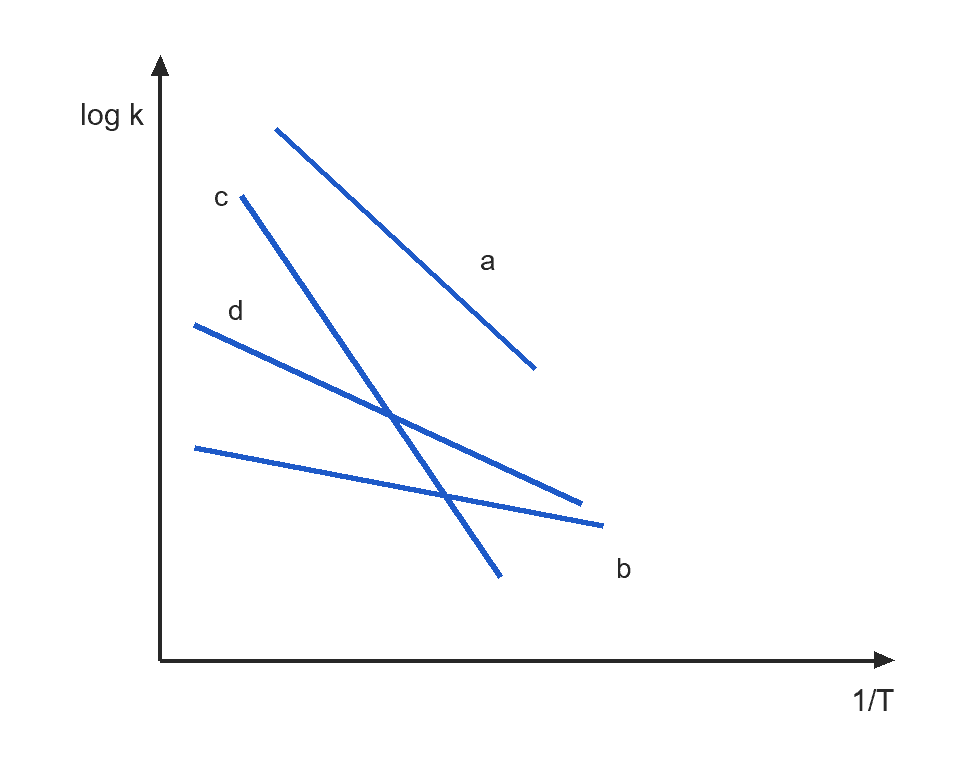
Consider the following plots of rate constant versus 1/T for four different reactions. Which of the following orders is correct for the activation energies of these reactions?
- 921 mark
Question 92
For the following reactions:
it was found that is decreased by 30 kJ/mol in the presence of catalyst. If the rate remains unchanged, the activation energy for catalysed reaction is (assume pre exponential factor is same):
- 931 mark
Question 93
The results given in the below table were obtained during kinetic studies of the following reaction:
Experiment [A]/(mol L⁻¹) [B]/(mol L⁻¹) Initial rate/mol L⁻¹ min⁻¹ I 0.1 0.1 II 0.1 0.2 III 0.2 0.1 IV X 0.2 V 0.3 Y X and Y in the given table are respectively:
- 941 mark
Question 94
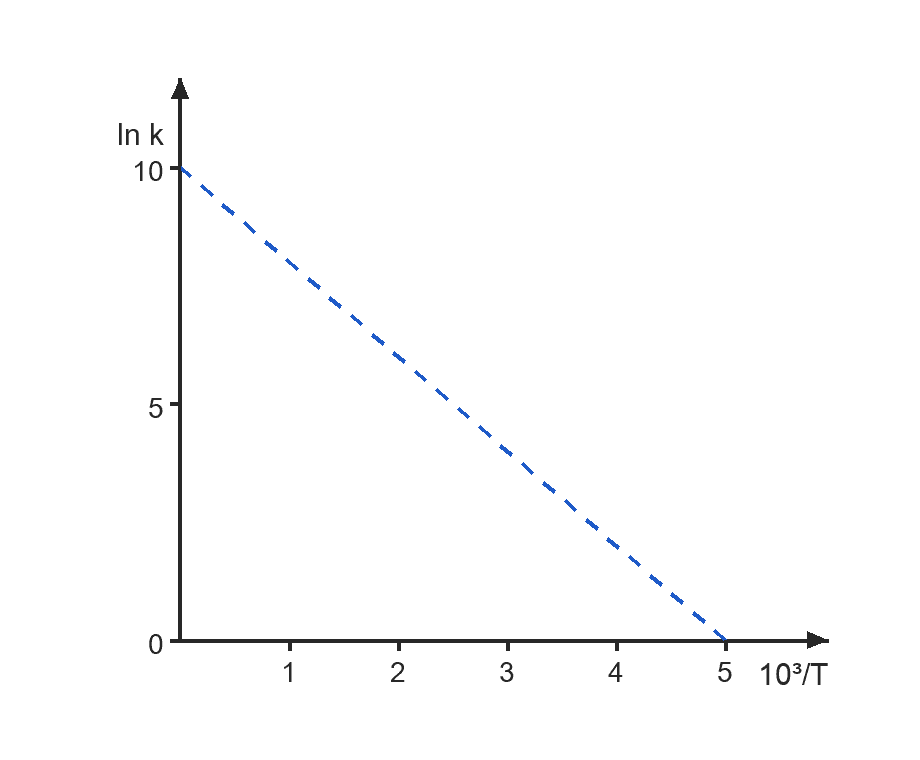
The rate constant (k) of a reaction is measured at different temperatures (T), and the data are plotted in the given figure. The activation energy of the reaction in kJ mol⁻¹ is: (R is gas constant)
- 951 mark
Question 95
Consider the following reactions:
A → P1; B → P2; C → P3; D → P4.
The order of the above reactions are a, b, c and d respectively. The following graph is obtained when log [rate] vs. log[conc.] are plotted:
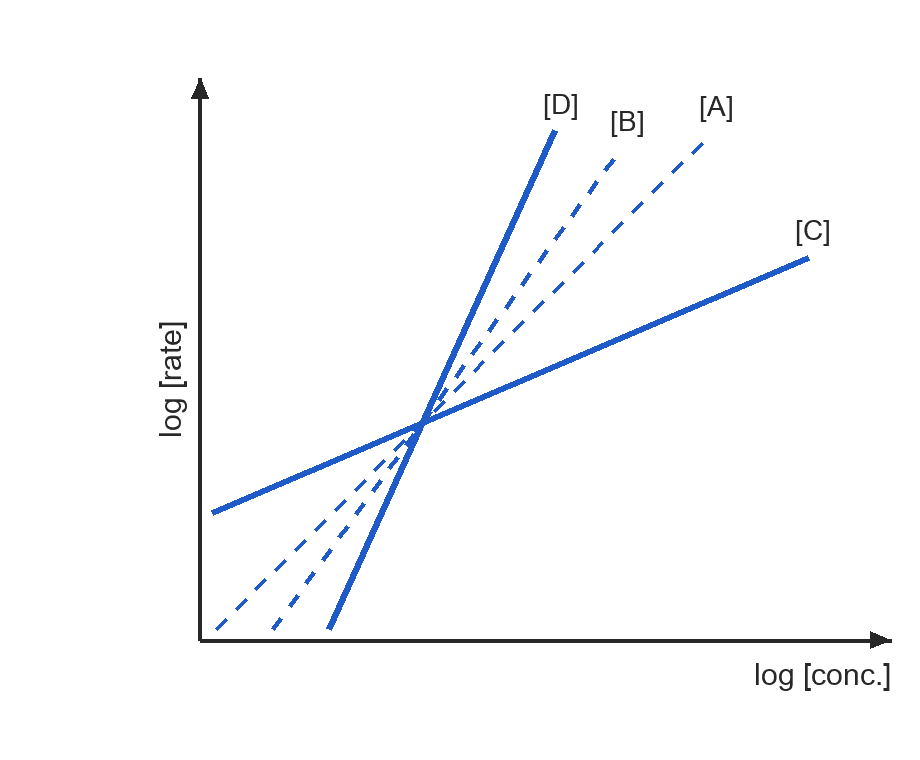
Among the following, the correct sequence for the order of the reactions is:
- 961 mark
Question 96
The rate of a reaction decreased by 3.555 times when the temperature was changed from 40°C to 30°C. The activation energy (in kJ mol⁻¹) of the reaction is ______.
Take: R = 8.314 J mol⁻¹ K⁻¹ and ln 3.555 = 1.265.
- 971 mark
Question 97
If 75% of a first order reaction was completed in 90 minutes, 60% of the same reaction would be completed in approximately (in minutes) ______.
(Take log 2 = 0.30; log 2.5 = 0.40)
- 981 mark
Question 98
The number of molecules with energy greater than the threshold energy for a reaction increases five fold by a rise of temperature from 27°C to 42°C. Its energy of activation in J/mol is ______.
(Take ln 5 = 1.6094; R = 8.314 J mol⁻¹ K⁻¹).
- 991 mark
Question 99
During the nuclear explosion, one of the products is ⁹⁰Sr with half life of 6.93 years. If 1 µg of ⁹⁰Sr was absorbed in the bones of a newly born baby in place of Ca, how much time, in years, is required to reduce it by 90% if it is not lost metabolically ______.
- 1001 mark
Question 100
For a reaction of order n, the unit of the rate constant is:
- 1011 mark
Question 101
Sucrose hydrolyses in acid solution into glucose and fructose following first order rate law with a half-life of 3.33 h at 25°C. After 9 h, the fraction of sucrose remaining is f. The value of is ______ × 10⁻². (Rounded off to the nearest integer)
[Assume: ln 10 = 2.303, ln 2 = 0.693]
- 1021 mark
Question 102
For the reaction: . The plot of log k vs is given below:
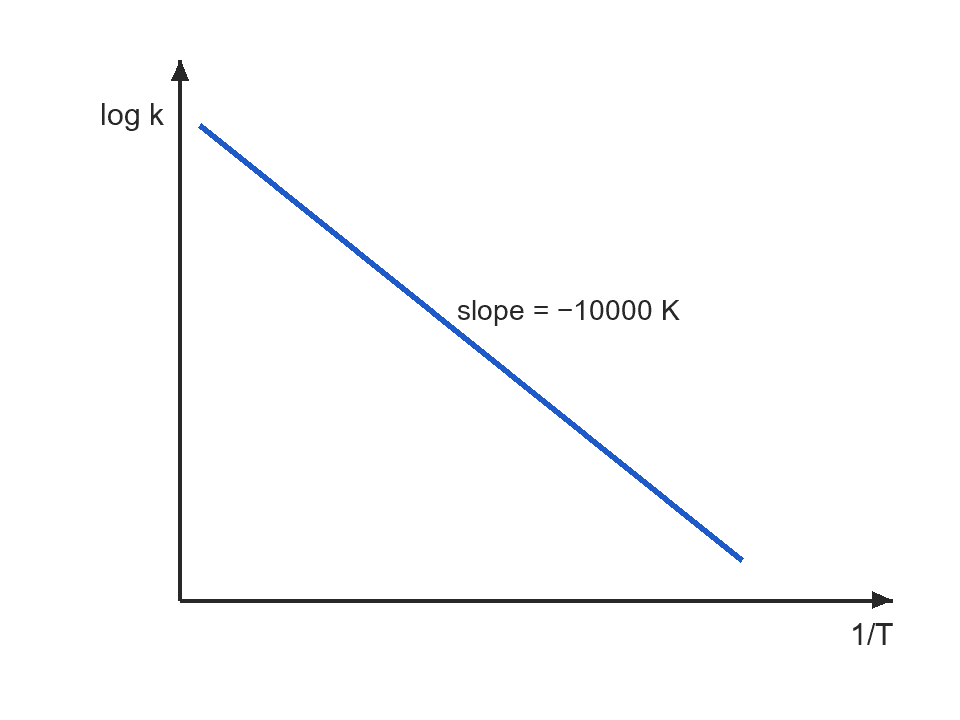
The temperature at which the rate constant of the reaction is 10⁻⁴ s⁻¹ is ______ K (Rounded off to the nearest integer)
[Given: The rate constant of the reaction is 10⁻⁵ s⁻¹ at 500 K]
- 1031 mark
Question 103
An exothermic reaction X → Y has an activation energy 30 kJ mol⁻¹. If energy change ΔE during the reaction is −20 kJ, then the activation energy for the reverse reaction in kJ is ______. (Integer answer)
- 1041 mark
Question 104
A and B decompose via first order kinetics with half-lives 54.0 min and 18.0 min respectively. Starting from an equimolar non-reactive mixture of A and B, the time-taken for the concentration of A to become 16 times that of B is ______ min. (Rounded off to the nearest integer).
- 1051 mark
Question 105
The decomposition of formic acid on gold surface follows first order kinetics. If the rate constant at 300 K is 1.0 × 10⁻³ s⁻¹ and the activation energy = 11.488 kJ mol⁻¹, the rate constant at 200 K is ______ × 10⁻⁵ s⁻¹. (Rounded off to the nearest integer).
(Given: R = 8.314 J mol⁻¹ K⁻¹)
- 1061 mark
Question 106
For a certain first order reaction 32% of the reaction is left after 570 s. The rate constant of this reaction is ______ × 10⁻³ s⁻¹. (Round off to the nearest integer)
[Given: log₁₀ 2 = 0.301, ln 10 = 2.303]
- 1071 mark
Question 107
The reaction: is an elementary reaction. For a certain quantity of reactions, if the volume of the reaction vessel is reduced by a factor of 3, the rate of the reaction increases by a factor of ______. (Round off to the nearest integer).
- 1081 mark
Question 108
A reaction has a half life of 1 min. The time required for 99.9% completion of the reaction is ______ min. (Round off to the nearest integer)
[Use: ln 2 = 0.68, ln 10 = 2.3]
- 1091 mark
Question 109
The inactivation rate of a viral preparation is proportional to the amount of virus. In the first minute after preparation, 10% of the virus is inactivated. The rate constant for viral inactivation is ______ × 10⁻³ min⁻¹. (nearest integer)
[Use: ln 10 = 2.303; log₁₀ 3 = 0.477; Property of logarithm: log xʸ = y log x]
- 1101 mark
Question 110
In the above first order reaction, the concentration of is mol L⁻¹ at 318 K. The concentration of after 1 hour was mol L⁻¹. The rate constant of the reaction at 318 K is ______ × 10⁻³ min⁻¹ (Nearest integer)
[Given: log 3 = 0.477, log 5 = 0.699]
- 1111 mark
Question 111
The following data was obtained for chemical reaction given below at 975 K.
[NO] (mol L⁻¹) [H₂] (mol L⁻¹) Rate (mol L⁻¹ s⁻¹) (A) (B) (C) The order of the reaction with respect to NO is ______ [Integer answer]
- 1121 mark
Question 112
The reaction that occurs in a breath analyser, a device used to determine the alcohol level in a person's blood stream is:
If the rate of appearance of is 2.67 mol min⁻¹ at a particular time, the rate of disappearance of at the same time is ______ mol min⁻¹. (Nearest integer)
- 1131 mark
Question 113
For a first order reaction, the ratio of the time for 75% completion of a reaction to the time for 50% completion is ______. (Integer answer)
- 1141 mark
Question 114
For the following reaction:
The rate of reaction is . Two moles of X are mixed with one mole of Y to make 1.0 L of solution. At 50 s, 0.5 mole of Y is left in the reaction mixture. The correct statement(s) about the reaction is(are)
(Use: ln 2 = 0.693)
(A) The rate constant, k, of the reaction is s⁻¹
(B) Half-life of X is 50 s.
(C) At 50 s, mol L⁻¹ s⁻¹.
(D) At 100 s, mol L⁻¹ s⁻¹.
- 1151 mark
Question 115
If rate constant of a reaction has the value mol s, the order of reaction is
- 1161 mark
Question 116
A reacts to form P. A plot of the reciprocal of the concentration of A vs time is a straight line. When the initial concentration of A is M, its half life is found to be 20 min. When initial concentration of A is M, the half life period will be
- 1171 mark
Question 117
In a reaction, A + B → Product, rate is doubled when the concentration of B is doubled, and rate increases by a factor of 8 when the concentration of both the reactants (A and B) are doubled. Rate law for the reaction can be written as
- 1181 mark
Question 118
In a zero-order reaction for every 10° rise of temperature, the rate is doubled. If the temperature is increased from 10°C to 100°C, the rate of the reaction will become
- 1191 mark
Question 119
The activation energy of a reaction can be determined from the slope of which of the following graphs?
- 1201 mark
Question 120
When initial concentration of a reactant is doubled in a reaction, its half-life period is not affected. The order of the reaction is
- 1211 mark
Question 121
What is the activation energy for a reaction if its rate doubles when the temperature is raised from 20°C to 35°C? (R = 8.314 J mol⁻¹ K⁻¹)
- 1221 mark
Question 122
The addition of a catalyst during a chemical reaction alters which of the following quantities?
- 1231 mark
Question 123
The rate of first-order reaction is 0.04 mol L⁻¹ s⁻¹ at 10 seconds and 0.03 mol L⁻¹ s⁻¹ at 20 seconds after initiation of the reaction. The half-life period of the reaction is
- 1241 mark
Question 124
The decomposition of phosphine (PH₃) on tungsten at low pressure is a first order reaction. It is because the
- 1251 mark
Question 125
Mechanism of a hypothetical reaction X₂ + Y₂ → 2XY, is given below:
(i) X₂ → X + X (fast)
(ii) X + Y₂ → XY + Y (slow)
(iii) X + Y → XY (fast)
The overall order of the reaction will be
- 1261 mark
Question 126
A first order reaction has a specific reaction rate of 10⁻² sec⁻¹. How much time will it take for 20 g of the reactant to reduce to 5 g?
- 1271 mark
Question 127
The correct difference between first and second order reaction is that
- 1281 mark
Question 128
When initial concentration of the reactant is doubled, the half-life period of a zero order reaction
- 1291 mark
Question 129
If the rate constant for a first order reaction is k. The time (t) required for the completion of 99% of the reaction is given by
- 1301 mark
Question 130
The rate constant for a first order reaction is s⁻¹. The time required to reduce 2.0 g of the reactant to 0.2 g is:
- 1311 mark
Question 131
The half-life for a zero order reaction having 0.02 M initial concentration of reactant is 100 s. The rate constant (in mol L⁻¹ s⁻¹) for the reaction is
- 1321 mark
Question 132
For a reaction A → B, enthalpy of reaction is −4.2 kJ mol⁻¹ and enthalpy of activation is 9.6 kJ mol⁻¹. The correct potential energy profile for the reaction is shown in option:

- 1331 mark
Question 133
The slope of Arrhenius plot of first order reaction is K. The value of of the reaction is: [Given R = 8.314 J K⁻¹ mol⁻¹]