
Opening your dashboard
Class 12 Chemistry Chapter 3 Electrochemistry: Practice Questions
126 questions on Chapter 3, each worked through on its own page with the AI tutor. Class 12 Chemistry, ICSE 2026-27.
126 questions
1–3 marks · Mixed difficulty
- 11 mark
Question 1
A galvanic cell is set up as
and allowed to supply current for several hours. What happens to the masses of the two metal electrodes?
- 21 mark
Question 2
In a galvanic cell whose cathode compartment contains silver nitrate solution, the salt bridge is filled with potassium nitrate in agar–agar gel and not with potassium chloride. The reason is that
- 33 marks
Question 3
A galvanic cell uses the reaction
V and V.
(a) Write the half-reactions at the anode and the cathode.
(b) Write the cell in standard notation and state the direction of electron flow in the external wire.
(c) Calculate the standard e.m.f. of the cell.
- 42 marks
Question 4
Zinc metal reacts with copper(II) sulphate solution whether the two are mixed in one beaker or set up as a Daniell cell. Explain why mixing them in one beaker gives no useful electrical energy, while the Daniell cell does.
- 53 marks
Question 5
Consider the cell
(a) Write the half-reactions that take place at the anode and at the cathode.
(b) Write the balanced overall ionic equation for the cell reaction.
(c) Why are platinum electrodes used in both half-cells?
- 61 mark
Question 6
Standard reduction potentials at 298 K are:
V; V; V; V; V
Which metal can reduce ions to tin but cannot reduce ions to iron under standard conditions?
- 71 mark
Question 7
Given the standard reduction potentials
V; V; V; V
which halide ion(s) can be oxidised to the halogen by ions under standard conditions?
- 82 marks
Question 8
Explain why the potential of a single electrode cannot be measured on its own, and how this difficulty is overcome.
- 93 marks
Question 9
Iron(III) chloride solution is used to etch away unwanted copper from printed circuit boards. Use
V, V and V
(a) Write the ionic equation for the etching reaction.
(b) Show that the reaction is feasible under standard conditions.
(c) Explain why iron(II) chloride solution cannot be used in place of iron(III) chloride.
- 103 marks
Question 10
Standard reduction potentials at 298 K:
V, V, V
Predict, with calculation, whether each change is feasible under standard conditions:
(a) ions reduce ions to .
(b) ions disproportionate into tin metal and ions.
(c) A piece of tin metal kept in a tin(II) chloride solution converts any formed by air oxidation back into .
- 111 mark
Question 11
Two silver electrodes are dipped in silver nitrate solutions of concentrations 0.001 M and 0.1 M, and the solutions are joined by a salt bridge. At 298 K (take V), the e.m.f. of this cell and its anode are
- 121 mark
Question 12
A cobalt rod dipped in a solution of ions shows a reduction potential of V at 298 K. If V and V, the concentration of in the solution is
- 133 marks
Question 13
For the cell
V and V. Take V at 298 K.
(a) Calculate the e.m.f. of the cell as written.
(b) What does the sign of your answer tell you about which electrode actually acts as the anode? Write the reaction that really takes place.
- 142 marks
Question 14
For the chlorine electrode
V. Write the Nernst equation for this electrode and calculate its reduction potential at 298 K ( V).
- 151 mark
Question 15
Given V and V, the standard Gibbs energy change for
at 298 K is ( C mol⁻¹)
- 161 mark
Question 16
For a redox reaction carried out in a galvanic cell, is found to be exactly 0 V at 298 K. The equilibrium constant of the reaction at this temperature is
- 173 marks
Question 17
The reaction
has an equilibrium constant of at 298 K. Given V, C mol⁻¹ and V, calculate
(a) for the reaction,
(b) the standard reduction potential of the electrode,
(c) for the reaction.
- 183 marks
Question 18
For the reaction
V, V and C mol⁻¹.
(a) Calculate and for the reaction as written.
(b) Calculate and when the equation is written as .
(c) What do your answers show about the nature of and ?
- 191 mark
Question 19
A copper wire and an aqueous solution of sodium chloride are both warmed from 25 °C to 50 °C. Their electrical conductances respectively
- 201 mark
Question 20
The conductivity () of an electrolyte solution measured in a conductivity cell does not depend on
- 212 marks
Question 21
Give two differences between metallic conduction and electrolytic conduction.
- 223 marks
Question 22
The electrodes of a conductivity cell each have an area of 1.25 cm² and are 0.80 cm apart. When the cell is filled with a solution, its resistance is 160 Ω. Calculate
(a) the cell constant,
(b) the conductance and the conductivity of the solution,
(c) the resistivity of the solution.
- 233 marks
Question 23
(Hypothetical data.) A conductivity cell of cell constant 1.50 cm⁻¹ shows a resistance of Ω when filled with the laboratory's distilled water. A saturated solution of a sparingly soluble salt, made in the same water, gives a resistance of Ω in the same cell at the same temperature.
(a) Calculate the conductivity of the water and of the solution.
(b) Calculate the conductivity due to the salt alone.
(c) Why must this correction be made for a sparingly soluble salt but is usually ignored for a 0.1 M KCl solution?
- 241 mark
Question 24
At 298 K, of HCl is 426.1 S cm² mol⁻¹, while that of NaCl is only 126.4 S cm² mol⁻¹. What is the main reason for this large difference?
- 253 marks
Question 25
The molar conductivities (S cm² mol⁻¹) of two electrolytes X and Y in water at 298 K are given below. (Hypothetical data.)
C (mol L⁻¹) 0.0001 0.001 0.01 of X 149.1 147.2 141.0 of Y 134.0 48.9 16.2 (a) Which of the two is a weak electrolyte? Give one reason from the data.
(b) Estimate of X and state how it is obtained.
(c) Why can of the other electrolyte not be found in the same way?
- 261 mark
Question 26
At 298 K, of is 307.0 S cm² mol⁻¹ and of is 73.5 S cm² mol⁻¹. The limiting molar conductivity of the ion is:
- 273 marks
Question 27
Formic acid, HCOOH, has at 298 K. The limiting molar conductivities of and ions are 349.6 and 54.6 S cm² mol⁻¹. Predict the molar conductivity and the conductivity of a 0.10 M formic acid solution at 298 K.
- 281 mark
Question 28
The limiting molar ionic conductivities at 298 K are 38.7, 50.1 and 73.5 S cm² mol⁻¹. Which statement best explains the order ?
- 292 marks
Question 29
At 298 K the limiting molar conductivities (S cm² mol⁻¹) of four salts are: NaCl 126.4, NaBr 128.2, KCl 149.8 and KBr 151.6.
(a) Explain, using Kohlrausch's law, why equals .
(b) of LiCl is 115.0 S cm² mol⁻¹. Predict of LiBr.
- 301 mark
Question 30
One faraday of electricity is passed through an aqueous solution of sodium sulphate between platinum electrodes. What is the total volume of gas (at STP) collected from both electrodes together?
- 313 marks
Question 31
A steel plate with a total surface area of 50.0 cm² is to be nickel-plated to a thickness of 0.010 mm from a solution of ions, using a current of 2.0 A. How long will the plating take? (Density of nickel = 8.9 g cm⁻³; Ni = 59; F = 96500 C mol⁻¹)
- 323 marks
Question 32
In a copper refining cell, a current of 10.0 A is passed for 1.00 hour and 10.0 g of copper is deposited on the cathode. Calculate the current efficiency of the cell. (Cu = 63.5; F = 96500 C mol⁻¹)
- 331 mark
Question 33
A silver coulometer and a cell containing a salt of metal M (atomic mass 45) are connected in series. When 2.16 g of silver is deposited, 0.300 g of M is deposited. The charge on the ion of M is:
- 342 marks
Question 34
An aqueous solution of copper(II) sulphate is electrolysed (a) with platinum electrodes and (b) with copper electrodes. For each case, name the product at the anode and state what happens to the concentration of in the solution.
- 353 marks
Question 35
200 mL of a neutral sodium chloride solution is electrolysed with a current of 0.50 A, using inert electrodes. At the end, the pH of the solution is 12.0. Assuming the volume does not change and all the current is used in the electrolysis of NaCl, find:
(a) the time for which the current was passed;
(b) the volume of chlorine (at STP) liberated at the anode.
- 361 mark
Question 36
Which of the following needs the largest quantity of electricity per mole of product formed by electrolysis?
- 371 mark
Question 37
Which observation is correct while a lead storage battery is being discharged (supplying current)?
- 382 marks
Question 38
A mercury cell gives an almost constant voltage of about 1.35 V throughout its life, whereas the voltage of an ordinary dry cell falls steadily with use. Explain.
- 393 marks
Question 39
A lead storage battery delivers a steady current of 2.0 A for 3.0 hours. Calculate the mass of lead consumed at the anode and the mass of sulphuric acid used up. (Pb = 207; H₂SO₄ = 98; F = 96500 C mol⁻¹)
- 401 mark
Question 40
In a hydrogen–oxygen fuel cell that uses concentrated aqueous KOH as electrolyte, the reaction at the anode is:
- 413 marks
Question 41
In a methanol–oxygen fuel cell the overall reaction is
The standard e.m.f. of the cell is 1.21 V and the standard enthalpy of combustion of methanol is −726 kJ mol⁻¹. Calculate per mole of methanol and the maximum (thermodynamic) efficiency of the cell. (F = 96500 C mol⁻¹)
- 422 marks
Question 42
(a) Write the overall reaction taking place in a nickel–cadmium cell while it is supplying current.
(b) Why can this cell be sealed and recharged many times?
- 431 mark
Question 43
Four iron nails are treated as described and kept for a week. Which nail will rust the most?
- 441 mark
Question 44
Aluminium ( = −1.66 V) is a more reactive metal than iron ( = −0.44 V), yet aluminium window frames hardly corrode in air. This is because:
- 452 marks
Question 45
(a) An iron nail that has been bent at its middle is kept in moist air. Where does rust appear first, and why?
(b) Why does very pure iron rust much more slowly than ordinary commercial iron?
- 463 marks
Question 46
An underground steel pipeline is protected by connecting it to buried blocks of magnesium. A steady protective current of 0.050 A flows from the magnesium to the pipe. Calculate the mass of magnesium used up in one year (365 days). Which electrode, magnesium or the pipe, is the anode? (Mg = 24; F = 96500 C mol⁻¹)
- 473 marks
Question 47
(a) Complete the following statement by selecting the correct alternative from the choices given.
The unit of equivalent conductance is:
(1) ohm⁻¹ cm² equiv⁻¹ (2) ohm⁻¹ cm² gm⁻¹ (3) ohm cm² equiv⁻¹ (4) ohm⁻¹ mole⁻¹
(b) Will nickel displace copper from a 1 M solution of copper sulphate? Justify your answer.
(c) The reduction potential of a metal X is −0.76 volts while that of Y is −2.38 volts. Which of the two metals is a stronger reducing agent? Give a reason for your answer.
- 483 marks
Question 48
(a) Complete the following statement by selecting the correct alternative from the choices given.
When zinc granule is dipped into copper sulphate solution, copper is precipitated because:
(i) Both, copper and zinc have a positive reduction potential.
(ii) Reduction potential of copper is higher than that of zinc.
(iii) Reduction potential of zinc is higher than that of copper.
(iv) Both, zinc and copper have a negative reduction potential.
(b) (i) State Faraday's First Law of Electrolysis.
(ii) How many electrons will flow when a current of 5 amperes is passed through a solution for 200 seconds?
- 493 marks
Question 49
(a) Fill in the blanks.
Zinc can displace ________ from solution, but cannot displace ________ from solution.
(b) Complete the following statement by selecting the correct alternative from the choices given:
The quantity of electricity required to deposit 1.15 g of sodium from molten NaCl (Na = 23, Cl = 35.5) is:
(1) 1 F (2) 0.5 F (3) 0.05 F (4) 1.5 F
- 503 marks
Question 50
(i) Calculate the maximum work that can be obtained from the given electrochemical cell constructed with two metals M and N.
The cell reaction is
(ii) The conductivity of 0.2 M KCl solution is 3 × 10⁻² ohm⁻¹ cm⁻¹. Calculate its molar conductance.
- 513 marks
Question 51
(a) Fill in the blanks.
In a galvanic cell, electrons flow from ________ to ________ through connecting wires.
(b) Two metallic elements A and B have the following standard oxidation potentials:
A = 0.40 V, B = −0.80 V. What would you expect if element A was added to an aqueous salt solution of element B? Give a reason for your answer.
(c) Name the law or principle confirmed by the following observation:
When 96500 coulombs of electricity is passed through acidulated water, 5.6 litres of oxygen at s.t.p. is liberated at the anode.
(d) Arrange Ag, Cr and Hg metals in the increasing order of reducing power. Given:
V, V, V
- 523 marks
Question 52
(i) Fill in the blanks.
(a) An electrochemical cell converts ________ energy to ________ energy.
(b) The molar conductance of a solution ________ with dilution, while its specific conductance ________ with dilution.
(ii) Complete the following statements by selecting the correct alternative from the choices given.
(A) A current liberates 0.50 g of hydrogen in 2 hours. The weight of copper (At. wt. = 63.5) deposited at the same time by the same current through copper sulphate solution is:
(a) 63.5 g (b) 31.8 g (c) 15.9 g (d) 15.5 g
(B) Kohlrausch's law matches with:
(a) Infinite dilution (b) mol L⁻¹ sec⁻¹ (c) Iodoform (d) K kg mol⁻¹ (e) Lactic acid
- 533 marks
Question 53
(i) Fill in the blanks:
(a) On dilution of a solution, its specific conductance ________ while its equivalent conductance ________.
(b) More ________ the standard reduction potential of substance, the ________ is its ability to displace hydrogen from acids.
(c) An aqueous solution of is ________ due to ________.
(ii) Complete the following statement by selecting the correct alternative from the choices given:
For a spontaneous reaction ΔG° and E° cell will be respectively:
(a) −ve and +ve (b) +ve and −ve (c) +ve and +ve (d) −ve and −ve
The conjugate acid of is:
(1) (2) (3) (4)
(iii) Electrochemical cell matches with:
(a) Bakelite (b) Nernst equation (c) Aniline (d) Ethylenediamine (e) Froth floatation process
(iv) Specific conductivity of 0.20 M solution of KCl at 298 K is 0.025 S cm⁻¹. Calculate its molar conductivity.
- 543 marks
Question 54
(i) Select the correct alternative from the choices given:
The cell reaction is spontaneous or feasible when e.m.f. of the cell is
(1) Negative (2) Positive (3) Zero (4) Either positive or negative
(ii) Fill in the blanks.
Equivalent conductivity is the conducting power of all the ions furnished by one ________ of an electrolyte present in a definite ________ of the solution.
(iii) Select the correct alternative from the choices given:
Which of the following electrolytes is least effective in causing flocculation of positively charged ferric hydroxide sol?
(a) (b) (c) (d) KBr
- 551 mark
Question 55
The reduction potential of hydrogen half-cell will be negative if:
- 561 mark
Question 56
Resistance of 0.2 M solution of an electrolyte is 50 Ω. The specific conductance of the solution is 1.3 S m⁻¹. If resistance of the 0.4 M solution of the same electrolyte is 260 Ω, its molar conductivity is:
- 571 mark
Question 57
Consider the following cell reaction
At M, = 0.1 atm and pH = 3, the cell potential at 25°C is
- 581 mark
Question 58
The standard reduction potentials for , , and are −0.76, −0.23 and −0.44 V respectively. The reaction will be spontaneous when
- 591 mark
Question 59
The electrochemical cell shown below is a concentration cell,
The emf of the cell depends on the difference in concentration of ions at the two electrodes. The emf of the cell at 298 K is 0.059 V.
The value of ΔG (kJ mol⁻¹) for the given cell is (take 1 F = 96500 C mol⁻¹)
- 601 mark
Question 60
Given = −0.74 V; = 1.51 V; = 1.33 V; = +1.36 V
Based on the data given above strongest oxidising agent will be
- 611 mark
Question 61
The standard reduction potential data at 25°C is given below.
V;
V;
V;
V;
V;
V;
V;
V
Match E° of the redox pair in List I with the values given in List II and select the correct answer using the code given below the lists.
List I List II P. 1. −0.18 V Q. 2. −0.4 V R. 3. −0.04 V S. 4. −0.83 V Codes (P Q R S):
- 621 mark
Question 62
Given below are the half-cell reactions:
; E° = −1.18 V
; E° = +1.51 V
The E° for will be
- 631 mark
Question 63
The equivalent conductance of NaCl at concentration C and at infinite dilution are and , respectively. The correct relationship between and is given as (where, the constant B is positive)
- 641 mark
Question 64
Resistance of 0.2 M solution of an electrolyte is 50 Ω. The specific conductance of the solution is 1.4 S m⁻¹. The resistance of 0.5 M solution of the same electrolyte is 280 Ω. The molar conductivity of 0.5 M solution of the electrolyte in S m² mol⁻¹ is
- 651 mark
Question 65
In a galvanic cell, the salt bridge
(a) does not participate chemically in the cell reaction
(b) stops the diffusion of ions from one electrode to another
(c) is necessary for the occurrence of the cell reaction
(d) ensures mixing of the two electrolytic solution.
(Select all correct statements.)
- 661 mark
Question 66
The molar conductivity of a solution of a weak acid HX (0.01 M) is 10 times smaller than the molar conductivity of a solution of a weak acid HY (0.10 M). If , the difference in their values, , is (consider degree of ionization of both acids to be ≪ 1)
- 671 mark
Question 67
For the following electrochemical cell at 298 K,
= 0.092 V when .
Given: = 0.151 V; = 0.059 V. The value of x is
- 681 mark
Question 68
Given
= 1.36 V, = −0.74 V
= 1.33 V, = −1.51 V.
Among the following, the strongest reducing agent is
- 691 mark
Question 69
For the following cell,
when the concentration of is 10 times the concentration of , the expression for ΔG (in J mol⁻¹) is
[F is Faraday constant; R is gas constant; T is temperature; = 1.1 V]
- 701 mark
Question 70
The conductance of a 0.0015 M aqueous solution of a weak monobasic acid was determined by using a conductivity cell consisting of platinized Pt electrodes. The distance between the electrodes is 120 cm with an area of cross-section of 1 cm². The conductance of this solution was found to be 5 × 10⁻⁷ S. The pH of the solution is 4. The value of limiting molar conductivity () of this weak monobasic acid in aqueous solution is Z × 10² S cm² mol⁻¹. The value of Z is
- 711 mark
Question 71
How long (approximate) should water be electrolysed by passing through 100 amperes current so that the oxygen released can completely burn 27.66 g of diborane? (Atomic weight of B = 10.8 u)
- 721 mark
Question 72
For the electrochemical cell,
the standard emf of the cell is 2.70 V at 300 K. When the concentration of is changed to x M, the cell potential changes to 2.67 V at 300 K. The value of x is ______.
(Given, = 11500 K V⁻¹, where F is the Faraday constant and R is the gas constant, ln(10) = 2.30)
- 731 mark
Question 73
Consider an electrochemical cell:
The value of ΔH° for the cell reaction is twice that of ΔG° at 300 K. If the emf of the cell is zero, ΔS° (in J K⁻¹ mol⁻¹) of the cell reaction per mole of B formed at 300 K is ______
(Given: ln(2) = 0.7, R (universal gas constant) = 8.3 J K⁻¹ mol⁻¹. H, S and G are enthalpy, entropy and Gibbs energy, respectively).
- 741 mark
Question 74
The standard electrode potential and its temperature coefficient for a cell are 2 V and −5 × 10⁻⁴ V K⁻¹ at 300 K respectively. The cell reaction is:
The standard reaction enthalpy () at 300 K in kJ mol⁻¹ is,
[Use R = 8 J K⁻¹ mol⁻¹ and F = 96,000 C mol⁻¹]
- 751 mark
Question 75
Calculate the standard cell potential (in V) of the cell in which following reaction takes place:
Given that = x V, = y V, = z V
- 761 mark
Question 76
A solution of is electrolysed between platinum electrodes using 0.1 Faraday electricity. How many moles of Ni will be deposited at the cathode?
- 771 mark
Question 77
If the standard electrode potential for a cell is 2 V at 300 K, the equilibrium constant (K) for the reaction:
at 300 K is approximately.
(R = 8 J K⁻¹ mol⁻¹, F = 96000 C mol⁻¹)
- 781 mark
Question 78
Given:
; E° = +1.81 V
; E° = +1.67 V
; E° = +1.61 V
; E° = +0.20 V
Oxidizing power of the species will increase in the order:
- 791 mark
Question 79
In the cell: the cell potential is 0.92 when a 10⁻⁶ molal HCl solution is used. The standard electrode potential of () electrode is:
- 801 mark
Question 80
For the cell , different half cells and their standard electrode potentials are given below:
M(aq)/M(s) (V) 1.40 0.80 0.77 −0.44 If = 0.76 V, which cathode will give a maximum value of per electron transferred?
- 811 mark
Question 81
Which one of the following graphs between molar conductivity () versus is correct?

- 821 mark
Question 82
Consider the following reduction processes:
; E° = −0.76 V
; E° = −2.87 V
; E° = −2.36 V
; E° = −0.25 V
The reducing power of the metals increases in the order
- 831 mark
Question 83
Given that the standard potentials (E°) of and are 0.34 V and 0.522 V respectively, the E° of is:
- 841 mark
Question 84
The equation that is incorrect is:
- 851 mark
Question 85
Amongst the following, the form of water with the lowest ionic conductance at 298 K is:
- 861 mark
Question 86
The variation of molar conductivity with concentration of an electrolyte (X) in aqueous solution is shown in the given figure.
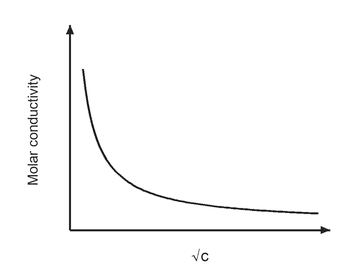
The electrolyte X is:
- 871 mark
Question 87
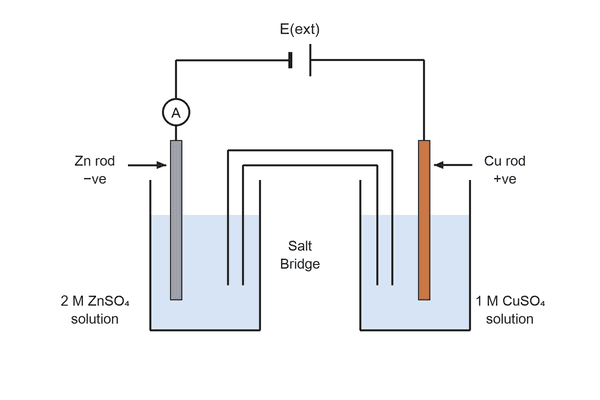
= +0.34 V; = 0.76 V
Identify the incorrect statement from the options below for the above cell:
- 881 mark
Question 88
An oxidation-reduction reaction in which 3 electrons are transferred has a ΔG° of 17.37 kJ mol⁻¹ at 25°C. The value of (in V) is ______ × 10⁻². (1 F = 96,500 C mol⁻¹)
- 891 mark
Question 89
The Gibbs energy change (in J) for the given reaction
at = 1 M and 298 K is ______
( = −0.16 V, = 0.34 V, Take F = 96500 C mol⁻¹)
- 901 mark
Question 90
For the disproportionation reaction:
at 298 K, ln K (where K is the equilibrium constant) is ______ × 10⁻¹.
Given:
- 911 mark
Question 91
What would be the electrode potential for the given half cell reaction at pH = 5?
(R = 8.314 J mol⁻¹ K⁻¹; Temp = 298 K; oxygen under standard atm. pressure of 1 bar)
- 921 mark
Question 92
For an electrochemical cell:
the ratio when this cell attains equilibrium is ______.
(Given = −0.14 V, = −0.13 V, = 0.06)
- 931 mark
Question 93
108 g of silver (molar mass 108 g mol⁻¹) is deposited at cathode from (aq) solution by a certain quantity of electricity. The volume (in L) of oxygen gas produced at 273 K and 1 bar pressure from water by the same quantity of electricity is ______.
- 941 mark
Question 94
Consider a 70% efficient hydrogen-oxygen fuel cell working under standard conditions at 1 bar and 298 K. Its cell reaction is
The work derived from the cell on the consumption of 1.0 × 10⁻³ mol of is used to compress 1.00 mol of a monoatomic ideal gas in a thermally insulated container. What is the change in the temperature (in K) of the ideal gas?
The standard reduction potentials for the two half-cells are given below:
, E° = 1.23 V
, E° = 0.00 V
Use F = 96500 C mol⁻¹, R = 8.314 J mol⁻¹ K⁻¹.
- 951 mark
Question 95
Match List-I with List-II
List-I (Parameter) List-II (Unit) (A) Cell constant (i) S cm² mol⁻¹ (B) Molar conductivity (ii) Dimensionless (C) Conductivity (iii) m⁻¹ (D) Degree of dissociation of electrolyte (iv) Ω⁻¹ m⁻¹ Choose the most appropriate answer from the options given below:
- 961 mark
Question 96
Consider the following cell reaction:
The value of is 4.315 V at 25°C. If ΔH° = −825.2 kJ mol⁻¹, the standard entropy change ΔS° in J K⁻¹ is ______. (Nearest integer)
[Given: Faraday constant = 96487 C mol⁻¹]
- 971 mark
Question 97
The resistance of a conductivity cell with cell constant 1.14 cm⁻¹, containing 0.001 M KCl at 298 K is 1500 Ω. The molar conductivity of 0.001 M KCl solution at 298 K in S cm² mol⁻¹ is ______. (Integer answer)
- 981 mark
Question 98
For the cell: the cell potential, = 0.3095 V.
For the cell: the cell potential = ______ × 10⁻² V. (Round off to the nearest integer)
- 991 mark
Question 99
Assume a cell with the following reaction.
= 2.97 V
for the above reaction is ______ V. (Nearest integer)
[Given: log 2.5 = 0.3979, T = 298 K]
- 1001 mark
Question 100
The magnitude of the change in oxidizing power of the couple is x × 10⁻⁴ V, if the concentration is decreased from 1 M to 10⁻⁴ M at 25°C. Assume concentration of and to be same on change in concentration), the value of x is ______. (Rounded off to the nearest integer)
[Given = 0.059]
- 1011 mark
Question 101
Emf of the following cell at 288 K in V is x × 10⁻².
The value of x is ______. (Rounded off to the nearest integer)
[Given: = −0.76 V; = +0.80 V; = 0.059]
- 1021 mark
Question 102
A 5.0 m mol dm⁻³ aqueous solution of KCl has a conductance of 0.55 mS when measured in a cell with cell constant 1.3 cm⁻¹. The molar conductivity of this solution is ______ × 10⁻⁴ mS m² mol⁻¹. (Rounded off to the nearest integer)
- 1031 mark
Question 103
A KCl solution of conductivity 0.14 S m⁻¹ shows a resistance of 4.19 Ω in a conductivity cell. If the same cell is filled with an HCl solution, the resistance drops to 1.03 ohm. The conductivity of the HCl solution is ______ × 10⁻² S m⁻¹. (Rounded off to the nearest integer).
- 1041 mark
Question 104
For the reaction:
The magnitude of the standard molar free energy change = − ______ kJ (Rounded off to the nearest integer)
= −0.440 V; = −0.036 V; = 0.539 V; F = 96500 C
- 1051 mark
Question 105
The molar conductivity at infinite dilution of barium chloride, sulphuric acid and hydrochloric acid are 280, 860 and 426 S cm² mol⁻¹ respectively. The molar conductivity at infinite dilution of barium sulphate is ______ S cm² mol⁻¹.
- 1061 mark
Question 106
Limiting molar conductivity of [i.e. ] equal to
- 1071 mark
Question 107
If the for a given reaction has a negative value, then which of the following gives the correct relationships for the values of and ?
- 1081 mark
Question 108
At 25°C, molar conductance of 0.1 molar aqueous solution of ammonium hydroxide is 9.54 ohm⁻¹ cm² mol⁻¹ and at infinite dilution its molar conductance is 238 ohm⁻¹ cm² mol⁻¹. The degree of ionisation of ammonium hydroxide at the same concentration and temperature is
- 1091 mark
Question 109
A button cell used in watches function as following.
If half cell potentials are
The cell potential will be
- 1101 mark
Question 110
A hydrogen gas electrode is made by dipping platinum wire in a solution of HCl of pH = 10 and by passing hydrogen gas around the platinum wire at one atm pressure. The oxidation potential of electrode would be?
- 1111 mark
Question 111
When 0.1 mol is oxidised, the quantity of electricity required to completely oxidise to is
- 1121 mark
Question 112
The weight of silver (at. wt. = 108) displaced by a quantity of electricity which displaces 5600 mL of at STP will be
- 1131 mark
Question 113
A device that converts energy of combustion of fuels like hydrogen and methane, directly into electrical energy is known as
- 1141 mark
Question 114
The pressure of required to make the potential of -electrode zero in pure water at 298 K is
- 1151 mark
Question 115
The molar conductivity of a 0.5 mol dm⁻³ solution of with electrolytic conductivity of S cm⁻¹ at 298 K in S cm² mol⁻¹ is
- 1161 mark
Question 116
During the electrolysis of molten sodium chloride, the time required to produce 0.10 mol of chlorine gas using a current of 3 amperes is
- 1171 mark
Question 117
Zinc can be coated on iron to produce galvanized iron but the reverse is not possible. It is because
- 1181 mark
Question 118
In the electrochemical cell:
, the emf of this Daniell cell is . When the concentration of is changed to 1.0 M and that changed to 0.01 M, the emf changes to . From the following, which one is the relationship between and ? (Given, RT/F = 0.059)
- 1191 mark
Question 119
Consider the change in oxidation state of bromine corresponding to different emf values as shown in the diagram below:
Then the species undergoing disproportionation is:
- 1201 mark
Question 120
For the cell reaction:
V at 298 K. The standard Gibbs energy () of the cell reaction is [Given that Faraday constant F = 96500 C mol⁻¹]
- 1211 mark
Question 121
For a cell involving one electron, V at 298 K the equilibrium constant for the cell reaction is [Given that V at T = 298 K]
- 1221 mark
Question 122
On electrolysis of dil. sulphuric acid using platinum electrode, the product obtained at anode will be
- 1231 mark
Question 123
The number of Faradays (F) required to produce 20 g of calcium from molten (Atomic mass of Ca = 40 g mol⁻¹) is
- 1241 mark
Question 124
In a typical fuel cell, the reactants (R) and product (P)
- 1251 mark
Question 125
The molar conductances of NaCl, HCl and at infinite dilution are 126.45, 426.16 and 91.0 S cm² mol⁻¹ respectively. The molar conductance of at infinite dilution is:
- 1261 mark
Question 126
The molar conductivity of 0.007 M acetic acid is 20 S cm² mol⁻¹. What is the dissociation constant of acetic acid? [ = 350 S cm² mol⁻¹, = 50 S cm² mol⁻¹]