
Opening your dashboard
Class 12 Biology Chapter 8 Evolution - Origin of Life: Practice Questions
128 questions on Chapter 8, each worked through on its own page with the AI tutor. Class 12 Biology, ICSE 2026-27.
128 questions
1–5 marks · Mixed difficulty
- 11 mark
Question 1
According to the nebular theory of the origin of the solar system, the solar nebula (a spherical cloud of gases and cosmic dust) turned into a rotating flattened disc because it
- 21 mark
Question 2
The early earth was a molten fire-ball at 4000–8000 °C. As it cooled and its matter condensed, which part of the earth appeared only after the temperature fell below 100 °C?
- 31 mark
Question 3
According to the Big Bang theory, the universe originated about 13.8 billion years ago by
- 42 marks
Question 4
A student argues: "Volcanoes on the early earth gave out water vapour (H₂O) and carbon dioxide (CO₂). Both contain oxygen, so the early atmosphere had plenty of oxygen for the first organisms to breathe."
Point out two errors in this argument.
- 53 marks
Question 5
Volcanic eruptions played a part in building three parts of the early earth. Explain how they helped to form:
(i) the continents
(ii) the atmosphere
(iii) the oceans
- 61 mark
Question 6
A scientist suggests that spores of a primitive microorganism, carried on a meteorite from a distant planet, reached the barren earth and then evolved into all life here. This idea belongs to the theory of
- 71 mark
Question 7
Which of the following is not a connotation (claim) of the theory of special creation?
- 82 marks
Question 8
The theory of special creation is the oldest idea about the origin of life, and many civilisations still hold it. Give two reasons why scientists do not accept it as a scientific explanation.
- 93 marks
Question 9
The theory of cosmic origin of life cannot be rejected straight away, yet it has gained little credibility.
(i) Suppose about stars in the universe have planets. If only one planet in a billion () has suitable conditions for life, about how many planets could support life?
(ii) Give one other observation that supports the theory.
(iii) Give one argument against the theory.
- 103 marks
Question 10
Both spontaneous generation and chemical evolution say that life came from non-living matter. Yet one was rejected and the other is the most accepted scientific theory. Differentiate between the two on three points.
- 111 mark
Question 11
In the possible steps of chemical evolution, a mixture of only methane (CH₄) and water vapour (H₂O), with energy, could give rise to
- 121 mark
Question 12
Today cells make proteins with the help of protein enzymes. Why could the very first proteins on the primitive earth not have been made with the help of protein enzymes?
- 131 mark
Question 13
In 1871 Darwin wrote that if a protein compound were chemically formed in a "warm little pond" today, it "would be instantly devoured or absorbed". What point was he making?
- 142 marks
Question 14
The table lists the gases in the earth's atmosphere at two times.
Time Gases in the atmosphere 4 billion years ago H₂, CH₄, H₂O, NH₃ Present time Ozone, O₂, CO₂, H₂O, N₂ (i) Was the atmosphere 4 billion years ago reducing or oxidising? Give one reason from the table.
(ii) Name the process that added the O₂ now present, and state how the ozone layer is linked to it.
- 153 marks
Question 15
Draw a labelled diagram to show how a coacervate is formed from protein molecules in water.
- 163 marks
Question 16
Differentiate between Oparin's coacervates and Sidney Fox's microspheres on three points.
- 174 marks
Question 17
Under the microscope, coacervate droplets look and behave in some ways like simple one-celled organisms.
(i) State three properties of coacervates that resemble those of living cells.
(ii) Why are coacervates still not regarded as living?
- 182 marks
Question 18
The first cells were anaerobic chemoheterotrophs that fed on the organic compounds of the primordial soup.
(i) Why could this way of life not continue for ever?
(ii) How did the evolution of the chlorophyll molecule solve the problem?
- 191 mark
Question 19
Before introducing the gases, Miller and Urey evacuated all the air from their apparatus. The main reason was to
- 201 mark
Question 20
Miller and Urey designed their experiment to test which idea of the Oparin–Haldane theory?
- 211 mark
Question 21
Which of the following conclusions can not be drawn from the Miller–Urey experiment?
- 224 marks
Question 22
The diagram shows a simplified apparatus like the one used by Miller and Urey. The arrows show the direction of flow.
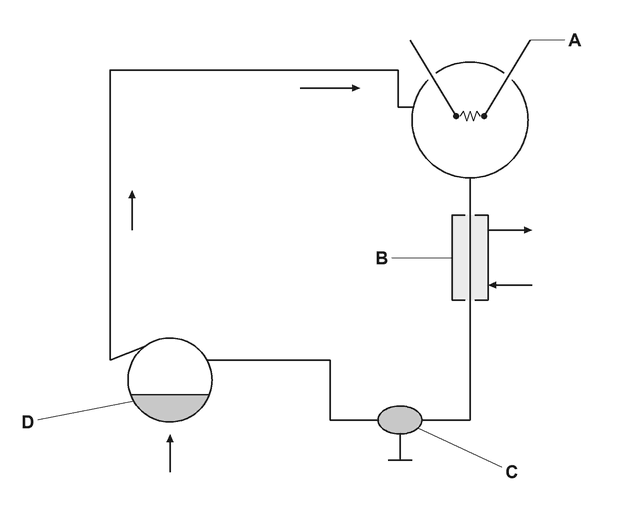
Identify the parts labelled A, B, C and D, and state the role of each in the experiment.
- 232 marks
Question 23
Miller and Urey made their apparatus sterile before starting the experiment. Give two reasons why this was important.
- 243 marks
Question 24
A school science club reads about three runs of an apparatus like Miller and Urey's, each kept free of oxygen for a week. (Hypothetical data.)
Run Gases inside Sparks and heating Organic molecules found in the trap 1 CH₄, NH₃, H₂, water vapour On Amino acids, simple sugars, adenine 2 CH₄, NH₃, H₂, water vapour Off None 3 H₂, water vapour On None (i) What does comparing runs 1 and 2 show?
(ii) What does comparing runs 1 and 3 show?
(iii) Which run best copies the primitive earth? Give a reason.
- 252 marks
Question 25
Experiments that copy the conditions of the primitive earth (the Miller–Urey experiment and later related experiments) have produced glycine, ribose, alanine, adenine and aspartic acid.
(i) Sort these into building blocks of proteins and building blocks of nucleic acids.
(ii) Name the large molecule each group could form if its members combined.
- 261 mark
Question 26
Which sequence lists, from the earliest to the latest, the three famous experiments that supported the theory of biogenesis?
- 272 marks
Question 27
Van Helmont claimed that human sweat (on a dirty shirt) kept with wheat bran gave rise to mice in about 3 weeks, and he took this as proof that life arises spontaneously. Using the theory of biogenesis, give two reasons why his conclusion was not valid.
- 282 marks
Question 28
According to the modern concept of abiogenesis, researchers have found that amino acids can form peptides, and that key intermediates for making RNA nucleotides can also form from non-living (abiogenic) materials.
(i) Of what is an RNA nucleotide made?
(ii) What does this finding suggest about the first self-replicating molecule?
- 291 mark
Question 29
Biologist Lederberg divided the origin of life into three stages. The change of the first prokaryotic heterotrophs and autotrophs into eukaryotic organisms, and of cyanobacteria into other forms of algae, belongs to the stage called
- 301 mark
Question 30
Which of the following is an example of evolution in the biological sense?
- 314 marks
Question 31
A bacterium and a banyan tree look nothing alike. State three fundamental similarities that both share with all other living organisms, and the conclusion these similarities support.
- 322 marks
Question 32
A student writes: "Evolution means an animal changing its own body during its lifetime to suit its surroundings, and such changes can easily be reversed." Point out two errors in this statement.
- 331 mark
Question 33
In a quarry, a trail of footprints made long ago in soft mud is found in a layer of sedimentary rock; the mud had baked hard before it was covered by sediments. In the classification of fossils, this is
- 343 marks
Question 34
Identify the type of fossil in each case and state how it was formed.
(i) The outline of a fern leaf seen as a thin black film on a slab of rock; none of its internal structure can be made out.
(ii) A piece of ancient wood in which the tissue has been replaced by silica; thin sections under a microscope still show its fine structure.
(iii) A whole insect preserved inside a piece of amber.
- 352 marks
Question 35
On a school field trip, a student breaks open a rock and finds a delicate, branching, leaf-like pattern along a crack. The teacher says it is a pseudofossil. Explain what this means and why it tells us nothing about evolution.
- 361 mark
Question 36
The early gametophyte of mosses and ferns, the protonema produced when their spores germinate, resembles a green alga. This observation is cited as
- 373 marks
Question 37
Most gymnosperms do not need water for fertilisation, but primitive gymnosperms such as cycads and Ginkgo biloba have ciliated sperms and need water for fertilisation.
(i) Which groups of lower plants share this feature?
(ii) What does it suggest about the origin of gymnosperms?
(iii) What position in plant evolution does it give to the cycads?
- 383 marks
Question 38
Humans have 46 chromosomes, while gorilla, chimpanzee and orangutan have 48.
(i) How do molecular studies explain this difference?
(ii) Give two other molecular findings that support a common ancestry of humans and great apes.
- 391 mark
Question 39
The codon UUU specifies the amino acid phenylalanine in a bacterium, in a mango plant and in a human being. This observation is direct evidence of
- 404 marks
Question 40
Explain, step by step, how the breaking up of Pangaea led to the formation of new species.
- 411 mark
Question 41
Woolly mammoths found frozen in the Siberian region lived about 10,000 years ago. They were clearly elephants, though they differ from present-day elephants. Which conclusion from the study of fossils does this best support?
- 422 marks
Question 42
(i) What are biogeographical realms?
(ii) Name the realm in which India lies, and any two other realms.
- 431 mark
Question 43
The phylogeny of the horse is the best-known example of palaeontology reconstructing evolutionary history because
- 444 marks
Question 44
(i) Draw a labelled diagram of the basic pattern of the pentadactyl limb.
(ii) In the horse's foot this pattern is modified. State two such modifications.
- 451 mark
Question 45
(Hypothetical data.) An undisturbed cliff of sedimentary rock shows four layers numbered 1 (lowest) to 4 (top). Fossils of fish, amphibians, reptiles and mammals each first appear in a different layer. Which order of first appearance, from layer 1 to layer 4, agrees with the fossil record?
- 463 marks
Question 46
(Hypothetical data.) A piece of charcoal from an ancient hearth contains 25% of the C present in the wood of a living tree. The half-life of C is 5,730 years.
(i) What is meant by half-life?
(ii) How many half-lives have passed since the wood died?
(iii) Find the age of the charcoal.
- 474 marks
Question 47
The table gives the height of some genera in the evolution of the horse, in random order.
Genus Epoch Height Merychippus Miocene up to 1.0 m Equus Pleistocene and present up to 1.6 m Eohippus Eocene about 0.4 m Pliohippus Pliocene 1.0 m and a little more Mesohippus Oligocene up to 0.6 m (i) Arrange the genera from the oldest to the most recent.
(ii) State the trend in height and how many times taller Equus is than Eohippus.
(iii) State two other changes in the limbs or teeth during the evolution of the horse.
- 481 mark
Question 48
Which statement about the evolution of plants is supported by the fossil record?
- 491 mark
Question 49
Within an evolving lineage, a continuous change shows a general degeneration and loss of organs over time. Such an evolutionary trend is described as
- 503 marks
Question 50
The table is an extract from the geological time scale (rounded current values). Each age is the time when that period or epoch began.
Era Period / epoch Began (million years ago) Cenozoic Oligocene 34 Cenozoic Eocene 56 Cenozoic Palaeocene 66 Mesozoic Cretaceous 145 Mesozoic Jurassic 201 Mesozoic Triassic 252 Palaeozoic Permian 299 Palaeozoic Carboniferous 359 Palaeozoic Devonian 419 (Hypothetical data.) Three fossils are dated at 330, 170 and 50 million years old. For each fossil, name the era, the period or epoch, and the dominant animal life of that time.
- 511 mark
Question 51
The earth originated approximately
- 521 mark
Question 52
Which of the following gases was absent on primitive earth?
- 531 mark
Question 53
Which of the following scientists suggested that amino acids were very important for origin of life?
- 541 mark
Question 54
Which of the following scientists tested the biochemical hypothesis of origin of life?
- 551 mark
Question 55
What were the views of Louis Pasteur?
- 561 mark
Question 56
According to biochemical evolution of life, the life originated
- 571 mark
Question 57
According to abiotic origin of life, life originated
- 581 mark
Question 58
What were the end products of Miller–Urey experiment?
- 591 mark
Question 59
Coacervates are clusters of
- 601 mark
Question 60
Which of the following statements is true?
- 611 mark
Question 61
Darwin's finches is a very good example of
- 621 mark
Question 62
Natural selection can lead to similar adaptations in the diverse groups surviving in similar habitats is called
- 631 mark
Question 63
Which of the following are homologous organs?
- 641 mark
Question 64
Which of the following are analogous organs?
- 651 mark
Question 65
Which of the following is a vestigial organ in humans?
- 661 mark
Question 66
The organs that have the same basic structure and developmental origin but may differ in function are called
- 671 mark
Question 67
Homology of organs in two animals suggests that both animals
- 681 mark
Question 68
Phylogeny represents the
- 691 mark
Question 69
What is true of palaeontological evidences?
- 701 mark
Question 70
Which of the following is present today but was absent about 3.5 billion years ago?
- 711 mark
Question 71
Theory of spontaneous generation was given by
- 721 mark
Question 72
Coacervates are
- 731 mark
Question 73
Which one is not a vestigial organ?
- 741 mark
Question 74
The wings of bat and bird are
- 751 mark
Question 75
Recapitulation theory was called the Law of Biogenesis by
- 761 mark
Question 76
According to Oparin, which one of the following was not present in the primitive atmosphere of the earth?
- 771 mark
Question 77
The gases used in the Miller-Urey experiment were
- 781 mark
Question 78
Coacervates were experimentally produced by
- 791 mark
Question 79
Presence of gills in the tadpole of frog indicates that
- 801 mark
Question 80
Which of the following is relatively most accurate method of dating of fossils?
- 811 mark
Question 81
An important evidence in favour of organic evolution is the occurrence of
- 821 mark
Question 82
Evolution history of an organism is known as
- 831 mark
Question 83
Which one of the following amino acids was not found to be synthesized in Miller's experiment?
- 841 mark
Question 84
The concept of chemical evolution is based on
- 851 mark
Question 85
Which one of the following statement is correct?
- 861 mark
Question 86
The finches of Galapagos islands provide an evidence in favour of
- 871 mark
Question 87
Miller and Urey performed an experiment to prove origin of life. They took gases NH and H alongwith
- 881 mark
Question 88
The age of fossils is determined by
- 891 mark
Question 89
Archaeopteryx is a missing link between
- 901 mark
Question 90
Most of the fossils are found in which rock?
- 911 mark
Question 91
Plants and animals of Galapagos island resemble most closely plants and animals of
- 921 mark
Question 92
Thorn of Bougainvillea and tendril of Cucurbita are examples of
- 931 mark
Question 93
Which one of the following is incorrect characteristics of protobionts (coacervates and microspheres) as envisaged in the abiogenic origin of life?
- 941 mark
Question 94
About 4.6 billion years ago, the earth had reducing ______ which means there was ______.
- 951 mark
Question 95
Oparin suggested the formation of specialised droplets called ______ that could grow, divide and replicate.
- 961 mark
Question 96
In Miller and Urey's experiment the energy was supplied by ______ in the gaseous chamber.
- 971 mark
Question 97
______ are the remains or impressions of organisms preserved in the rocks.
- 981 mark
Question 98
The first living organisms were ______.
- 991 mark
Question 99
With the evolution of ______ molecule the earth atmosphere changed from reducing to ______.
- 1001 mark
Question 100
In the primeval earth, solar radiation, lightning and ______ served as the energy sources.
- 1011 mark
Question 101
In the primeval earth, the organic molecules accumulated in ______ because their ______ was extremely slow in the absence of any life or enzyme catalysts.
- 1021 mark
Question 102
According to the concept of biological evolution, all organisms are related through ancestry.
- 1031 mark
Question 103
Diverse kinds of organisms are evolved at various periods of time; hence their basic life processes are different.
- 1041 mark
Question 104
Microbes, plants and animals appear so distinct from one another that they cannot have similarities in patterns of reproduction.
- 1051 mark
Question 105
Pasteur's experiment proved that life originated from pre-existing life.
- 1061 mark
Question 106
Organs having same function but different origin are homologous organs.
- 1071 mark
Question 107
Analogous organs and vestigial organs suggest the presence of a common ancestor.
- 1085 marks
Question 108
Match the following:
Column A Column B 1. Oparin – Haldane theory (a) Abiotic origin of life 2. Vestigial organs (b) Recreated primitive earth conditions in lab 3. Analogous organs (c) Remnants of the functional organs 4. Miller–Urey (d) Convergent evolution 5. Homologous organs (e) Divergent evolution - 1091 mark
Question 109
Evolution of this molecule led to release of O in the earth's atmosphere.
- 1101 mark
Question 110
Absence of this gas that led to the reducing atmosphere on earth.
- 1111 mark
Question 111
An important fossil that is supposed to be a missing link between reptiles and birds.
- 1121 mark
Question 112
Organs that are useless for present organisms but were functional in the ancestors.
- 1131 mark
Question 113
Term used for the study of fossils.
- 1141 mark
Question 114
Assertion (A): The primitive atmosphere was reducing atmosphere, i.e., without free oxygen.
Reason (R): In the primitive atmosphere, oxygen was involved in forming ozone.
- 1151 mark
Question 115
Assertion (A): Coacervates are believed to be the precursors of life.
Reason (R): Coacervates were self-duplicating aggregates of proteins surrounded by lipid molecules.
- 1161 mark
Question 116
Assertion (A): The earliest organisms that appeared on the earth were non-green and anaerobes.
Reason (R): The first autotrophic organisms were chemoautotrophs that did not release oxygen.
- 1171 mark
Question 117
Assertion (A): Thorns of Bougainvillea and tendrils of Cucurbita are homologous organs.
Reason (R): Homologous organs have similar functions but are different in their structural details and origin.
- 1181 mark
Question 118
Assertion (A): The early embryos of fish, salamander, tortoise, chick and humans resemble one another closely.
Reason (R): Ontogeny recapitulates phylogeny.
- 1193 marks
Question 119
Find out from newspapers and popular science articles any new fossil discoveries or controversies about evolution.
- 1203 marks
Question 120
List some modern-day animals and using the internet resources link it to a corresponding ancient fossil. Name both.
- 1212 marks
Question 121
Which of the following are homologous organs?
(a) Trunk of an elephant and forelimbs of a monkey
(b) Wings of a bird and wings of butterfly
- 1222 marks
Question 122
Which of the following are analogous organs?
(a) Legs of cockroach and legs of cat.
(b) Pectoral fin of fish and forelimb of a frog.
- 1231 mark
Question 123
Wing of bat is homologous to
- 1242 marks
Question 124
Give two reasons why life cannot originate today.
- 1253 marks
Question 125
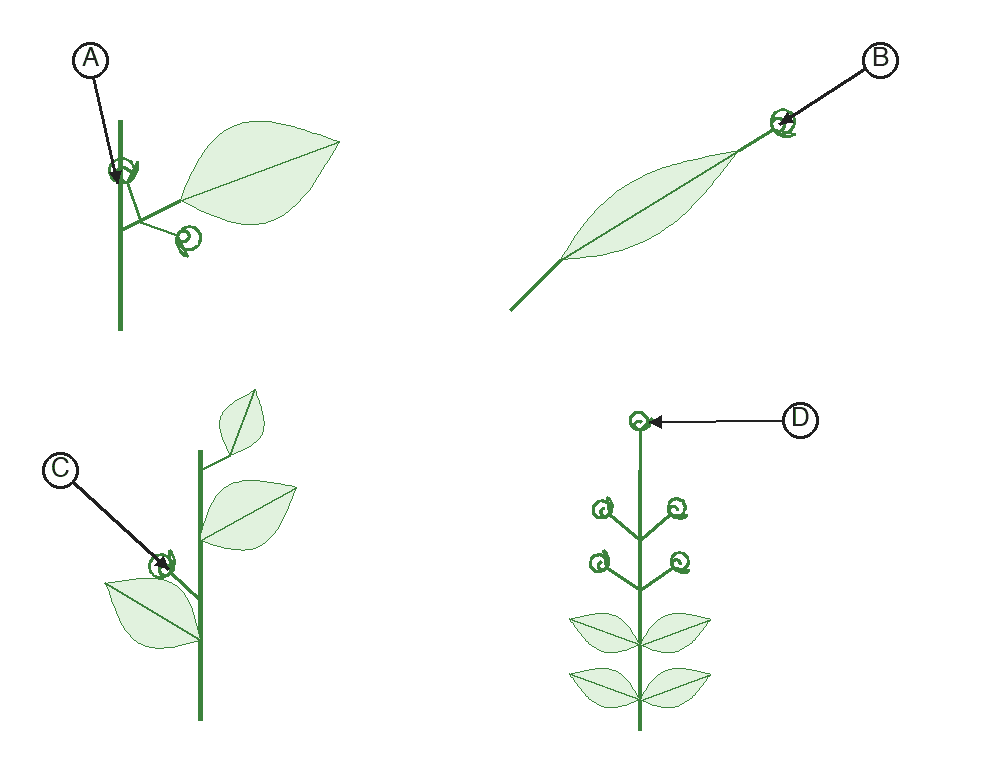
What is the evolutionary significance of the following figure and label A, B, C and D?
- 1263 marks
Question 126
Classify the following as examples of homology and analogy.
(i) Hearts of fish and crocodiles
(ii) Eyes of octopus and mammals
(iii) Wings of butterfly and birds
(iv) Tubers of sweet potato and potato
(v) Thorn of bougainvillea and tendril of cucurbita
(vi) Forelimb of whale and forelimb of a bat
- 1271 mark
Question 127
According to Abiogenesis, life originates from
- 1281 mark
Question 128
Mention the scientific name of protozoan parasite that causes Amoebiasis.