
Opening your dashboard
Class 12 Biology Chapter 7 Molecular Basis of Inheritance: Practice Questions
193 questions on Chapter 7, each worked through on its own page with the AI tutor. Class 12 Biology, ICSE 2026-27.
193 questions
1–10 marks · Mixed difficulty
- 11 mark
Question 1
A compound is made of ribose sugar joined to the base uracil. It has no phosphate group. What is it called?
- 23 marks
Question 2
(Hypothetical data.) One strand of a short double-stranded DNA molecule has 50 bases: A = 12, T = 8, G = 14, C = 16.
(a) Give the number of each base in the complementary strand.
(b) Give the total number of each base in the whole molecule and show that it obeys Chargaff's rule.
(c) How many hydrogen bonds hold the two strands together?
- 31 mark
Question 3
Under the electron microscope, a straight stretch of B-form DNA measures 68 nm along its axis. How many base pairs does it contain, and how many complete turns of the helix?
- 42 marks
Question 4
A student suggests that adenine could pair with guanine across the two strands of DNA. Give two reasons, from the structure of DNA, why this pairing does not occur.
- 53 marks
Question 5
Draw a labelled diagram of a short polynucleotide chain of three nucleotides. Label the 5' end, the 3' end, the sugar, a nitrogenous base and the bond that joins two nucleotides.
- 61 mark
Question 6
(Hypothetical data.) At metaphase, a chromosome has arms of 6 µm and 3 µm on the two sides of its centromere. Into which category does it fall?
- 72 marks
Question 7
Histone proteins are rich in the amino acids lysine and arginine.
(a) How does this help histones to package DNA?
(b) Name the proteins needed for the further coiling of chromatin at metaphase.
- 82 marks
Question 8
In a stained nucleus, region P of the chromatin stains lightly and region Q stains darkly.
(a) Name P and Q.
(b) Which region is more likely to contain genes being transcribed? Give a reason.
- 91 mark
Question 9
Avery, MacLeod and McCarty treated extracts of heat-killed S cells in different ways before mixing them with live R cells. Which treatment stopped the transformation of R cells?
- 103 marks
Question 10
In the Hershey and Chase experiment, suppose protein (and not DNA) had been the genetic material of the T₂ phage.
(a) Where would the radioactive sulphur (S³⁵) have been found after blending and centrifugation?
(b) Where was S³⁵ actually found, and where was P³²?
(c) What did the actual result prove?
- 111 mark
Question 11
In the Hershey and Chase experiment, the infected E. coli culture was agitated in a blender before centrifugation. Why?
- 122 marks
Question 12
Hershey and Chase used S³⁵ to label one part of the T₂ phage and P³² to label the other. Explain why each isotope labels only one part of the phage.
- 131 mark
Question 13
Viruses that have RNA as their genetic material have a shorter life span and evolve faster. Which property of RNA explains this?
- 143 marks
Question 14
It is believed that RNA, not DNA, was the first genetic material.
(a) Give two reasons that support this view.
(b) Why did DNA later take over as the store of genetic information?
- 153 marks
Question 15
(Hypothetical experiment.) E. coli grown for many generations in ¹⁴N medium is transferred to a medium containing only ¹⁵N (as ¹⁵NH₄Cl). One generation takes 20 minutes. DNA is separated by density after 20, 40 and 60 minutes.
(a) What kind of DNA is found after 20 minutes?
(b) What proportions of hybrid and heavy DNA are found after 40 minutes?
(c) What proportions are found after 60 minutes?
- 161 mark
Question 16
During replication, the two strands of a DNA molecule unwind and separate in a zipper-like fashion. Which bonds are broken for this?
- 172 marks
Question 17
A segment of a DNA molecule is
5'-ATGCCA-3'
3'-TACGGT-5'
Show the two daughter segments formed after one round of semi-conservative replication. Mark each strand as old or new.
- 181 mark
Question 18
In the Meselson and Stahl experiment, how could DNA containing ¹⁵N be told apart from DNA containing ¹⁴N?
- 191 mark
Question 19
In a eukaryotic nucleus, which enzyme makes the 45S pre-rRNA that matures into the 28S, 18S and 5.8S rRNAs?
- 203 marks
Question 20
(Hypothetical data.) A eukaryotic gene gives an hnRNA with three exons of 300, 450 and 250 nucleotides and two introns of 600 and 400 nucleotides.
(a) How long is the RNA after splicing, and what fraction of the hnRNA was removed?
(b) What is added at the 5' end and at the 3' end of the RNA?
(c) Ignoring the cap, what will be the approximate length of the fully processed mRNA?
- 211 mark
Question 21
(Hypothetical example.) In a mutant bacterium, RNA polymerase cannot bind the Rho factor (ρ). Which part of transcription is most directly affected?
- 222 marks
Question 22
In bacteria, translation of an mRNA often begins even before its transcription is complete. Give two reasons why this cannot happen in a eukaryotic cell.
- 231 mark
Question 23
Why was the idea that two bases together code for one amino acid rejected?
- 243 marks
Question 24
(Hypothetical sequence.) An mRNA reads 5'-AUG GCU UGG AAA UAA-3'. Use these codons: AUG – Met, GCU and GCC – Ala, UGG – Trp, AAA – Lys, UAA and UGA – stop.
(a) Write the polypeptide it codes for.
(b) A mutation changes the third base of codon 2 from U to C. What is the effect on the polypeptide? Name the property of the code involved.
(c) A different mutation changes the G at the third position of codon 3 to A. What is the effect?
- 254 marks
Question 25
(Hypothetical sequence.) An mRNA reads 5'-AUG CAU AUG GGA GGC UAG-3'. Use these codons: AUG – Met, CAU – His, GGA and GGC – Gly, UAG – stop.
(a) Write the amino acid sequence.
(b) State the role of the first AUG and of the second AUG.
(c) Which property of the genetic code is shown by GGA and GGC?
(d) How many codons are read, and how many amino acids are joined? Explain the difference.
- 261 mark
Question 26
During elongation of a polypeptide, the first tRNA (carrying methionine) sits in the P site and a second tRNA with its amino acid has just entered the A site. Which statement is correct immediately after the peptide bond between amino acids 1 and 2 is formed, before translocation?
- 273 marks
Question 27
A short mRNA made in a bacterial cell has the base sequence (hypothetical data):
5′–CCAGAUGUUUGGCUUCGGAUAGCAU–3′
Codons needed: AUG = Met (start), UUU = Phe, UUC = Phe, GGC = Gly, GGA = Gly; UAA, UAG, UGA = stop.
(i) Write the codons of the part that will be translated, starting from the start codon.
(ii) Write the amino acid sequence of the polypeptide and state how many peptide bonds it contains.
(iii) Name the stretches CCAG (before the start codon) and CAU (after the stop codon) and state their role.
- 282 marks
Question 28
Only 20 kinds of amino acids are used to make proteins, yet a cell contains more than 20 kinds of tRNA. Explain why.
- 291 mark
Question 29
In a cell, ribosomes begin translating an mRNA while that mRNA is still being transcribed, and a single mRNA carries the information for three different enzymes. Which statement about this cell is correct?
- 304 marks
Question 30
(i) Draw a labelled diagram of a polysome with four ribosomes on one mRNA. Show the 5′ and 3′ ends, the start and stop codons, the growing polypeptide chains and the direction in which the ribosomes move.
(ii) Which of the four ribosomes carries the longest polypeptide chain? Give a reason.
(iii) If the mRNA has one translational unit, how many polypeptides will the four ribosomes make, and will they be the same or different?
- 313 marks
Question 31
The template strand of a short gene reads (hypothetical data):
3′–TACAAGACCCCTTTTATT–5′
Codons needed: AUG = Met, UUC = Phe, UGG = Trp, GGA = Gly, AAA = Lys; UAA, UAG, UGA = stop.
(i) Write the mRNA transcribed from this strand and the polypeptide it codes for.
(ii) A mutation changes the 9th base of the template strand (counting from the 3′ end) from C to T. Write the new mRNA and the new polypeptide.
(iii) Name this type of change and state its effect on the protein.
- 321 mark
Question 32
Even before any lactose is added to the medium, an E. coli cell contains a small quantity of the enzyme permease. Why is this small quantity important for switching on the lac operon?
- 334 marks
Question 33
Predict whether each strain of E. coli below makes β-galactosidase (a) in a medium without lactose and (b) in a medium with lactose. Give a reason in each case. (Hypothetical strains.)
(i) Strain P: a normal lac operon.
(ii) Strain Q: the regulator (i) gene is lost, so no repressor protein is made.
(iii) Strain R: the promoter region is changed so that RNA polymerase cannot bind to it.
(iv) Which of these strains wastes energy when no lactose is present? Explain.
- 342 marks
Question 34
In a mutant E. coli, the regulator gene of the tryptophan operon makes a repressor protein that cannot bind tryptophan. Predict what happens to the enzymes that make tryptophan when the medium contains plenty of tryptophan, and explain why this is a loss to the cell.
- 351 mark
Question 35
In a eukaryotic cell, the primary RNA transcript of a gene is made normally, but the amount of protein formed is controlled by whether the introns are removed from it. At which level is gene expression being regulated here?
- 363 marks
Question 36
Three enzymes of a bacterium were studied (hypothetical observations):
Enzyme X is made at the same rate all the time, whatever is added to the medium.
Enzyme Y is made only after a particular sugar is added to the medium.
Enzyme Z stops being made when a particular amino acid is supplied in high concentration.
Classify each enzyme by the way its production is controlled, and give one example of each type from E. coli.
- 371 mark
Question 37
In the basic method of total DNA sequencing used in the Human Genome Project, the DNA fragments were put into bacterial artificial chromosomes (BAC) and yeast artificial chromosomes (YAC). What was the purpose of this step?
- 383 marks
Question 38
The human genome has about 3 × 10⁹ base pairs and about 20,000 protein-coding genes, and less than 2 per cent of the genome codes for proteins.
(i) Calculate the largest number of base pairs that can code for proteins.
(ii) If these coding base pairs were shared equally among the genes, how many coding base pairs would one gene have at most?
(iii) A typical human protein-coding gene, including its introns, spans about 25,000 base pairs. Use your answer to (ii) to explain why a gene is longer than its coding part.
- 392 marks
Question 39
A national gene bank stores frozen sperms, eggs and embryos of rare animal breeds along with seeds of old crop varieties. State what a gene bank is and why such gene banks are being used more and more today.
- 401 mark
Question 40
The genome of rice is about 430 Mb, of sorghum about 770 Mb and of wheat about 16,000 Mb. About how many times larger is the wheat genome than the rice genome?
- 412 marks
Question 41
The International Rice Genome Sequencing Project (IRGSP) chose the clone-by-clone shotgun sequencing strategy. State two advantages of this strategy for the project.
- 423 marks
Question 42
A child rescued from kidnappers is claimed by two couples. DNA fingerprints of the child (C), couple 1 (woman W1, man M1) and couple 2 (woman W2, man M2) are shown. The bands are numbered 1 to 10 from the top.
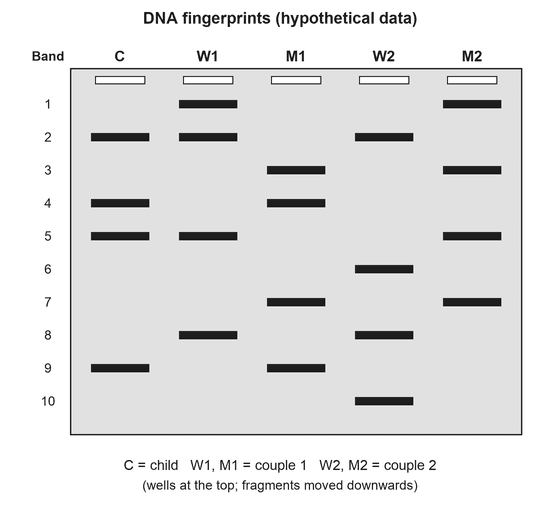
(i) Which couple are the biological parents of the child? Give a reason.
(ii) List the child's bands inherited from the mother and those inherited from the father.
(iii) Why must every band of a child be present in one of its biological parents?
- 431 mark
Question 43
At one VNTR site (hypothetical data), a mother's two chromosomes carry 6 and 9 repeats and the father's two chromosomes carry 4 and 7 repeats. Take each band's length as the number of repeats × 15 base pairs. Which pair of bands can their child not have at this site?
- 442 marks
Question 44
Give reasons:
(i) In DNA fingerprinting, the separated DNA fragments are split into single strands before hybridisation.
(ii) The VNTR probes used are made radioactive.
- 451 mark
Question 45
DNA from a blood stain at a crime scene gives exactly the same fingerprint as suspect X. Suspect X has a monozygotic (identical) twin. What can the analyst correctly conclude from the fingerprint alone?
- 463 marks
Question 46
State how DNA fingerprinting can help in each situation:
(i) A zoo is planning a breeding programme for a few animals of an endangered species.
(ii) Doctors are planning a bone marrow transplant for a patient.
(iii) Several patients in a hospital ward have the same infection, and doctors want to know which microorganism is responsible.
- 471 mark
Question 47
A culture of lysogenic E. coli cells, each carrying a prophage, grows normally for many generations. When the culture is exposed to UV rays, many cells burst and release phages. Why?
- 483 marks
Question 48
An Hfr cell of E. coli forms a conjugation bridge with an F⁻ cell. Its chromosome enters the F⁻ cell in the order genes A, B, C, D, with the F factor last. The bridge breaks after genes A and B have entered (hypothetical experiment).
(i) Which genes of the donor can the recipient gain?
(ii) Will the recipient become a male (F⁺) cell? Give a reason.
(iii) Why is the recipient's DNA after this transfer called recombinant DNA?
- 491 mark
Question 49
Experiment 1: purified DNA from a donor strain of bacteria is added to a culture of a recipient strain, and some recipient cells gain a donor trait. Experiment 2: bacteriophages grown in the donor strain are allowed to infect the recipient strain, and some recipient cells gain a donor trait. The cells never touch in either experiment. Which processes are these?
- 503 marks
Question 50
The AIDS virus (a retrovirus) and the measles virus (a paramyxovirus) both have RNA as their genetic material.
(i) Which of the two can insert a copy of its genes into a chromosome of the host cell? Explain how.
(ii) How does the other virus make copies of its genetic material?
(iii) What is the viral DNA that has become part of the host chromosome called?
- 511 mark
Question 51
In a DNA helix, complementary pairing is always between
- 521 mark
Question 52
The S-strain of bacteria Diplococcus pneumoniae
- 531 mark
Question 53
What had happened when heat-killed S cells along with the live R cells were injected into mice?
- 541 mark
Question 54
In radioactive phages P gets incorporated in
- 551 mark
Question 55
The enzyme that joins the newly synthesised fragments of DNA is called
- 561 mark
Question 56
The enzyme that polymerises deoxyribonucleotides in 5′→ 3′ direction only is called
- 571 mark
Question 57
Which one of the following is a non-sense codon?
- 581 mark
Question 58
Which of the following is a starting codon?
- 591 mark
Question 59
Which of the following RNA has a clover leaf structure in the two dimensional form?
- 601 mark
Question 60
If the sequence of bases on DNA is ATG, what will be the bases in the anticodon of tRNA in protein synthesis?
- 611 mark
Question 61
If the sequence of bases on the anticodon of tRNA is AUG, what will be the base sequence of mRNA?
- 621 mark
Question 62
The formation of tRNA from one of the DNA strands is known as
- 631 mark
Question 63
The formation of polypeptide from mRNA is called
- 641 mark
Question 64
The shifting of tRNA from A site to P site is called
- 651 mark
Question 65
Insertion or deletion of a single base in a DNA segment causes
- 661 mark
Question 66
A change in the wobble position of a gene means a change in the
- 671 mark
Question 67
Semi-conservative mode of replication was showed by
- 681 mark
Question 68
During the process of transcription, the molecule formed is
- 691 mark
Question 69
A codon contains
- 701 mark
Question 70
In the Lactose operon model, the repressor proteins bind to which of the following genes?
- 711 mark
Question 71
RNA polymerase binds to the
- 721 mark
Question 72
The function of the operator gene is dependent on
- 731 mark
Question 73
The regions on the gene that do not code for any protein are known as
- 741 mark
Question 74
Amplification in DNA fingerprinting refers to
- 751 mark
Question 75
During which process the changed molecule of DNA fragments separate out according to their molecular size?
- 761 mark
Question 76
Length of DNA with 23 base pairs is
- 771 mark
Question 77
The ratio constant for a species is
- 781 mark
Question 78
During replication of a bacterial chromosome DNA synthesis starts from a replication origin site and
- 791 mark
Question 79
During transcription, if the nucleotide sequence of the DNA strand that is being coded is ATACG, then the nucleotide sequence in the mRNA would be
- 801 mark
Question 80
A gene of operon which synthesizes a repressor protein is
- 811 mark
Question 81
The concept of lac operon was proposed by
- 821 mark
Question 82
All the terminator codons begin with
- 831 mark
Question 83
Which one of the following group of codons is called as degenerate codons?
- 841 mark
Question 84
During protein synthesis in an organism at one point the process comes to a halt. Select the group of the three codons from the following, from which any one of the three could bring about this halt.
- 851 mark
Question 85
During transcription, RNA polymerase holoenzyme binds to gene promoter and assumes a saddle-like structure. The DNA binding sequence is
- 861 mark
Question 86
The two polynucleotide chains in DNA are
- 871 mark
Question 87
Central dogma of genetic information is modified by the discovery of
- 881 mark
Question 88
tRNA consisting of three unpaired bases constitute
- 891 mark
Question 89
The codon AUG is
- 901 mark
Question 90
During the replication of DNA, the synthesis of DNA as lagging strand takes place in segments, these segments are called
- 911 mark
Question 91
Initiation codon of protein synthesis is
- 921 mark
Question 92
Which is true according to Chargaff's rule?
- 931 mark
Question 93
Which one is a terminator codon?
- 941 mark
Question 94
In DNA molecule, adenine is 15%. What would be percentage of guanine?
- 951 mark
Question 95
Antiparallel strands of a DNA molecule means that
- 961 mark
Question 96
Which one is wrongly matched?
- 971 mark
Question 97
Meselson and Stahl experiment proved
- 981 mark
Question 98
The basis of DNA fingerprinting is
- 991 mark
Question 99
Select the correct option.
In the DNA molecule
- 1001 mark
Question 100
______ is the technique by which the three-dimensional structure of macromolecules can be studied.
- 1011 mark
Question 101
The DNA molecule takes a complete turn after every ______ base pairs.
- 1021 mark
Question 102
A nucleotide consists of a ______, a ______ and a nitrogenous base.
- 1031 mark
Question 103
The experiment on DNA using N isotope proved that its replication is ______.
- 1041 mark
Question 104
______ are enzymes that unwind DNA helices while ______ break and reseal the strands.
- 1051 mark
Question 105
New strands of DNA are formed only in the ______ direction.
- 1061 mark
Question 106
A sequence of three nitrogenous bases that code for an amino acid is called ______.
- 1071 mark
Question 107
______ is a segment of DNA strand on which a new strand is produced.
- 1081 mark
Question 108
______ in RNA replaces thymine in DNA.
- 1091 mark
Question 109
______ has the shape of a clover-leaf.
- 1101 mark
Question 110
The formation of a peptide bond is catalysed by the enzyme ______.
- 1111 mark
Question 111
Sickle cell anaemia is caused due to a change from glutamic acid to ______ at position 6 in the β chain.
- 1121 mark
Question 112
In lac operon concept the three structural genes are regulated by a single gene called ______.
- 1131 mark
Question 113
In DNA fingerprinting, the separated DNA fragments are transferred from the gel to a nylon membrane by a technique called ______.
- 1141 mark
Question 114
A lab technique called ______ quickly creates unlimited copies of even a tiny fragment of DNA.
- 1151 mark
Question 115
Prokaryotic cell contains only one chromosome.
- 1161 mark
Question 116
Each chromosome consists of a number of genes.
- 1171 mark
Question 117
DNA is a part of a gene.
- 1181 mark
Question 118
Complementary base for guanine is adenine.
- 1191 mark
Question 119
Acrocentric chromosome has centromere near the extreme end.
- 1201 mark
Question 120
Hershey and Chase experiment proves the semi-conservative mode of replication of DNA.
- 1211 mark
Question 121
DNA ligase can join together the short sections of newly synthesised DNA fragments.
- 1221 mark
Question 122
Both prokaryotes and eukaryotes have only one RNA polymerase that transcribe different RNAs.
- 1231 mark
Question 123
The promoter gene is present between the operator gene and regulator gene in tryptophan operon.
- 1241 mark
Question 124
Exon regions of mRNA do not code for any polypeptide.
- 12510 marks
Question 125
Match the following:
Column A Column B 1. Bacteriophages (a) Polymerisation of free DNA nucleotides 2. Bacterial transformation (b) Join together short fragments of DNA 3. Semi-conservative replication of DNA (c) Breaking the weak hydrogen bonds between DNA strands 4. DNA polymerase (d) Meselson and Stahl's 5. DNA ligase (e) Hershey and Chase 6. Helicases (f) Griffith 7. RNA polymerase I (g) tRNA 8. Clover leaf-shaped structure (h) mRNA 9. Genetic code (i) Variable number of tandem repeats 10. DNA fingerprinting (j) Transcribes rRNA - 1261 mark
Question 126
Chromosome with centromere at its extreme end.
- 1271 mark
Question 127
Bonds present between the complementary bases in DNA.
- 1281 mark
Question 128
The complementary nitrogenous base for a cytosine.
- 1291 mark
Question 129
Chromosome that appears V-shaped in anaphase stage.
- 1301 mark
Question 130
Condensed or constricted part of chromosome where chromatids are attached.
- 1311 mark
Question 131
Three base sequences present on tRNA complementary to codon on mRNA.
- 1321 mark
Question 132
Newly synthesised short fragments of DNA formed on lagging strand.
- 1331 mark
Question 133
mRNA having number of cistrons or gene segments transcribed on it.
- 1341 mark
Question 134
Viruses that have RNA as the genetic material and capable of reverse transcription.
- 1351 mark
Question 135
Process by which single strand of RNA is transcribed from one strand of DNA.
- 1361 mark
Question 136
The coding regions of DNA.
- 1371 mark
Question 137
A process by which number of copies of a DNA fragment are made by polymerase chain reaction.
- 1381 mark
Question 138
Largest known human gene identified by human genome project.
- 1391 mark
Question 139
Enzyme needed for activation of amino acids in the cytoplasm.
- 1401 mark
Question 140
Codons in genetic code that do not code for any aminoacid.
- 1412 marks
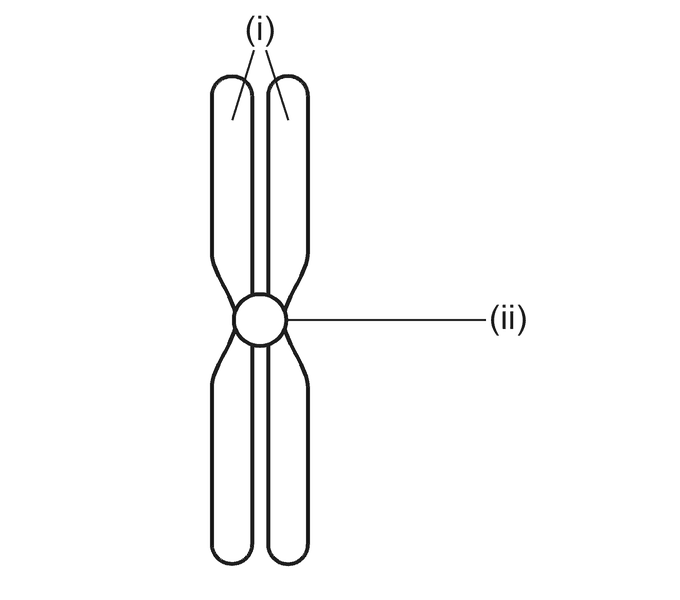
Question 141
Label the parts marked (i) and (ii) in the following diagram.
- 1422 marks
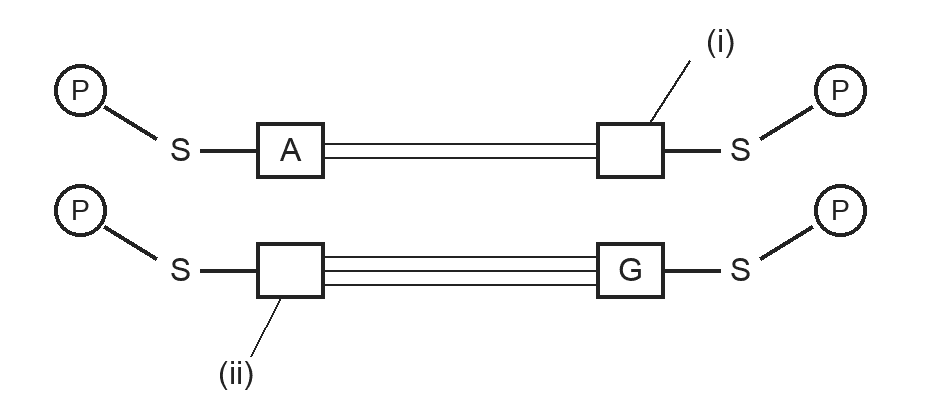
Question 142
Label the bases marked (i) and (ii) in the following diagram of a DNA segment.
- 1431 mark
Question 143
Assertion (A): The two chains of a DNA double helix are anti-parallel.
Reason (R): Nucleotides in the each helix are joined together by phosphodiester bonds.
- 1441 mark
Question 144
Assertion (A): DNA is associated with basic proteins called histones.
Reason (R): Negatively charged DNA wrapped around histone octamers to form a structure called nucleosome.
- 1451 mark
Question 145
Assertion (A): Sequences of bases in one polynucleotide chain of DNA can determine the sequence of bases in the other chain.
Reason (R): There are three hydrogen bonds between A and T and two between C and G.
- 1461 mark
Question 146
Assertion (A): In Griffith's experiment, a mixture of heat-killed virulent bacteria R and live non-virulent bacteria S, lead to the death of mice.
Reason (R): Transforming principle got transferred from heat-killed R strain to S strain and made it virulent.
- 1471 mark
Question 147
Assertion (A): DNA is a better genetic material than RNA.
Reason (R): DNA is more reactive and mutates at a faster rate.
- 1481 mark
Question 148
Assertion (A): Central dogma is the flow of information from DNA to mRNA and then decoding it in the form of protein.
Reason (R): In retroviruses, reverse of central dogma occurs.
- 1491 mark
Question 149
Assertion (A): UAA, UAG and UGA codons on mRNA terminate protein synthesis.
Reason (R): These codons are not recognised by tRNA.
- 1501 mark
Question 150
Assertion (A): mRNA has some untranslated regions that are not translated.
Reason (R): UTRs are required for efficient translation.
- 1511 mark
Question 151
Assertion (A): Repetitive DNA sequences make up very large portion of human genome.
Reason (R): Repetitive sequences do not have direct coding functions in the genome.
- 1521 mark
Question 152
Assertion (A): DNA fingerprinting is applied in paternity testing in case of disputes.
Reason (R): It employs the principle of polymorphism in DNA sequences as the polymorphisms are inheritable from parent to children.
- 1532 marks
Question 153
Group the following as nitrogenous bases and nucleosides:
Adenine, Cytidine, Thymine, Guanosine, Uracil and Cytosine.
- 1542 marks
Question 154
If a double-stranded DNA has 20% of cytosine, calculate the percentage of adenine in the DNA.
- 1552 marks
Question 155
If the sequence of the coding strand in a transcription unit is written as follows:
5′-ATGCATGCATGCATGCATGCATGCATGC-3′
Write down the sequence of mRNA.
- 1563 marks
Question 156
Depending upon the chemical nature of the template (DNA or RNA) and the nature of nucleic acids synthesised from it (DNA or RNA), list the types of nucleic acid polymerases.
- 1572 marks
Question 157
List two essential roles of ribosome during translation.
- 1583 marks
Question 158
Explain (in one or two lines) the function of the following:
(a) Promoter
(b) tRNA
(c) Exons
- 1593 marks
Question 159
Why is the Human Genome Project called a mega project?
- 1603 marks
Question 160
Briefly describe the following:
(a) Transcription
(b) Polymorphism
(c) Translation
(d) Bioinformatics
- 1612 marks
Question 161
If the length of E. coli DNA is 1.36 mm, how many base pairs will be present in E. coli?
- 1622 marks
Question 162
Both DNA and RNA are genetic materials. Why is DNA said to be a better genetic material? Explain.
- 1632 marks
Question 163
If sequence of nucleotides in mRNA is
AUG UUU UUC UUC UAC,
then
(i) What will be the sequence present on the anticodon site of tRNA?
(ii) What will be the sequence in the template strand of DNA?
- 1642 marks
Question 164
Can glucose or galactose act as inducer in lac operon? Explain.
- 1652 marks
Question 165
In Southern-blot hybridisation, put the following in correct sequence.
(i) Digestion of DNA.
(ii) Isolation of DNA.
(iii) Transferring, blotting of separated DNA fragments to synthesise membranes.
(iv) Separation of DNA fragments by electrophoresis.
(v) Hybridisation using labelled VNTR.
(vi) Detection of hybridised DNA fragments.
- 1661 mark
Question 166
The association of histone H1 with a nucleosome indicates
- 1671 mark
Question 167
If there are 999 bases in an RNA that codes for a protein with 333 amino acids, and the base at position 901 is deleted such that the length of the RNA becomes 998 bases, how many codons will be altered?
- 1681 mark
Question 168
A gene whose expression helps to identify transformed cell is known as
- 1691 mark
Question 169
The final proof for DNA as the genetic material came from the experiments of
- 1701 mark
Question 170
Which of the following RNAs should be most abundant in animal cell?
- 1711 mark
Question 171
The correct order of steps in Polymerase Chain Reaction (PCR) is
- 1721 mark
Question 172
The experimental proof for semiconservative replication of DNA was first shown in a
- 1731 mark
Question 173
All of the following are part of an operon except
- 1741 mark
Question 174
AGGTATCGCAT is a sequence from the coding strand of a gene. What will be the corresponding sequence of the transcribed mRNA?
- 1751 mark
Question 175
Many ribosomes may associate with a single mRNA to form multiple copies of a polypeptide simultaneously. Such strings of ribosomes are termed as
- 1761 mark
Question 176
Which of the following features of genetic code does allow bacteria to produce human insulin by recombinant DNA technology?
- 1771 mark
Question 177
Expressed Sequence Tags (ESTs) refers to
- 1781 mark
Question 178
The frequency of recombination between gene pairs on the same chromosome as a measure of the distance between genes was explained by
- 1791 mark
Question 179
Under which of the following conditions will there be no change in the reading frame of following mRNA?
5′AACAGCGGUGGUAUU3′
- 1802 marks
Question 180
Group the following as nitrogenous bases and nucleosides:
Adenine, Cytidine, Thymine, Guanosine, Uracil and Cytosine.
- 1812 marks
Question 181
If a double-stranded DNA has 20 per cent of cytosine, calculate the per cent of adenine in the DNA.
- 1822 marks
Question 182
If the sequence of one strand of DNA written as follows:
5′-ATGCATGCATGCATGCATGCATGCATGC-3′
Write down the sequence of complementary strand in 5′ → 3′ direction.
- 1832 marks
Question 183
If the sequence of the coding strand in a transcription unit is written as follows:
5′-ATGCATGCATGCATGCATGCATGCATGC-3′
Write down the sequence of mRNA.
- 1842 marks
Question 184
Which property of DNA double helix led Watson and Crick to hypothesise semi-conservative mode of DNA replication? Explain.
- 1853 marks
Question 185
Depending upon the chemical nature of the template (DNA or RNA) and the nature of nucleic acids synthesised from it (DNA or RNA), list the types of nucleic acid polymerases.
- 1862 marks
Question 186
List two essential roles of ribosome during translation.
- 1873 marks
Question 187
Explain (in one or two lines) the function of the following:
(a) Promoter
(b) tRNA
(c) Exons
- 1883 marks
Question 188
Why is the Human Genome project called a mega project?
- 1891 mark
Question 189
Give one significant contribution of each of the following scientists:
(i) F. Griffith
(ii) P. Ehrlich
- 1901 mark
Question 190
Length of the DNA with 23 base pairs is:
- 1911 mark
Question 191
During which phase of the cell cycle, does DNA replication take place?
- 1921 mark
Question 192
How many sets of primers are required in each cycle of PCR?
- 1931 mark
Question 193
Which one of the following enzymes is used to join DNA fragments?