
Opening your dashboard
Class 12 Biology Chapter 6 Chromosomes, Sex-Linked Inheritance and Human Genetic Disorders: Practice Questions
115 questions on Chapter 6, each worked through on its own page with the AI tutor. Class 12 Biology, ICSE 2026-27.
115 questions
1–5 marks · Mixed difficulty
- 11 mark
Question 1
Sutton compared the behaviour of chromosomes with that of Mendel's factors. The chromosome statement "only one chromosome of a homologous pair passes into a gamete" is matched by which behaviour of Mendel's factors?
- 21 mark
Question 2
Sutton and Boveri proposed that chromosomes carry Mendel's factors. Who later replaced the term 'factor' with the term 'gene', in 1909?
- 32 marks
Question 3
Mendel published his results in 1866, yet his work remained unrecognised for about 35 years. Give two reasons for this.
- 43 marks
Question 4
A cell has two pairs of homologous chromosomes, A₁A₂ and B₁B₂. It undergoes meiosis.
(a) In how many different ways can the two pairs line up at the equatorial plate in metaphase I? Name the gametes each arrangement produces.
(b) If meiosis occurs in a large number of such cells, what fraction of all the gametes will carry A₁B₂? Give a reason.
- 54 marks
Question 5
(Hypothetical data.) A pea plant with round, yellow seeds of genotype RrYy is test-crossed with a wrinkled, green plant (rryy). The genes for seed shape and seed colour lie on different pairs of chromosomes. The cross gives 320 seeds.
(a) Write the types of gametes each parent forms.
(b) Give the genotype and phenotype of each kind of offspring.
(c) How many seeds of each phenotype would you expect?
(d) Use the behaviour of chromosomes to explain why the classes appear in equal proportion.
- 61 mark
Question 6
Two genes lie very close together on the same chromosome and are completely linked. A plant heterozygous for both genes is test-crossed. Which offspring are expected?
- 72 marks
Question 7
In Morgan's crosses on Drosophila, the genes for yellow body and white eyes showed 1.3% recombination, while the genes for white eyes and miniature wings showed 37.2% recombination.
(a) Which pair of genes is more tightly linked?
(b) Which pair lies farther apart on the chromosome? Give a reason.
- 83 marks
Question 8
(Hypothetical data.) In a plant, gene A and gene B lie on the same chromosome. A plant that received AB from one parent and ab from the other is test-crossed with aabb. The progeny are:
Offspring genotype Number AaBb 418 aabb 422 Aabb 82 aaBb 78 (a) Which classes are parental and which are recombinant?
(b) Calculate the recombination frequency.
(c) What does this value tell you about the two genes?
- 92 marks
Question 9
Crossing over occurs between two linked genes A and B in a cell undergoing meiosis. Even so, only half of the gametes from that cell are recombinant. Explain why, naming the gametes formed.
- 103 marks
Question 10
A plant with the alleles A and B on one chromosome and a and b on its homologue is test-crossed with aabb. Copy and complete the table to show the expected percentage of each offspring class in three situations.
Offspring Genes assort independently Genes completely linked Genes linked, 8% recombination AaBb ? ? ? Aabb ? ? ? aaBb ? ? ? aabb ? ? ? - 111 mark
Question 11
Between which structures, and at which stage, does crossing over take place?
- 121 mark
Question 12
In a test cross, genes G and H show 4% recombination. What distance separates them on a linkage map?
- 131 mark
Question 13
(Hypothetical data.) A linkage map shows three genes in the order M – N – O. The map distance M–N is 7 units and N–O is 11 units. Taking map distances to add along the line, what recombination frequency would you expect between M and O?
- 143 marks
Question 14
(Hypothetical data.) Four linked genes W, X, Y and Z gave these recombination frequencies in test crosses:
Gene pair W–X X–Y W–Y Y–Z W–Z Recombination (%) 5 8 13 2 15 (a) Work out the order of the genes on the chromosome.
(b) Draw the linkage map with the distances.
(c) Predict the recombination frequency between X and Z.
- 154 marks
Question 15
(Hypothetical data.) On a linkage map, gene K is at position 0, gene L at 6 and gene M at 21 map units. A plant that received KM from one parent and km from the other is test-crossed with kkmm, giving 1000 offspring.
(a) What recombination frequency is expected between K and M?
(b) How many offspring of each of the four classes would you expect? Show which are recombinant.
(c) Which two genes are most likely to be inherited together? Give a reason.
- 161 mark
Question 16
In the fowl, the body cells of a male are 76 + ZZ and those of a female are 76 + ZW. Which eggs does a hen produce?
- 172 marks
Question 17
In 1891 Henking studied spermatogenesis in a few insects and saw a condensed body in the nucleus.
(a) What did he observe about how this body was distributed among the sperms?
(b) What did this body later turn out to be, and what does its presence or absence decide in such insects?
- 183 marks
Question 18
A couple's first three children are all daughters. Relatives say the mother 'can only have girls'.
(a) Name the gametes each parent forms, with their chromosome content.
(b) What was the probability, before any of them was born, that all three children would be daughters?
(c) What is the probability that their fourth child will be a son? Explain why the mother is not responsible for the sex of the children.
- 191 mark
Question 19
In Drosophila, pairs II, III and IV are alike in both sexes. How can the chromosomes of a male cell be recognised?
- 204 marks
Question 20
Draw a labelled flow diagram to show how sex is determined in the fowl, whose male cells are 76 + ZZ and female cells 76 + ZW. Show the parents, the gametes and the zygotes with their percentages, and state which parent decides the sex of the chick.
- 211 mark
Question 21
Morgan crossed a red-eyed female Drosophila with a white-eyed male, then crossed the red-eyed F₁ females and males with each other. In this F₂, what fraction of all the flies are white-eyed males?
- 221 mark
Question 22
Morgan's Cross III (white-eyed female × red-eyed male) gave red-eyed F₁ females and white-eyed F₁ males. If these F₁ flies are crossed with each other, what fraction of the F₂ females will be white-eyed?
- 233 marks
Question 23
Hairy ears in humans is supposed to be due to a gene on the Y chromosome.
(a) If a man has hairy ears, which of his children will inherit the trait?
(b) Why will none of his daughters show it?
(c) How does the path of this trait to his grandchildren differ from that of an X-linked recessive trait of a man?
- 244 marks
Question 24
(Hypothetical data.) A red-eyed female Drosophila is crossed with a red-eyed male. The 200 offspring are: 100 red-eyed females, 52 red-eyed males and 48 white-eyed males.
(a) Give the genotype of the male parent, with a reason.
(b) Give the genotype of the female parent, with a reason.
(c) Why are there no white-eyed females?
(d) If the same female were crossed with a white-eyed male, what proportion of the daughters would be white-eyed?
- 252 marks
Question 25
A female Drosophila is red-eyed but carries the white-eye allele (XᴿXʳ).
(a) Why is she called a carrier?
(b) What fraction of her sons will be white-eyed, whatever the eye colour of the male she mates with? Give a reason.
- 261 mark
Question 26
Which of the following is not a source of the routine reshuffling of genes (recombination) in sexually reproducing organisms?
- 271 mark
Question 27
A single base in a gene is changed. The change is in the third base of one codon, and the polypeptide made afterwards has exactly the same amino acids as before. This is best described as a
- 283 marks
Question 28
Part of an mRNA strand reads (hypothetical sequence):
AUG GCU UCA GGA CUU
During copying of the DNA, one extra base G is inserted just after the first codon.
(a) Write the new mRNA sequence divided into codons.
(b) Name this type of gene mutation.
(c) Explain why the protein made will differ at more than one amino acid.
- 293 marks
Question 29
A plant breeder treats four batches of seeds, one with each of these: ethylmethane sulphonate (EMS), gamma rays, sodium azide and ultraviolet rays.
(a) Sort the four agents into chemical mutagens and physical mutagens.
(b) Are the mutations obtained spontaneous or induced? Give one reason.
(c) Why does a plant breeder deliberately cause mutations?
- 301 mark
Question 30
The gene order on a chromosome is K L M N O P. After a mutation, the order reads K L M N L M N O P. This structural change is
- 313 marks
Question 31
A plant species has a diploid number 2n = 8 (hypothetical example). Ignore crossing over.
(a) How many kinds of gametes can one plant form by independent assortment alone?
(b) How many kinds of zygotes are possible when gametes of two such plants fuse at random?
(c) Why will the real variety among the offspring be even greater than your answer to (b)?
- 321 mark
Question 32
A man has 47 chromosomes. He is taller than average, his sexual development is typical for a male and he is fertile. His sex chromosomes are most likely
- 331 mark
Question 33
A person's karyotype shows 44 autosomes with the sex chromosomes XXXXY. This person would be
- 341 mark
Question 34
Genetic testing shows that all four alpha globin gene copies of a newborn are faulty. The baby most likely has
- 354 marks
Question 35
Draw a labelled diagram to show how non-disjunction of chromosome 21 during egg formation can give rise to a child with Down's syndrome. State the chromosome number of the egg and of the zygote formed.
- 362 marks
Question 36
Give reasons:
(a) A person carrying the gene for Huntington's chorea may pass it to their children before they know they have the disorder.
(b) There are no carriers of an autosomal dominant disorder.
- 373 marks
Question 37
Two people, each heterozygous () for the sickle cell gene, have a large number of children (hypothetical example). For this exercise, assume that children with do not survive to adulthood.
(a) Give the expected ratio of the three genotypes among their children at birth.
(b) What is the expected ratio of genotypes among the children who survive to adulthood?
(c) What is the chance that a child of this couple who has reached adulthood is a carrier?
- 383 marks
Question 38
Answer the following about beta (β) thalassaemia.
(a) Why does a child with β-thalassaemia major need frequent blood transfusions?
(b) What problem do repeated transfusions create, and how is it handled?
(c) Why is a person with β-thalassaemia minor generally healthy?
- 391 mark
Question 39
In a family, a disorder appears in every generation, every affected member has an affected parent, and unaffected members never pass it to their children. This disorder is most likely
- 404 marks
Question 40
Two parents with normal skin colour have a child with albinism. In this family albinism is inherited as an autosomal recessive trait.
(a) What is the basic defect in albinism?
(b) Describe how the child's skin, hair and eyes look.
(c) Albinism is said to be not a disease by itself. What care does a person with albinism need, and why?
(d) Using A for the normal allele and a for the allele for albinism, give the genotypes of the parents and the chance that their next child has albinism.
- 411 mark
Question 41
Steps in preparing a human karyotype are given in jumbled order:
P — the cells are fixed and stained
Q — white blood cells are separated and cultured
R — each chromosome is cut out of the photograph and arranged by size and shape
S — cell division is arrested at metaphase with colchicine
T — cells showing all the chromosomes are photographed
The correct order is
- 422 marks
Question 42
Mendel worked out the laws of inheritance by crossing pea plants, but human inheritance cannot be studied in this way. Give two reasons, and name the method mainly used instead.
- 433 marks
Question 43
A hospital laboratory prepared karyotypes of three patients (hypothetical data).
Patient Total chromosomes Sex chromosomes Other finding P 45 X only none Q 47 XX three copies of chromosome 21 R 47 XXY none For each patient, name the disorder, state the sex, and give one feature you would expect.
- 443 marks
Question 44
Explain how each of the following approaches helps in the study of human genetics:
(a) studies on identical and fraternal twins
(b) culturing human cells in specific media under aseptic conditions
(c) human cytology
- 451 mark
Question 45
Study the pedigree chart of a family showing a trait.

The mode of inheritance of the trait is most likely
- 463 marks
Question 46
Study the pedigree chart.
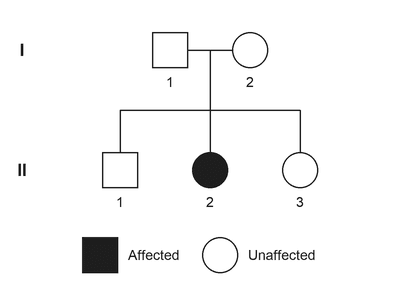
(a) Is the trait dominant or recessive? Give a reason.
(b) Can it be X-linked recessive? Give a reason.
(c) What is the probability that the unaffected son II-1 is a carrier?
- 474 marks
Question 47
The pedigree below shows haemophilia in a family. Use H for the normal allele and h for the haemophilia allele.
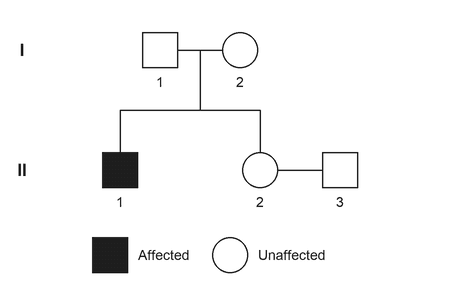
(a) Give the genotypes of I-1 and I-2, with a reason.
(b) What is the probability that II-2 is a carrier?
(c) II-2 marries a normal man (II-3). What is the probability that their first son is haemophilic?
(d) Why could the haemophilia of II-1 not have come from his father?
- 481 mark
Question 48
A woman with normal vision has normal parents, but her brother is colour blind. She marries a colour blind man. What is the probability that their daughter will be colour blind?
- 492 marks
Question 49
In a family, a woman affected by a recessive disorder has a son who is unaffected.
(a) Explain why the disorder cannot be X-linked recessive.
(b) Explain why it cannot be Y-linked.
- 503 marks
Question 50
Phenylketonuria (PKU) is an autosomal recessive disorder. A normal man, whose parents are normal but whose sister has PKU, marries a woman known to be a carrier (hypothetical family).
(a) What is the probability that the man is a carrier?
(b) If he is a carrier, what is the chance that a child of this couple has PKU?
(c) What is the overall probability that their first child has PKU?
- 511 mark
Question 51
According to the chromosome theory
- 521 mark
Question 52
The chromosomes in eukaryotic organisms are best studied in
- 531 mark
Question 53
If the linked genes are present not very far off on the chromosome, the recombinant frequency would be
- 541 mark
Question 54
If the cross over frequency of genes A, B and C are as given, between A and B = 10%, between B and C = 5%, between A and C = 5.5%, the sequence of genes on the chromosome would be
- 551 mark
Question 55
The agents that cause mutations are called as
- 561 mark
Question 56
When a particular chromosome is present in a single copy in a normal diploid cell it is called
- 571 mark
Question 57
50% recombinants in linked genes occur when
- 581 mark
Question 58
Which one of the following gives rise to a normal human female?
- 591 mark
Question 59
A haemophilic man marries a normal homozygous woman. What is the probability that their son will be haemophilic?
- 601 mark
Question 60
A haemophilic man marries a normal homozygous woman. What is the probability that their daughter will be haemophilic?
- 611 mark
Question 61
A female would be colour blind only if
- 621 mark
Question 62
A normal woman whose father was colour blind marries a normal man. There will be ............... chance that her sons would be colour blind.
- 631 mark
Question 63
Which one is correctly matched?
- 641 mark
Question 64
The recessive genes located on X chromosome in humans are always
- 651 mark
Question 65
Turner's syndrome is due to
- 661 mark
Question 66
Down's syndrome occurs as a result of
- 671 mark
Question 67
A disease caused by an autosomal non-disjunction is
- 681 mark
Question 68
Thalassaemia and sickle cell anemia are caused due to a problem in globin molecule synthesis. Select the correct statement.
- 691 mark
Question 69
A woman has an X-linked condition on one of her X chromosomes. This chromosome can be inherited by
- 701 mark
Question 70
Select the incorrect statement.
- 711 mark
Question 71
What is the genetic disorder in which an individual has an overall masculine development gynaecomastia, and is sterile?
- 721 mark
Question 72
Chemical used in karyotyping to arrest the mitotic cell division at metaphase stage is
- 731 mark
Question 73
Sickle cell anaemia is an example of following
- 741 mark
Question 74
The chromosomes that do not determine the sex of an individual are called ______.
- 751 mark
Question 75
Haemophilia is due to a ______ gene.
- 761 mark
Question 76
Fruit fly Drosophila melanogaster has ______ pairs of autosomes.
- 771 mark
Question 77
The mutations that occur due to insertion or deletion of a single base of DNA segment are called ______ mutations.
- 781 mark
Question 78
If mother is a carrier of colourblind gene, there is a possibility of ______ offspring to be colourblind.
- 791 mark
Question 79
A human male produces two types of gametes half containing X chromosome and half containing Y chromosome.
- 801 mark
Question 80
All sons of a colour blind father will always be colour blind.
- 811 mark
Question 81
Down's syndrome is due to trisomy of chromosome number 20.
- 821 mark
Question 82
Phenylketonuria exhibits itself in the homozygous recessive condition.
- 831 mark
Question 83
If both parents are carriers of thalassaemia, they need genetic counselling as there is 50% chance of the child being thalassaemia major.
- 841 mark
Question 84
In beta thalassaemia minors, the two of the four beta globin genes are faulty.
- 855 marks
Question 85
Match the following:
Column A Column B 1. Sickle cell anaemia (a) Cooley's anaemia 2. Thalassaemia major (b) Colour blindness 3. Karyotype (c) Presence of extra copy of X chromosome 4. Klinefelter's syndrome (d) Single base substitution at 6th codon for valine 5. Sex linked inheritance (e) Systematic arrangement of complete set of chromosomes - 861 mark
Question 86
A sudden, spontaneous change in the DNA of a chromosome.
- 871 mark
Question 87
Who determines the sex of the baby, male or female?
- 881 mark
Question 88
Which chromosomes do not take part in the sex determination?
- 891 mark
Question 89
Both father and mother have normal vision but son is colour blind. From whom has the son inherited the disease?
- 901 mark
Question 90
All the genes located on the same chromosome.
- 911 mark
Question 91
Kind of inheritance exhibited by haemophilia gene.
- 921 mark
Question 92
A technique by which trisomy of Down's syndrome can be detected.
- 931 mark
Question 93
A disease in which carrier individuals are resistant to malaria.
- 941 mark
Question 94
Assertion (A): In humans, the gamete contributed by the male determines whether the child produced will be male or female.
Reason (R): Sex in humans is a polygenic trait depending upon a cumulative effect of some genes on X-chromosome and some on Y-chromosome.
- 951 mark
Question 95
Assertion (A): A pair of genes is said to be linked if their recombination frequency is 50% or lower.
Reason (R): Higher frequency of crossing over is shown in linked genes if distance between them is longer.
- 961 mark
Question 96
Assertion (A): Haemophilia is a recessive sex-linked disease.
Reason (R): Haemophilia occurs due to the absence of a clotting factor in the blood.
- 971 mark
Question 97
Assertion (A): Sickle cell anaemia is an autosome linked genetically inherited disorder affecting many new born babies.
Reason (R): It is caused by substitution of valine by glutamic acid at the sixth position of the beta globin chain of haemoglobin molecule.
- 981 mark
Question 98
Assertion (A): Phenylketonuria is a recessive hereditary disorder which leads to accumulation of phenyl pyruvic acid and other derivatives in the brain.
Reason (R): The affected individual lacks an enzyme that converts amino acid phenylalanine into tyrosine.
- 991 mark
Question 99
Assertion (A): Turner's syndrome is caused by the absence of any one of the X and Y sex chromosome.
Reason (R): Such individuals show masculine as well as feminine development.
- 1001 mark
Question 100
Thalassaemia and sickle cell anemia are caused due to a problem in globin molecule synthesis. Select the correct statement.
- 1011 mark
Question 101
What is the genetic disorder in which an individual has an overall masculine development gynaecomastia, and is sterile?
- 1022 marks
Question 102
Briefly mention the contribution of T.H. Morgan in genetics.
- 1032 marks
Question 103
The map distance between genes A and B is 3 units, between B and C is 10 units and between C and A is 7 units. What is the order of the genes on the linkage map?
- 1042 marks
Question 104
Assume that no new mutations have arisen in the family. Answer each question with either 'Yes' or 'No'
(i) Could this be inherited as recessive trait?
(ii) Could this be inherited as dominant trait?

- 1051 mark
Question 105
Drosophila has four pairs of chromosomes and human has 23 pairs of chromosomes. How many linkage groups will each have?
- 1062 marks
Question 106
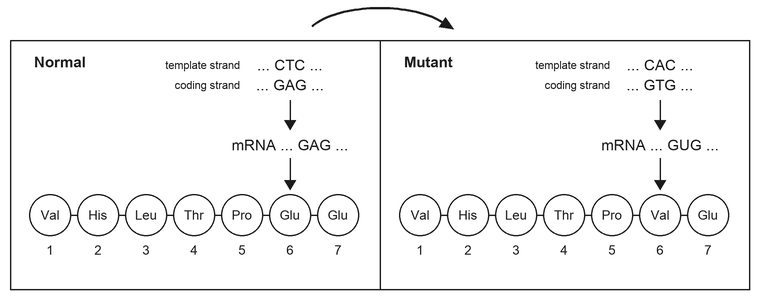
Identify the type of 'Mutation' occurring in the following diagram and name the 'Disease'.
- 1072 marks
Question 107
Mention the steps involved in the following pea plant cross
Removal of anthers — A
↓
Transfer of pollen — B
↓
Raising the next generation — C
- 1081 mark
Question 108
Why is haemophilia uncommon in females?
- 1091 mark
Question 109
Define Aneuploidy.
- 1101 mark
Question 110
Name the source of thermostable DNA polymerase.
- 1111 mark
Question 111
The maternal grandfather of a boy is colourblind, but his maternal grandmother is normal. The father of the boy is also normal. What is the probability of this boy being colourblind?
- 1122 marks
Question 112
Give one significant difference between the following:
(i) Linkage and crossing over
- 1132 marks
Question 113
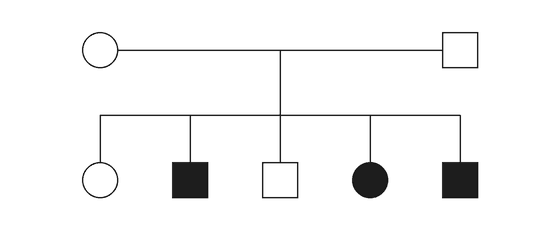
In given pedigree chart, the trait shown is:
- 1142 marks
Question 114
If the mother is a carrier of colour blindness and the father is normal, show the possible genotype and phenotype of the offspring of the next generation, with the help of a punnett square.
- 1152 marks
Question 115
The pedigree chart given below represents the pattern of inheritance of sickle cell anaemia in a family. Study it carefully and answer the questions that follow.

(i) What is the genotype of the father?
(ii) What is the phenotype of the mother?