
Opening your dashboard
Class 12 Biology Chapter 3 Human Reproduction: Practice Questions
177 questions on Chapter 3, each worked through on its own page with the AI tutor. Class 12 Biology, ICSE 2026-27.
177 questions
1–5 marks · Mixed difficulty
- 11 mark
Question 1
A sperm formed in a seminiferous tubule finally leaves the body through the urethra. Which route does it follow?
- 21 mark
Question 2
In a man, the gland that lies just below the urinary bladder and surrounds the urethra is removed by surgery. Which contribution to the semen is lost?
- 32 marks
Question 3
In a man the urethra carries both urine and semen, but in a woman it carries urine only.
(a) Explain this difference.
(b) How is the passage of urine prevented during ejaculation?
- 44 marks
Question 4
Draw a labelled diagram of the human male reproductive system as seen in a section from the side. Label the testis, scrotum, epididymis, vas deferens, seminal vesicle, prostate gland, Cowper's gland and urethra.
- 51 mark
Question 5
Starting from the end nearest the ovary, which is the correct order of the parts of a fallopian tube?
- 61 mark
Question 6
Which statement about the fallopian tubes is correct?
- 72 marks
Question 7
The vagina is said to have two roles in reproduction.
(a) State both roles.
(b) Which other passage joins the vagina to form the birth canal?
- 83 marks
Question 8
Milk made in a mammary gland passes through several structures before it comes out at the nipple.
(a) Where is milk produced, and where is it stored before it flows out?
(b) Arrange these passages in the order in which milk flows through them: mammary duct, lactiferous duct, mammary tubule, mammary ampulla.
(c) About how many lobes does each mammary gland have, and what separates one lobe from the next?
- 91 mark
Question 9
Which cell in the wall of a seminiferous tubule is haploid and yet still divides?
- 101 mark
Question 10
An egg is fertilised normally by a sperm, but the zygote fails to carry out its first cleavage division. A fault in which part of the sperm is the most likely cause?
- 114 marks
Question 11
Copy and complete the table for spermatogenesis in humans by filling in the blanks (a) to (h).
Cell Chromosome number Process that forms the next cell Next cell Spermatogonium 46 (a) Primary spermatocyte Primary spermatocyte (b) First meiotic division (c) Secondary spermatocyte (d) (e) Spermatids Spermatid (f) (g) (h) - 123 marks
Question 12
Predict and explain the effect on a man's testes if:
(a) the release of LH (ICSH) from the anterior pituitary is blocked;
(b) the release of FSH is blocked;
(c) the Sertoli cells stop secreting inhibin.
- 131 mark
Question 13
In what form are the future egg cells present in the ovaries of a baby girl at birth?
- 141 mark
Question 14
Which event turns a human secondary oocyte into an ovum?
- 152 marks
Question 15
In oogenesis, the first meiotic division gives one large cell and one very small cell.
(a) Name the two cells.
(b) What is gained by this unequal division?
- 164 marks
Question 16
The figure shows a mature follicle in a human ovary.
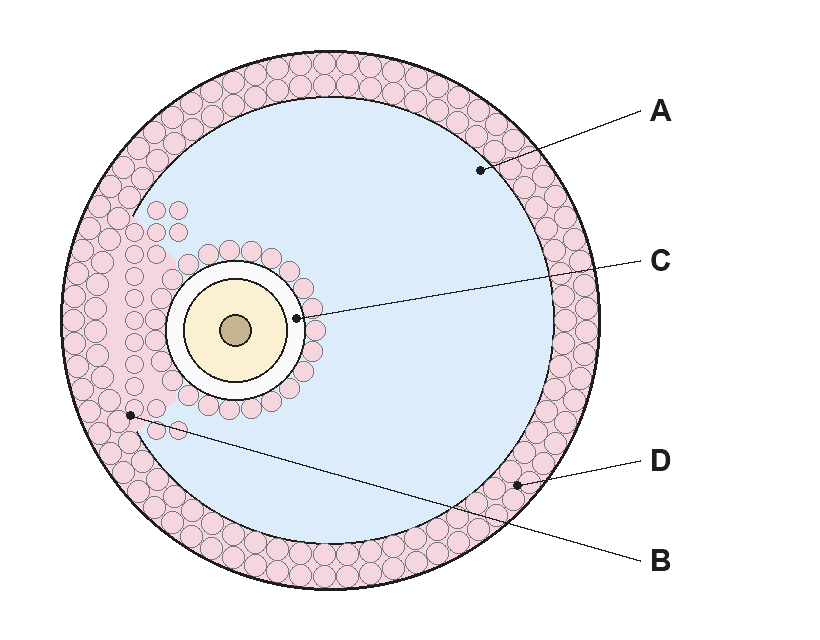
(a) Name the parts A, B, C and D.
(b) Name the fluid present in A and the cells that secrete it.
(c) Name the cell enclosed by C, and state the stage it has reached.
- 173 marks
Question 17
A female child is born with about 20 lakh (2 million) primary follicles in her two ovaries. By puberty about 2 lakh are left in each ovary, and only about 450 ever mature during her reproductive life.
(a) What percentage of the follicles present at birth are left at puberty?
(b) What percentage of the follicles present at puberty ever mature?
(c) Name the process by which the follicles present at puberty that never mature are lost, and the cells that dispose of them.
- 181 mark
Question 18
A woman has a regular 28-day cycle. Her menstruation began on 3 March, which is day 1 of the cycle. On about which date is ovulation expected?
- 191 mark
Question 19
A woman takes a medicine that keeps her blood progesterone level high all through the month. Which effect is expected?
- 203 marks
Question 20
The thickness of the lining of a woman's uterus was measured on different days of one cycle, in which the ovum was not fertilised. (Hypothetical data.)
Day of cycle 6 10 14 21 27 Thickness of endometrium (mm) 4.0 7.0 10.0 12.0 12.5 (a) In which phase does the thickness rise from 4.0 mm to 10.0 mm? Name the hormone responsible and the structure that secretes it.
(b) Which hormone, from which structure, makes the lining go on thickening after day 14?
(c) Predict how the thickness will change in the first few days of the next cycle, and give the reason.
- 214 marks
Question 21
When the ovum released in a cycle is not fertilised, the following events take place. They are listed out of order.
P. The blood vessels of the endometrium constrict, and its supply of oxygen and nutrients falls.
Q. The levels of FSH and LH in the blood fall.
R. The rising level of progesterone inhibits the release of GnRH.
S. The corpus luteum degenerates, and the levels of progesterone and oestrogen fall.
T. The endometrium breaks down and menstruation begins.
(a) Write the events in the correct order.
(b) Why is the corpus luteum said to trigger its own degeneration?
- 222 marks
Question 22
(a) Menstruation occurs only when a certain event fails to take place. Name that event.
(b) Name two factors, other than pregnancy, that can cause a lack of menstruation.
- 231 mark
Question 23
In a human ovum, the polar bodies are released from one region of the egg. What are this region and the region diametrically opposite to it called?
- 242 marks
Question 24
The human egg is described as alecithal.
(a) What does this term mean?
(b) Why is the human egg able to do without a store of yolk?
- 254 marks
Question 25
The figure shows a human ovum at the time of ovulation.
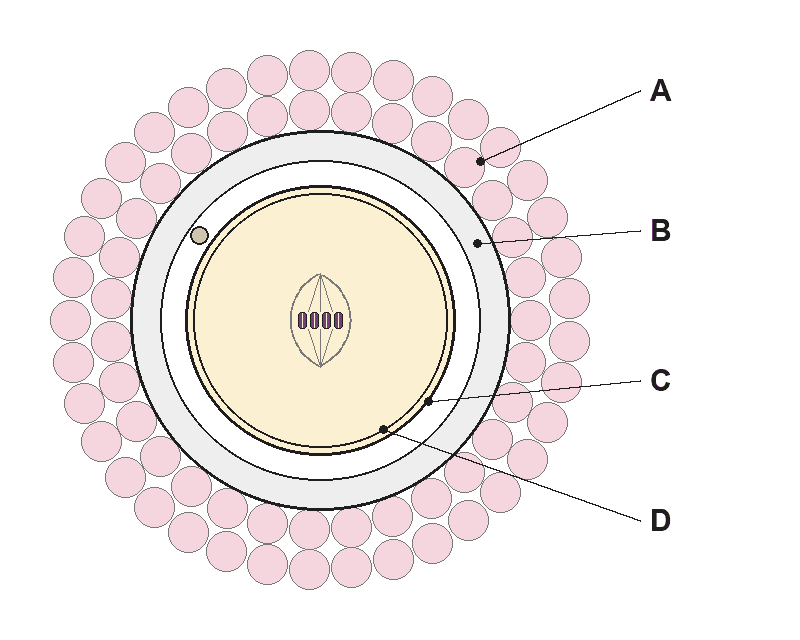
(a) Name the layers A, B, C and D.
(b) Which of these layers must the sperm get through first, and what breaks it down?
(c) Which layer thickens after fertilisation, and why?
- 261 mark
Question 26
Four events that take place when a human sperm meets the ovum are listed below.
P — The sperm enters the egg cytoplasm.
Q — The male and female pronuclei fuse.
R — Hyaluronidase dissolves the ground substance binding the follicle cells.
S — The egg completes its second meiotic division and gives off a polar body.
Which is the correct order?
- 272 marks
Question 27
Millions of sperms are deposited in the vagina during insemination, yet only one sperm fertilises the ovum. Explain (a) why only a few sperms reach the egg, and (b) why many sperms must still reach it.
- 281 mark
Question 28
A couple already has three daughters. What is the probability that their fourth child will be a son?
- 293 marks
Question 29
A family blames the mother for having only daughters. Using the kinds of gametes made by each parent, show that the sex of a child is decided by the father.
- 303 marks
Question 30
Draw a labelled diagram of a human ovum just after a sperm has entered it, showing how other sperms are kept out. Mark the fertilisation membrane, perivitelline space, plasma membrane, polar body, male pronucleus and female pronucleus. State how the fertilisation membrane is formed.
- 311 mark
Question 31
In the textbook plan of cleavage, a human zygote has just completed its third cleavage division. How many blastomeres are present, and what is the plane of the third cleavage?
- 321 mark
Question 32
Which statement about cleavage of the human zygote is correct?
- 333 marks
Question 33
The diagram shows a section of a human embryo about five days after fertilisation.

(a) Identify P, Q and R.
(b) State what each of P and Q gives rise to.
- 342 marks
Question 34
A defect in one germ layer of an early embryo (hypothetical example) affects the heart, the gonads and the muscles. Name this germ layer. Of the brain and the liver, which comes from the ectoderm and which from the endoderm?
- 351 mark
Question 35
During gastrulation in the human embryo, which germ layer is formed last, and from which cells?
- 363 marks
Question 36
Give reasons:
(a) After implantation, the human embryo depends on the mother for its nutrition.
(b) The blastula can increase in size, though the morula before it could not.
(c) Damage to the front end of the neural tube would affect the brain rather than the spinal cord.
- 371 mark
Question 37
Early in a pregnancy (hypothetical case), the chorion fails to secrete human chorionic gonadotropin (hCG). Which outcome is expected?
- 383 marks
Question 38
The following substances cross the placenta: oxygen, carbon dioxide, nutrients, excretory wastes, antibodies against measles.
(a) Which of these move from maternal blood to foetal blood?
(b) Which move from foetal blood to maternal blood?
(c) Which item in the list shows that the placenta acts as an ultrafilter? Explain the term.
- 391 mark
Question 39
The human egg is devoid of yolk, yet a small yolk sac forms in the human embryo. If the yolk sac failed to form (hypothetical case), which function would be lost?
- 402 marks
Question 40
At birth the doctor clamps and cuts the umbilical cord. (a) Which two structures does this cord join, and where is it attached on each? (b) Which foetal membrane forms its blood vessels?
- 414 marks
Question 41
Blood samples of three women were tested for some hormones (hypothetical data). "+" means detected and "–" means not detected.
Woman hCG hPL Relaxin Progesterone P + + – + Q – – – + R + + + + (a) Which woman is not pregnant? Give a reason.
(b) Which woman is most likely close to childbirth? Give a reason.
(c) Woman Q is not pregnant but has progesterone in her blood. Which structure in her ovary is the likely source?
(d) Name two hormones, other than the placental ones, whose levels rise several-fold in maternal blood during pregnancy.
- 421 mark
Question 42
A foetus is examined at 20 weeks of pregnancy (hypothetical case). Which feature fits this stage?
- 432 marks
Question 43
Why is the first trimester called a very critical time in the development of the baby? Give two reasons.
- 443 marks
Question 44
The following events were noted during a pregnancy:
P — Eyelids separate and eyelashes form.
Q — Fingers and toes are formed.
R — The heart forms and begins to beat.
S — The first movement of the foetus is felt.
(a) Arrange them in the order in which they occur.
(b) State the trimester in which each occurs.
- 451 mark
Question 45
Which statement correctly describes the third trimester (7–9 months) of human pregnancy?
- 461 mark
Question 46
Labour does not normally begin at the 30th week of pregnancy. Which is the reason?
- 472 marks
Question 47
A woman's last menstrual cycle began on 5 January 2026 (hypothetical example). Taking the average duration of pregnancy as 280 ± 7 days counted from the first day of the last menstrual cycle, find (a) her expected date of delivery and (b) the range of dates within which the birth is expected.
- 484 marks
Question 48
When a baby is born, its lungs expand and it begins breathing. (a) Explain the change in the circulation that must take place at this time. (b) Why is blood flow through the pulmonary arteries sometimes inadequate, and what does this show about the switchover?
- 491 mark
Question 49
A mother nurses her baby only briefly at each feed, so her breasts are not fully emptied. Over the next days her milk production falls. Which explains this?
- 502 marks
Question 50
Milk made in the mammary glands flows out only when the baby begins nursing. Name the hormone that controls (a) the production of milk and (b) the ejection of milk, and state where the first is secreted and what raises the level of the second.
- 511 mark
Question 51
What is true of gametes?
- 521 mark
Question 52
Which of the following is a primary sex organ?
- 531 mark
Question 53
Sperms are produced in
- 541 mark
Question 54
A single highly coiled tube where sperms are stored, get concentrated and mature is known as
- 551 mark
Question 55
Fertilisation of an ova takes place in the
- 561 mark
Question 56
The function of Sertoli cells is to
- 571 mark
Question 57
From one primary spermatocyte, number of spermatids produced are
- 581 mark
Question 58
From one primary oocyte, number of ova produced are
- 591 mark
Question 59
The egg released from the Graafian follicle is in the following stage
- 601 mark
Question 60
Oestrogen is secreted by the
- 611 mark
Question 61
Meiosis II takes place in the
- 621 mark
Question 62
Vas deferens is a part of a
- 631 mark
Question 63
The secretions of seminal vesicles contain
- 641 mark
Question 64
The large elongated cells that provide nutrition to developing sperms are
- 651 mark
Question 65
Repeated mitotic divisions occur in
- 661 mark
Question 66
Corpus luteum is formed by
- 671 mark
Question 67
Proliferative phase coincides with the
- 681 mark
Question 68
The follicle cells surrounding the ova at the time of ovulation form the
- 691 mark
Question 69
Which part of the sperm contains the respiratory enzymes?
- 701 mark
Question 70
The fertilisation in human beings takes place in the
- 711 mark
Question 71
Capacitation refers to changes in the
- 721 mark
Question 72
Sperm lysins are released from
- 731 mark
Question 73
A stage of development showing cells in three primary germ layers is
- 741 mark
Question 74
The protective and nutritive layer of the blastocyst is
- 751 mark
Question 75
Archenteron is found in the
- 761 mark
Question 76
At which of the following stages the implantation in uterus takes place?
- 771 mark
Question 77
Segmentation cavity is another name for
- 781 mark
Question 78
Which of the following layers form a part of foetal placenta?
- 791 mark
Question 79
A vital connection between mother and foetus is called
- 801 mark
Question 80
Sequence of hormones during menstrual cycle is
- 811 mark
Question 81
Proliferation of endometrium is controlled by hormone
- 821 mark
Question 82
In a vertebrate which germ layer forms the skeleton muscles?
- 831 mark
Question 83
If mammalian ovum fails to get fertilised which one of the following is unlikely?
- 841 mark
Question 84
Find out the incorrect statement from the following:- the process of gastrulation is characterised by
- 851 mark
Question 85
Sertoli cells are regulated by the pituitary hormone known as
- 861 mark
Question 86
Withdrawal of which of the following hormones is the immediate cause of menstruation?
- 871 mark
Question 87
Acrosome of sperms is/are modified
- 881 mark
Question 88
Term used for the birth of the fully formed foetus is called
- 891 mark
Question 89
In gastrulation, which is/are formed?
- 901 mark
Question 90
The embryo at 16-celled stage is known as
- 911 mark
Question 91
Capacitation of sperms occurs in
- 921 mark
Question 92
Accessory sexual character in female is promoted by
- 931 mark
Question 93
Sertoli cells are found in testis. These cells are
- 941 mark
Question 94
In human adult females hormone oxytocin:
- 951 mark
Question 95
In humans, at the end of the first meiotic division, the male germ cells differentiate into the
- 961 mark
Question 96
Changes in the female secondary sex organs are controlled by ______ of the ovary in the proliferative phase of the menstrual cycle while the changes in the secretory phase are controlled by the hormone ______.
- 971 mark
Question 97
Growth of the Graafian follicle is stimulated mainly by ______ of the pituitary while ovulation is stimulated mainly by ______ of the same gland.
- 981 mark
Question 98
A primary spermatocyte is produced by ______ division while a secondary oocyte results from ______ division.
- 991 mark
Question 99
Uterine glands grow and elongate in the ______ phase of the menstrual cycle while they are secreted in the ______ phase of the cycle.
- 1001 mark
Question 100
Spermatozoa are produced in the ______ of testes while ova are formed in the ______ of ovaries.
- 1011 mark
Question 101
Corpus luteum secretes ______ while Leydig cells secrete ______.
- 1021 mark
Question 102
The secretory phase of the menstrual cycle is also called the ______ phase because it is controlled by the hormone ______.
- 1031 mark
Question 103
Vasa efferentia conduct the sperms out from the ______ while vas deferens conducts the sperms from the ______.
- 1041 mark
Question 104
A secondary oocyte has a ______ chromosome number while a fertilised ovum has a ______ chromosome number.
- 1051 mark
Question 105
______ is a primary sex organ while ______ is a secondary sex organ in males.
- 1061 mark
Question 106
The axial filament of the tail piece is attached to the ______ centriole.
- 1071 mark
Question 107
______ is an active enzyme present in the sperm lysin.
- 1081 mark
Question 108
The blastodermic vesicle has a fluid filled cavity called the ______.
- 1091 mark
Question 109
The implantation of the embryo occurs at about ______ day.
- 1101 mark
Question 110
The degenerated corpus luteum is called ______.
- 1111 mark
Question 111
Hormone HCG stimulates ______ in ovary that produces progesterone.
- 1121 mark
Question 112
______ and ______ foetal membranes take part in the formation of placenta.
- 1131 mark
Question 113
Agents that cause malformation in the developing embryo are called ______.
- 1141 mark
Question 114
______ is the first milk secreted by mother's mammary glands.
- 1151 mark
Question 115
Hormone prolactin is produced by ______.
- 1161 mark
Question 116
Corpus luteum secretes the female hormone oestrogen.
- 1171 mark
Question 117
Graafian follicle bursts to release an egg from ovary.
- 1181 mark
Question 118
Placenta produces hormone prolactin.
- 1191 mark
Question 119
Fusion of sperm and egg is called implantation.
- 1201 mark
Question 120
Gestation period in humans is of about 320 days.
- 1211 mark
Question 121
Amniotic fluid acts as a shock absorber.
- 1221 mark
Question 122
Sperm is a single cell.
- 1231 mark
Question 123
Sperms are produced by epididymis.
- 1241 mark
Question 124
Menarche is when menstruation stops.
- 1251 mark
Question 125
Sertoli cells produce hormone testosterone.
- 1261 mark
Question 126
Mark the wrong item in the series and give the reason: Spermatocyte; polar body; spermatid; spermatogonium.
- 1271 mark
Question 127
Mark the wrong item in the series and give the reason: Endometrium; corpus luteum; acrosome; Graafian follicle.
- 1281 mark
Question 128
Mark the wrong item in the series and give the reason: Vas deferens; fallopian tube; epididymis; Cowper's gland.
- 1291 mark
Question 129
Mark the wrong item in the series and give the reason: Testes; prostate; seminal vesicles; Cowper's glands.
- 1301 mark
Question 130
Mark the wrong item in the series and give the reason: Fallopian tubes; vagina; uterus; ovaries.
- 1311 mark
Question 131
Mark the wrong item in the series and give the reason: Leydig cells; corpus luteum; Graafian follicle; sertoli cells.
- 1321 mark
Question 132
Mark the wrong item in the series and give the reason: Vasa efferentia; epididymis; vas deferens; seminal vesicle.
- 1331 mark
Question 133
Mark the wrong item in the series and give the reason: Secondary spermatocyte; polar body; spermatid; spermatogonia.
- 1341 mark
Question 134
Mark the wrong item in the series and give the reason: FSH; oestrogen; Graafian follicle; corpus luteum.
- 1351 mark
Question 135
Mark the wrong item in the series and give the reason: Acrosome; flagellum; spiral mitochondria; spermatid.
- 1361 mark
Question 136
Fully developed structure in ovary containing an egg ready for ovulation.
- 1371 mark
Question 137
An accessory gland in males whose secretion activates the sperms.
- 1381 mark
Question 138
A highly coiled tube in which the sperms mature.
- 1391 mark
Question 139
Period for which the foetus remains inside the uterus.
- 1401 mark
Question 140
Site of production of sperms in man.
- 1411 mark
Question 141
Term used for the stoppage of menstruation.
- 1421 mark
Question 142
Innermost foetal membrane which secretes amniotic fluid.
- 1431 mark
Question 143
Two substances that diffuse out of the foetus into the placenta.
- 1441 mark
Question 144
A hollow pear-shaped muscular organ where embryo develops.
- 1451 mark
Question 145
Male hormone produced by the interstitial cells or Leydig cells.
- 1461 mark
Question 146
Hormone that stimulates contraction of uterus during childbirth.
- 1471 mark
Question 147
Structure formed after the release of ovum from Graafian follicle.
- 1481 mark
Question 148
Structure formed by the villi of the foetus and the uterus of the mother.
- 1491 mark
Question 149
Part in female reproductive system where fertilisation takes place.
- 1501 mark
Question 150
First fluid released from the mammary glands after birth.
- 1511 mark
Question 151
Assertion (A): The interstitial spaces of seminiferous tubules contain Leydig cells.
Reason (R): Leydig cells synthesise and secrete hormones called androgens.
- 1521 mark
Question 152
Assertion (A): The testes are situated outside the abdominal cavity within the scrotum.
Reason (R): Scrotum helps to maintain the lower temperature of testes by 2°C for normal spermatogenesis.
- 1531 mark
Question 153
Assertion (A): The infundibulum is a funnel shaped part of oviduct which is closest to ovary.
Reason (R): The edges of infundibulum help in collection of ovum after ovulation.
- 1541 mark
Question 154
Assertion (A): Finger-like projections appear on the trophoblast called chorionic villi after implantation.
Reason (R): Chorionic villi are surrounded by the uterine tissue and maternal blood.
- 1551 mark
Question 155
Assertion (A): Both FSH and LH attain a peak level during middle of the menstrual cycle around 14th day.
Reason (R): LH surge induces the formation of corpus luteum at ovulation.
- 1561 mark
Question 156
Assertion (A): Fertilisation occurs when ovum and sperm are transported simultaneously to the ampullary–isthmic junction.
Reason (R): During fertilisation a sperm comes in contact with the zona pellucida layer of the ovum.
- 1571 mark
Question 157
Assertion (A): The spermatids are transformed into spermatozoa by a process called spermiogenesis.
Reason (R): Spermatids undergo meiotic division to form haploid spermatozoa.
- 1581 mark
Question 158
Assertion (A): Implantation occurs when the blastomere stage gets embedded into the thickened wall of uterus.
Reason (R): After implantation, the trophoblast layer forms a special tissue called placenta.
- 1591 mark
Question 159
Assertion (A): At the end of pregnancy, placenta secretes a hormone called relaxin.
Reason (R): Relaxin keeps the levels of oestrogen and progesterone high necessary to maintain pregnancy.
- 1601 mark
Question 160
Assertion (A): The foetal ejection reflex triggers the release of oxytocin from maternal pituitary.
Reason (R): Oxytocin acts on uterine muscles and causes stronger uterine contractions.
- 1615 marks
Question 161
Read the source given and answer the questions that follow.
The male reproductive system consists of certain accessory ducts such as rete testis, vasa efferentia, epididymis and vas deferens. Rete testis are the network of tubules which are located on the inner side of the testis. From here vasa efferentia emerge which are the small ducts that carry sperms to the epididymis. In epididymis, the sperms get concentrated and pass to vas deferens. Vas deferens opens into the common urethra. Male accessory glands include: prostate glands, seminal vesicle and bulbourethral glands. Semen is the fluid containing spermatozoa and secretions of accessory glands. Seminal vesicles add secretion containing spermatozoa activating substances like fructose, citrate and prostaglandins, etc. Prostate glands present at the neck of the urinary bladder secrete the alkaline fluid which is essential to neutralise the acidic secretions present in vagina. Bulbourethral glands also known as Cowper's glands located just above the prostate gland, add clear mucous and glycoproteins which act as lubricant.
1. Which one of the following is an accessory gland of human male reproductive system?
(a) vas deferens (b) seminal vesicle (c) vas efferentia (d) prostaglandins
2. At which site do the sperms get concentrated in the male reproductive system?
(a) seminal vesicles (b) bulbourethral glands (c) epididymis (d) rete testis
3. The glands which add glycoproteins to semen are
(a) Cowper's glands (b) seminal vesicles (c) epididymis (d) prostate glands
4. The ducts that carry sperms to the epididymis are
(a) rete testis (b) urethra (c) vas deferens (d) vas efferentia
5. The nature of prostate glands is
(a) alkaline (b) slightly acidic (c) neutral (d) highly acidic
- 1622 marks
Question 162
Write two major functions each of testis and ovary.
- 1632 marks
Question 163
Describe the structure of a seminiferous tubule.
- 1642 marks
Question 164
Name the hormones involved in regulation of spermatogenesis.
- 1652 marks
Question 165
Define spermiogenesis and spermiation.
- 1662 marks
Question 166
What are the major components of seminal plasma?
- 1673 marks
Question 167
What are the major functions of male accessory ducts and glands?
- 1683 marks
Question 168
Name the functions of the following:
(i) Corpus luteum
(ii) Endometrium
(iii) Acrosome
(iv) Sperm tail
(v) Fimbriae
- 1692 marks
Question 169
How many eggs are released by a human ovary in a month? How many eggs do you think would have been released if the mother gave birth to identical twins? Would your answer change if the twins born were fraternal?
- 1701 mark
Question 170
How many autosomes and sex chromosomes are found in a single matured human sperm?
- 1712 marks
Question 171
Sometimes the doctor injects some medicine into the body of a woman to induce uterine contractions and delivery. What do you think that the doctor has injected?
- 1722 marks
Question 172
Not all copulations result in pregnancy. Give a reason.
- 1732 marks
Question 173
Blood of mother never mixes up with that of the foetus. Yet it nourishes the foetus. How?
- 1741 mark
Question 174
Define the following:
Spermiogenesis
- 1751 mark
Question 175
How is the chromosome number maintained in sexually reproducing organisms?
- 1761 mark
Question 176
Expand the following abbreviation:
PID
- 1772 marks
Question 177
Mention the location and the function of Leydig cells.