
Opening your dashboard
Class 12 Biology Chapter 20 Environmental Issues: Practice Questions
133 questions on Chapter 20, each worked through on its own page with the AI tutor. Class 12 Biology, ICSE 2026-27.
133 questions
1–5 marks · Mixed difficulty
- 11 mark
Question 1
Phosphate fertiliser spread on a field helps the crop grow. After heavy rain, the same phosphate washes into a nearby pond in large amounts and the fish begin to die. In the pond, the phosphate is best described as
- 22 marks
Question 2
Classify each of the following kinds of pollution in two ways — by its origin and by the physical nature of the pollutant:
(i) ash, toxic gases and dust thrown out by an erupting volcano;
(ii) hot water released from a power plant into a river.
- 33 marks
Question 3
Give reasons:
(i) Domestic sewage is biodegradable, yet it can still pollute a lake.
(ii) Mercury released into a river can harm animals living far away from the factory that released it.
(iii) Biodegradable wastes, if handled properly, are not a permanent problem.
- 41 mark
Question 4
Two kinds of dust are released from a stone quarry: particles about 30 µm across and particles about 0.5 µm across. Which statement about them is correct?
- 51 mark
Question 5
In a busy city, the level of PAN (peroxyacetyl nitrate) in the air rises sharply on sunny afternoons but stays low at night, although traffic is heavy at both times. The best explanation is that PAN
- 63 marks
Question 6
A family keeps a charcoal stove burning inside a closed room on a cold night to stay warm. Explain why this can be fatal.
- 73 marks
Question 7
Students surveyed sensitive epiphytic lichens on tree trunks at different distances from a coal-fired thermal power plant. (Hypothetical data.)
Distance from plant (km) Sensitive lichen species found 1 0 3 1 6 4 10 7 (a) What does the pattern in the table indicate?
(b) Name the gaseous pollutant most likely responsible and its source in the plant.
(c) Why is such a lichen survey useful to environmental agencies?
- 81 mark
Question 8
To handle more flue gas, an engineer greatly increases the speed at which dirty gas flows between the plates of a thermal power plant's electrostatic precipitator. The most likely result is that
- 92 marks
Question 9
Suggest one suitable control device for each exhaust below and give the reason for your choice:
(i) a fertiliser plant whose exhaust contains ammonia gas;
(ii) a thermal power plant whose exhaust contains large amounts of fine fly ash.
- 101 mark
Question 10
A car fitted with a catalytic converter is filled with leaded petrol for several months. What is the effect on its exhaust?
- 113 marks
Question 11
Water samples were collected on the same day. (Hypothetical data.)
Sample pH Rain in industrial city X 4.2 Rain in hill village Y 5.8 Lake Z near city X 4.6 (a) Which rain sample shows the normal acidity of unpolluted rain? Why is even unpolluted rain slightly acidic?
(b) Name the acids most likely lowering the pH of the rain in city X and the gases they come from.
(c) Predict the effect of lake Z's water on its plankton, molluscs and fish.
- 121 mark
Question 12
A sound meter shows 90 dB near a busy road and 60 dB in a quiet classroom. The sound near the road is how many times as intense as that in the classroom?
- 134 marks
Question 13
Permissible ambient noise levels (day = 6 am to 10 pm, night = 10 pm to 6 am), under the Noise Pollution (Regulation and Control) Rules, 2000:
Zone Day Night Residential 55 dB 45 dB Silent zone 50 dB 40 dB A sound meter gave these readings. (Hypothetical data.)
Place Time Reading Housing colony (residential) 7 pm 62 dB Housing colony (residential) 11 pm 50 dB Hospital (silent zone) 2 pm 48 dB Hospital (silent zone) 1 am 44 dB (a) Which readings are above the permissible level?
(b) Suggest two measures the town could take to reduce noise in the housing colony.
- 142 marks
Question 14
A worker in a textile mill says, "The noise of these machines does not hurt my ears, so I do not need ear muffs." Explain why the worker is wrong.
- 151 mark
Question 15
A pregnant woman works for many months beside loud machines in a factory. Which possible effect of this noise on her unborn child has been reported?
- 164 marks
Question 16
An oil tanker capsizes near the coast and a large oil slick spreads over the sea.
(a) State two harmful effects of the spill on marine life.
(b) Describe two methods to clean up the oil slick.
- 173 marks
Question 17
The dissolved oxygen (DO) of three ponds was measured. (Hypothetical data.)
Pond DO (mg/L) P 8.6 Q 6.1 R 3.4 (a) Classify each pond as clean, polluted or heavily polluted.
(b) Suggest one likely cause of the DO value of pond R and state its effect on the fish.
- 182 marks
Question 18
A sample from a chemical factory's drain has a BOD of 40 mg/L but a COD of 300 mg/L. (Hypothetical data.) What does the large difference between the two values tell us about the organic matter in the sample?
- 191 mark
Question 19
A persistent pesticide was measured along a lake food chain. (Hypothetical data.)
Level Pesticide (ppb) Water 0.002 Zooplankton 0.03 Small fish 0.3 Large fish 2 Fish-eating bird 8 The concentration in the fish-eating bird is about how many times that in the water?
- 203 marks
Question 20
Identify the water pollutant and name the disease in each case:
(i) An infant in a farming village, fed with well water from beside heavily fertilised fields, turns bluish and has difficulty getting oxygen.
(ii) Fishermen who eat fish from a bay into which a factory drains its wastewater suffer from numbness of the lips, tongue and limbs, blurred vision and deafness.
(iii) People in a village whose drinking water comes from a deep well develop hardened bones and stiff, painful joints.
- 211 mark
Question 21
Domestic sewage is about 99.9% water and 0.1% impurities. Which part of these impurities is the most difficult to remove during treatment?
- 223 marks
Question 22
A farmer keeps dairy cattle, bee boxes, compost pits and a biogas unit on the farm along with the crops. Explain how linking these activities lets the farmer avoid buying chemical fertilisers and fuel.
- 232 marks
Question 23
A farmer says, "Pesticides kill only the pests, so spraying more of them can do no harm." Give two reasons why the farmer is wrong.
- 244 marks
Question 24
A town is deciding between continuing its open dumps (with burning of waste) and shifting to a sanitary landfill.
(a) How is waste handled in each method?
(b) State one problem of each method.
- 251 mark
Question 25
Hospital waste is burnt at a very high temperature in an incinerator instead of being thrown on an open dump, mainly because it
- 261 mark
Question 26
Farmers near a coal-based thermal power plant find a fine grey powder settling on their fields every day, coming from the plant's tall chimney. Which type of waste and pollutant is this?
- 273 marks
Question 27
Classify each of the following as a direct or an indirect cause of soil pollution. Give a reason for each.
(i) Rain falling on fields near a smelter brings down sulphur compounds released from its chimney.
(ii) A town dumps its discarded food, paper and polythene bags on vacant land at its edge.
(iii) Canal water carrying pollutants is used to irrigate fields, and the pollutants pass into the soil.
- 284 marks
Question 28
A city council plans four steps to reduce its waste and control soil pollution.
(i) Build transfer stations at different points in the city.
(ii) Lay pneumatic pipes.
(iii) Recycle 250 tonnes of waste paper every year (hypothetical data). Take it that recycling one tonne of paper saves about 17 trees.
(iv) Ask nearby farms to use biological control of pests.
Explain how each step helps. For step (iii), also work out the number of trees saved each year.
- 291 mark
Question 29
Low radioactivity is found in the well water of a remote village. There is no nuclear power plant, hospital, research laboratory or weapons test site within hundreds of kilometres. What is the most likely source?
- 303 marks
Question 30
A patch of soil near an old nuclear test site was contaminated with strontium-90, whose half-life is 28 years. Suppose the soil held 80 units of strontium-90 when it was first contaminated (hypothetical data).
(i) What is meant by the half-life of a radioactive element?
(ii) How many units of strontium-90 will remain in the soil after 84 years?
(iii) Why is such contamination a danger to animals and humans who never visit the site?
- 312 marks
Question 31
Give reasons:
(i) Nuclear waste is called a highly potent pollutant.
(ii) Wastes with a long half-life are stored in shielded containers buried deep in rocks, instead of being discharged into sewers.
- 321 mark
Question 32
Equal amounts of two radioactive substances, X and Y, are spilled on a field. X has a half-life of a few seconds; Y has a half-life of thousands of years. Which statement is correct?
- 331 mark
Question 33
The methane concentration of the atmosphere was about 700 ppb in 1750 and about 1,750 ppb in 2000. By about what percentage did it increase over this period?
- 343 marks
Question 34
The table shows the atmospheric CO₂ concentration at three times.
Year CO₂ concentration (ppm) 1750 280 2000 368 2022 417 (i) Calculate the percentage increase in CO₂ from 1750 to 2022 (to one decimal place).
(ii) Calculate the average rise in CO₂ per year between 2000 and 2022.
(iii) Give two human activities that are mainly responsible for this rise.
- 351 mark
Question 35
With global warming, the Northern Hemisphere is expected to become warmer than the Southern Hemisphere. Which reason supports this prediction?
- 363 marks
Question 36
A farmer in a dry region with nutrient-poor soil grows a C₃ crop.
(i) Explain how a rise in atmospheric CO₂ could help the crop cope with the shortage of water.
(ii) Explain how it could help the crop in the nutrient-poor soil.
(iii) Why is the overall food production of the world still expected to fall as CO₂ rises?
- 372 marks
Question 37
A shrub and a tree species grow together in a band between 1,500 m and 2,000 m on a mountain slope (hypothetical example).
(i) If the average temperature rises by a few degrees, in which direction on the mountain is the band likely to shift? Why?
(ii) Why may the trees in the band die and be replaced by shrubs?
- 381 mark
Question 38
A 5% loss of ozone results in a 10% increase in UV radiation reaching the earth. If the ozone over a region falls by 15% and the same proportion holds, by how much will the UV radiation reaching the surface increase?
- 393 marks
Question 39
The thickness of ozone above Antarctica in spring is given below. 1 Dobson unit (DU) is equivalent to a 0.01 mm thick layer.
Year Ozone thickness (DU) 1979 225 1985 136 1994 94 (i) Express the 1985 value as the thickness of a layer in mm.
(ii) Calculate the percentage fall in ozone thickness from 1979 to 1994 (to the nearest whole number).
(iii) The 'ozone hole' over Antarctica is not a permanent feature. Explain.
- 402 marks
Question 40
Give reasons:
(i) CFCs are unreactive at the earth's surface, yet they destroy ozone.
(ii) Production of CFCs has been phased out worldwide since 2010, yet the ozone layer over Antarctica is not expected to return to its 1980 level until about 2066.
- 411 mark
Question 41
Scientists fear that fish catches in the seas around Antarctica may fall when the ozone hole is large, although the fish themselves live deep in the water. Which is the best explanation?
- 421 mark
Question 42
Rain washes the top soil off a farmer's field on a hill slope every monsoon. Which practice will reduce this by slowing down the flow of water?
- 433 marks
Question 43
A farmer irrigates a field heavily from a canal for several years, but the field has no drainage. Water stands in the field, a thin white crust appears on the soil surface and the crop grows poorly.
(i) What has happened to the soil, and where does the white crust come from?
(ii) Why does the crop grow poorly?
(iii) Suggest one measure to prevent this.
- 443 marks
Question 44
A district has a total land area of 2,000 km², of which 1,500 km² is plains and 500 km² is hills. Its forest cover is 19.4% of the total land area (hypothetical data). The National Forest Policy (1988) of India recommends 33% forest cover for the plains and 67% for the hills.
(i) Calculate the forest area (in km²) the district should have according to the policy.
(ii) Calculate the forest area it has at present and the shortfall.
(iii) State one way in which this shortfall could be made up.
- 451 mark
Question 45
Jhum cultivation was practised in the North-Eastern states for a long time without lasting damage, but it has now led to large-scale deforestation. Why?
- 464 marks
Question 46
Fill in the missing steps in these chains showing the effects of deforestation.
(i) Deforestation → Reduced shade → ________ → Quick run-off → ________ → Flood
(ii) Deforestation → Decreased evaporation → ________ → Drought
(iii) Deforestation → Reduced water retention → ________
(iv) Why are plant and animal life of a deforested area severely affected in the end?
- 472 marks
Question 47
State whether each activity is an example of protection (conservation) forestry or production (commercial) forestry, with a reason.
(i) Fast-growing Eucalyptus trees are planted intensively on available land to supply wood to a paper mill.
(ii) A degraded forest is declared a sanctuary and protected from human interference so that its flora and fauna can revive.
- 481 mark
Question 48
Which feature best describes the Joint Forest Management (JFM) introduced by the Government of India in the 1980s?
- 493 marks
Question 49
The Chipko Movement began in the Himalayan villages in the early 1970s.
(i) What does the word 'Chipko' mean, and what form of protest does it describe?
(ii) What injustice in the Mandal forest set off the confrontation of 1973?
(iii) How did the movement change the way the forest was seen?
- 502 marks
Question 50
Compare the protest led by Amrita Devi in 1731 with the Chipko Movement of the 1970s.
(i) Give one feature common to both.
(ii) Give one difference between them.
- 511 mark
Question 51
Which of the following is a non-biodegradable pollutant?
- 521 mark
Question 52
Ozone depletion has resulted in
- 531 mark
Question 53
Increase in CO₂ is harmful in atmosphere because it
- 541 mark
Question 54
Acid rain is due to the precipitation of
- 551 mark
Question 55
CFCs cause
- 561 mark
Question 56
The greenhouse gases
- 571 mark
Question 57
Photochemical smog is mainly composed of
- 581 mark
Question 58
pH of acid rain is
- 591 mark
Question 59
Eutrophication leads to death of fish due to
- 601 mark
Question 60
Methaemoglobinemia is due to the following pollutant in drinking water
- 611 mark
Question 61
The noise level that may lead to pain and physical discomfort is
- 621 mark
Question 62
Minamata disease is caused by
- 631 mark
Question 63
If DDT is sprayed in a lake, after 15 years, its highest concentration will be found in
- 641 mark
Question 64
If BOD of a lake is high it means
- 651 mark
Question 65
Which one of the following is a 'radiatively active gas'?
- 661 mark
Question 66
Ozone layer is present in
- 671 mark
Question 67
Harmful UV rays of sun are absorbed by
- 681 mark
Question 68
Ozone hole was first discovered over
- 691 mark
Question 69
Nitrogen oxides produced from the emission of automobiles and power plants, are the source of fine airborne particles which lead to
- 701 mark
Question 70
A lake with an inflow of domestic sewage rich in organic waste may result in
- 711 mark
Question 71
Minamata disease was caused due to the consumption of
- 721 mark
Question 72
Expand BOD.
- 731 mark
Question 73
The term 'Biomagnification' refers to the
- 741 mark
Question 74
Formation of nonfunctional methaemoglobin causes blue baby syndrome. This is due to
- 751 mark
Question 75
Which of the following is secondary pollutant?
- 761 mark
Question 76
Montreal protocol was passed in
- 771 mark
Question 77
Photochemical smog pollution does not contain
- 781 mark
Question 78
The montreal protocol refers to
- 791 mark
Question 79
Greenhouse effect is due to
- 801 mark
Question 80
Ozone hole results in
- 811 mark
Question 81
Ozone layer occurs in
- 821 mark
Question 82
A lake near a village suffered heavy mortality of fishes within a few days. Consider the following reasons for this
(a) lots of urea and phosphate fertilisers were used in the crops in the vicinity
(b) the area was sprayed with DDT by an aircraft
(c) the lake water turned green and stinky
(d) phytoplankton populations in the lake declined initially thereby greatly reducing photosynthesis
Which two of the above were main reasons of fish mortality in the lake?
- 831 mark
Question 83
Increase in BOD in water leads to
- 841 mark
Question 84
The agents that cause pollution are called ________.
- 851 mark
Question 85
________ pollutants can be broken down by microorganisms.
- 861 mark
Question 86
Global warming is a consequence of ________ effect caused by ________ level of carbon dioxide.
- 871 mark
Question 87
CFCs are used in ________, ________ and ________.
- 881 mark
Question 88
Depletion of ozone layer is caused by mainly ________.
- 891 mark
Question 89
________ and ________ are known as greenhouse gases.
- 901 mark
Question 90
Skeletal fluorosis causes symptoms of ________ and ________, and it is due to ________.
- 911 mark
Question 91
Excessive loading of nutrients in a lake leads to ________ causing ________ in O₂.
- 921 mark
Question 92
________, ________, ________ are the greenhouse gases that lead to warming up of earth's surface.
- 931 mark
Question 93
________ appears due to thinning of ozone layer every year over Antarctica during the month of August–September.
- 941 mark
Question 94
Photochemical smog occurs due to warming up of air in winters.
- 951 mark
Question 95
Acid rain causes erosion of brick and marble structures.
- 961 mark
Question 96
High DO of water signifies water is clean.
- 971 mark
Question 97
Industrial effluents containing high amount of nitrates released in water bodies cause eutrophication.
- 981 mark
Question 98
Oxygen and nitrogen are greenhouse gases.
- 991 mark
Question 99
Ozone layer is present in the stratosphere of earth.
- 1001 mark
Question 100
Ozone is one of the greenhouse gases responsible for creating ozone hole in Antarctica.
- 1011 mark
Question 101
Minamata disease is caused by consuming water-containing cadmium.
- 1021 mark
Question 102
Global warming is as a result of enhanced greenhouse effect.
- 1031 mark
Question 103
Biological magnification is due to accumulation of non-biodegradable pollutants in the tissues of animals and their increased concentration in a food chain.
- 1045 marks
Question 104
Match the following:
Column A Column B 1. CO₂ (a) Non-biodegradable 2. Fabric filters (b) Itai-itai disease 3. Incinerator (c) Particulate emission 4. Cadmium (d) Burning at high temperature 5. DDT (e) Greenhouse effect - 1051 mark
Question 105
Poisonous compound formed by CO₂ with haemoglobin.
- 1061 mark
Question 106
Gases that lead to global warming.
- 1071 mark
Question 107
A disease caused due to mercury contaminated water.
- 1081 mark
Question 108
Algal bloom seen in lakes due to excess loading of nutrients.
- 1091 mark
Question 109
An annelid that is recognised as an indicator for polluted waters.
- 1101 mark
Question 110
Assertion (A): Compressed natural gas (CNG) is a natural gas under pressure and is mainly composed of methane.
Reason (R): One of the advantages of using CNG as a fuel in automobiles is that it requires very less space for storage as compared to petrol or diesel.
- 1111 mark
Question 111
Assertion (A): Photochemical smog is mainly composed of nitrogen oxides, volatile organic compounds, ozone and peroxyacetyl nitrates.
Reason (R): Photochemical smog develops in cold weather conditions by the interaction of secondary pollutants.
- 1121 mark
Question 112
Assertion (A): Excess of nitrates in drinking water are harmful for infants.
Reason (R): Nitrates are responsible for the 'blue-baby syndrome'.
- 1131 mark
Question 113
Assertion (A): Eutrophication shows sudden increase in the growth of green plants or productivity in water.
Reason (R): With increasing eutrophication, there is depletion of dissolved oxygen in water which leads to death of most fish and aquatic life.
- 1141 mark
Question 114
Assertion (A): Biological magnification is a phenomenon through which certain pollutants go on accumulating in increased concentration along the food chain.
Reason (R): The pollutants go on accumulating because they are non-biodegradable and each predator feeds on many preys and hence accumulates more.
- 1151 mark
Question 115
Assertion (A): Handicapped children were born to mothers exposed to the atomic bombs during World War II even after many years.
Reason (R): Exposure of human body to radiations causes mutations.
- 1161 mark
Question 116
Assertion (A): Deforestation is one main factor contributing to global warming.
Reason (R): Besides CO₂, two other gases – methane and CFCs are also included under greenhouse gases.
- 1171 mark
Question 117
Assertion (A): UV radiation causes photo-dissociation of ozone into O₂ and O, thus causing damage to the stratospheric ozone layer.
Reason (R): Ozone hole is resulting in global warming and climate change.
- 1181 mark
Question 118
Assertion (A): Chlorofluorocarbons (CFCs) are responsible for ozone depletion.
Reason (R): Ozone level or thickness is decreasing every year.
- 1191 mark
Question 119
Assertion (A): Greenhouse gases inhibit the escape of total radiation by absorbing the long wave infrared radiations and reflecting them back towards the earth.
Reason (R): Greenhouse gases increase the temperature of earth.
- 1203 marks
Question 120
List all the wastes that you generate, at home, school or during your trips to other places, could you very easily reduce? Which would be difficult or rather impossible to reduce?
- 1213 marks
Question 121
What measures, as an individual, you would take to reduce environmental pollution?
- 1222 marks
Question 122
Study the graph and answer the questions given below.
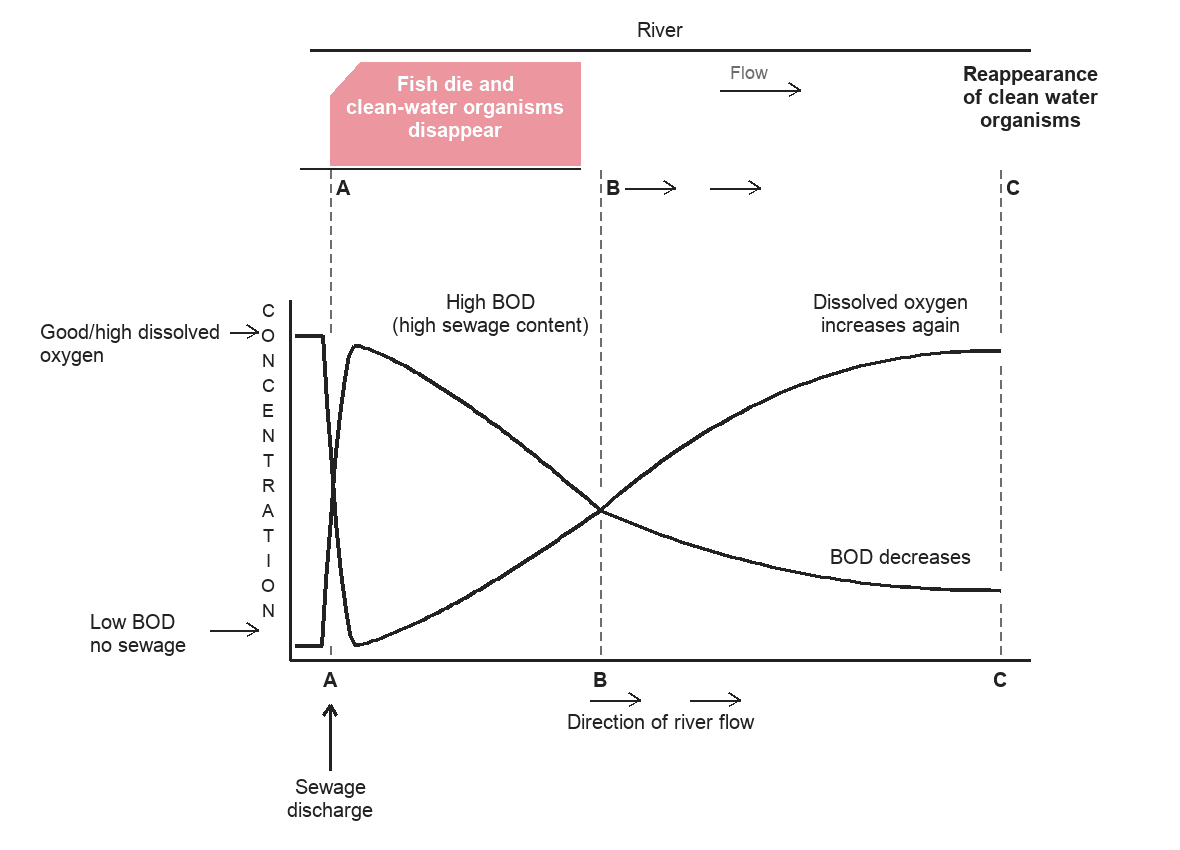
(a) What measures would you take to decrease BOD and increase DO?
(b) What kind of sewage discharge will increase BOD?
- 1232 marks
Question 123
Name four metals which are recovered during the recycling of e-waste.
- 1243 marks
Question 124
Complete the following:
A B 1. ________ Carbon monoxide and nitrogen oxide 2. Electrostatic precipitator ________ 3. ________ High noise level 4. Landfills ________ - 1253 marks
Question 125
To reduce the air pollution, the fuel for public transport, i.e., of buses in Delhi was changed from petrol to another fuel. Name the fuel and its three advantages.
- 1262 marks
Question 126
How do FOAM help in wastewater treatment?
- 1273 marks
Question 127
Observe the following diagram and answer the questions.
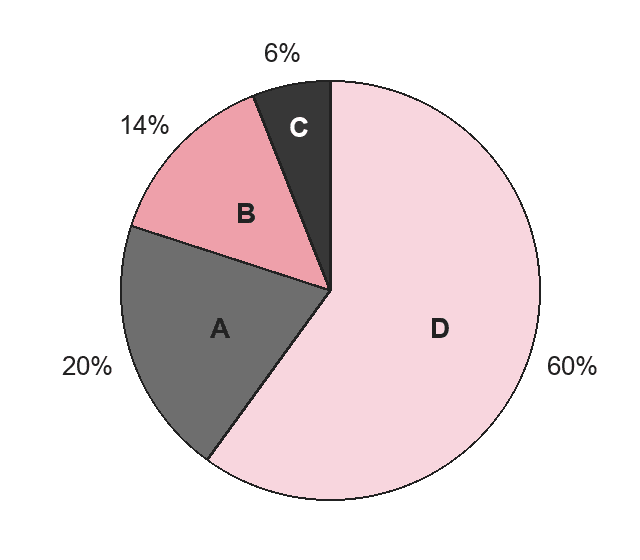
(i) Name the gases.
(ii) Which of these two are known as greenhouse gases?
(iii) Which of these is the major cause of depletion of ozone layer?
- 1281 mark
Question 128
What is Dobson unit?
- 1291 mark
Question 129
Montreal Protocol aims at:
- 1302 marks
Question 130
What is biomagnification? Write two effects of biomagnification.
- 1312 marks
Question 131
Write a short note on the contribution of Ahmed Khan of Bangalore.
- 1322 marks
Question 132
List any four effects of global warming.
- 1332 marks
Question 133
State any four measures to control pollution.