
Opening your dashboard
Class 12 Biology Chapter 16 Biotechnology and Its Applications: Practice Questions
127 questions on Chapter 16, each worked through on its own page with the AI tutor. Class 12 Biology, ICSE 2026-27.
127 questions
1–5 marks · Mixed difficulty
- 11 mark
Question 1
A plant breeder wants rice to gain one useful trait whose gene is found only in an unrelated organism, while all the other traits of the rice stay the same. Why is genetic engineering better suited to this than traditional cross-hybridisation?
- 22 marks
Question 2
Scientists hope to transfer the nif gene into cereal crops such as wheat and rice.
(a) What new ability would these cereals gain?
(b) State one benefit of this to the farmer or the environment.
- 31 mark
Question 3
GM crops have many advantages. Which advantage is correctly paired with its example?
- 43 marks
Question 4
A seed company wants to make one Bt crop that resists cotton bollworms and another that resists the corn borer.
(a) On what two factors does the choice of the Bt toxin gene depend? Why can one gene not serve every crop?
(b) Name the cry gene(s) suited to the cotton crop.
(c) Name the cry gene suited to the corn crop.
- 52 marks
Question 5
In making nematode-resistant tobacco, suppose the introduced gene produced only the sense RNA in the host cells, and no anti-sense RNA. Would the plant still be protected from Meloidogyne incognita? Explain why.
- 62 marks
Question 6
Name the two methods used at present to introduce transgenes into plant genomes, and state briefly how the DNA enters the plant cells in each.
- 71 mark
Question 7
Soyabean accounts for 57% and maize for 24% of the global area of transgenic crops. What percentage of this area is under all other transgenic crops put together?
- 81 mark
Question 8
Insulin controls the blood sugar level by converting glucose into glycogen. Which pair correctly gives two signs of diabetes mellitus?
- 92 marks
Question 9
Earlier, diabetic patients were given insulin extracted from the pancreas of slaughtered cattle and pigs. Give two reasons why this has been replaced by human insulin made by recombinant DNA technology.
- 101 mark
Question 10
Which approach to treating a child with ADA deficiency could give a permanent cure?
- 113 marks
Question 11
In gene therapy for ADA deficiency, the normal ADA gene is carried by a retrovirus, which is an RNA virus.
(a) How does this gene end up in the DNA of the patient's stem cell chromosome?
(b) Why must the retrovirus be engineered before it is used?
(c) Why are bone marrow stem cells, rather than any body cells, treated?
- 123 marks
Question 12
In mammals, insulin is first made as a pro-hormone.
(a) What does the pro-hormone contain that mature insulin does not?
(b) Describe the structure of mature insulin.
(c) Why was this a challenge in making human insulin by rDNA technology, and how was it overcome in 1983?
- 131 mark
Question 13
Gene therapy works best for disorders in which one defective gene can be replaced by a normal functioning gene. Which disease fits this description?
- 141 mark
Question 14
Cell P, taken from a two-cell embryo, can form a complete organism. Cell Q, taken from the bone marrow, can form blood platelets, white blood cells and red blood cells only. Cells P and Q are respectively
- 153 marks
Question 15
A researcher starts with a few stem cells in a culture dish. Over many weeks they divide again and again into millions of cells, and these cells still remain undifferentiated. Later, when given suitable conditions, some of them turn into heart muscle cells.
Name the three unique characteristics of stem cells shown in this account, linking each to the observation.
- 163 marks
Question 16
Parents of a newborn baby are advised to preserve the baby's umbilical cord blood in a blood bank instead of discarding it. Give three reasons for this advice, comparing cord blood stem cells with adult stem cells where suitable.
- 171 mark
Question 17
At the time of a birth, stem cells are harvested from both the placenta and the umbilical cord blood. Which result is expected?
- 184 marks
Question 18
Answer the following about stem cell research.
(a) Why is research on embryonic stem cells more controversial than on adult stem cells?
(b) Why is the risk of rejection almost nil when a patient receives their own adult stem cells?
(c) How is a human embryonic stem cell line obtained, and with whose permission?
(d) Name one disease for which adult stem cell treatment has been used successfully for many years, and how.
- 193 marks
Question 19
The table shows how a pathogen built up in a patient's blood after infection. (Hypothetical data.)
Day after infection Pathogen in blood Symptoms 3 very low none 10 low none 25 very high fever and weakness (a) Why did the symptoms appear only by day 25?
(b) Why would conventional serum and urine analysis on day 3 probably miss the infection?
(c) How could PCR detect the infection on day 3?
- 201 mark
Question 20
Clones of cells from a patient are tested with a radioactive probe complementary to the normal form of a gene, followed by autoradiography. Clone X appears on the photographic film; clone Y does not. What does this show?
- 211 mark
Question 21
A doctor suspects that a patient's cancer is linked to a mutation in a gene. Which technique from rDNA technology is used to detect such mutations?
- 221 mark
Question 22
In 1997, Rosie, the first transgenic cow, produced human protein-enriched milk (2.4 g per litre) that is nutritionally more balanced for human babies than natural cow milk. Which human protein did this milk contain?
- 234 marks
Question 23
Draw a labelled flow chart showing the four steps in the production of a transgenic animal. In the step where the gene is transferred, name two methods used.
- 243 marks
Question 24
In 1982, researchers fused a growth hormone gene with a regulatory switch of a mouse gene, injected this fusion gene into a fertilised mouse egg and implanted the egg in a surrogate mother.
(a) How did the mice born differ from normal mice?
(b) Why did their offspring also show this change?
(c) Under which application of transgenic animals does a study like this fall?
- 254 marks
Question 25
Name the application of transgenic animals that each example below serves.
(a) Mice are made to carry genes that make them more sensitive to toxic substances, and are then exposed to such substances.
(b) A transgenic mouse model is made to study cystic fibrosis.
(c) An animal is made to produce α-1-antitrypsin.
(d) Transgenic mice are used to check a new vaccine before it is given to humans.
- 261 mark
Question 26
Critics of a project that moves a gene from a soil bacterium into a food crop say that it mixes the genetic material of two very different kinds of organisms. Which major bioethical concern are they raising?
- 273 marks
Question 27
A seed company plans to grow a herbicide-tolerant transgenic crop in fields where wild relatives of that crop grow as weeds.
(i) What is the risk in doing this?
(ii) How could this make the weeds a bigger problem for farmers?
(iii) What precaution does the chapter suggest?
- 281 mark
Question 28
Which of the following is NOT one of the potential risks of GM crops discussed in the chapter?
- 292 marks
Question 29
Scientists plan to give pigs a human gene so that organ parts grown in the pigs can be transplanted into humans without rejection. State two bioethical concerns that this plan raises, and say why each one applies here.
- 303 marks
Question 30
A student says: "Once GEAC has checked that a GM organism is safe, there is no ethical question left about using it." Is the student right? Give three points to support your answer.
- 311 mark
Question 31
Which one of the following could be granted a patent?
- 322 marks
Question 32
(Hypothetical case.) An inventor filed a patent application for a new biological process in 2027, and the patent was granted a few years later. In 2040, a rival firm wants to use the same process to make products for sale.
(i) Can the rival firm use the process freely in 2040? Give a reason.
(ii) From which year will the patent no longer protect the process?
- 331 mark
Question 33
One biopatent covers "all transgenic plants of the Brassica family". Why are such broad patents considered morally unacceptable?
- 343 marks
Question 34
For each of the following, say whether it can be patented, and give a reason.
(i) A new genetically modified strain of yeast made in a laboratory
(ii) The observation that green leaves make food in sunlight
(iii) A new composition of two chemicals made for use as a herbicide
- 352 marks
Question 35
A company says it will publish the full details of its new enzyme-production process only after it gets a patent. Explain why the patent system is said to encourage the disclosure of information, and how this disclosure helps others.
- 361 mark
Question 36
Which of the following situations is an example of biopiracy?
- 373 marks
Question 37
Explain why companies and research labs of industrialised nations turn to the bioresources and traditional knowledge of developing nations. Give three points.
- 381 mark
Question 38
In June 1995 a legal opposition was filed at the European Patent Office against a patent on a method of extracting neem oil to control fungi on plants. The opposition argued that the patent had been wrongly granted because the claimed technique lacked
- 394 marks
Question 39
Each case below shows one way in which bioresources of a developing country are exploited. Name the way in each case.
(i) A patent in another country covers the entire germplasm of a rice variety native to India.
(ii) A plant compound that villagers have long used to keep insects away is identified as a valuable biomolecule and patented.
(iii) A gene from a local medicinal plant is isolated, patented and used to make a commercial product.
(iv) A village's centuries-old method of treating an ailment with a herb is itself patented.
- 402 marks
Question 40
Suggest two measures, from the worldwide fight against biopiracy, that would protect a developing country and its communities from the exploitation of their bioresources.
- 411 mark
Question 41
Bioweapon agents are described as extremely difficult to detect. The reason given is that they
- 422 marks
Question 42
In 1942 the British army tested an anthrax bomb on Gruinard Island off the coast of Scotland. Scientists expected the spores to die quickly or blow away into the ocean, yet the island remained uninhabitable for almost 50 years. What two features of biological weapons does this show?
- 433 marks
Question 43
An envelope containing a white powder is opened in an office, and tests show that the powder contains anthrax bacteria. Using the control and defence measures against bioweapons, state what should be done:
(i) by the officials who must enter the room to remove the envelope
(ii) for the desk, papers and other articles the powder touched
(iii) for an employee who later shows symptoms of the disease
- 441 mark
Question 44
Which international agreement banned the development, production and stockpiling of biological weapons, while still allowing work for protective and other peaceful purposes?
- 451 mark
Question 45
A laboratory inserts the gene for interferon into E. coli and grows the bacteria to get a very large number of copies of that one gene. This is an example of
- 464 marks
Question 46
The figure shows the steps used to create Dolly, the first mammal cloned from an adult body cell.
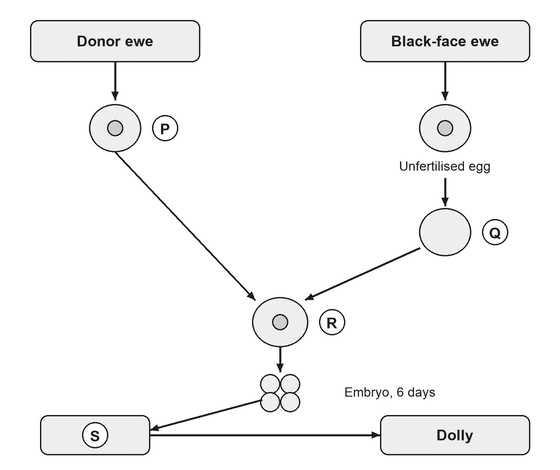
(i) From which part of the donor ewe was cell P taken?
(ii) How was the unfertilised egg changed to give Q?
(iii) How were P and Q made to fuse to form R?
(iv) What is S?
- 473 marks
Question 47
Give reasons:
(i) The cell taken from the donor ewe was starved of nutrients before nuclear transfer.
(ii) Dolly was genetically identical to the donor ewe and not to the black-face ewe that gave the egg.
(iii) Dolly was a major breakthrough, even though frogs had been cloned by nuclear transplantation in the 1960s.
- 481 mark
Question 48
Cloning a mammal is more difficult than cloning a frog. Which pair of reasons is correct?
- 492 marks
Question 49
Give two reasons why cloning a plant is easier than cloning an animal.
- 501 mark
Question 50
A breeder wants an exact copy of a prize ewe whose qualities are already well known. Why is cloning from one of her adult body cells preferred to cloning from an embryonic cell?
- 511 mark
Question 51
Bt cotton contains the gene of
- 521 mark
Question 52
In Bt cotton, the Bt protein
- 531 mark
Question 53
The 'Flavr Savr' tomato is
- 541 mark
Question 54
Children with SCID cannot make the following enzyme
- 551 mark
Question 55
SCID patients cannot produce the following cells
- 561 mark
Question 56
A transgene expression can achieve which of the following?
- 571 mark
Question 57
Rhizobium is an example of
- 581 mark
Question 58
The gene 'cry' is naturally present in
- 591 mark
Question 59
A gene that is transferred into an organism by genetic engineering is called
- 601 mark
Question 60
Biopiracy is related to which of the following?
- 611 mark
Question 61
Which of the following is used in biowar?
- 621 mark
Question 62
Insect-resistant transgenic cotton has been produced by inserting a piece of DNA from
- 631 mark
Question 63
Cultivation of Bt cotton has been much in the news. The prefix Bt means
- 641 mark
Question 64
Bacillus thuringiensis (Bt) strains have been used for designing novel
- 651 mark
Question 65
Hirudin is
- 661 mark
Question 66
Golden rice is a promising transgenic crop. When released for cultivation, it will help in
- 671 mark
Question 67
Cry 1 endotoxins obtained from Bacillus thuringiensis are effective against
- 681 mark
Question 68
Human insulin is being commercially produced from a transgenic species of
- 691 mark
Question 69
The soil bacteria Bacillus thuringiensis produces an insecticidal protein called ________.
- 701 mark
Question 70
Bacteria ________ is used as a vector to introduce nematode-specific gene into the host plant.
- 711 mark
Question 71
Sense RNA and anti-sense RNA when present together form a ________.
- 721 mark
Question 72
In 'Flavr tomato', the production of ________ was blocked to increase their shelf-life.
- 731 mark
Question 73
Human insulin is commercially produced by transgenic ________ containing human gene.
- 741 mark
Question 74
Immunodeficiency disease SCID occurs due to deletion of the gene for ________.
- 751 mark
Question 75
With the help of ________ technology, early diagnosis of a disease can be done.
- 761 mark
Question 76
In a biopatent ________ can be patented but not a ________.
- 771 mark
Question 77
________ and ________ have been used as biological agents in the biowar in the past.
- 781 mark
Question 78
________ technique for early diagnosis is based on the principle of antigen–antibody interaction.
- 791 mark
Question 79
PCR and ELISA are two techniques used in increasing agriculture production of crops.
- 801 mark
Question 80
Golden rice is a transgenic crop rich in fat content.
- 811 mark
Question 81
Bt toxin protein exists as an inactive protoxin form in bacteria.
- 821 mark
Question 82
Bt protein binds to the enzymes in the bollworm gut and disrupts the lining.
- 831 mark
Question 83
Gene cryIAb produces toxins that control corn borer.
- 841 mark
Question 84
Protein hirudin is extracted from the flowers of transgenic Brassica napus crop.
- 851 mark
Question 85
Pro-hormone of insulin has an extra stretch of peptide called A-peptide.
- 861 mark
Question 86
Chain A and chain B of insulin are produced separately and then combined with disulphide bonds to form human insulin.
- 871 mark
Question 87
Bacteria E. coli is used as a vector to introduce the functional gene of ADA in human cells.
- 881 mark
Question 88
Transgenic mice have been used to study the safety of polio vaccine.
- 895 marks
Question 89
Match the following:
Column A Column B 1. Hirudin (a) Nematode 2. ELISA (b) Insulin 3. Cry toxin (c) Brassica napus 4. E. coli (d) AIDS 5. RNAi (e) Bt cotton - 901 mark
Question 90
A fruit softening enzyme that degrades pectin in tomato.
- 911 mark
Question 91
Scientific name of bacteria from which the gene for insecticidal protein is taken.
- 921 mark
Question 92
Additional nutrient present in golden rice.
- 931 mark
Question 93
A strategy that makes tobacco plants nematode resistant.
- 941 mark
Question 94
Name of genetically modified tomato with longer shelf life.
- 951 mark
Question 95
An organism that is used like a factory producing human insulin.
- 961 mark
Question 96
Kind of cells the ADA-deficient patients cannot produce.
- 971 mark
Question 97
An organisation in India that deals with the research and safety of GM organisms.
- 981 mark
Question 98
An official license granted for biological entities and their products.
- 991 mark
Question 99
Getting patents for already known products indigenous to a country.
- 1001 mark
Question 100
Assertion (A): RNAi (RNA interference) occurs in all eukaryotic organisms as a method of cellular defence.
Reason (R): This method involves silencing of a specific mRNA due to a complementary dsRNA that binds to specific mRNA and prevents translation of the mRNA.
- 1011 mark
Question 101
Assertion (A): Flavr Savr, a transgenic tomato which remains fresh and retains their flavour for a long time.
Reason (R): Production of polygalacturonase enzyme, which degrades pectin, is blocked in Flavr Savr.
- 1021 mark
Question 102
Assertion (A): Bt cotton is resistant to a group of insects.
Reason (R): Bacillus thuringiensis produces an insecticidal protein called Bt toxin which is toxic to the larvae of certain insects.
- 1031 mark
Question 103
Assertion (A): Using rDNA technology human insulin can be produced into bacterial cells.
Reason (R): The chains A and B polypeptides of the human insulin are produced separately, extracted and then combined by creating disulphide bonds to produce human insulin.
- 1041 mark
Question 104
Assertion (A): Hirudin is a type of protein that prevents blood clotting.
Reason (R): The gene that encodes hirudin is transferred into Brassica napus, where hirudin is accumulated in the seeds.
- 1051 mark
Question 105
Assertion (A): The children with SCID, cannot make adenosine aminase, an enzyme essential for immune system.
Reason (R): SCID can be cured by giving injections of matured B and T cells.
- 1061 mark
Question 106
Assertion (A): In ELISA, a pathogen can be detected by the presence of antigens like proteins, glycoproteins or by detecting antibodies synthesised against the pathogens in the blood stream.
Reason (R): ELISA test is a technique based on antigen–antibody interactions.
- 1071 mark
Question 107
Assertion (A): The hormone insulin consists of two short polypeptide chains, chain A and chain B, which are linked together by diphosphate bridges.
Reason (R): Insulin is first synthesised as a pro-enzyme. The hormone has an extra stretch of peptide called the C-peptide.
- 1081 mark
Question 108
Assertion (A): Organisations like GEAC are necessary to monitor GM researches and test the safety of introducing GM organisms for public services.
Reason (R): When genetically modified organisms are introduced into the ecosystem, GM researches can have unpredictable results which even can be disastrous.
- 1091 mark
Question 109
Assertion (A): An example of biopiracy is USA's patent of brazzein, a protein that was obtained from West African plant.
Reason (R): The plant Pentadiplandra brazzeana has been growing in the wild and not used by the locals for centuries.
- 1101 mark
Question 110
Crystals of Bt toxin produced by some bacteria do not kill the bacteria themselves because
- 1112 marks
Question 111
What are transgenic bacteria? Illustrate using any one example.
- 1122 marks
Question 112
Can you suggest a method to remove oil (hydrocarbon) from seeds based on your understanding of rDNA technology and chemistry of oil?
- 1132 marks
Question 113
What is golden rice?
- 1142 marks
Question 114
Does our blood have proteases and nucleases?
- 1152 marks
Question 115
Consult internet and find out how to make orally active protein pharmaceutical. What is the major problem to be encountered?
- 1161 mark
Question 116
Give the term for replacing a defective mutant allele with a functional allele.
- 1172 marks
Question 117
Does your blood have proteases and nuclease? If so what is its function?
- 1182 marks
Question 118
Name the genetically engineered human insulin. How many amino acids are present in it?
- 1192 marks
Question 119
Give one word for the following:
(1) RNAi
(2) Preventing mRNA translation
(3) Mobile genetic element
(4) Sequence of base pairs that needs same on the 2 strands
- 1202 marks
Question 120
Complete the following table:
Process Aim (1) Preserves genetic information Sexual reproduction (2) (3) Crossing over and multiplication of desired as well as undesired genes Genetic engineering (4) - 1212 marks
Question 121
Three steps to produce genetically modified organisms are
(i) Identification of DNA with ______
(ii) Introduction of identified DNA to ______
(iii) Maintenance of DNA in host and transfer to ______
- 1222 marks
Question 122
Complete the basic steps to create GMO
(i) ______ with desired gene
(ii) ______ into host
(iii) ______ into progeny
- 1233 marks
Question 123
Find out how to make orally active protein pharmaceutical. What is the major problem to be encountered?
- 1243 marks
Question 124
Study the given flow chart and answer
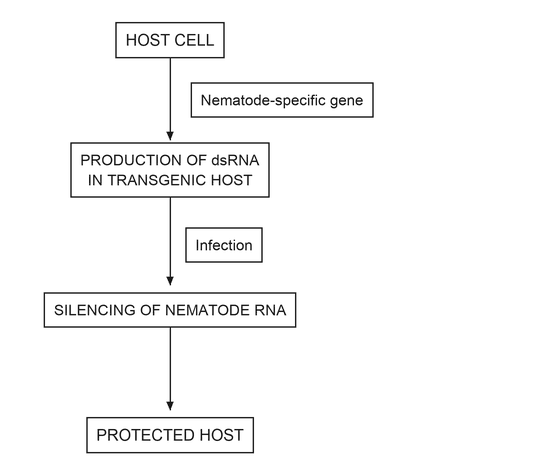
1. Name the defence mechanism used.
2. In which plant has it been done?
3. Name the nematode infested.
- 1252 marks
Question 125
Suggest a method to remove oil from seeds based on rDNA technology.
- 1261 mark
Question 126
Which one of the following factors is responsible for activation of protoxin into active Bt toxin of Bacillus thuringiensis?
- 1272 marks
Question 127
State the steps involved in the process of gene therapy for the treatment of ADA-deficiency.