
Opening your dashboard
Class 12 Biology Chapter 14 Microbes in Human Welfare: Practice Questions
127 questions on Chapter 14, each worked through on its own page with the AI tutor. Class 12 Biology, ICSE 2026-27.
127 questions
1–4 marks · Mixed difficulty
- 11 mark
Question 1
A disease agent isolated from a diseased plant turns out to be a small, circular, single-stranded RNA molecule with no protein coat around it. The agent is a
- 21 mark
Question 2
Which description of a microbe is matched with the correct kingdom?
- 32 marks
Question 3
Viruses are microbes, yet they are not placed in any of the five kingdoms. Give two reasons.
- 43 marks
Question 4
A student writes: "Microbes live only where conditions are mild, and they are mostly harmful to us."
Give three facts that show the statement is wrong.
- 52 marks
Question 5
A spoonful of curd is stirred into warm milk, and the bowl is put straight into a refrigerator. Next morning the milk has still not set.
Explain why, and say what should be done.
- 61 mark
Question 6
A dairy curdles milk at 40–46°C for 4–5 hours to make a product with a flavour of acetaldehyde and acetic acid. Which pair of microbes does it use?
- 73 marks
Question 7
Baker's yeast is added to bread dough. The starch of the flour is then broken down and fermented in this order:
starch —(P)→ maltose —(Q)→ glucose —(R)→ ethanol + carbon dioxide
(a) Name the enzymes P and Q.
(b) Name enzyme R, and say which of its two products makes the dough rise.
- 81 mark
Question 8
Yeast produces ethanol in bread dough, yet baked bread contains only a trace of alcohol. This is mainly because
- 92 marks
Question 9
Toddy is said to be made by natural fermentation, while bread dough is fermented by an added microbe.
Explain this difference.
- 103 marks
Question 10
The steps of cheese making are shown below.
pasteurised milk + starter culture at 40°C → enzyme Y added → liquid Z drained off → solid portion ripened
(a) Name Y and state its role.
(b) Name the liquid Z.
(c) Many varieties of cheese pass through these same steps, yet each has its own texture, flavour and taste. Why? Give one example.
- 111 mark
Question 11
Of the drinks below, which is bottled without distillation and yet has the highest alcohol content?
- 122 marks
Question 12
Black grapes are crushed, and the juice is divided between two vats. In vat P the skins are left in the juice; in vat Q the skins are removed. Yeast is added to both.
Which kind of wine will each vat give? Give the reason.
- 133 marks
Question 13
Without asking a doctor, a student takes an antibiotic for a seasonal viral flu. The flu does not improve, and the student develops diarrhoea.
(a) Why did the antibiotic not help with the flu?
(b) Why did the student get diarrhoea?
(c) What danger arises if the student keeps over-using antibiotics?
- 141 mark
Question 14
A patient has ringworm, a fungal infection of the skin. Which antibiotic is used especially for this?
- 151 mark
Question 15
Butter left for a long time turns rancid. The acid responsible, and the kind of microbe that makes it, are
- 161 mark
Question 16
The fungi Aspergillus niger and Penicillium are used to make a product that is widely given to cows, babies and lactating mothers as a source of calcium. The product is
- 174 marks
Question 17
In a brewery fermenter, yeast ferments glucose as follows:
(Molar masses: glucose 180 g/mol, ethanol 46 g/mol, carbon dioxide 44 g/mol.)
(a) Name the yeast, and state whether oxygen is present during this fermentation.
(b) Calculate the masses of ethanol and carbon dioxide formed from 900 g of glucose.
(c) Why is the CO₂ level of beer adjusted before it is bottled?
- 183 marks
Question 18
Lactic acid can be made by bacteria as well as by fungi.
(a) Name one bacterium and one fungus used.
(b) Which source gives the purer product?
(c) Give two uses of lactic acid outside the food industry.
- 191 mark
Question 19
In a sewage treatment plant, part of the activated sludge from the secondary settling tank is pumped back into the aeration tank. This is done to
- 202 marks
Question 20
Why can the effluent from the primary settling tanks not be released straight into a river? Give two reasons.
- 211 mark
Question 21
Which of the following is not a part of the tertiary treatment of wastewater?
- 224 marks
Question 22
The figure shows the flow of sewage through a treatment plant.
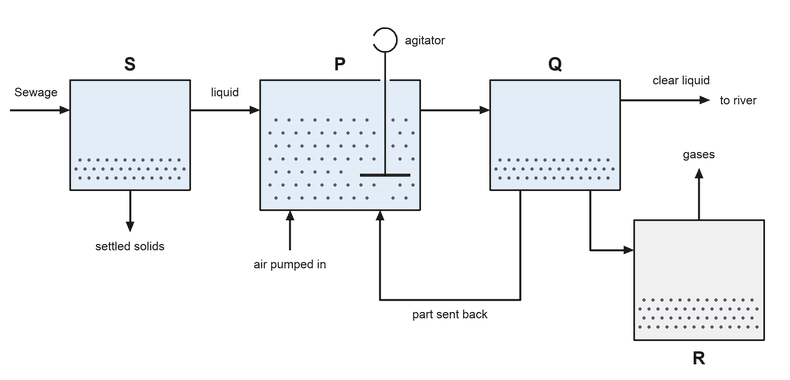
(a) Name the units S, P, Q and R.
(b) In which lettered unit is the BOD of the effluent reduced, and why?
(c) In which lettered unit are methane, hydrogen sulphide and carbon dioxide released?
- 233 marks
Question 23
(Hypothetical data.) The BOD of the effluent entering the aeration tank of a city plant is 250 mg/L. After aeration it is 25 mg/L.
(a) Calculate the percentage fall in BOD.
(b) Which microbes bring about this fall, and how?
(c) One day the air pumps of the aeration tank fail. Predict what would happen to the BOD of the effluent, and why.
- 241 mark
Question 24
Which statement about primary treatment of sewage is correct?
- 252 marks
Question 25
Water leaving the secondary settling tank looks clear. Explain why it may still be given tertiary treatment. Give two points.
- 261 mark
Question 26
While a biogas plant is working, its floating cover is seen to rise slowly above the slurry. What does this show?
- 273 marks
Question 27
The figure shows a biogas plant with some parts lettered.
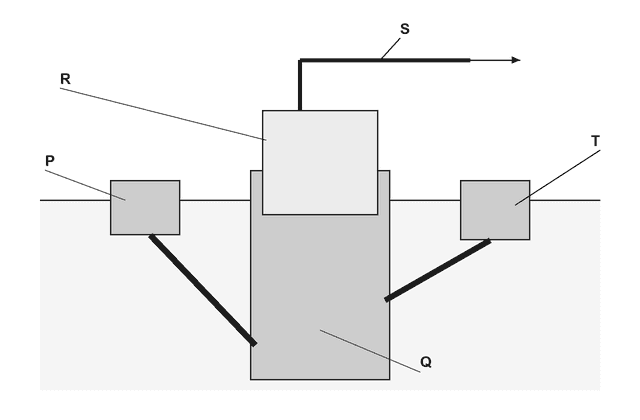
Name the parts P, R and T, and state the function of each.
- 281 mark
Question 28
A student fills two identical bottles with the same fresh cattle-dung slurry. Air is bubbled through bottle X all the time; bottle Y is sealed airtight. Which bottle gives more methane, and why?
- 292 marks
Question 29
A district plans an energy plantation to supply biomass to its biogas plants.
(a) What is meant by an energy plantation?
(b) Why are plant species with a high calorific value and a good growth rate chosen for it?
- 301 mark
Question 30
In India, the technology of biogas production was developed mainly by the joint efforts of
- 313 marks
Question 31
Gas samples from two village biogas digesters were analysed. (Hypothetical data.)
Gas Digester P (%) Digester Q (%) Methane 62 20 Carbon dioxide 34 22 Nitrogen 3 46 Oxygen 1 12 (a) Which digester is working properly? Support your answer with the usual composition of biogas.
(b) Suggest what has gone wrong in the other digester, and explain why this lowers its methane output.
- 324 marks
Question 32
A village panchayat plans a community biogas plant that will send gas to nearby houses through pipes.
Give four reasons, based on the properties of biogas and the working of the plant, why this plan is useful for the village.
- 331 mark
Question 33
A nursery owner wants to use a fungus as a biocontrol agent to protect seedlings against several plant pathogens. Which fungus is suited to this?
- 341 mark
Question 34
A farmer uses Bacillus thuringiensis (Bt) against butterfly caterpillars on a mustard crop. Arrange these events in the correct order.
-
The toxin is released in the gut of the larvae.
-
Dried Bt spores from a sachet are mixed with water and sprayed on the crop.
-
The larvae are killed.
-
Caterpillars feeding on the leaves take in the Bt.
-
- 352 marks
Question 35
A mango orchard owner keeps honeybee boxes in the orchard for pollination and wants to control a caterpillar pest.
Give two reasons why baculoviruses of the genus Alphabaculovirus (formerly Nucleopolyhedrovirus) suit the owner better than a chemical insecticide that kills many kinds of insects.
- 363 marks
Question 36
A farmer sprayed the same mixture of chemical insecticides on a cotton field every season. After a few years, ladybird beetles and dragonflies were rarely seen in the field. (Hypothetical example.)
(a) Explain why these insects disappeared.
(b) Why is their loss harmful to the farmer?
(c) Name one microbial biocontrol agent the farmer could use instead, and say why it would not cause this problem.
- 371 mark
Question 37
Which statement best describes the aim of the biological control of pests?
- 383 marks
Question 38
A vegetable grower follows Integrated Pest Management (IPM) on the farm.
(a) Describe two non-chemical measures that can be used to reduce the number of pests.
(b) When is a chemical pesticide still used under IPM, and in what amount?
- 391 mark
Question 39
In Australia, the spread of cactus plants of the genus Opuntia was checked without using chemicals. Which agent was used?
- 403 marks
Question 40
Many farmers are being advised to use bioherbicides in place of chemical herbicides.
(a) Give two problems caused by chemical herbicides.
(b) The first bioherbicide product, registered in 1981 for controlling milk-weed vine in citrus orchards, was called a mycoherbicide. Why was it given this name?
- 414 marks
Question 41
A kitchen-garden owner wants to use only natural insecticides.
(a) Name the plant from which each of these is obtained: rotenones, nicotine, pyrethrum.
(b) Why are natural insecticides considered safer than synthetic insecticides?
- 421 mark
Question 42
In some mycorrhizae, the fungus lives between the cortical cells of the root and sends hyphal projections into these cells, where they form swollen vesicles or finely branched masses. Such an association is called
- 432 marks
Question 43
Three plots of soybean (a legume) were treated differently. (Hypothetical data.)
Plot Treatment Yield (kg per hectare) 1 No treatment 1800 2 Seeds inoculated with rhizobia (root-nodule bacteria) 2100 3 Seeds inoculated with rhizobia + phosphate fertiliser 2400 (a) Why did plot 2 give a higher yield than plot 1?
(b) Why did plot 3 give the highest yield?
- 441 mark
Question 44
Azotobacter grown along with jowar increases the yield by 10–25 kg per hectare. A farmer grows jowar with Azotobacter on a 4-hectare field. The extra yield the farmer can expect from the whole field is
- 453 marks
Question 45
A state agriculture department wants rice farmers to use free-living cyanobacteria such as Nostoc and Aulosira as biofertilisers.
Give three reasons that support this plan.
- 463 marks
Question 46
Sort these biofertilisers into bacteria, cyanobacteria and fungi, and state the kind of association each one shows:
Azotobacter, Aulosira, Glomus, Azospirillum, Anabaena azollae, Rhizobium
- 471 mark
Question 47
A farmer grows millets and wants to add a bacterial biofertiliser that fixes atmospheric nitrogen in the soil, irrespective of the crop grown. Which one should the farmer choose?
- 483 marks
Question 48
In a nitrogen-deficient hill soil, pine seedlings whose roots carry an ectomycorrhizal fungus grow better than seedlings without it. (Hypothetical example.)
(a) What does the fungus receive from the pine tree?
(b) Give two ways in which the fungus helps the tree.
- 492 marks
Question 49
A farmer used a biofertiliser for one season and says, "I saw hardly any change in my crop, so biofertilisers are useless."
Give two points you would make to correct this view.
- 504 marks
Question 50
Draw a labelled diagram of the root system of a leguminous plant showing root nodules, with a section through a nodule.
Explain the relationship between the plant and the bacterium seen in the nodule.
- 511 mark
Question 51
The bacteria used for converting milk into curd is
- 521 mark
Question 52
Scientific name of Baker's yeast is
- 531 mark
Question 53
The specific distinct flavour of 'Roquefort cheese' is due to ripening by a specific
- 541 mark
Question 54
The source of sugar for making beer is
- 551 mark
Question 55
The antibiotic penicillin is produced from
- 561 mark
Question 56
Which of the following is not a useful product of microbes?
- 571 mark
Question 57
In the aeration tanks the sewage is treated/mixed with
- 581 mark
Question 58
Biogas is mainly
- 591 mark
Question 59
Which of the following bacteria is found in symbiotic association with legumes?
- 601 mark
Question 60
Which of the following bacteria is found in association with roots of grasses and rice?
- 611 mark
Question 61
Biofertilisers give a better yield when added along with
- 621 mark
Question 62
The cyanobacterium, Anabaena azollae, lives in association with
- 631 mark
Question 63
Ectomycorrhiza is an association of
- 641 mark
Question 64
Cultivation of Bt cotton has been much in the news. The prefix Bt means
- 651 mark
Question 65
Mycorrhiza promotes plant growth by
- 661 mark
Question 66
Which one is a neem product that is used as an insect repellent?
- 671 mark
Question 67
The gene cry is naturally present in
- 681 mark
Question 68
Which of the following is used as an immunosuppressive agent in organ transplants?
- 691 mark
Question 69
The following molecules are used as blood-cholesterol lowering agents.
- 701 mark
Question 70
Methanogens are found in the following
- 711 mark
Question 71
Milk is converted into curd by ________ bacteria.
- 721 mark
Question 72
In cheese making, the milk is fermented by the 'starter culture' of usually ________ bacteria.
- 731 mark
Question 73
Fermentation of alcoholic beverages is done by ________, also called Brewer's yeast.
- 741 mark
Question 74
Chemical substances produced by certain microbes that kill or inhibit the growth of other disease-causing microbes are called ________.
- 751 mark
Question 75
________ enzyme, produced by bacteria and modified by genetic engineering, is used as a 'clot buster'.
- 761 mark
Question 76
Cyclosporin A biomolecule is produced by fungi ________.
- 771 mark
Question 77
________ is the main source of methanogens for the production of biogas.
- 781 mark
Question 78
________ bacteria is used as a biopesticide to produce Bt cotton.
- 791 mark
Question 79
The cyanobacteria ________ is a biofertiliser found in association with the leaves of floating fern.
- 801 mark
Question 80
BOD of ________ water is more than the drinking water.
- 811 mark
Question 81
Viroids and prions are pathogens that are simpler than viruses.
- 821 mark
Question 82
Baking of bread is done by adding yeast called Streptococcus thermophilus.
- 831 mark
Question 83
Antibiotic penicillin is derived from a bacteria called Penicillium.
- 841 mark
Question 84
Primary treatment of sewage is a physical process while secondary treatment is done by adding bacteria.
- 851 mark
Question 85
Main component of biogas is methane and is produced by microbial fermentation.
- 861 mark
Question 86
Bacteria that causes curdling of milk.
- 871 mark
Question 87
Bacteria used in ripening of Swiss cheese.
- 881 mark
Question 88
Microbe producing citric acid.
- 891 mark
Question 89
Microbe used for commercial production of ethanol.
- 901 mark
Question 90
Molecule used as immunosuppressive agent.
- 911 mark
Question 91
Term given to useful aerobic bacterial growth in secondary treatment of sewage.
- 921 mark
Question 92
Major component of biogas.
- 931 mark
Question 93
Major source of methanogens in production of biogas.
- 941 mark
Question 94
Many members of this genus form mycorrhizae.
- 951 mark
Question 95
Free-living nitrogen-fixing bacteria.
- 961 mark
Question 96
Assertion (A): Lactobacillus bacteria are added to milk to convert it into curd.
Reason (R): Lactobacillus bacteria add to the nutritive value by increasing vitamin B₁₂ content.
- 971 mark
Question 97
Assertion (A): Yeast such as Saccharomyces cerevisiae is used in baking industry.
Reason (R): Carbon dioxide produced during fermentation causes bread dough to rise by thermal expansion.
- 981 mark
Question 98
Assertion (A): The primary treatment of sewage is called the physical treatment while the secondary treatment is called the biological treatment.
Reason (R): Primary sewage treatment depends only upon sedimentation properties of materials present in sewage and filtration.
- 991 mark
Question 99
Assertion (A): Baculoviruses are pathogens that attack insects and other arthropods and they are being used as biological control agents.
Reason (R): These viruses are species-specific and so have a narrow spectrum and destroy specific pests or insects.
- 1001 mark
Question 100
Assertion (A): Leguminous plants are nitrogen fixers.
Reason (R): Leguminous plants have Rhizobium in their root nodules.
- 1011 mark
Question 101
Assertion (A): Mycorrhizae are symbiotic associations between fungi and cyanobacteria.
Reason (R): Cyanobacteria are photosynthetic nitrogen fixers and so increase the efficiency of fungi.
- 1021 mark
Question 102
Assertion (A): Disadvantages of synthetic pesticides can be overcome by the use of natural biopesticides.
Reason (R): Biopesticides are harmless agents which are used to control weeds and pest without causing any damage.
- 1031 mark
Question 103
Assertion (A): Dragon flies can be used to decrease occurrence of diseases like malaria, dengue, etc.
Reason (R): Baculoviruses are effective in controlling many insects and other arthropods.
- 1041 mark
Question 104
Assertion (A): Acetic acid production involves both aerobic and anaerobic processes.
Reason (R): Production of alcohol from glucose is an aerobic process and production of acetic acid from alcohol is an anaerobic process.
- 1051 mark
Question 105
Assertion (A): An organ transplant patient, if not provided with cyclosporin A, may reject the transplanted organ.
Reason (R): Cyclosporin A inhibits activation of T-cells and interferes with destruction of non-self cells.
- 1062 marks
Question 106
Give examples to prove that microbes release gases during metabolism.
- 1072 marks
Question 107
In which food would you find lactic acid bacteria? Mention some of their useful applications.
- 1082 marks
Question 108
Name some traditional Indian foods made of wheat, rice and Bengal gram (or their products) which involve use of microbes.
- 1091 mark
Question 109
In which way have microbes played a major role in controlling diseases caused by harmful bacteria?
- 1102 marks
Question 110
Name any two species of fungus, which are used in the production of the antibiotics.
- 1111 mark
Question 111
What is sewage?
- 1123 marks
Question 112
In which way can sewage be harmful to us?
- 1132 marks
Question 113
What is the key difference between primary and secondary sewage treatment?
- 1142 marks
Question 114
Do you think microbes can also be used as source of energy? If yes, how?
- 1152 marks
Question 115
Three water samples namely river water, untreated sewage water and secondary effluent were subjected to BOD test. The BOD values of the three samples A, B and C were recorded as 20, 8 and 400 mg/L, respectively. Which sample of the water is most polluted?
- 1162 marks
Question 116
Find out the name of the microbes from which cyclosporin A (an immunosuppressive drug) and statins (blood cholesterol lowering agents) are obtained.
- 1172 marks
Question 117
Find out the role of microbes in the following and discuss it with your teacher.
(i) Single cell protein (SCP)
(ii) Soil
- 1183 marks
Question 118
Give importance of— Penicillin, Curd, Citric acid and Biogas.
- 1192 marks
Question 119
Why is whisky more intoxicating than beer?
- 1202 marks
Question 120
Biogas plants are more often built in rural areas. Why?
- 1212 marks
Question 121
In human beings the roughage contains cellulose but in cattle it is not. Why?
- 1222 marks
Question 122
A person has suffered a heart attack due to a floating clot in a coronary artery.
(a) Name the bacterium that can save this person.
(b) Mention its product and its action.
- 1232 marks
Question 123
Represent the relationship between
(a) Organic waste with that of BOD.
(b) Dissolved oxygen with that of BOD.
- 1243 marks
Question 124
What according to your opinion is the reason for failure of the major programmes like Ganga Action Plan or Yamuna Action Plan?
- 1252 marks
Question 125
Bacteria cannot be seen with the naked eyes, but these can be seen with the help of a microscope. If you have to carry a sample from your home to your biology laboratory to demonstrate the presence of microbes under a microscope, which sample would you carry and why?
- 1261 mark
Question 126
Which of the following is paired incorrectly:
- 1271 mark
Question 127
Give the biological name of the following:
(i) The mould from which penicillin is obtained.
(ii) Baker's yeast.
(iii) The microbe used to produce Swiss cheese.
(iv) A symbiotic nitrogen fixing bacterium found in root nodules.