
Opening your dashboard
Class 12 Biology Chapter 13 Plant Breeding to Enhance Food Production: Practice Questions
115 questions on Chapter 13, each worked through on its own page with the AI tutor. Class 12 Biology, ICSE 2026-27.
115 questions
1–8 marks · Mixed difficulty
- 11 mark
Question 1
A breeder is developing a new variety of a fodder crop grown to feed cattle. Which set of agronomic traits should the new variety have?
- 22 marks
Question 2
A farmer grows a traditional long-duration rice variety and gets only one crop a year from the field. A newly released variety of the same crop is short-duration and matures early and uniformly.
Give two advantages the new variety offers the farmer.
- 33 marks
Question 3
A field of crop plants faces the following stresses during one season:
drought, nematodes, high salinity of the soil, frost, a bacterial disease, insect attack, heat.
(a) Sort them into biotic and abiotic factors.
(b) Why is increased tolerance to such stresses a desirable trait in an improved variety?
- 43 marks
Question 4
Rice production in India rose from about 35 million tonnes in 1960–61 to about 136 million tonnes in 2022–23.
(a) By how many times did production increase? (Give your answer to one decimal place.)
(b) From which two parent varieties were India's semi-dwarf rice varieties first derived, and where was each developed?
(c) Name the better-yielding semi-dwarf rice varieties developed later in India.
- 51 mark
Question 5
Many crops grown in India today were introduced from elsewhere. Which crop is correctly paired with the region it originally came from?
- 62 marks
Question 6
The weed Argemone mexicana, now common in Indian fields, entered India along with a plant introduction.
(a) Which safeguard should have stopped it?
(b) Describe how this safeguard is carried out on an imported consignment of plants or seeds.
- 73 marks
Question 7
A potato breeder in India is looking for genes that give resistance to a new disease.
(a) Why would the breeder search the germplasm of the Peruvian Andes and not only the potato varieties grown in India?
(b) Name one other crop that came to India from the same region.
(c) A plant brought to a new locality has to adjust to its changed environment. What is this adjustment called?
- 81 mark
Question 8
A seed bank stores the seeds of many old desi rice varieties. Every few years, a sample of each stored variety is sown in the field and fresh seeds are collected from the crop. Why is this done?
- 92 marks
Question 9
A breeder looking for disease resistance in a crop collects seeds of its wild relatives from forests, not only of the varieties farmers grow today.
Give two reasons why wild relatives are important for this germplasm collection.
- 101 mark
Question 10
In a cross between two rice varieties, a breeder removes the stamens from some flowers with fine forceps. Which flowers are treated in this way, and why?
- 113 marks
Question 11
A student wrote the steps of artificial hybridisation in the wrong order:
P — Dust pollen of the male parent on the stigma.
Q — Cover the flower with a paper bag and tag it.
R — Remove the stamens from immature flowers of the female parent.
S — Collect the seeds when they mature.
T — Cover the pollinated flower with the bag again.
U — Select two healthy parents and grow them separately.
(a) Write the letters in the correct order.
(b) Why are the two parent plants grown separately?
(c) Why is the flower bagged again after pollen is dusted on it?
- 123 marks
Question 12
Three crosses are listed below.
(i) Sonalika wheat × Kalyan Sona wheat
(ii) Saccharum barberi × Saccharum officinarum
(iii) Triticum (wheat) × Secale (rye)
(a) Name the type of hybridisation in each cross.
(b) Which type is the most commonly used, and which is the most difficult? State one problem with hybrids of the most difficult type.
- 132 marks
Question 13
A farmer has to choose between two lots of hybrid maize seed. Their labels read (hypothetical data):
Entry on label Lot P Lot Q Germination 96% 70% Pure seed 99% 92% Weed seeds 0% 2% Inert matter 1% 6% Which lot should the farmer buy? Give two reasons from the label.
- 144 marks
Question 14
A new pure line of wheat has given excellent yields in the research fields of a breeding institute. Describe the stages it must pass through before farmers can buy it as certified seed.
- 151 mark
Question 15
The development of a disease in a wheat crop depends on the interaction of three factors. Which of them can a plant breeder change through breeding?
- 161 mark
Question 16
A maize line with a high aspartic acid content and low nitrogen and sugar content suffers little insect damage. This biochemical trait gives the line resistance to
- 173 marks
Question 17
In mung bean, resistance to yellow mosaic virus and powdery mildew was obtained through induced mutations.
(a) Why do breeders turn to induced mutations when conventional breeding cannot give a resistant variety?
(b) Outline the steps of mutation breeding, from seed to new variety.
- 182 marks
Question 18
Two oilseed lines are being considered for a biofortification programme. The fatty acids in their oil are (hypothetical data):
Fatty acid type Line X Line Y Saturated 60% 15% Polyunsaturated 15% 60% Others 25% 25% Which line should the breeder develop further? Give a reason.
- 194 marks
Question 19
A family eats maize as its main food and almost no pulses.
(a) What is meant by the protein quality of a food?
(b) Why is the family's diet poor in protein quality although maize contains protein?
(c) How would adding pulses help?
(d) How has plant breeding improved maize itself? Name one such variety.
- 201 mark
Question 20
A breeder treats the growing shoot tip of a sterile hybrid seedling with colchicine. The treated cells come to have double the number of chromosomes. How does colchicine bring this about?
- 211 mark
Question 21
A diploid plant has 2n = 24 chromosomes (hypothetical example). An autotetraploid is produced from it. How many chromosomes are present in a body cell and in a gamete of the autotetraploid?
- 221 mark
Question 22
Emmer wheat, Triticum dicoccum (2n = 28), is crossed with the wild goat grass Aegilops squarrosa (now named Aegilops tauschii; 2n = 14). How many chromosomes will the F₁ hybrid have before its chromosome number is doubled?
- 233 marks
Question 23
In a population of a sexually reproducing diploid plant with 2n = 20 (hypothetical example), a seedling with 30 chromosomes is found.
(a) Which two kinds of gametes must have fused to form it? Show the chromosome count.
(b) Describe two ways in which one of these gametes could have been formed.
- 244 marks
Question 24
A farmer obtains a very high yield from F₁ hybrid maize seed. The farmer saves seed from this crop and sows it the next year, but the new crop is weaker and gives a lower yield.
(a) Why was the F₁ hybrid crop so vigorous?
(b) Explain why the crop from the saved seed did poorly.
(c) What should the farmer do to keep getting high yields?
- 251 mark
Question 25
An F₁ hybrid has the genotype AaBbCcDd, in which each recessive allele has a harmful effect that is masked by its dominant allele. If the F₁ plants are self-pollinated, what fraction of the offspring will be homozygous recessive for at least one of the four genes? (The four genes assort independently.)
- 261 mark
Question 26
In the same period of time, a 250 kg cow produces 200 g of protein, while 250 g of the microorganism Methylophilus methylotrophus produces 25 tonnes of protein. How many times more protein does the microorganism produce than the cow?
- 272 marks
Question 27
Many families in a growing town are changing their diet from mainly grain to more meat.
Explain why this change increases the demand for cereals, and why single cell protein (SCP) is suggested as a way to meet the demand for protein.
- 283 marks
Question 28
A potato-chips factory releases waste water rich in starch into a nearby stream.
(i) Name a microorganism that could be grown on this waste water to produce single cell protein.
(ii) Give two benefits of using the waste water in this way.
- 291 mark
Question 29
A student says that the name "single cell protein" is misleading. Which fact best supports the student?
- 301 mark
Question 30
A tissue culture medium contains inorganic salts, vitamins, sucrose, amino acids and BAP. Which of these is the source of energy for the growing explant?
- 313 marks
Question 31
(Hypothetical data.) In a school laboratory, 20 culture tubes were set up with carrot explants. Within a week, 12 tubes showed fungal and bacterial growth over the medium and their explants died.
Suggest three steps of the procedure that were probably done wrongly, and say how each should be done.
- 323 marks
Question 32
Callus pieces were placed on medium X, and after some time shoots grew from them. When the shoots were 2–3 cm long, they were cut and placed on medium Y, where roots grew from their lower ends.
(i) Which group of plant hormones did medium X contain? Give one example.
(ii) Which group of plant hormones did medium Y contain? Give one example.
(iii) Why were the shoots moved to medium Y instead of being left on medium X?
- 331 mark
Question 33
A researcher wants to add a herbicide to the medium and pick out, from a very large number of plant cells, the few cells that tolerate it. Which culture suits this best?
- 342 marks
Question 34
A somatic embryo of carrot formed in culture looks very much like the embryo inside a carrot seed.
State one similarity and one difference between the two.
- 351 mark
Question 35
An oil-palm company uses tissue culture to raise thousands of plants from one high-yielding tree, all with the same genotype as that tree. These plants are called
- 364 marks
Question 36
A plant breeder has an F₁ hybrid of genotype AaBb (the two genes lie on different chromosomes) and wants homozygous pure lines from it by anther culture.
(i) Write the genotypes of the pollen grains that the F₁ plant can produce.
(ii) The plants grown from these pollen grains are sterile. Why, and how are they made fertile?
(iii) Write the genotypes of all the homozygous lines obtained.
(iv) How much time does this save compared with selfing for several generations?
- 371 mark
Question 37
In an interspecific cross, the hybrid seeds began to shrivel a few days after fertilisation and their embryos collapsed. The main reason the embryos died is that
- 382 marks
Question 38
Explain how embryo culture helps in each case.
(i) Orchid seeds sown in soil fail to give seedlings.
(ii) Seeds of a certain species do not germinate because of inhibitors present in the seed coat.
- 392 marks
Question 39
A scientist introduces a desirable gene into a single cell of a crop plant growing in culture.
Explain why plant tissue culture is needed to obtain a whole plant carrying this gene, and why the new trait can be passed on to the plant's offspring.
- 401 mark
Question 40
A scientist wants to introduce foreign DNA into plant cells that have been made into protoplasts. When should this be done?
- 412 marks
Question 41
Study the figure, which shows a plant cell being changed by treatment X.
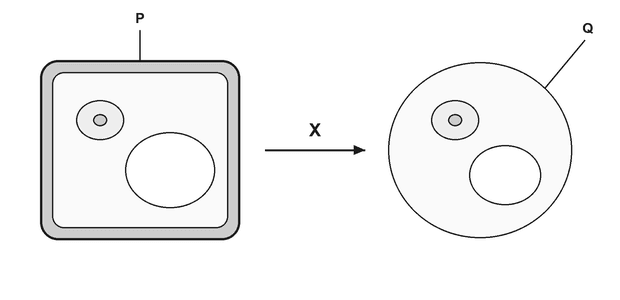
(i) Name the structure P, which is missing from the cell on the right, and the treatment X that removes it.
(ii) Name the structure Q, which forms the outer boundary of the cell on the right, and name this kind of cell.
- 421 mark
Question 42
Protoplasts were kept in a suitable culture medium for some days. Which change shows that they are on the way to forming a callus?
- 433 marks
Question 43
A breeder wants to combine a non-flowering clone of potato with a flowering clone of potato.
(i) Why can sexual hybridisation not be used here?
(ii) Outline how a hybrid of the two clones can still be produced.
(iii) Why does the hybrid cell carry the characters of both clones?
- 442 marks
Question 44
Plant species P has two sets of chromosomes of genome A (AA), and species Q has two sets of genome B (BB).
Explain how fusing protoplasts of P and Q can give an allopolyploid directly, and write the genome make-up of the somatic hybrid.
- 451 mark
Question 45
A farmer sprays dried spores of Bacillus thuringiensis (Bt), mixed with water, on a mustard crop attacked by butterfly caterpillars. Where does the Bt toxin act to kill the caterpillars?
- 463 marks
Question 46
(Hypothetical example.) For many years a farmer sprayed a broad-spectrum chemical pesticide on the paddy fields. Now:
(i) spiders and frogs that eat the pests have become rare;
(ii) traces of the pesticide are found in the village's drinking-water well;
(iii) the pesticide is found in the bodies of villagers who eat fish from the paddy channels.
Explain how the use of the chemical pesticide caused each observation.
- 471 mark
Question 47
An orchard owner wants to kill one particular insect pest without harming the honeybees that pollinate the trees. Which control agent suits the owner best?
- 484 marks
Question 48
A farmer plants a strip of a crop that the pests prefer, some distance away from the main cash crop.
(i) Explain how this helps the farmer.
(ii) Name three other practices used in Integrated Pest Management (IPM) to reduce pests.
- 493 marks
Question 49
In Australia, the cactus Opuntia spread over large areas. Instead of chemicals, the cochineal insect was used to control it.
(i) How does the cochineal insect harm Opuntia?
(ii) Why is this an example of a bioherbicide?
(iii) Give one reason why chemical herbicides were not preferred.
- 501 mark
Question 50
Which natural insecticide is correctly matched with the plant it comes from?
- 511 mark
Question 51
Green revolution refers to the increased production of
- 521 mark
Question 52
Callus is
- 531 mark
Question 53
Colchicine brings about
- 541 mark
Question 54
Triticale is obtained by crossing wheat with
- 551 mark
Question 55
Which chemical is used for producing polyploid?
- 561 mark
Question 56
In protoplast fusion the enzymes required are
- 571 mark
Question 57
Haploids are more suitable for mutation studies than the diploids. This is because
- 581 mark
Question 58
Loss of vigour associated with inbreeding is called
- 591 mark
Question 59
The gene 'cry' is naturally present in
- 601 mark
Question 60
Triticale is an
- 611 mark
Question 61
Which of the following is not correct about plant introduction?
- 621 mark
Question 62
Mating between two individuals of different genotypes is called
- 631 mark
Question 63
Homozygosity increases in
- 641 mark
Question 64
A plant tissue culture does not need
- 651 mark
Question 65
Shoot regeneration is promoted by
- 661 mark
Question 66
Somaclonal variations are variations present in
- 671 mark
Question 67
The explants used for the production of virus-free plants are from
- 681 mark
Question 68
Protoplasts are used for genetic engineering because
- 691 mark
Question 69
Embryo culture is used for
- 701 mark
Question 70
Haploid plants are produced from
- 711 mark
Question 71
Select the mismatch
- 721 mark
Question 72
Which of the following is correctly matched for the product produced by them?
- 731 mark
Question 73
Conversion of milk to curd improves its nutritional value by increasing the amount of
- 741 mark
Question 74
Select the correct group of biocontrol agents
- 751 mark
Question 75
___ consists of single cells and small groups of cells suspended in a liquid culture medium.
- 761 mark
Question 76
The ability of plant cells to regenerate into complete plants is called ___.
- 771 mark
Question 77
Genetic variations that are present in the plant cells of a tissue culture are called ___.
- 781 mark
Question 78
___ are useful in producing plants from some interspecific crosses where hybrid seeds degenerate at an early stage.
- 791 mark
Question 79
Fusion between protoplasts of the selected parents is induced by a solution of ___.
- 801 mark
Question 80
Doubling of chromosomes in haploids is done by treating them with ___.
- 811 mark
Question 81
Most commonly used cytokinins in meristem culture is ___.
- 821 mark
Question 82
___ is a plant part that is excised from the plant and used for initiation of tissue culture.
- 831 mark
Question 83
Loss of vigour associated with inbreeding is called ___.
- 841 mark
Question 84
Germplasm means the genetic material of high yielding varieties of a species.
- 851 mark
Question 85
Biofortification refers to breeding crops with higher levels of minerals, vitamins and proteins.
- 861 mark
Question 86
Triticum durum is a hexapolyploid variety of wheat.
- 871 mark
Question 87
Inbreeding promotes heterozygosity and is used to have superior variety.
- 881 mark
Question 88
Somatic embryo regeneration is induced by high concentration of auxins like 2,4-D.
- 898 marks
Question 89
Match the following:
Column A Column B 1. 2,4-D (a) Colchicine 2. PEG (b) Single cell protein 3. Cry gene (c) Callus culture 4. HYV wheat variety (d) Heterosis 5. Lysine-rich maize variety (e) Sonalika 6. Autopolyploidy (f) Rattan 7. Spirulina (g) Somatic hybridisation 8. Hybrid vigour (h) Insect resistance - 901 mark
Question 90
A technique that involves crossing of two varieties in plants to get desired and improved variety.
- 911 mark
Question 91
Removing of stamens from the immature bisexual flower with forceps.
- 921 mark
Question 92
A breeding technique by which genetic variations are created through changes in the base sequence in the genes.
- 931 mark
Question 93
A polyploid cell or organism that has more than two copies of the same set of chromosomes.
- 941 mark
Question 94
Term used for cells from which cell walls have been removed by digestion with enzymes.
- 951 mark
Question 95
Assertion (A): Removal of male parts in a flower is called emasculation.
Reason (R): Bagging is not required for emasculated flowers.
- 961 mark
Question 96
Assertion (A): Allopolyploidy involves numerical increase of the same genome.
Reason (R): Autopolyploidy develops through hybridisation between two species followed by doubling of chromosomes.
- 971 mark
Question 97
Assertion (A): Inbreeding depression or loss of vigour occurs when inbreeding is continued for many generations.
Reason (R): Autopolyploidy can be done to overcome the harmful effects of inbreeding depression.
- 981 mark
Question 98
Assertion (A): Biofortification is a good practical aspect to improve health of the people.
Reason (R): Biofortification is breeding of crops with higher levels of vitamins, minerals, proteins and healthier fats.
- 991 mark
Question 99
Assertion (A): Virus-free plants can be produced by the meristem tissue culture.
Reason (R): The virus fails to grow during the growth of the host tissue in the artificial medium.
- 1001 mark
Question 100
Assertion (A): Somatic embryos can be formed from any cell in plant tissue culture.
Reason (R): Any living plant cell is capable of differentiating into somatic embryos.
- 1011 mark
Question 101
Assertion (A): For plant tissue culture, it is essential that the explants, culture vessels, medium and instruments are free from microbes.
Reason (R): In a nutrient medium the cells grow into an unorganised mass of cells called callus.
- 1021 mark
Question 102
Assertion (A): Protoplast culture is an important technique of genetic engineering.
Reason (R): Protoplast culture technique results in the production of somatic-hybrid plants.
- 1032 marks
Question 103
Explain what is meant by biofortification.
- 1042 marks
Question 104
Which part of the plant is best suited for making virus-free plants and why?
- 1052 marks
Question 105
What is the major advantage of producing plants by micropropagation?
- 1062 marks
Question 106
Find out what the various components of the medium used for propagation of an explant in vitro?
- 1072 marks
Question 107
Name any five hybrid varieties of crop plants which have been developed in India.
- 1081 mark
Question 108
Disease resistance is obtained through
- 1091 mark
Question 109
Man-made crop Triticale is a hybrid between
- 1102 marks
Question 110
Match the two columns correctly
Species Biofortified quality (a) Carrot (i) Enriched protein (b) Lab (ii) Enriched vitamin A (c) Bathua (iii) Enriched vitamin C (d) Mustard (iv) Iron - 1111 mark
Question 111
The microbe used to control insect larvae growing on cotton.
- 1121 mark
Question 112
The fungus that is being developed as a bio-control agent.
- 1131 mark
Question 113
Give one significant contribution of each of the following scientists:
(i) T.R. Malthus
(ii) R. Mishra
- 1142 marks
Question 114
What is a single cell protein? How is it significant for human welfare?
- 1152 marks
Question 115
Explain the term biofortification. How is this technique useful for the production of golden rice?