
Opening your dashboard
Class 12 Biology Chapter 12 Animal Breeding for Improvement in Food Production: Practice Questions
107 questions on Chapter 12, each worked through on its own page with the AI tutor. Class 12 Biology, ICSE 2026-27.
107 questions
1–5 marks · Mixed difficulty
- 11 mark
Question 1
A farmer runs a fish pond and keeps bee boxes along its banks. Both are practices of animal husbandry. Which products do they mainly add to the food supply, in the same order?
- 23 marks
Question 2
The nutritional values (in percentage) of four animal products are given below.
Product Fat Protein Sugar Minerals Water Milk 3.60 4.00 4.50 0.70 87.20 Egg 12.00 13.00 — 1.00 74.20 Meat 3.60 21.10 — 1.10 74.20 Fish 2.50 20.00 — 1.30 77.20 (a) Which product is the richest source of protein, and which product comes a close second?
(b) Which product has the highest fat content?
(c) Name the only product in the table that contains sugar, and state its water content.
- 33 marks
Question 3
Some years ago it was estimated that more than 70% of the world's livestock was found in India and China, yet these two countries contributed only about 25% of the world's farm products.
(a) What does this tell you about the livestock of these countries?
(b) Suggest two ways of raising animals that can increase the milk, egg and meat obtained from them.
- 41 mark
Question 4
Which programme is correctly matched with the product whose production it increased?
- 51 mark
Question 5
A small farmer in a village wants cattle of one breed: the cows should give a fairly good amount of milk for the family, and the bullocks of the same breed should be able to plough the family's field. Which breed should the farmer choose?
- 63 marks
Question 6
The average milk production of two breeds is given below.
Breed Milk per lactation period Lactation period Sahiwal (indigenous) 2,800 litres 300 days Frieswal (cross-breed) 5,000 litres 326 days (a) Calculate the average milk produced per day by each breed (to one decimal place).
(b) How many more litres per lactation, and how many more days of lactation, does Frieswal give?
(c) Which two features of a successful cross-breed do these figures show?
- 72 marks
Question 7
A research centre has produced a new cross-breed of cow that gives a lot of milk. Before releasing it to farmers, the scientists still test it for many other characters.
Name four characters, other than milk yield, that are studied, and say why milk yield alone is not enough.
- 81 mark
Question 8
A farmer feeds a milking cow 18 kg of green fodder and only 2 kg of grain mixture every day. The farm's feeding chart recommends about 15–20 kg of green fodder and 4–5 kg of grain mixture a day for such a cow. Which statement about this ration is correct?
- 93 marks
Question 9
A dairy store has the following feed items: berseem, wheat bran, silage, oil seed cake, hay and molasses.
(a) Sort them into roughage and concentrates.
(b) Which of the two groups is easier to digest and richer in protein?
- 102 marks
Question 10
Cow P is an old cow that is not giving milk. Cow Q has recently calved and is in her lactation period.
Which type(s) of food requirement must each cow's ration meet? Explain briefly.
- 111 mark
Question 11
A shed is being planned for ten cows, allowing about 6 m² of floor space per cow. Which plan follows the conditions for good health and shelter of cattle?
- 123 marks
Question 12
Give reasons:
(a) Dairy cattle are brushed regularly.
(b) The floor of a cattle shed is given a proper slope.
(c) A cattle shed should have sufficient inlets and outlets for air.
- 133 marks
Question 13
A farmer records the following about two cows on the farm one morning. (Hypothetical data.)
Observation Cow X Cow Y Body temperature 38.3 °C 40.5 °C Feeding Eats regularly Has stopped eating Behaviour Alert, normal posture Inactive and lethargic Milk this morning 10 litres 6 litres (usually 10) (a) Which cow is likely to be diseased? Give two signs from the table that support your answer.
(b) State one step the farmer should take at once.
- 141 mark
Question 14
Which of the following is correctly classified?
- 152 marks
Question 15
A veterinary chart lists four cattle diseases: rabies, brucellosis, ringworm and ascariasis.
State whether each is a viral, bacterial, fungal or parasitic disease.
- 163 marks
Question 16
Foot and mouth disease has broken out in three cows of a village herd of forty. The veterinary officer orders three steps:
(i) the three cows are kept apart from the herd;
(ii) the healthy cows are taken to graze on a different pasture;
(iii) the shed and feeding troughs are cleaned and disinfected.
Explain how each step helps to stop the disease spreading.
- 174 marks
Question 17
A dairy cooperative plans to make ghee and khoya for sale. A member suggests buying buffaloes instead of cows.
Give four points about buffaloes and their milk that support this suggestion.
- 181 mark
Question 18
On a layer (egg) farm, young female chickens that are being raised to replace the laying hens are kept in a separate shed until they reach sexual maturity. These birds are called
- 193 marks
Question 19
A farmer has 500 hens of an indigenous breed, each laying about 65 eggs a year. The farmer plans to replace them with 500 hens of an improved cross-breed that lays about 200 eggs per bird a year.
(a) How many eggs a year does the farm get now, and how many will it get after the change?
(b) By how many eggs a year will the output rise?
(c) State one more advantage of the improved breed for the farm's costs.
- 201 mark
Question 20
On a layer farm the lights of one shed failed for two weeks, and the egg output of that shed fell. Which is the best explanation?
- 212 marks
Question 21
The life of a hen on a layer farm runs as follows:
chick → period X → sexual maturity → period Y → end of egg laying
Name periods X and Y, and the name given to the bird during each.
- 221 mark
Question 22
A farmer has little money for feed but wants a large number of eggs. Which breed suits this farmer, and why?
- 232 marks
Question 23
At a poultry show, four birds of the indigenous breed Aseel are displayed: one golden red, one white, one black, and one black and red.
Name the Aseel variety each bird belongs to.
- 241 mark
Question 24
Which group lists only diseases of poultry birds?
- 254 marks
Question 25
An inspector visiting a new poultry farm notes four faults:
(i) birds were bought from a market without checking their health;
(ii) droppings have not been cleared from the cages for weeks;
(iii) the birds have never been vaccinated;
(iv) a bird that died yesterday is still lying in its cage.
For each fault, state the correct practice and how it protects the flock.
- 261 mark
Question 26
In the inbreeding strategy for cattle, the first step is to pick a superior cow and a superior bull of the same breed. Which pair of descriptions is used to pick them?
- 272 marks
Question 27
Give reasons: Selective inbreeding over a few generations helps a breeder get rid of harmful recessive genes in a herd.
- 284 marks
Question 28
A dairy co-operative owns cows of an inferior local breed and wants a superior breed that still suits local conditions.
Draw a flow chart of the cross-breeding technique it should follow, and state two features of the breed finally obtained.
- 291 mark
Question 29
A farmer asks why mules cannot be bred by mating two mules, so that a male donkey must always be mated with a female horse. The correct explanation is that
- 302 marks
Question 30
Give two differences between out-crossing and cross-breeding.
- 311 mark
Question 31
A veterinary worker is called to a village to inseminate a cow artificially with frozen semen. The cow should be inseminated
- 322 marks
Question 32
In MOET, the embryos of a high milk-yielding cow are placed in a carrier cow that may be of inferior quality.
Explain why the calves born are still of high quality, and state what the carrier cow contributes.
- 334 marks
Question 33
The flow chart shows how cross-breeding is used. Identify P, Q, R and S.
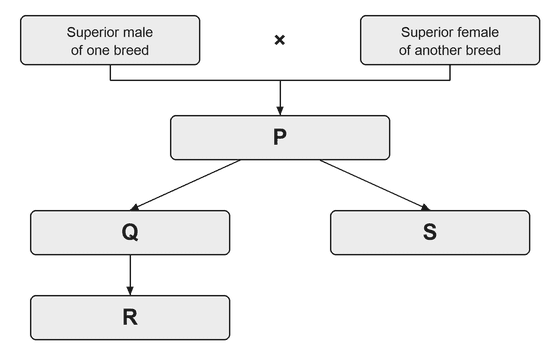
- 341 mark
Question 34
Which one of these matings is an example of interspecific hybridisation?
- 351 mark
Question 35
A student watching a beehive sees a worker bee returning with nectar and pollen. In which part of its life is this worker most likely to be?
- 362 marks
Question 36
A honey company setting up a large apiary chooses the Italian bee, Apis mellifera.
Give two reasons for this choice.
- 371 mark
Question 37
Two apiaries are managed in the same way with the same bees. Near apiary X, crops flower for about two months; near apiary Y, flowers are present for only about three weeks. Which statement is correct?
- 383 marks
Question 38
A farmer who grows sunflower and mustard places a few beehives at the edge of her fields.
Explain three ways in which this benefits her.
- 391 mark
Question 39
A person tries to open a beehive to take out the honey. Which members of the colony defend the hive, and what happens to many of them after they sting?
- 402 marks
Question 40
A bee-keeper notices that the drones in a hive do no work for most of the year.
Explain the role of the drones and what happens to them after the breeding season.
- 413 marks
Question 41
Ravi set up five beehives and got little honey in the first year. He made three mistakes:
(a) He placed the hives far from any crops or orchards.
(b) A group of bees left one hive and he did not catch them.
(c) He did not change the care of the hives from summer to winter.
Name the important aspect of successful bee-keeping that he ignored in each case, and say why it matters.
- 422 marks
Question 42
Honey is made from nectar, yet a bee-keeper is advised to have plenty of pollen-bearing flowers near the apiary as well.
Give two reasons.
- 431 mark
Question 43
In composite fish culture, five or six types of fish are reared together in one pond. Fish with different food habits are chosen so that
- 441 mark
Question 44
A co-operative rears fish in a lagoon on the coast, where sea water flows in and mixes with river water. This activity is
- 452 marks
Question 45
Two fish ponds had losses.
Pond 1: over several weeks, small fish kept disappearing; frogs, water beetles and birds were often seen there.
Pond 2: one morning, the day after waste water from a nearby factory drained into it, fish of all sizes were found dead at the same time.
Suggest the most likely cause of death in each pond, with a reason.
- 461 mark
Question 46
(Hypothetical data.) A fish farmer rears 2,000 young fish. With old methods about 30% of them survived; with new methods of breeding, hatching and growing, the survival rate can be 95%. How many more fish survive with the new methods?
- 472 marks
Question 47
A factory that extracts oil from fish throws away the tails, fins and bones.
Suggest two useful products that can be made from this waste, and give the use of each.
- 483 marks
Question 48
India's marine fish landings have stayed at about 3.5 million tonnes a year in recent years (2023–24), even though fishing vessels now use echo-sounders and satellite data to find fish.
(i) How do the traditional and modern methods of catching marine fish differ?
(ii) Why can catching fish more efficiently create a problem, and how is it being met?
- 491 mark
Question 49
The manager of a fish farm wants to keep the water in good condition. Which set of factors should be checked at regular intervals?
- 504 marks
Question 50
A state fisheries department sets up a fish hatchery with circulating clean water to supply young fish to farmers.
Explain how a hatchery works and how it helps fish farming.
- 511 mark
Question 51
Which of the following breeds of cows are strong and sturdy but yield less milk?
- 521 mark
Question 52
Holstein-Friesian is a
- 531 mark
Question 53
Which of the following is an important cross-breed of cow?
- 541 mark
Question 54
What is true of the concentrates given in animal feed, they are
- 551 mark
Question 55
Which one of the following is a bacterial disease?
- 561 mark
Question 56
The workers of honey bee
- 571 mark
Question 57
Which of the following is an exotic breed of fowls?
- 581 mark
Question 58
The poultry birds that are grown for meat are called
- 591 mark
Question 59
Levels of following vitamins are kept high in broilers:
- 601 mark
Question 60
The exotic edible variety of freshwater fish is
- 611 mark
Question 61
A well known infectious disease of fish is
- 621 mark
Question 62
The following technique increases homozygosity and reduces fertility
- 631 mark
Question 63
Jersey is an ___ breed of cow.
- 641 mark
Question 64
Karan Fries is a cross breed between ___ and ___.
- 651 mark
Question 65
A cross breed between Brown Swiss and Sahiwal is ___.
- 661 mark
Question 66
Murrah is an original breed of buffalo from ___ and ___.
- 671 mark
Question 67
Milk yield of Surti breed is ___ to ___ litres.
- 681 mark
Question 68
Additives in animal feed contain ___, ___ and ___.
- 691 mark
Question 69
Aseel breed gives high yield of ___ but poor yield of ___.
- 701 mark
Question 70
The levels of vitamins ___ and ___ are kept high in poultry feed.
- 711 mark
Question 71
___ is the fastest growing carp.
- 721 mark
Question 72
___ and ___ are highly infectious diseases of the fish.
- 731 mark
Question 73
Milk of buffaloes contains more fat than cow's milk.
- 741 mark
Question 74
Jersey is an Indian breed of cow.
- 751 mark
Question 75
Mehsana is a breed of buffalo.
- 761 mark
Question 76
Mule is produced by inbreeding technique.
- 771 mark
Question 77
Karan Swiss is produced by cross-breeding Jersey and Red Sindhi.
- 781 mark
Question 78
Rhode Island Red is a good egg layer and also meat yielding.
- 791 mark
Question 79
Indigenous breeds of cows give a very high yield of milk.
- 801 mark
Question 80
Inbreeding refers to mating of closely related animals of the same breed.
- 811 mark
Question 81
Out-crossing technique of breeding gives rise to interspecific hybrid.
- 821 mark
Question 82
Frozen embryos are used in artificial insemination.
- 835 marks
Question 83
Match the following:
Column A Column B 1. MOET (a) Mating of closely related animals of same breed 2. Exotic breeds (b) Super ovulation 3. Inbreeding (c) Mating of male and female animals from two different species or breeds 4. Hybrid (d) Breeds from foreign countries 5. Artificial insemination (e) Number of cows can be impregnated by frozen semen - 841 mark
Question 84
A dual purpose breed.
- 851 mark
Question 85
A cross-breed between Holstein-Friesian and Sahiwal.
- 861 mark
Question 86
Process of impregnation of number of cows (upto 3000) by the semen collected from one bull.
- 871 mark
Question 87
Poultry that is reared for obtaining meat.
- 881 mark
Question 88
Process of rearing of fishes.
- 891 mark
Question 89
The fastest growing carp in freshwaters.
- 901 mark
Question 90
Dairy development programme that increased the production of milk in India.
- 911 mark
Question 91
Animal feed that is high in fibres and low in proteins.
- 921 mark
Question 92
Period of milk production between birth of a young one and the next pregnancy in cows.
- 931 mark
Question 93
Exotic variety of honeybee.
- 941 mark
Question 94
Assertion (A): Cattle breeds can be improved by superovulation and embryo transplantation at 8–32 cell stage into a surrogate mother.
Reason (R): Superovulation in high milk-yielding cows is induced by injecting with hormones.
- 951 mark
Question 95
Assertion (A): In multiple ovulation embryos transfer—MOET technology, hormones with progesterone like activity are given to the cow to induce superovulation.
Reason (R): After mating, the embryos at 4–6 celled stage are recovered and transferred to surrogate mothers.
- 961 mark
Question 96
Assertion (A): Drones are haploid members of honey bee that develop from unfertilised egg.
Reason (R): They are referred as male members of the colony.
- 971 mark
Question 97
Assertion (A): Out crossing practice involves mating of animals with no common ancestor on either side for 4-5 generations.
Reason (R): A single outcross often helps to overcome inbreeding depression.
- 981 mark
Question 98
Assertion (A): A good apiary should have abundance of flora within 1-2 km radius.
Reason (R): Honey bees help in cross-pollination of flowers.
- 992 marks
Question 99
Explain in brief the role of animal husbandry in human welfare.
- 1002 marks
Question 100
What is meant by the term 'breed'? What are the objectives of animal breeding?
- 1013 marks
Question 101
What is apiculture? How is it important in our lives?
- 1022 marks
Question 102
Discuss the role of fishery in enhancement of food production.
- 1031 mark
Question 103
Bulls' semen is stored in
- 1042 marks
Question 104
Look at the cross:
A × B (parents) → MULE
(a) Name the parents for this mule.
(b) Specify the type of hybridisation involved here.
- 1051 mark
Question 105
What is cryo preservation?
- 1062 marks
Question 106
What is outbreeding? How is it useful in animal breeding?
- 1072 marks
Question 107
Enumerate any four essential features of good and effective poultry farm management practices.