
Opening your dashboard
Class 12 Biology Chapter 10 Human Health and Diseases: Practice Questions
154 questions on Chapter 10, each worked through on its own page with the AI tutor. Class 12 Biology, ICSE 2026-27.
154 questions
1–4 marks · Mixed difficulty
- 11 mark
Question 1
Ravi's medical tests are all normal and he has no disease. For several months, however, he has felt constantly low and has stopped meeting his friends. According to the WHO definition of health, Ravi:
- 21 mark
Question 2
Gout is a painful condition in which crystals of uric acid, formed in the body itself, collect in the joints. Among the five types of disease agents, uric acid here acts as a:
- 33 marks
Question 3
Classify each condition below as congenital, acquired communicable or acquired non-communicable, giving one reason for each.
(a) A boy who has been colour blind since birth.
(b) Bleeding gums in a sailor whose diet lacked vitamin C for several months.
(c) Ringworm patches that a girl developed after using her cousin's comb.
- 43 marks
Question 4
A scientist studying a disease of goats (hypothetical example) did the following:
Step 1 — found the same rod-shaped bacterium in every sick goat.
Step 2 — grew the bacterium in a pure culture on an artificial medium.
Step 3 — found the same bacterium again in large numbers in goats that fell ill later.
(a) Which of Koch's four conditions has the scientist not tested? Why is it essential?
(b) Why could the same steps not be used if the disease were caused by a virus?
- 51 mark
Question 5
Several students in a hostel caught the same infection. Health officers found the pathogen on door handles, taps and shared soap that the students touched. This is an example of:
- 62 marks
Question 6
A woman catches German measles in the third month of her pregnancy, and her doctor is worried about the baby.
(a) Name the mode by which the pathogen can reach the foetus.
(b) Name one other disease the chapter lists as spreading to the foetus in the same way.
- 71 mark
Question 7
A malaria patient's chart shows a bout of high fever every 72 hours. Which species of Plasmodium is most likely to be the cause?
- 82 marks
Question 8
Two plague patients are admitted to a hospital.
Patient X has painful, swollen lymph nodes in the groin near a flea bite.
Patient Y has chest pain and coughs up bloody mucus.
(a) Name the type of plague in each patient.
(b) Which patient must be kept in isolation, and why?
- 91 mark
Question 9
A strict vegetarian who has never eaten pork is found to have cysticercosis. The most likely way she was infected is by:
- 103 marks
Question 10
Ascaris lumbricoides and Taenia solium both live in the human intestine.
(a) State one difference in the hosts needed to complete their life cycles.
(b) Give one preventive measure that protects against Taenia but not against Ascaris.
(c) Give one preventive measure that protects against both.
- 113 marks
Question 11
A child with respiratory diphtheria has a thick grey-white membrane over the back of the throat and tonsils.
(a) Why can this membrane be fatal?
(b) Antibiotics like erythromycin are given. Why may the doctor also give an antitoxin?
(c) How can diphtheria be prevented in infants?
- 122 marks
Question 12
To control malaria, a village health worker sprays kerosene oil on puddles and open drains, and releases Gambusia fish into the large village pond.
(a) What do both measures have in common, and how does that reduce malaria?
(b) Why are fish preferred to kerosene for the large pond?
- 131 mark
Question 13
A patient has fever, chills and fast breathing. The patient coughs up rusty sputum, and the chest X-ray shows a blotchy white area where fluid and pus fill the air sacs. The most likely disease and its common cause are:
- 143 marks
Question 14
Several students in a hostel develop red, itchy, ring-shaped patches on the groin and between the toes.
(a) Why has the infection spread so fast in the hostel?
(b) Why does it appear in these particular regions?
(c) How is it treated?
- 151 mark
Question 15
In the trachea, bacteria trapped in mucus are swept towards the throat by beating cilia and expelled by coughing. This defence belongs to which type of innate barrier?
- 161 mark
Question 16
Bacteria landing on healthy, unbroken skin usually do not survive for long. Which of the following is one reason for this?
- 173 marks
Question 17
A patient's white blood cell count was 7,000 per mm³ before a bacterial infection and 18,000 per mm³ during it (hypothetical data).
(a) Which line of defence do these cells form, and why does their count rise?
(b) Name the two most important phagocytes and state how each destroys bacteria.
- 182 marks
Question 18
The steps by which a natural killer cell kills its target are jumbled below.
P — Granzymes and water enter the target cell through the pores, and the cell dies.
Q — The natural killer cell releases perforins from its vesicles.
R — Perforin molecules are inserted into the plasma membrane of the target cell, forming a pore.
S — The natural killer cell meets a virus-infected body cell.
(a) Write the steps in the correct order.
(b) Name one other kind of body cell that natural killer cells attack.
- 191 mark
Question 19
A doctor wants to know whether a patient is meeting a pathogen for the first time. A rise of which antibody class, the first to be secreted in a primary response, would point to this?
- 203 marks
Question 20
A person met an antigen for the first time on day 0 and met the same antigen again on day 60. Antibody levels in the blood (arbitrary units; hypothetical data) were:
Day 0 7 14 28 60 63 67 90 Antibody level 0 2 10 3 1 60 100 80 (a) How many days after each exposure did the level peak, and how many times higher was the second peak?
(b) Which cells explain the difference?
(c) Why would the person probably not fall ill after the second exposure?
- 212 marks
Question 21
Name the mechanism of antibody action in each case and state its result.
(a) Antibodies coat bacteria so that macrophages engulf them more easily.
(b) Antibodies bind a toxin released by bacteria and make it harmless.
- 221 mark
Question 22
Millions of different B cells are present at birth, yet antibodies are normally not made against the body's own antigens. Why?
- 231 mark
Question 23
The hepatitis B vaccine given to babies is best described as:
- 243 marks
Question 24
A one-year-old child is given a vaccine containing attenuated measles virus.
(a) Why does the vaccine not give the child measles?
(b) How does it protect the child against a later attack of wild measles virus?
(c) Why are some vaccines given in a few repeated doses instead of one?
- 254 marks
Question 25
State whether each of the following gives active or passive immunity, with a reason.
(a) A 2-month-old baby receives the DPT-Hib vaccine.
(b) A patient with diphtheria is injected with antitoxin.
(c) A child who recovered from measles never gets measles again.
(d) Antibodies extracted from the blood of a horse are injected into a person bitten by a rabid dog.
- 261 mark
Question 26
In a patient, the immune system makes antibodies against the patient's own red blood cells, and this leads to chronic anaemia. The condition is best described as
- 273 marks
Question 27
Meera handled a pet rabbit for the first time and had no reaction. A month later she handled the same rabbit and within minutes began sneezing, with itchy skin and watery eyes.
Explain why there was no reaction the first time but a strong reaction the second time.
- 282 marks
Question 28
A baby with severe combined immunodeficiency (SCID) is kept in a protective isolation room in which the air is filtered to be almost free of germs.
Give two reasons why this is necessary.
- 291 mark
Question 29
A boy who sneezes and has watery eyes every spring when trees flower is given an anti-histamine tablet. His symptoms soon reduce because the drug
- 303 marks
Question 30
In both an allergy and an autoimmune disease, the body's own immune response causes harm.
State how the two differ in (i) the antigen the response is directed against, (ii) the harm that results, and (iii) one example of each.
- 311 mark
Question 31
Patches of lymphoid tissue in the wall of the small intestine, where mature lymphocytes meet antigens that enter with food, are called
- 321 mark
Question 32
Removal of which organ would leave a person less able to trap microorganisms carried in the blood, and would also remove a store of red blood cells?
- 333 marks
Question 33
The flow chart shows how lymphocytes are formed and where they go.
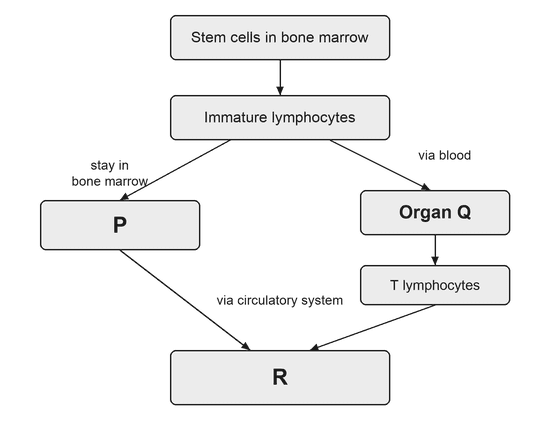
(i) Name the cells P and the organ Q.
(ii) What do the cells acquire in P's site and in organ Q, and why are these sites called primary lymphoid organs?
(iii) Name two organs that make up R and state what happens to the lymphocytes there.
- 342 marks
Question 34
During a throat infection, a doctor feels swollen, tender lymph nodes in the patient's neck.
Explain why the lymph nodes swell.
- 352 marks
Question 35
About half of the lymphoid tissue in the human body is mucosa-associated lymphoid tissue (MALT).
State where MALT is found and explain why this location is useful.
- 361 mark
Question 36
The statements below describe events when HIV infects a T-helper cell.
1. Viral DNA is integrated into the host cell's DNA.
2. HIV binds to the plasma membrane of the T-helper cell.
3. Reverse transcriptase makes a DNA copy of the viral RNA.
4. New viruses are assembled and released from the cell.
5. Viral RNA and viral proteins are made.
Which is the correct sequence?
- 374 marks
Question 37
Draw a neat labelled diagram of the structure of the human immunodeficiency virus (HIV). Label any four parts.
- 383 marks
Question 38
A person's blood was tested with an HIV antibody ELISA ten days after a possible infection, and the result was negative. The doctor advised a repeat test some weeks later.
(i) What does this ELISA detect in the blood?
(ii) Why does a negative result at ten days not rule out infection?
(iii) If the repeat ELISA is positive, which test is used to confirm it, and what does that test detect?
- 391 mark
Question 39
After a positive HIV ELISA, a Western blot assay is done on the same serum. What does the Western blot add?
- 403 marks
Question 40
The table shows the T-helper cell count of a person infected with HIV who received no anti-viral treatment. (Hypothetical data.)
Years after infection 0 2 5 8 10 T-helper cells per microlitre of blood 1000 800 550 300 150 (i) Describe the trend and explain what causes it.
(ii) At which of these times is the person most likely to suffer opportunistic diseases? Give a reason.
(iii) Name two such diseases.
- 412 marks
Question 41
Give reasons:
(i) A barber should use a fresh new blade for every customer.
(ii) Blood is tested for HIV before it is transfused.
- 421 mark
Question 42
Normal cells grown in a culture dish stop dividing once they form a single layer and touch one another. Cells taken from a tumour keep dividing and pile up in heaps. The tumour cells have lost
- 431 mark
Question 43
Groundnuts stored in a damp godown develop a mould. Regularly eating such mouldy nuts is linked with cancer of which organ, caused by which carcinogen?
- 442 marks
Question 44
Give reasons: a patient on chemotherapy often loses hair and becomes anaemic, but both conditions get corrected after the treatment is stopped.
- 453 marks
Question 45
(i) Arrange the following events of metastasis in the correct order:
(a) Secondary tumours develop a new network of blood vessels.
(b) Malignant cells break away from the primary tumour.
(c) The cells travel through blood or lymph.
(d) Surviving cells invade nearby tissue and establish secondary tumours.
(ii) Why is event (a) needed?
(iii) Can a benign tumour go through these events? Give a reason.
- 461 mark
Question 46
Mutation in the gene p53 on chromosome 17 is one of the most common genetic changes found in cancer cells. Normally, p53 is
- 473 marks
Question 47
A 55-year-old man has had a persistent cough and hoarseness for several weeks, along with unexplained loss of weight.
(i) Why should he see a doctor without delay?
(ii) Which test confirms whether a growth is cancerous, and how is it done?
(iii) State one difference between a CT scan and an MRI scan.
- 481 mark
Question 48
A man with kidney failure receives a kidney from his identical twin brother. This transplant is
- 494 marks
Question 49
A patient needs a kidney. The patient's father has HLA haplotypes a and b; the mother has c and d; the patient has a and c. Each child inherits one haplotype from each parent. (Assume the HLA complex is passed on as one unit.)
(i) What is the probability that a brother or sister of the patient has both haplotypes the same as the patient?
(ii) What is the probability that the brother or sister shares exactly one haplotype with the patient?
(iii) How many haplotypes does the patient's father share with the patient?
(iv) Use your answers to explain why a sibling is preferred to a parent as a donor, but an identical twin is preferred to both.
- 502 marks
Question 50
After a kidney transplant, a patient on immunosuppressant drugs is advised to keep away from people suffering from infections.
Give reasons for (i) the use of the drugs and (ii) this advice.
- 511 mark
Question 51
Which of the following is a part of the innate (non-specific) immunity?
- 521 mark
Question 52
Which of the following is not a component of innate immunity?
- 531 mark
Question 53
The word pathogen refers to a
- 541 mark
Question 54
Histamines are released from
- 551 mark
Question 55
Natural killer cells destroy the target cell by
- 561 mark
Question 56
One of the unique features of adaptive immunity is
- 571 mark
Question 57
Both B cells and T cells are derived from
- 581 mark
Question 58
The function of helper T-cell is to
- 591 mark
Question 59
Special proteins released by a viral infected cell are called
- 601 mark
Question 60
Cell-mediated immunity involves
- 611 mark
Question 61
The most abundant immunoglobulin class is of
- 621 mark
Question 62
The secondary immune response is due to
- 631 mark
Question 63
The primary lymphoid organ is
- 641 mark
Question 64
Secondary lymphoid organ is
- 651 mark
Question 65
What did Dr. Jenner inoculate in the boy for the first time?
- 661 mark
Question 66
A person without thymus would not be able to
- 671 mark
Question 67
The antigen–antibody reaction during allergies releases
- 681 mark
Question 68
The following disease is an autoimmune disease
- 691 mark
Question 69
HIV selectively infects and kills
- 701 mark
Question 70
Human immunodeficiency virus (HIV) contains
- 711 mark
Question 71
Which of the following diseases can be contracted by the droplet infection?
- 721 mark
Question 72
Pyrogens are the chemicals released by
- 731 mark
Question 73
The term allergens refers to
- 741 mark
Question 74
AIDS from an infected person can be caused by
- 751 mark
Question 75
The interferons make the cells resistant to
- 761 mark
Question 76
Which of the following disease is caused by a virus?
- 771 mark
Question 77
Which one of the following diseases spreads by the droplet infection?
- 781 mark
Question 78
The causative organism of AIDS is
- 791 mark
Question 79
Malaria is caused by
- 801 mark
Question 80
The disease ringworm is caused by
- 811 mark
Question 81
Cancer that affect and arise in the mesodermal tissue are called
- 821 mark
Question 82
Leukemia is often referred to as
- 831 mark
Question 83
Agents that produce cancers are called
- 841 mark
Question 84
HIV causes
- 851 mark
Question 85
HIV that causes AIDS, first starts destroying
- 861 mark
Question 86
Passive immunity can be obtained through
- 871 mark
Question 87
Active immunity is related to
- 881 mark
Question 88
Filariasis is caused by
- 891 mark
Question 89
Interferons are
- 901 mark
Question 90
Transplantation of tissues/organs fails often due to non-acceptance by the patient's body. Which type of immune-response is responsible for such rejections?
- 911 mark
Question 91
In which disease does mosquito transmitted pathogen cause chronic inflammation of lymphatic vessels?
- 921 mark
Question 92
Which of the following is not an autoimmune disease?
- 931 mark
Question 93
Which of the following immune responses is responsible for rejection of kidney graft?
- 941 mark
Question 94
Certain cells when infected with a virus, respond by releasing ______ that make other cells resistant to viral infections.
- 951 mark
Question 95
______ are large irregular-shaped cells that engulf microbes, viruses and cell debris.
- 961 mark
Question 96
Natural killer cells kill virus-infected cells by creating ______ in the plasma membrane of the target cells.
- 971 mark
Question 97
Specific immunity has two major group of cells. These are ______ and ______.
- 981 mark
Question 98
T cells mature in ______.
- 991 mark
Question 99
Each immunoglobulin (Ig) is made of 4 polypeptide chains. Two long chains called ______ and two short chains called ______.
- 1001 mark
Question 100
Substances like dust, pollens and certain foods that cause allergies are called ______.
- 1011 mark
Question 101
______ is caused by antibodies that attack the myelin sheath of nerve cells.
- 1021 mark
Question 102
Dengue is caused by the bite of female Anopheles mosquito which breeds in clean water.
- 1031 mark
Question 103
Chikungunya is a viral disease transmitted by the bite of an infected Aedes aegypti.
- 1041 mark
Question 104
Ringworm is a common fungal infection and is highly contagious.
- 1051 mark
Question 105
Natural killer cells kill the infected cell by creating a large pore in the membrane of the cell.
- 1061 mark
Question 106
An immunoglobulin is made up of two short polypeptides called heavy chains and two long polypeptides called light chains.
- 1071 mark
Question 107
Mast cells release pyrogens which cause itching of the skin in allergy.
- 1081 mark
Question 108
HIV has a special enzyme called reverse transcriptase by which it can replicate to produce cDNA in host cell.
- 1091 mark
Question 109
Sarcomas affect and arise from the epithelial or ectodermal tissue of the organs.
- 1101 mark
Question 110
The immunity with which an individual is born and which is always available to protect a living body.
- 1111 mark
Question 111
Chemicals released as alarm signals from damaged mast cells of the body.
- 1121 mark
Question 112
Process of production of B and T cells in the body.
- 1131 mark
Question 113
Sites on the antigens that are recognised by antibodies present on B cells.
- 1141 mark
Question 114
Organs where the maturation and proliferation of lymphocytes take place.
- 1151 mark
Question 115
Sites where B and T lymphocytes mature.
- 1161 mark
Question 116
A cluster of genes in humans that determine the histocompatibility between donor and recipients.
- 1171 mark
Question 117
A sudden, violent and fatal reaction caused by an allergen.
- 1181 mark
Question 118
Type of cells, HIV selectively infects and kills in the person.
- 1191 mark
Question 119
Diseases that result from a defect in one or more components of the innate or adaptive immunity.
- 1201 mark
Question 120
Assertion (A): There is no chance of malaria to a man on the bite of male Anopheles mosquito.
Reason (R): It carries a non-virulent strain of Plasmodium.
- 1211 mark
Question 121
Assertion (A): Escherichia coli and Shigella sp. are all responsible for diarrhoeal diseases.
Reason (R): Dehydration is common to all types of diarrhoeal diseases and adequate supply of fluids and electrolytes should be ensured.
- 1221 mark
Question 122
Assertion (A): Plasmodium vivax is responsible for malaria.
Reason (R): Malaria spreads by polluted water.
- 1231 mark
Question 123
Assertion (A): Histamine is related with allergic and inflammatory reactions.
Reason (R): Histamine is a vasodilator.
- 1241 mark
Question 124
Assertion (A): Organ transplantation patients are given immunosuppressant drugs.
Reason (R): Transplanted tissues have antigens which can stimulate the specific immune response in the recipient.
- 1251 mark
Question 125
Assertion (A): Person who has received a cut and is bleeding needs to be given anti-tetanus treatment.
Reason (R): Anti-tetanus injection provides immunity by producing antibodies for tetanus.
- 1261 mark
Question 126
Assertion (A): Interferons are a type of antibodies produced by the body cells infected by bacteria.
Reason (R): Interferons stimulate inflammation at the site of injury.
- 1271 mark
Question 127
Assertion (A): HIV-infected persons are prone to opportunistic diseases.
Reason (R): Immune system weakens during HIV infection.
- 1281 mark
Question 128
Assertion (A): Cancer cells are virtually immortal until the body in which they reside dies.
Reason (R): Cancer is caused by damage to genes regulating the cell division cycle.
- 1293 marks
Question 129
In which way has the study of biology helped us to control infectious diseases?
- 1302 marks
Question 130
How does the transmission of each of the following diseases take place?
(a) Amoebiasis
(b) Malaria
(c) Ascariasis
(d) Pneumonia
- 1312 marks
Question 131
What measure would you take to prevent water-borne diseases?
- 1322 marks
Question 132
Discuss with your teacher what does 'a suitable gene' means, in the context of DNA vaccines.
- 1332 marks
Question 133
Name the primary and secondary lymphoid organs.
- 1342 marks
Question 134
The following are some well-known abbreviations, which have been used in this chapter. Expand each one to its full form:
(a) MALT
(b) CMI
(c) AIDS
(d) NACO
(e) HIV
- 1352 marks
Question 135
What are the various routes by which transmission of human immunodeficiency virus takes place?
- 1362 marks
Question 136
Explain what is meant by metastasis.
- 1373 marks
Question 137
Do you think that friends can influence one to take alcohol/drug? If yes, how may one protect oneself from such an influence?
- 1382 marks
Question 138
Why is that once a person starts taking alcohol or drugs, it is difficult to get rid of this habit? Discuss it with your teacher.
- 1392 marks
Question 139
All human beings have proto-oncogenes. But all of them do not suffer from cancer. Why?
- 1402 marks
Question 140
Do you agree that at certain times infected cells of our body can protect the non-infected cells? If yes, how?
- 1411 mark
Question 141
Against which diseases does the MMR vaccine give protection?
- 1422 marks
Question 142
A person with elephantiasis has an abnormally increased swelling in the lower limbs. What could be the reason for the swelling?
- 1432 marks
Question 143
Complete the blank spaces:
Type of pathogen Name of pathogen Symptoms Disease name (I) a. ______ Entamoeba Abdominal pain b. ______ (II) Bacteria c. ______ Respiratory problem d. ______ - 1442 marks
Question 144
Why should one take an immunosuppressant agent all through their life after an organ transplantation?
- 1452 marks
Question 145
Complete the following.
(i) TB : Airborne :: Malaria : ______
(ii) Colostrum : Passive immunity :: Vaccine : ______
- 1462 marks
Question 146
A person has been bitten by a poisonous snake and is rushed to the doctor for an urgent immune response.
(a) What kind of immunisation was the person provided to get an immediate response?
(b) Define this kind of immunity.
- 1471 mark
Question 147
Name the antibody which is most effective in allergies.
- 1481 mark
Question 148
Give the biological name of the organism causing typhoid.
- 1491 mark
Question 149
Name the type of antibody that can be transferred through the placenta.
- 1501 mark
Question 150
Assertion (A): A person who has received a cut from a sharp object and is bleeding, needs to be given an anti-tetanus injection.
Reason (R): Anti-tetanus injection stimulates the production of antibodies for tetanus.
- 1511 mark
Question 151
Give one difference between the following pairs:
Sites of maturation of B-Lymphocytes and T-Lymphocytes
- 1522 marks
Question 152
Give one significant difference between primary lymphoid organs and secondary lymphoid organs. Give one example of each.
- 1532 marks
Question 153
Give one significant difference between each of the following pairs:
(i) Humoral immunity and cell mediated immunity.
(ii) Benign tumour and malignant tumour.
- 1542 marks
Question 154
Riya went to the hospital to meet her sister who was undergoing some treatment. The hospital was crowded with patients suffering from various types of allergies, pneumonia and Ascariasis.
Name the disease that Riya is most likely to get infected with. Give one reason for your answer.