
Opening your dashboard
Class 11 Physics Chapter 5 Motion in a Plane - Vectors: Practice Questions
140 questions on Chapter 5, each worked through on its own page with the AI tutor. Class 11 Physics, ICSE 2026-27.
140 questions
1–4 marks · Mixed difficulty
- 11 mark
Question 1
(Hypothetical data.) A delivery rider starts at corner P of a square city block of side . The rider goes along three sides of the block, from P to Q to R and on to S, as shown in the figure.
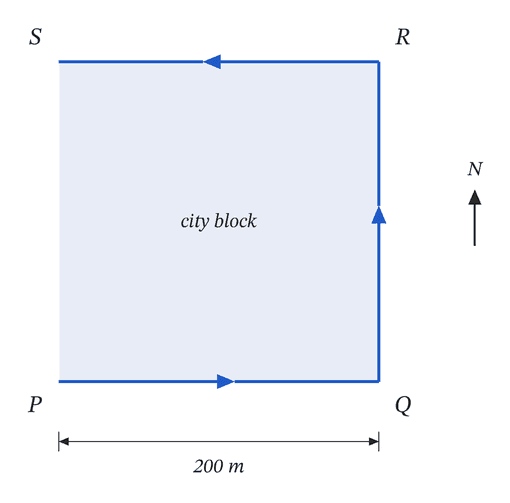
What are the distance the rider travels and the magnitude of the rider's displacement?
- 22 marks
Question 2
State whether each of the following is a scalar or a vector, and give a reason in each case.
(i) The reading on the speedometer of a car.
(ii) The pull of a towing rope on a broken-down car.
(iii) The energy stored in a fully charged phone battery.
(iv) The wind reported by a weather station as “18 km/h from the north-west”.
- 33 marks
Question 3
(Hypothetical data.) A giant wheel of radius turns slowly in a vertical plane. A seat starts at the lowest point L, passes the point M where it is level with the axle C, and goes on to the top T, as shown in the figure.
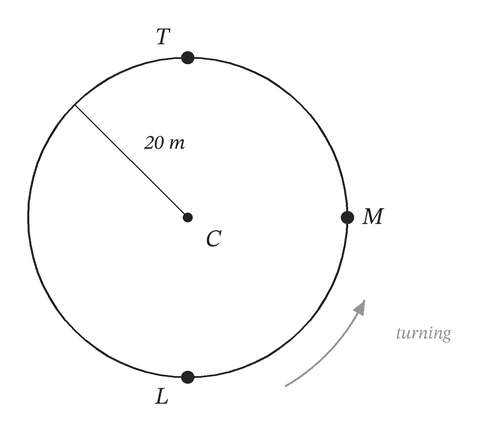
Find the distance travelled by the seat and the magnitude and direction of its displacement
(i) from L to M, and
(ii) from L to T.
(iii) Explain why the distance is larger than the magnitude of the displacement in both cases.
- 43 marks
Question 4
(Hypothetical data.) A bus travels due east in minutes and then due north in minutes. For the whole trip, find
(i) the average speed, and
(ii) the magnitude and direction of the average velocity,
both in .
- 51 mark
Question 5
A body moves from one point to another during a certain time interval. Which statement about its average speed and the magnitude of its average velocity over that interval is always true?
- 61 mark
Question 6
Five vectors , , , and are drawn on a grid of dots, as shown in the figure.

Which statement is correct?
- 71 mark
Question 7
A lift car and its counterweight hang from the two ends of a cable that passes over a pulley, as shown in the figure. The car is moving up at . (Hypothetical data.)

The velocity of the car and the velocity of the counterweight are
- 82 marks
Question 8
Vectors are sometimes divided into polar vectors and axial vectors. Classify each of the following as a polar vector or an axial vector, and give a reason in each case.
(i) The velocity of a car on a straight road.
(ii) The angular velocity of a spinning top.
(iii) The momentum of a cricket ball in flight.
(iv) The torque applied by a spanner to tighten a nut.
- 94 marks
Question 9
(Hypothetical data.) The figure shows a campus map drawn on a grid of dots apart, with north towards the top of the page. The gate O, the library L, the canteen C and the hostel H are marked.
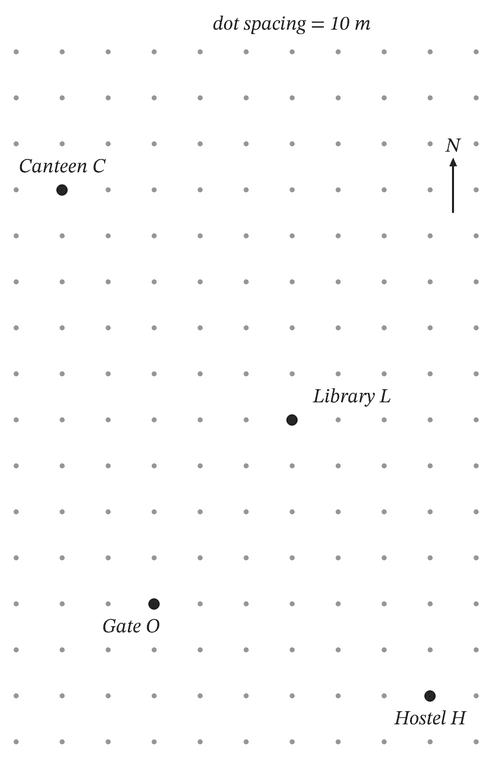
Taking the gate O as the origin,
(i) find the magnitude and direction of the position vector of the library and of the canteen;
(ii) find the magnitude and direction of the displacement of a student who walks from the library to the canteen;
(iii) show that this displacement comes out the same if the hostel H is taken as the origin instead.
- 101 mark
Question 10
A bound (fixed or localised) vector is one whose starting point is fixed, so it cannot be shifted to another starting point without changing what it describes. Which one of the following is a bound vector?
- 113 marks
Question 11
(Hypothetical data.) A cargo ship is towed by two tugs. Tug A pulls with a force of along a rope at to the left of the ship's keel line. Tug B pulls with a force of along a rope at an angle to the right of the keel line, as shown in the figure.

(i) Find the angle for which the resultant pull on the ship is exactly along the keel line.
(ii) Find the magnitude of this resultant pull.
- 121 mark
Question 12
(Hypothetical data.) A rover on a test field moves north, then east, then south and finally west, as shown in the figure.
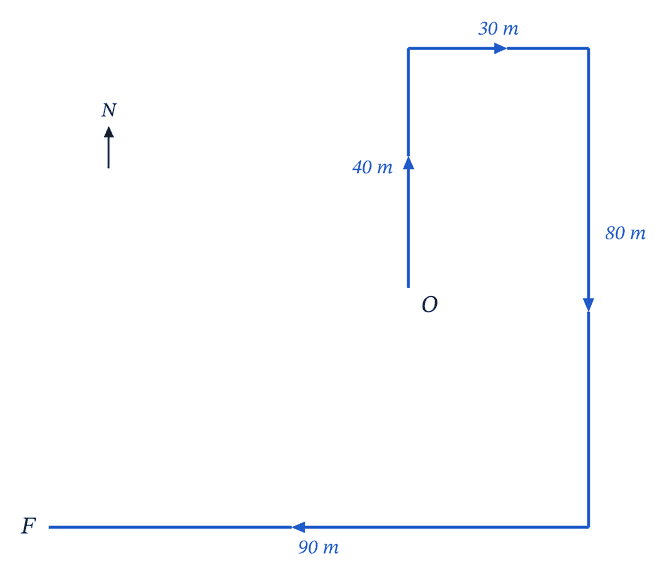
Its resultant displacement from the start O to the finish F is
- 133 marks
Question 13
(Hypothetical data.) On a force table, three strings tied to a small knot pull on it horizontally with forces of , and , set by weights hanging over pulleys at the edge of the table. Because the knot stays at rest, the three pulls add up to the zero vector. Find
(i) the angle between the string and the string, and
(ii) the angle between the string and the string.
- 141 mark
Question 14
Two forces of magnitudes and act at a point. Their resultant is perpendicular to the smaller force. The angle between the two forces is
- 152 marks
Question 15
(Hypothetical data.) A picture hangs from a nail by a wire tied to its two top corners. Each half of the wire pulls on the nail with a force of , and the two halves make an angle of with each other at the nail, as shown in the figure.
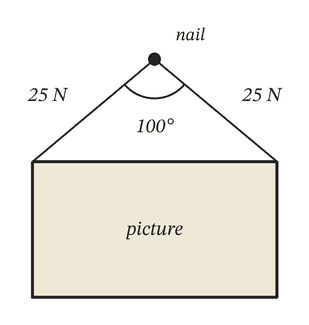
Find the magnitude and direction of the resultant force of the wire on the nail. The wire passes the whole weight of the picture on to the nail, so this resultant equals the weight; hence find the mass of the picture. Take .
- 161 mark
Question 16
(Hypothetical data.) A tennis ball strikes a smooth vertical wall at , travelling at to the wall, and rebounds at the same speed and at the same angle to the wall, as shown in the figure.
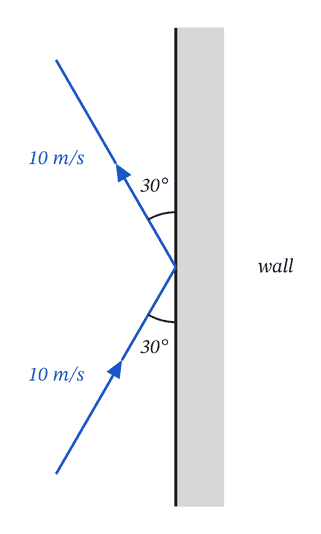
The change in the velocity of the ball is
- 173 marks
Question 17
Two forces and act at a point. Their sum is due east, and their difference is due north. Find the magnitude and direction of each force, and the angle between the two forces.
- 181 mark
Question 18
In a triangle PQR, and , as shown in the figure.
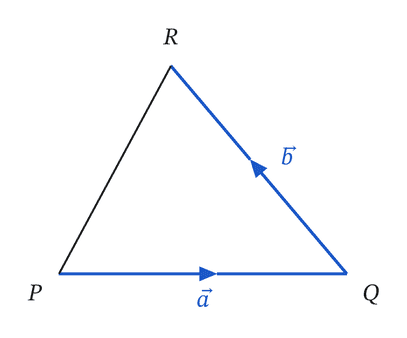
The vector is
- 193 marks
Question 19
(Hypothetical data.) An ice-hockey puck slides due east at . A player's stick is in contact with it for , after which the puck moves due north at . Find
(i) the magnitude and direction of the change in the velocity of the puck, and
(ii) the average acceleration of the puck while the stick is in contact with it.
- 202 marks
Question 20
For two vectors and with an angle between them, show that is greater than when is more than . Check the result for units, units and .
- 211 mark
Question 21
Which one of the following is a unit vector?
- 223 marks
Question 22
(Hypothetical data.) A hut H is due north of a camp O, but a lake lies between them. A hiker walks along a straight trail from O in the direction east of north to a junction J. From J a second straight trail, in the direction west of north, leads to the hut, as shown in the figure.

The hiker's two displacements are the components of the displacement along the two trail directions. Find the length of each trail.
- 232 marks
Question 23
A force of magnitude acts along the line from the point to the point , in the direction from A to B, as shown in the figure. The coordinates are in metres.
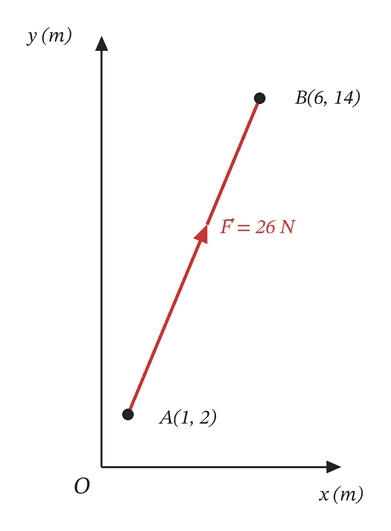
(i) Find the unit vector in the direction of the force.
(ii) Write the force in terms of the unit vectors and .
- 241 mark
Question 24
Which statement about resolving a vector in a plane into two components is correct?
- 253 marks
Question 25
(Hypothetical data.) Two straight roads leave a junction O: road 1 runs due east and road 2 runs north of east. Let and be unit vectors along road 1 and road 2. A new footpath from O is to bisect the angle between the two roads.
(i) Show that points along the bisector.
(ii) Find .
(iii) Hence write the unit vector along the footpath in terms of and , and state the direction of the footpath.
- 261 mark
Question 26
(Hypothetical data.) A robot vacuum cleaner starts at the origin of a floor grid whose -axis points east and whose -axis points north. Some time later, its displacement has the rectangular components and . Its displacement is
- 273 marks
Question 27
(Hypothetical data.) Three people pull horizontal ropes tied to a ring O on a heavy crate. The pulls are due east, at north of east and at north of west, as shown in the figure.
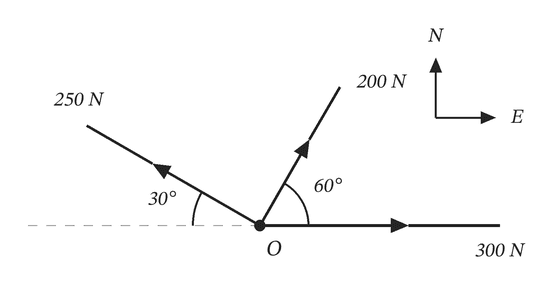
(a) Using rectangular components, find the magnitude and direction of the resultant horizontal pull on the ring.
(b) A fourth rope is to be added so that the four horizontal pulls on the ring balance. Find the pull this rope must exert.
- 281 mark
Question 28
A displacement has rectangular components along the -axis and along the -axis. A student turns both axes anticlockwise through about the origin and works out the components of the same displacement again. Which of the following is the same for both sets of axes?
- 292 marks
Question 29
(Hypothetical data.) A delivery drone flies in a straight line at a steady speed of , climbing at above the horizontal.
(a) How long does it take to gain of height?
(b) How far does it move horizontally in that time?
- 303 marks
Question 30
(Hypothetical data.) A light aircraft is about to land on a runway that points due east. The wind blows at from a direction north of east, as shown in the figure.

(a) Find the component of the wind velocity along the runway and the component across it.
(b) The pilot may land only if the component across the runway (the crosswind) is not more than . Is landing allowed?
(c) For the same wind speed, what angle between the wind's direction and the runway would make the crosswind just equal to ?
- 311 mark
Question 31
Vector has rectangular components units and units, and vector has rectangular components units and units. Using the angle each vector makes with the -axis, the angle between and is
- 321 mark
Question 32
A constant force acts on a particle while it moves from the point to the point , with coordinates in metres. The work done by the force is
- 331 mark
Question 33
A spanner lies along the -axis from the centre O of a nut to the point P, where a force is applied in the direction, as shown in the figure. The -axis points out of the page.

The torque of this force about O is , where . The torque points
- 344 marks
Question 34
(Hypothetical data.) A rectangular solar panel on a roof has one corner at the origin O. Take the -axis due east, the -axis due north and the -axis vertically upwards. The two edges of the panel from O are (along the bottom, horizontal) and (up the slope), as shown in the figure.
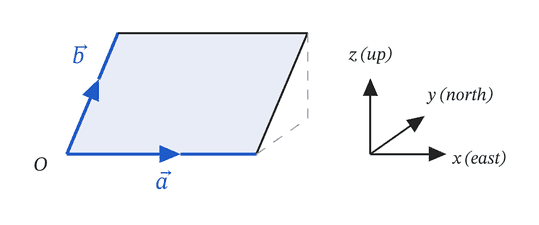
The area vector of the panel is ; its magnitude is the area of the panel and it points along the normal to the panel.
(a) Find and the area of the panel.
(b) Find the angle between and the vertical. This is the tilt of the panel.
(c) Early one morning the sun is due east, in the direction of the unit vector , and sunlight delivers to each square metre held face-on to it. The power falling on the panel is watts, with in square metres. Find .
- 351 mark
Question 35
(Hypothetical data.) A horse walking on a canal bank pulls a barge with a rope. The force of the rope on the barge is , and the barge moves along the canal with velocity . The power delivered to the barge by the rope, , is
- 363 marks
Question 36
In a methane molecule, the carbon atom is at the origin and two of the hydrogen atoms are at the points with position vectors and , where .
(a) Use the scalar product to find the H–C–H bond angle.
(b) Find the length of a C–H bond.
(c) Find the distance between these two hydrogen atoms.
- 372 marks
Question 37
The unit vectors along the axes obey , , and . Use these to find and . What does the result show about the vector product?
- 383 marks
Question 38
(Hypothetical data.) In a warehouse, a worker guides a box down a straight ramp from the point to the point , with coordinates in metres and the -axis vertically upwards. Throughout the move the worker pulls the box with a constant force . Take . Find
(a) the work done on the box by gravity,
(b) the work done on the box by the worker's pull, and
(c) the angle between the worker's pull and the displacement of the box.
- 391 mark
Question 39
(Hypothetical data.) At a metro station, Riya walks up a stopped escalator in . On another day she stands still on the same escalator while it moves up, and she reaches the top in . If she walks up at her usual pace while the escalator is moving up, she will reach the top in
- 404 marks
Question 40
(Hypothetical data.) At noon, ship B is due north of ship A. Ship A sails due east at and ship B sails due south at , as shown in the figure.

(a) Find the velocity of B relative to A.
(b) Find the least distance between the ships and the time at which they are closest.
(c) Each ship's radar can detect the other only within . If both keep their courses and speeds, will either ship ever detect the other on radar?
- 411 mark
Question 41
(Hypothetical data.) Two ships A and B move with constant velocities. Every few minutes the navigator of A measures the bearing of B (the compass direction in which B is seen from A) and the distance to B. The bearing stays exactly the same, while the distance keeps decreasing. If neither ship changes its course or speed, then
- 423 marks
Question 42
(Hypothetical data.) A cyclist and a walker leave the same school gate O at the same time. In the next , the cyclist rides due east along a straight road and the walker walks due north along another straight road.
(a) Find the displacement of the cyclist relative to the walker at the end of the 10 minutes.
(b) Both move at steady speeds. Find the velocity of the cyclist relative to the walker, in .
- 434 marks
Question 43
(Hypothetical data.) On a two-lane highway, a car long travels at behind a truck long travelling at . The front of the car is behind the rear of the truck, as shown in the figure.
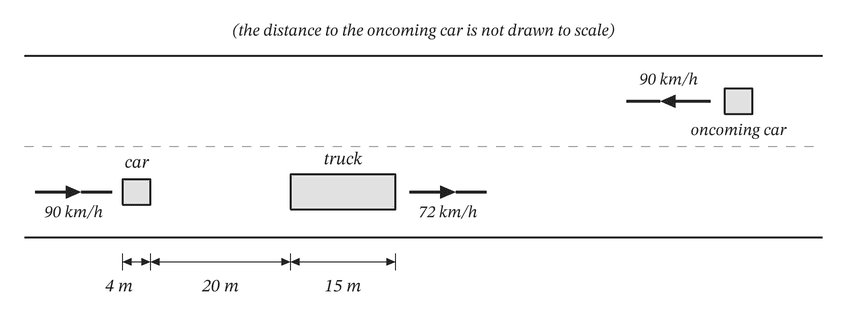
The driver overtakes at a steady and returns to the original lane when the rear of the car is ahead of the front of the truck.
(a) Find the time taken for the overtake.
(b) Find the distance the car travels along the road during the overtake.
(c) A car coming the other way in the other lane also travels at . What is the least distance between the two cars at the start of the overtake that lets the overtaking car get back safely?
- 441 mark
Question 44
(Hypothetical data.) A train moves due east at . Inside it, a child walks towards the back of the train at relative to the train. On a road beside the track, a car moves due west at . The velocity of the child relative to the car is
- 452 marks
Question 45
(Hypothetical data.) A long jumper leaves the take-off board at , at above the horizontal. Treat the jumper as a point projectile that lands at the take-off height, neglect air resistance and take . Find
(a) the horizontal distance covered in the air, and
(b) the greatest height reached above the take-off height.
- 463 marks
Question 46
(Hypothetical data.) A lawn sprinkler at ground level O sends a jet of water at , at above the horizontal. A thin hedge tall stands from the sprinkler, in the vertical plane of the jet, as shown in the figure.
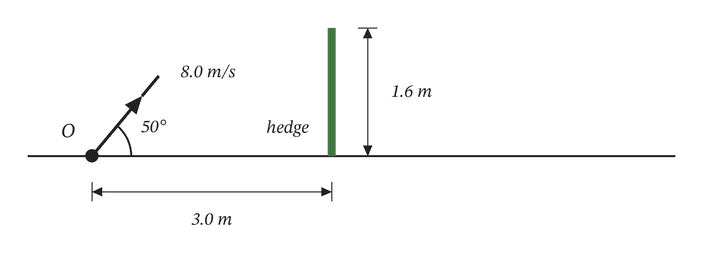
Neglect air resistance and take .
(a) Find whether the jet passes over the hedge.
(b) How far from the sprinkler does the water land?
- 471 mark
Question 47
(Hypothetical data.) A stone is thrown with a speed of at above the horizontal. Neglect air resistance and take . How long after the throw is the stone first moving in a direction above the horizontal?
- 483 marks
Question 48
(Hypothetical data.) A fielder can throw a cricket ball at . The fielder throws it to the wicketkeeper, who is away. Take the ball to be thrown and caught at the same height, neglect air resistance, and take .
(a) Find the two angles of projection that make the ball reach the keeper.
(b) Find the time of flight for each angle.
(c) For a quick run-out, which angle should the fielder choose, and how much time does it save?
- 494 marks
Question 49
(Hypothetical data.) A shot-putter releases the shot at the point P, above level ground, with a speed of at above the horizontal, as shown in the figure.
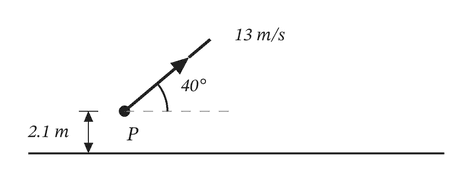
Neglect air resistance and take . Find
(a) the time for which the shot is in the air,
(b) the horizontal distance from P to the point where the shot lands, and
(c) the speed of the shot just before it lands.
- 501 mark
Question 50
(Hypothetical data.) A ball is thrown from level ground at above the horizontal and lands on the same level ground. Neglecting air resistance, how does the angle between the ball's velocity and its acceleration change during the flight?
- 512 marks
Question 51
Why can’t the vectors be added algebraically?
- 522 marks
Question 52
(i) Is it possible to add any two vectors?
(ii) When can you say that two vectors and are (a) parallel and (b) perpendicular?
(iii) Prove that .
- 531 mark
Question 53
Can the component of a vector be greater than vector itself?
- 541 mark
Question 54
How can the resultant of 13 vectors acting at a point be found?
- 552 marks
Question 55
A vector has magnitude and direction. Does it have a location in space? Can it vary with time? Will two equal vectors and at different locations in space necessarily have identical physical effect? Give examples in support of your answer.
- 562 marks
Question 56
A vector has both magnitude and direction. Does that mean anything that has magnitude and direction is necessarily a vector? Can you consider the rotation of a body as a vector?
- 572 marks
Question 57
Can you associate vector with (a) the length of a wire bent into a loop, (b) a plane area and (c) sphere? Explain.
- 582 marks
Question 58
Can you apply commutative and associative law to vector subtraction?
- 592 marks
Question 59
Can two vectors of different magnitude be combined to give a zero resultant? Can three vectors?
- 602 marks
Question 60
Can three vectors not in a plane give zero resultant? Can four vectors?
- 611 mark
Question 61
Can there be motion in two dimensions with acceleration only in one direction?
- 621 mark
Question 62
What is the direction of motion of a projectile at the highest point? Why?
- 632 marks
Question 63
If the greatest height reached by a projectile is 3/4th the horizontal range, what is the angle of projection?
- 642 marks
Question 64
A person can throw a stone to a maximum height . What is the maximum horizontal distance he can throw?
- 652 marks
Question 65
From the same height one stone is dropped and another stone is thrown horizontally. Which will reach the ground first? Why?
- 661 mark
Question 66
What is the angle preferred by athletes in throws?
- 672 marks
Question 67
From a flying aeroplane, a body should be dropped in advance to hit a target. Why?
- 682 marks
Question 68
A body is projected horizontally from the top of a building. Draw the velocity–time graph for the horizontal and vertical component of velocity.
- 692 marks
Question 69
Explain how the vertical and horizontal component of the velocity of projection vary during the time of flight.
- 703 marks
Question 70
If , and are three vectors, when you can say that and are the same?
- 713 marks
Question 71
If , under what condition will be equal to ?
- 724 marks
Question 72
A number of vectors are as shown in the following figure. They can be combined in various ways, like .
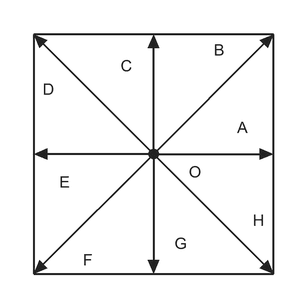
What is the value of (a) , (b) , (c) , (d) , (e) and (f) ? Given that the vectors along a straight line are equal and opposite with respect to the origin O.
- 733 marks
Question 73
In Question 7, how will you combine and such that their vector sum is (i) , (ii) and (iii) ?
- 743 marks
Question 74
Two billiard balls are rolling on a flat table. One has the velocity component , and the other has component and . If both the balls start moving from the same point, what is the angle between their paths?
- 753 marks
Question 75
What should be the angle between and such that the magnitude of the resultant is ?
- 763 marks
Question 76
A spider crawls due north, due east and then climbs vertically upwards on a wall. What is the magnitude of the resultant displacement?
- 773 marks
Question 77
Find the direction cosines of the vector .
- 783 marks
Question 78
Find the unit vector of the vector .
- 793 marks
Question 79
The vertical component of a force acting at to the horizontal is . Find the force and the horizontal component.
- 803 marks
Question 80
A force acts on a body at a certain angle with the horizontal such that the vertical component is twice the horizontal component. What is the inclination of the force?
- 813 marks
Question 81
What is the magnitude and direction of (a) and (b) ?
- 823 marks
Question 82
The result of scalar product and the vector product of two given vectors is zero. If one vector is , what is the other vector?
- 833 marks
Question 83
Given, , . Calculate the angle made by with the -axis?
- 843 marks
Question 84
Simplify:
(i)
(ii)
- 853 marks
Question 85
Obtain the condition for the two vectors and to be parallel?
- 863 marks
Question 86
What are the values of the following:
(i)
(ii)
(iii) , if
- 873 marks
Question 87
Prove that .
- 883 marks
Question 88
A ball is projected horizontally with a velocity of . What is the velocity of the ball after ? .
- 893 marks
Question 89
An aeroplane moving horizontally with a speed of drops a food packet while flying at a height of . Find the horizontal range.
- 903 marks
Question 90
A ball is thrown at an angle with the horizontal. Its time of flight is 2 second. Its horizontal range is . What is the horizontal component of the velocity of projection?
- 913 marks
Question 91
If 4 seconds be the time in which a projectile reaches a point of its path and 5 seconds the time from till it reaches the horizontal plane through the point of projection, show that the height of above the horizontal plane is .
- 923 marks
Question 92
A boy is able to throw a ball to a maximum height of . What maximum distance can he throw the ball in a horizontal direction?
- 933 marks
Question 93
A boat is moving with a velocity with respect to ground. The water in the river is moving with a velocity with respect to the ground. Calculate the relative velocity of the boat with respect to water.
- 943 marks
Question 94
A ship is steaming north at and a man walks across its deck in a direction due west at . Find his resultant velocity in the ship.
- 951 mark
Question 95
Two vectors are given by and . Another vector has the same magnitude as but has the same direction as . Then, which of the following vectors represent ?
- 961 mark
Question 96
Among the following, the vector quantity is
- 971 mark
Question 97
If the magnitude of sum of two vectors is equal to the magnitude of difference of the two vectors, the angle between these vectors is
- 981 mark
Question 98
For the following set(s) of forces (in the same unit) the resultant can never be zero
- 991 mark
Question 99
Three vectors , and are shown in the figure. Let S be any point on the vector . The distance between the point P and S is . The general relation among vectors , and is

- 1001 mark
Question 100
If a vector is perpendicular to the vector . Then, the value of is
- 1011 mark
Question 101
and are two vectors given by and . The magnitude of the component of along is
- 1021 mark
Question 102
A particle moves in the - plane under the influence of a force such that its linear momentum is , where and are constants. The angle between the force and the momentum is
- 1031 mark
Question 103
If vector and are functions of time, then the value of at which they are orthogonal to each other is
- 1041 mark
Question 104
Can the resultant of 2 vectors be zero?
- 1051 mark
Question 105
The speed of a boat is 5 km/h in still water. It crosses a river of width 1 km along the shortest possible path in 15 minutes. The velocity of the river water is
- 1061 mark
Question 106
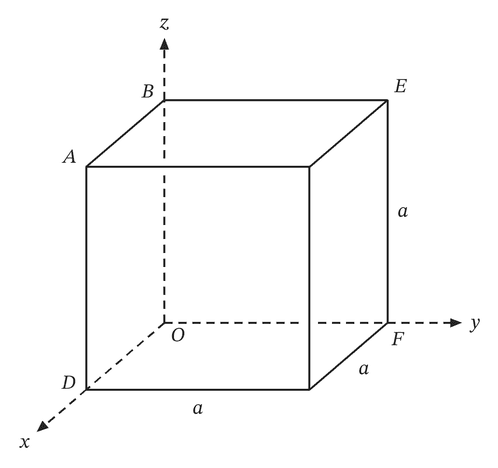
In the cube of side ‘’ shown in the given figure, the vector from the central point of the face to the central point of the face will be
- 1071 mark
Question 107
A particle moves from the point m, at , with an initial velocity . It is acted upon by a constant force which produces a constant acceleration . What is the distance of the particle from the origin at time 2 s?
- 1081 mark
Question 108
The angle of projection at which the horizontal range and maximum height of projectile are equal is
- 1091 mark
Question 109
The relation between the time of flight of a projectile and the time to reach the maximum height is
- 1101 mark
Question 110
A ball is projected with kinetic energy at an angle of to the horizontal. At the highest point during its flight, its kinetic energy will be
- 1111 mark
Question 111
A projectile is given an initial velocity of m/s, where is along the ground and is along the vertical. If , the equation of its trajectory is
- 1121 mark
Question 112
If a body of mass is thrown with velocity at an angle of to the horizontal and another body of the same mass is thrown with the same speed at an angle of to the horizontal. The ratio of horizontal range of to will be
- 1131 mark
Question 113
In a projectile motion, velocity at maximum height is
- 1141 mark
Question 114
A body is thrown with a velocity of 9.8 m/s making an angle of with the horizontal. It will hit the ground after a time
- 1151 mark
Question 115
The speed of a projectile at its maximum height is half of its initial speed. The angle of projection is
- 1161 mark
Question 116
A projectile is projected with kinetic energy . If it has the maximum possible horizontal range, then its kinetic energy at the highest point will be
- 1171 mark
Question 117
A particle is moving with velocity , where is a constant. The general equation for its path is
- 1181 mark
Question 118
The and coordinates of the particle at any time are and respectively where and are in meters and in seconds. The acceleration of the particle at s is
- 1191 mark
Question 119
The position coordinate of a particle moving in a 3D coordinate system is given by
; and
The speed of the particle is
- 1201 mark
Question 120
Two guns and can fire bullets at speeds 1 km/s and 2 km/s respectively. From a point on a horizontal ground, they are fired in all possible directions. The ratio of maximum areas covered by the bullets fired by the two guns, on the ground is
- 1211 mark
Question 121
When an object is shot from the bottom of a long smooth inclined plane kept at an angle with horizontal, it can travel a distance along the plane. But when the inclination is decreased to and the same object is shot with the same velocity, it can travel distance. Then will be
- 1221 mark
Question 122
A particle starts from the origin at with an initial velocity of m/s and moves in the - plane with a constant acceleration . The -coordinate of the particle at the instant when its -coordinate is 32 m is meters. The value of is
- 1231 mark
Question 123
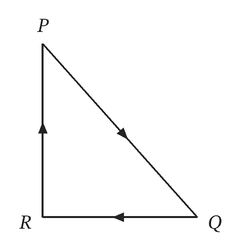
A particle moving with velocity is acted by three forces shown by the vector triangle as shown in figure. The velocity of the particle will
- 1241 mark
Question 124
The trajectory of a projectile in a vertical plane is , where and are constants and and are respectively the horizontal and vertical distances of the projectile from the point of projection. The angle of projection and the maximum height attained are respectively given by
- 1251 mark
Question 125
What will be the projection of vector on vector ?
- 1261 mark
Question 126
If , then the angle between and is
- 1271 mark
Question 127
The ranges and heights for two projectiles projected with the same initial velocity at angles and with the horizontal are , and , respectively. Choose the correct option.
- 1281 mark
Question 128
A player kicks a football with an initial speed of at an angle of from the ground. What are the maximum height and the time taken by the football to reach at the highest point during motion (take )?
- 1291 mark
Question 129
A car starts from rest and accelerates at . At s, a ball is dropped out of a window by a person sitting in the car. What is the velocity and acceleration of the ball at s (take )?
- 1301 mark
Question 130
The maximum vertical height to which a man can throw a ball is 136 m. The maximum horizontal distance upto which he can throw the same ball is
- 1311 mark
Question 131
is a vector quantity such that = a non-zero constant. Which of the following expression is true for ?
- 1321 mark
Question 132
Two vectors and have equal magnitudes. If magnitude of is equal to two times the magnitude of , then the angle between and will be
- 1331 mark
Question 133
If two vectors and are perpendicular to each other, then the value of will be
- 1341 mark
Question 134
Assertion: For an observer looking out through the window of a fast-moving train, the nearby objects appear to move in the opposite direction to the train, while the distant objects appear to be stationary.
Reason: If the observer and object are moving at velocities and respectively with reference to a laboratory frame, the velocity of the object with respect to the observer is .
- 1351 mark
Question 135
Assertion: When a body is dropped or thrown horizontally from the same height, it would reach the ground at the same time.
Reason: Horizontal velocity has no effect on the vertical motion.
- 1361 mark
Question 136
Assertion: If dot product and cross product of and are zero, it implies that one of the vector and must be a null vector.
Reason: A null vector is a vector of zero magnitude.
- 1371 mark
Question 137
If and , then the unit vector in the direction of is . The value of is ______.
- 1381 mark
Question 138
If the initial velocity in the horizontal direction of a projectile is unit vector and the equation of trajectory is . The component vector of initial velocity is ______ (Take ).
- 1391 mark
Question 139
An object is projected in the air with initial velocity at an angle. The projectile motion is such that the horizontal range is maximum. Another object is projected in the air with a horizontal range half of the range of the first object. The initial velocity remains the same in both cases. The value of the angle of projection at which the second object is projected will be ______ degree. (Mark the smallest angle possible.)
- 1401 mark
Question 140
Vectors and are perpendicular to each other when , the ratio of to is . The value of is ______.