
Opening your dashboard
Class 11 Maths Chapter 6 Complex Numbers: Practice Questions
50 questions on Chapter 6, each worked through on its own page with the AI tutor. Class 11 Maths, ICSE 2026-27.
50 questions
1–4 marks · Mixed difficulty
- 11 mark
Question 1
The value of the product is
- 21 mark
Question 2
The value of is
- 33 marks
Question 3
For a positive integer , find the value of when is of the form (a) , (b) , (c) , (d) , where is a whole number. Hence write down the value of .
- 42 marks
Question 4
A student writes the following "proof":
and concludes that . Identify the incorrect step and explain why it is wrong. What is the correct value of ?
- 51 mark
Question 5
The value of is
- 63 marks
Question 6
Let , where is a positive integer.
Show that when is even and when is odd. Hence find the value of .
- 71 mark
Question 7
The point representing a complex number lies in the second quadrant of the Argand plane. The point representing lies in the
- 83 marks
Question 8
The points , , in the Argand plane represent the complex numbers , and respectively. Show that triangle is right-angled and isosceles, and find its area.
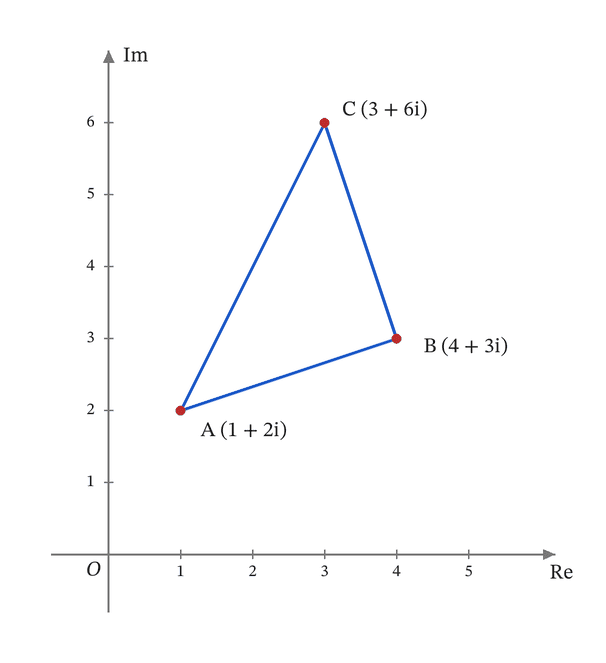
- 93 marks
Question 9
Three vertices of a parallelogram , taken in order, are represented in the Argand plane by the complex numbers , and respectively. Find the complex number representing the fourth vertex , and the complex number representing the point where the diagonals meet.
- 101 mark
Question 10
The distance between the points representing and in the Argand plane is
- 114 marks
Question 11
The point represents in the Argand plane. Find the complex number representing the image of after reflection in
(a) the real axis,
(b) the imaginary axis,
(c) the origin,
(d) the line .
In each case, also express the image in terms of or .
- 121 mark
Question 12
If and are non-zero real numbers, then is always
- 133 marks
Question 13
Find two complex numbers whose sum is and whose product is . Explain why no two real numbers have this sum and product.
- 141 mark
Question 14
Complex numbers and satisfy and . Then the product is
- 153 marks
Question 15
Find the real values of for which is a real number. For each such , find that real number.
- 163 marks
Question 16
Show that . Hence find the value of .
- 173 marks
Question 17
Solve for the complex number :
Give your answer in the form and check it.
- 184 marks
Question 18
Find the real and imaginary parts of , where is real and not an integer multiple of . Express the imaginary part in terms of .
- 191 mark
Question 19
Which of the following statements about complex numbers is correct?
- 201 mark
Question 20
If is a complex number with , then is always equal to
- 213 marks
Question 21
Find the complex number which satisfies . Also find .
- 221 mark
Question 22
If , then the greatest value of is
- 234 marks
Question 23
For any two complex numbers and , prove that
Verify the result for and , and state what it means for a parallelogram in the Argand plane.
- 241 mark
Question 24
If and are real numbers, not both zero, then is equal to
- 253 marks
Question 25
Find all complex numbers such that and the real part of exceeds its imaginary part by .
- 261 mark
Question 26
The complex number has principal argument
- 274 marks
Question 27
Let and .
(i) Using the rules for the modulus and argument of a product and a quotient, find and in polar form, and hence in the form .
(ii) Check your value of by first writing and in the form and multiplying.
- 281 mark
Question 28
If is a non-zero complex number with , then the principal argument of is
- 294 marks
Question 29
A complex number has modulus and principal argument .
(i) Write in the form .
(ii) Find the modulus and principal argument of .
(iii) Find the modulus and principal argument of .
- 301 mark
Question 30
The principal argument of the complex number is
- 313 marks
Question 31
Find the locus of the point in the Argand plane for which , where . Describe the locus in words.
- 321 mark
Question 32
If and , then the principal argument of is
- 334 marks
Question 33
Let . Find the modulus and principal argument of , and write in polar form, when
(i) ;
(ii) .
- 344 marks
Question 34
In the Argand plane, is the origin and the point represents . is a square whose vertices are taken in the anticlockwise order.
(i) Using multiplication by , find the complex numbers represented by and .
(ii) Find the modulus and principal argument of the complex number represented by .
- 351 mark
Question 35
The square roots of are
- 363 marks
Question 36
Find the square roots of .
- 374 marks
Question 37
Solve the quadratic equation over the complex numbers.
- 381 mark
Question 38
If , where and are real and , is a square root of , then equals
- 393 marks
Question 39
Find the square roots of in the form , and then write each square root in polar form.
- 401 mark
Question 40
The modulus of each square root of is
- 414 marks
Question 41
Find all the complex numbers such that .
- 421 mark
Question 42
Which of the following is a square root of ?
- 433 marks
Question 43
Let be a complex cube root of unity.
(i) Show that .
(ii) Find in the form .
- 443 marks
Question 44
Let be a complex cube root of unity.
(i) By expanding, find the value of .
(ii) Using the factorisation , find the value of .
- 451 mark
Question 45
If is a complex cube root of unity, the quadratic equation whose roots are and is
- 464 marks
Question 46
Using the complex cube roots of unity, find the remainder when is divided by .
- 471 mark
Question 47
If , then the principal argument of is
- 483 marks
Question 48
If , find the value of in the form .
- 491 mark
Question 49
If is a complex cube root of unity, the least positive integer for which is
- 504 marks
Question 50
Find all the complex numbers which satisfy , and show that the non-zero ones are exactly the cube roots of unity.