Confirming your payment

Skip to content

Sign up now and get .

Opening your dashboard

Class 11 Maths Chapter 4 Trigonometric Functions: Practice Questions

49 questions on Chapter 4, each worked through on its own page with the AI tutor. Class 11 Maths, ICSE 2026-27.

49 questions

1–4 marks · Mixed difficulty

  1. 1

    Question 1

    If 7sin⁡2θ+3cos⁡2θ=47\sin^2\theta + 3\cos^2\theta = 4 and 0<θ<π20 < \theta < \dfrac{\pi}{2}, then tan⁡θ\tan\theta is equal to

    MCQEasy
    1 mark
  2. 2

    Question 2

    If x=3sec⁡θx = 3\sec\theta and y=4tan⁡θy = 4\tan\theta, then the relation between xx and yy, free of θ\theta, is

    MCQEasy
    1 mark
  3. 3

    Question 3

    If θ\theta lies in the second quadrant, then tan⁡θ\tan\theta expressed in terms of sin⁡θ\sin\theta is

    MCQMedium
    1 mark
  4. 4

    Question 4

    If cos⁡θ=1−t21+t2\cos\theta = \dfrac{1 - t^2}{1 + t^2}, where 0<t<10 < t < 1 and θ\theta is acute, find sin⁡θ\sin\theta and tan⁡θ\tan\theta in terms of tt.

    Medium
    2 marks
  5. 5

    Question 5

    Prove that (sin⁡θ+cosec⁡θ)2+(cos⁡θ+sec⁡θ)2=7+tan⁡2θ+cot⁡2θ(\sin\theta + \operatorname{cosec}\theta)^2 + (\cos\theta + \sec\theta)^2 = 7 + \tan^2\theta + \cot^2\theta.

    Medium
    3 marks
  6. 6

    Question 6

    Prove that (1+cot⁡θ−cosec⁡θ)(1+tan⁡θ+sec⁡θ)=2(1 + \cot\theta - \operatorname{cosec}\theta)(1 + \tan\theta + \sec\theta) = 2.

    Medium
    3 marks
  7. 7

    Question 7

    Prove that sec⁡6θ−tan⁡6θ=1+3tan⁡2θsec⁡2θ\sec^6\theta - \tan^6\theta = 1 + 3\tan^2\theta\sec^2\theta.

    Medium
    3 marks
  8. 8

    Question 8

    Prove that sin⁡θ−2sin⁡3θ2cos⁡3θ−cos⁡θ=tan⁡θ\dfrac{\sin\theta - 2\sin^3\theta}{2\cos^3\theta - \cos\theta} = \tan\theta.

    Medium
    3 marks
  9. 9

    Question 9

    Prove that (sec⁡A−cosec⁡A)(1+tan⁡A+cot⁡A)=tan⁡Asec⁡A−cot⁡Acosec⁡A(\sec A - \operatorname{cosec} A)(1 + \tan A + \cot A) = \tan A\sec A - \cot A\operatorname{cosec} A.

    Medium
    3 marks
  10. 10

    Question 10

    If sec⁡θ=x+14x\sec\theta = x + \dfrac{1}{4x}, where x≠0x \ne 0, prove that sec⁡θ+tan⁡θ=2x\sec\theta + \tan\theta = 2x or 12x\dfrac{1}{2x}.

    Medium
    3 marks
  11. 11

    Question 11

    Find all values of θ\theta with 0≤θ≤π20 \le \theta \le \dfrac{\pi}{2} that satisfy 2cos⁡2θ+3sin⁡θ=32\cos^2\theta + 3\sin\theta = 3.

    Medium
    3 marks
  12. 12

    Question 12

    If xsin⁡3θ+ycos⁡3θ=sin⁡θcos⁡θx\sin^3\theta + y\cos^3\theta = \sin\theta\cos\theta and xsin⁡θ=ycos⁡θx\sin\theta = y\cos\theta, where sin⁡θcos⁡θ≠0\sin\theta\cos\theta \ne 0, prove that x2+y2=1x^2 + y^2 = 1.

    Medium
    4 marks
  13. 13

    Question 13

    The terminal side of an angle θ\theta in standard position passes through the point P(−8,15)P(-8, 15). The value of sec⁡θ+tan⁡θ\sec\theta + \tan\theta is

    MCQEasy
    1 mark
  14. 14

    Question 14

    The angles below are in radians. Which of the following is positive?

    MCQEasy
    1 mark
  15. 15

    Question 15

    The equation 1+cot⁡2θ=−cosec⁡θ\sqrt{1 + \cot^2\theta} = -\operatorname{cosec}\theta is true exactly when θ\theta lies in the

    MCQMedium
    1 mark
  16. 16

    Question 16

    Which of the following is defined at θ=3π2\theta = \dfrac{3\pi}{2}?

    MCQEasy
    1 mark
  17. 17

    Question 17

    The domain of the function f(x)=11−sin⁡xf(x) = \dfrac{1}{1 - \sin x} is (nn is an integer)

    MCQEasy
    1 mark
  18. 18

    Question 18

    The equation sec⁡θ=2a−1\sec\theta = 2a - 1 has a solution θ\theta if and only if

    MCQMedium
    1 mark
  19. 19

    Question 19

    The range of f(x)=12+sin⁡xf(x) = \dfrac{1}{2 + \sin x}, x∈Rx \in R, is

    MCQEasy
    1 mark
  20. 20

    Question 20

    The set of all values of cos⁡2θ−3cos⁡θ\cos^2\theta - 3\cos\theta, as θ\theta varies over RR, is

    MCQMedium
    1 mark
  21. 21

    Question 21

    The terminal side of an angle θ\theta in standard position lies along the ray y=2xy = 2x, x<0x < 0. Find the values of all six trigonometric functions of θ\theta.

    Medium
    3 marks
  22. 22

    Question 22

    Find the domain of f(x)=sin⁡xf(x) = \sqrt{\sin x}

    (i) for xx in the interval [0,2π)[0, 2\pi),

    (ii) as a subset of RR.

    Medium
    2 marks
  23. 23

    Question 23

    Find the range of f(θ)=sin⁡2θ+cos⁡4θf(\theta) = \sin^2\theta + \cos^4\theta, θ∈R\theta \in R.

    Medium
    3 marks
  24. 24

    Question 24

    Find the domain of g(x)=1sec⁡x−1g(x) = \dfrac{1}{\sec x - 1}.

    Medium
    3 marks
  25. 25

    Question 25

    Which of the following is equal to cos⁡20∘\cos 20^\circ?

    MCQEasy
    1 mark
  26. 26

    Question 26

    Which of the following is not equal to sin⁡θ\sin\theta for every value of θ\theta?

    MCQEasy
    1 mark
  27. 27

    Question 27

    If sin⁡θ=−12\sin\theta = -\dfrac{1}{2}, tan⁡θ=13\tan\theta = \dfrac{1}{\sqrt{3}} and 0∘<θ<360∘0^\circ < \theta < 360^\circ, then θ\theta is

    MCQEasy
    1 mark
  28. 28

    Question 28

    If sin⁡130∘=x\sin 130^\circ = x, express each of the following in terms of xx:

    (i) cos⁡220∘\cos 220^\circ

    (ii) tan⁡310∘\tan 310^\circ

    (iii) sin⁡400∘\sin 400^\circ

    Medium
    3 marks
  29. 29

    Question 29

    Prove that sin⁡{nπ+(−1)nθ}=sin⁡θ\sin\left\{n\pi + (-1)^n\theta\right\} = \sin\theta for every integer nn. Hence find the value of sin⁡17π6\sin\dfrac{17\pi}{6}.

    Medium
    3 marks
  30. 30

    Question 30

    A point PP starts at A(1,0)A(1, 0) and moves on the circle x2+y2=1x^2 + y^2 = 1 (centre OO), so that ∠AOP=θ\angle AOP = \theta, measured anticlockwise (a clockwise turn is negative). Find the coordinates of PP when

    (i) θ=2025∘\theta = 2025^\circ

    (ii) θ=−2025∘\theta = -2025^\circ

    (iii) Find the distance between these two positions of PP.

    Class 11 Maths Trigonometric Functions

    Medium
    3 marks
  31. 31

    Question 31

    Show that cos⁡x+cos⁡(x+π2)+cos⁡(x+π)+cos⁡(x+3π2)=0\cos x + \cos\left(x + \dfrac{\pi}{2}\right) + \cos(x + \pi) + \cos\left(x + \dfrac{3\pi}{2}\right) = 0 for every real xx.

    Easy
    2 marks
  32. 32

    Question 32

    An angle of 55 radians is not a standard angle. Taking π≈3.14\pi \approx 3.14,

    (i) find the quadrant in which an angle of 55 radians lies;

    (ii) express sin⁡5\sin 5, cos⁡5\cos 5 and tan⁡5\tan 5 as tt-ratios of the acute angle (2π−5)(2\pi - 5), with the correct signs.

    Medium
    2 marks
  33. 33

    Question 33

    For k=0,1,2,…,11k = 0, 1, 2, \ldots, 11, the point PkP_k on the circle x2+y2=1x^2 + y^2 = 1 is Pk=(cos⁡kπ6, sin⁡kπ6)P_k = \left(\cos\dfrac{k\pi}{6},\ \sin\dfrac{k\pi}{6}\right).

    (i) Write the coordinates of P1P_1, P5P_5 and P9P_9.

    (ii) Show that triangle P1P5P9P_1P_5P_9 is equilateral and find its area.

    Medium
    3 marks
  34. 34

    Question 34

    The period of f(x)=∣sin⁡x∣f(x) = |\sin x| is

    MCQEasy
    1 mark
  35. 35

    Question 35

    The period of f(x)=sin⁡πx3f(x) = \sin\dfrac{\pi x}{3} is

    MCQEasy
    1 mark
  36. 36

    Question 36

    Let f(x)=sin⁡x2+cos⁡x3f(x) = \sin\dfrac{x}{2} + \cos\dfrac{x}{3}.

    (i) Find the periods of sin⁡x2\sin\dfrac{x}{2} and cos⁡x3\cos\dfrac{x}{3}.

    (ii) Show that 12π12\pi is a period of ff.

    (iii) Show that neither 4π4\pi nor 6π6\pi is a period of ff.

    Medium
    4 marks
  37. 37

    Question 37

    In which of the following intervals are both sin⁡x\sin x and cos⁡x\cos x decreasing?

    MCQEasy
    1 mark
  38. 38

    Question 38

    Which of the following is the correct ascending order?

    MCQMedium
    1 mark
  39. 39

    Question 39

    (i) Explain why tan⁡x\tan x is increasing on the interval (−π2,π2)\left(-\dfrac{\pi}{2}, \dfrac{\pi}{2}\right).

    (ii) Show by an example that tan⁡x\tan x is not increasing on the interval (0,π)(0, \pi), x≠π2x \ne \dfrac{\pi}{2}.

    Medium
    3 marks
  40. 40

    Question 40

    Show that the period of f(x)=∣sin⁡x∣+∣cos⁡x∣f(x) = |\sin x| + |\cos x| is π2\dfrac{\pi}{2}.

    Medium
    3 marks
  41. 41

    Question 41

    Without using tables or a calculator, decide which is greater in each pair (the angles are in radians; take π≈3.14\pi \approx 3.14):

    (i) sin⁡1\sin 1 or sin⁡3\sin 3

    (ii) cos⁡2\cos 2 or cos⁡4\cos 4

    (iii) sin⁡1\sin 1 or cos⁡1\cos 1

    Medium
    3 marks
  42. 42

    Question 42

    The graph of y=cos⁡xy = \cos x can be obtained from the graph of y=sin⁡xy = \sin x by

    MCQEasy
    1 mark
  43. 43

    Question 43

    Draw the graph of y=∣cos⁡x∣y = |\cos x| for 0≤x≤2π0 \le x \le 2\pi, taking xx at intervals of π6\dfrac{\pi}{6}. From your graph, state

    (i) the range of yy,

    (ii) the period of ∣cos⁡x∣|\cos x|,

    (iii) the values of xx in [0,2π][0, 2\pi] at which the graph touches the xx-axis.

    Medium
    3 marks
  44. 44

    Question 44

    By drawing the graphs of y=cos⁡xy = \cos x and y=xπy = \dfrac{x}{\pi} on the same axes, find the number of real solutions of the equation πcos⁡x=x\pi\cos x = x. Verify that x=−πx = -\pi is one of them.

    Medium
    3 marks
  45. 45

    Question 45

    Draw the graphs of y=sin⁡xy = \sin x and y=cos⁡xy = \cos x on the same axes for 0≤x≤2π0 \le x \le 2\pi. Use them to find

    (i) the xx-coordinates of the points where the two graphs meet,

    (ii) the interval in which sin⁡x>cos⁡x\sin x > \cos x.

    Medium
    3 marks
  46. 46

    Question 46

    Which of the following statements about the graph of y=sec⁡xy = \sec x is false?

    MCQEasy
    1 mark
  47. 47

    Question 47

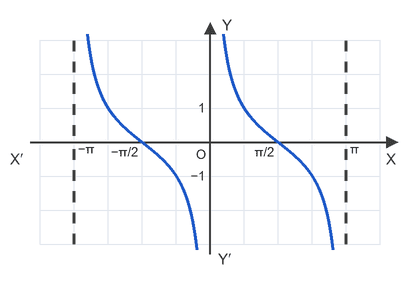
    The figure shows the graph of a function on −π<x<π-\pi < x < \pi, x≠0x \ne 0. The dashed lines and the yy-axis are its asymptotes.

    Class 11 Maths Trigonometric Functions

    The function is

    MCQEasy
    1 mark
  48. 48

    Question 48

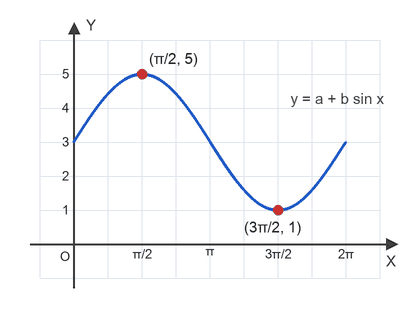
    The figure shows the graph of y=a+bsin⁡xy = a + b\sin x for 0≤x≤2π0 \le x \le 2\pi, where aa and bb are constants. Its highest point is (π2,5)\left(\dfrac{\pi}{2}, 5\right) and its lowest point is (3π2,1)\left(\dfrac{3\pi}{2}, 1\right).

    Class 11 Maths Trigonometric Functions

    (i) Find aa and bb.

    (ii) Find yy when x=7π6x = \dfrac{7\pi}{6}.

    (iii) Find the values of xx in [0,2π][0, 2\pi] at which y=3y = 3.

    Medium
    3 marks
  49. 49

    Question 49

    Draw the graph of y=cosec⁡xy = \operatorname{cosec} x for 0<x<2π0 < x < 2\pi, x≠πx \ne \pi. From the graph,

    (i) write the range of cosec⁡x\operatorname{cosec} x;

    (ii) state the intervals in which cosec⁡x\operatorname{cosec} x is increasing;

    (iii) find the number of solutions of cosec⁡x=2\operatorname{cosec} x = 2 in (0,2π)(0, 2\pi), and the solutions.

    Medium
    4 marks