
Opening your dashboard
Class 11 Chemistry Chapter 9 Redox Reactions: Practice Questions
88 questions on Chapter 9, each worked through on its own page with the AI tutor. Class 11 Chemistry, ICSE 2026-27.
88 questions
1–4 marks · Mixed difficulty
- 11 mark
Question 1
According to the classical concept, in which of the following reactions is the first reactant oxidised by the removal of hydrogen?
- 22 marks
Question 2
When iron filings are stirred into a yellow-brown solution of iron(III) chloride, the solution turns pale green as iron(II) chloride forms:
Using the classical concept, state which substance is oxidised and which is reduced, giving the criterion used in each case.
- 33 marks
Question 3
Classify each change below as oxidation or reduction of the carbon compound, according to the classical concept, and name the criterion you used.
(a) Methanol vapour is passed over heated copper:
(b) Methanal slowly takes up oxygen from the air:
(c) An oil is hardened with hydrogen over a nickel catalyst:
- 41 mark
Question 4
Judged by the classical concept, which one of these changes is a reduction of the substance written first?
- 53 marks
Question 5
Dry ammonia gas passed over heated black copper(II) oxide leaves reddish-brown copper, while nitrogen and water vapour come off:
(a) Using the classical concept, name the substance oxidised and give the criterion.
(b) Name the substance reduced and give the criterion.
(c) Use this reaction to explain why oxidation and reduction always take place together.
- 61 mark
Question 6
Which of the following half-reactions is balanced in both atoms and charge, and also represents a reduction?
- 72 marks
Question 7
Cerium(IV) ions oxidise iron(II) ions in acidic solution. The ionic equation is
(a) Explain why the classical concept cannot be used to classify this ionic reaction.
(b) Using the electronic concept, write the oxidation half-reaction and the reduction half-reaction.
- 83 marks
Question 8
A solution of chromium(II) ions in dilute acid is quickly oxidised by oxygen from the air. The two half-reactions are
(a) State which half-reaction is the oxidation and which is the reduction, with a reason.
(b) Combine the two half-reactions into one balanced ionic equation.
(c) Show that your equation is balanced in charge.
- 91 mark
Question 9
Magnesium burns in nitrogen to form magnesium nitride, , which is made of and ions. How many electrons are transferred for each molecule that reacts, and in which direction?
- 103 marks
Question 10
Sodium heated in hydrogen forms the white ionic solid sodium hydride:
(a) Show that the classical concept leads to a contradiction when it is used to decide what is oxidised and what is reduced here.
(b) Sodium hydride contains and ions. Use the electronic concept to identify the substance oxidised and the substance reduced, with half-reactions.
(c) When molten sodium hydride is electrolysed, hydrogen gas is given off at the anode. Explain how this supports your answer to (b).
- 114 marks
Question 11
A clean copper wire is dipped into silver nitrate solution. (Hypothetical data.) Shiny silver crystals grow on the wire, and the solution turns blue as 0.635 g of copper dissolves. [Cu = 63.5, Ag = 108, ]
(a) Write the oxidation and reduction half-reactions.
(b) Calculate the amount (in mol) of electrons transferred.
(c) Calculate the number of electrons transferred.
(d) Calculate the mass of silver deposited.
- 121 mark
Question 12
Charcoal heated with concentrated sulphuric acid gives carbon dioxide and sulphur dioxide:
Which statement correctly identifies the oxidising agent?
- 133 marks
Question 13
Iodine shows oxidation numbers from −1 to +7 in its compounds. On the basis of oxidation numbers, state whether each of the following can act only as an oxidising agent, only as a reducing agent, or as both. Give a reason in each case.
(a) Potassium iodide, KI
(b) Iodine,
(c) Potassium periodate,
- 142 marks
Question 14
With one balanced ionic equation for each, show that iron(II) ions, , act as a reducing agent towards chlorine but as an oxidising agent towards zinc.
- 151 mark
Question 15
Copper dissolves in dilute nitric acid:
What fraction of the nitric acid molecules that react act as the oxidising agent?
- 163 marks
Question 16
Sodium sulphite is used to remove leftover chlorine from treated water before it is discharged:
A tank of water contains 1.00 g of dissolved chlorine. (Hypothetical data.) [Na = 23, S = 32, O = 16, Cl = 35.5]
(a) Identify the oxidising agent and the reducing agent, showing the change in oxidation number of the element concerned in each.
(b) How many electrons does one sulphite ion give up?
(c) Calculate the minimum mass of sodium sulphite needed to remove all the chlorine.
- 171 mark
Question 17
Sulphur dioxide gas decolourises a brown solution of iodine:
Consider the following statements.
P. Iodine is the oxidising agent.
Q. Sulphur dioxide is reduced.
R. Each sulphur atom loses two electrons.
S. Water acts as the reducing agent.
Which of the statements are correct?
- 181 mark
Question 18
Tetrasodium pyrophosphate, , is used as a food additive and in detergents. What is the oxidation number of phosphorus in it?
- 193 marks
Question 19
Calculate the oxidation number of the element named in each species.
(a) Manganese in
(b) Sulphur in thionyl chloride,
(c) Nitrogen in the nitronium ion,
- 203 marks
Question 20
Ethanol, , contains two carbon atoms in different surroundings.
(a) Calculate the average oxidation number of carbon from the molecular formula .
(b) Find the oxidation number of each carbon atom separately. Use the rule that, for a carbon atom, each bond to hydrogen counts −1, each bond to a more electronegative atom (here oxygen) counts +1, and a C–C bond counts 0.
(c) Explain why the answers to (a) and (b) are different.
- 211 mark
Question 21
What is the oxidation number of cobalt in the complex compound , in which is a neutral ligand?
- 223 marks
Question 22
Tin is extracted by heating its ore, cassiterite (), with carbon:
(a) Write the oxidation number of every element on both sides of the equation.
(b) Using these values, identify the element oxidised and the element reduced.
(c) Find the number of electrons gained by one tin atom, and show that it equals the number lost by the two carbon atoms.
- 231 mark
Question 23
Xenon forms the colourless liquid oxyfluoride . What is the oxidation number of xenon in this compound?
- 244 marks
Question 24
Two oxides of chromium, X and Y, contain 68.4 % and 52.0 % chromium by mass respectively. [Cr = 52, O = 16]
(a) Find the empirical formula of oxide X.
(b) Find the oxidation number of chromium in X.
(c) Find the empirical formula of oxide Y and the oxidation number of chromium in it.
(d) Which of the two oxides would you expect to act as an oxidising agent? Give a reason based on oxidation numbers.
- 254 marks
Question 25
In the manufacture of nitric acid, nitrogen passes through the sequence
(a) Find the oxidation number of nitrogen in each of the four species.
(b) State whether nitrogen is oxidised or reduced in each of the first two steps.
(c) The last step is
State what happens to the oxidation number of the nitrogen atoms in this step.
(d) Find the total number of electrons lost by one nitrogen atom when it is converted from into .
- 261 mark
Question 26
A comproportionation reaction is the reverse of disproportionation: two species that contain the same element in different oxidation states react to give that element in one intermediate oxidation state. Which of the following is a comproportionation reaction?
- 274 marks
Question 27
Classify each redox reaction below as a combination, decomposition, displacement or disproportionation reaction. In each case, state which element is oxidised and which is reduced, with the change in its oxidation number.
(a) Sulphur dioxide combines with oxygen in the contact process:
(b) Silver oxide is heated strongly:
(c) Burning magnesium continues to burn in carbon dioxide:
(d) White phosphorus is warmed with sodium hydroxide solution:
- 281 mark
Question 28
Early car air bags were inflated by nitrogen from the very fast decomposition of sodium azide:
Which statement about this reaction is correct?
- 291 mark
Question 29
When phosphorous acid, , is heated strongly, it gives phosphoric acid and phosphine:
Which description of this reaction is correct?
- 302 marks
Question 30
Chlorine dioxide, , a yellow gas used to bleach wood pulp, reacts with sodium hydroxide solution:
(a) Find the oxidation number of chlorine in each chlorine-containing species.
(b) Name the type of redox reaction and explain your choice.
- 313 marks
Question 31
Sodium reacts vigorously with cold water, magnesium reacts with hot water or steam, and iron reacts only when steam is passed over the red-hot metal:
(a) Explain why all three reactions are classified as hydrogen-displacement redox reactions.
(b) For the reaction of iron, find the change in oxidation number of iron and of hydrogen, and show that the electrons lost equal the electrons gained.
(c) What do the different conditions tell us about the reducing power of the three metals?
- 322 marks
Question 32
The reaction
can be carried out either as a direct redox reaction or as an indirect redox reaction.
(a) Explain the difference between the two ways of carrying it out.
(b) State the main form in which the energy released appears in each case.
- 331 mark
Question 33
Fluorine reacts with water, the main reaction being
Which statement about this reaction is correct?
- 341 mark
Question 34
Which half-equation correctly shows the reduction of nitrate ions to ammonia in an alkaline (basic) solution?
- 353 marks
Question 35
In faintly alkaline solution, potassium permanganate oxidises iodide ions to iodate ions and is itself reduced to manganese dioxide. Balance the ionic equation by the ion-electron (half-reaction) method:
- 361 mark
Question 36
In acidic solution, dichromate ions oxidise nitrite ions, , to nitrate ions and are themselves reduced to chromium(III) ions. How many moles of nitrite ions are oxidised by one mole of dichromate ions?
- 373 marks
Question 37
White phosphorus is oxidised by hot concentrated nitric acid to phosphoric acid, and brown nitrogen dioxide is given off. Balance the equation by the oxidation number method:
- 384 marks
Question 38
Some older breath-alcohol tubes contained silica gel coated with potassium dichromate and sulphuric acid. Ethanol in the breath is oxidised to ethanoic acid, while orange dichromate ions are reduced to green chromium(III) ions.
(a) Write the balanced oxidation half-reaction for ethanol, , changing to ethanoic acid, , in acidic solution.
(b) Write the balanced reduction half-reaction for dichromate ions in acidic solution.
(c) Combine the two half-reactions into the balanced ionic equation.
(d) Name the oxidising agent and explain how the tube shows that ethanol was present.
- 391 mark
Question 39
In acidic solution, hydroxylamine, , reduces iron(III) ions to iron(II) ions and is itself oxidised to dinitrogen oxide, . A 25.0 mL sample of 0.0400 M hydroxylamine solution is warmed with an excess of acidified iron(III) sulphate. (Hypothetical data.) How many moles of iron(II) ions are formed?
- 404 marks
Question 40
Hydrazine, , is made industrially by oxidising ammonia with sodium hypochlorite in alkaline solution:
(a) Find the change in oxidation number of nitrogen and of chlorine.
(b) Write the balanced oxidation half-reaction in basic solution.
(c) Write the balanced reduction half-reaction in basic solution.
(d) Add the half-reactions to obtain the balanced ionic equation, and check it.
- 413 marks
Question 41
A student balanced the reaction of acidified potassium permanganate with tin(II) ions as
(a) Show that the atoms in the student's equation are balanced but the charges are not.
(b) Write the correctly balanced equation, using the electrons lost and gained.
- 423 marks
Question 42
Nitrous acid is unstable and slowly disproportionates in solution into nitric acid and nitrogen monoxide. Balance the reaction by the ion-electron method in acidic solution, writing nitric acid in its ionised form:
- 431 mark
Question 43
A student sets up the cell shown below, with a nickel half-cell and a silver half-cell.

Potassium nitrate solution, rather than potassium chloride solution, is used to fill the salt bridge of this cell. Why?
- 444 marks
Question 44
The figure shows a cell made from a zinc half-cell and an iron half-cell. The standard reduction potentials are V and V.
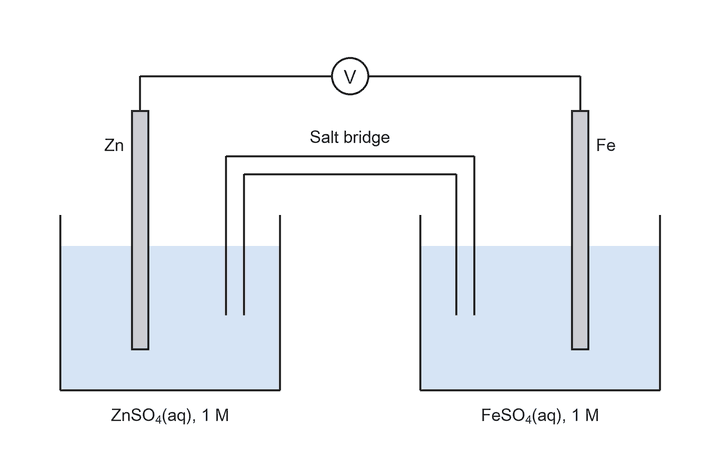
(a) Which rod is the anode? Give a reason, even though both potentials are negative.
(b) Write the half-reaction at each electrode and the overall cell reaction.
(c) Write the cell in standard notation and calculate .
(d) State the direction in which electrons flow in the wire and the direction in which anions move in the salt bridge.
- 451 mark
Question 45
Unwanted copper on printed circuit boards is often dissolved away with iron(III) chloride solution. The standard reduction potentials are V, V and V. Which statement correctly explains this etching?
- 463 marks
Question 46
The figure shows how the standard electrode potential of a metal X is measured. (Hypothetical data.) With X dipping in 1 M solution, the voltmeter reads 0.40 V and X is the negative terminal. In a second experiment, a metal Y dipping in 1 M solution is connected in the same way; the voltmeter reads 0.34 V and Y is the positive terminal.
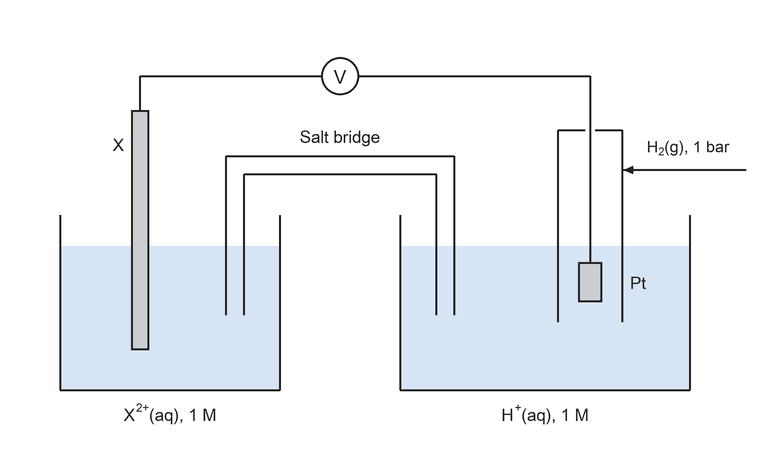
(a) Find and .
(b) A cell is now made from the X and Y half-cells. Which metal is the anode? Write the cell reaction.
(c) Calculate for this cell.
- 471 mark
Question 47
For the cell , the standard reduction potentials are V and V. What is for the cell reaction ? (F = 96500 C mol⁻¹)
- 483 marks
Question 48
The standard reduction potentials of three alkali metals are V, V and V.
(a) Arrange the three metals in order of decreasing reducing power in aqueous solution.
(b) Lithium has the highest ionisation enthalpy of the three, yet it is the strongest reducing agent in water. Explain why.
- 491 mark
Question 49
Which cell notation represents a galvanic cell in which the reaction takes place?
- 504 marks
Question 50
A cell is set up as , with V and V. The cell supplies current until the lead electrode has lost 2.07 g. (Hypothetical data.) [Pb = 207, Ag = 108, F = 96500 C mol⁻¹]
(a) Name the anode and write the half-reaction at each electrode.
(b) Write the cell reaction and calculate .
(c) Calculate the charge that passed through the external circuit.
(d) Calculate the mass of silver deposited on the silver electrode.
- 511 mark
Question 51
Given:
The values of , and in the above redox reaction are respectively:
- 521 mark
Question 52
Oxidation state of sulphur in anions , and increases in the order:
- 531 mark
Question 53
Which one of the following cannot function as an oxidising agent?
- 541 mark
Question 54
Copper becomes green when exposed to moist air for a long period. This is due to:
- 551 mark
Question 55
Amongst the following, identify the species with an atom in +6 oxidation state:
- 561 mark
Question 56
How many electrons are involved in the following redox reaction?
(Unbalanced)
- 571 mark
Question 57
Consider the reaction:
Which of the following statements is correct?
- 581 mark
Question 58
In which of the following reactions, hydrogen peroxide acts as an oxidizing agent?
- 591 mark
Question 59
The oxidation states of Cr in , , and respectively are:
- 601 mark
Question 60
An example of a disproportionation reaction is:
- 611 mark
Question 61
In order to oxidise a mixture of one mole of each of , , and in acidic medium, the number of moles of required is:
- 621 mark
Question 62
Given:
; V
; V
; V
; V
Oxidizing power of the species will increase in the order:
- 631 mark
Question 63
Given that V;
V;
V;
V
The strongest oxidising agent is:
- 641 mark
Question 64
Consider the following reduction processes:
; V
; V
; V
; V
The reducing power of the metals increases in the order:
- 651 mark
Question 65
In the reaction of oxalate with permanganate in acidic medium, the number of electrons involved in producing one molecule of is:
- 661 mark
Question 66
The compound that cannot act both as oxidising and reducing agent is:
- 671 mark
Question 67
The redox reaction among the followings is:
- 681 mark
Question 68
The oxidation states of iron atoms in compounds (A), (B) and (C), respectively, are , and . The sum of , and is ________.
(A)
(B)
(C)
- 691 mark
Question 69
The oxidation states of transition metal atoms in , and , respectively, are , and . The sum of , and is ________.
- 701 mark
Question 70
Oxidation number of potassium in , and , respectively, is:
- 711 mark
Question 71
Consider the following equations:
The sum of the stoichiometric coefficients , , , and for products A, B, C, D and E, respectively, is ________.
- 721 mark
Question 72
The species given below that does NOT show disproportionation reaction is:
- 731 mark
Question 73
If the above equation is balanced with integer coefficients, the value of is ________.
- 741 mark
Question 74
The reaction of sulphur in alkaline medium is given below:
The values of '' is ________. (Integer answer)
- 751 mark
Question 75
These are physical properties of an element
(A) Sublimation enthalpy
(B) Ionisation enthalpy
(C) Hydration enthalpy
(D) Electron gain enthalpy
The total number of above properties that affect the reduction potential is ________. (Integer answer)
- 761 mark
Question 76
Which of the given reactions is not an example of disproportionation reaction?
- 771 mark
Question 77
Which one of the following is an example of disproportionation reaction?
- 781 mark
Question 78
Which of the following reactions is the metal displacement reaction? Choose the right option.
- 791 mark
Question 79
A mixture of potassium chlorate, oxalic acid and sulphuric acid is heated. During the reaction which element undergoes maximum change in the oxidation number?
- 801 mark
Question 80
When gas reacts with hot and concentrated sodium hydroxide solution, the oxidation number of chlorine changes from:
- 811 mark
Question 81
Standard reduction potentials of the half reactions are given below:
; E° = +2.85 V
; E° = +1.36 V
; E° = +1.06 V
; E° = +0.53 V
The strongest oxidising and reducing agents respectively are:
- 821 mark
Question 82
For the redox reaction
The correct coefficients of the reactants for the balanced equation are
, , (in this order):
- 831 mark
Question 83
Consider the change in oxidation state of bromine corresponding to different emf values as shown in the diagram below:
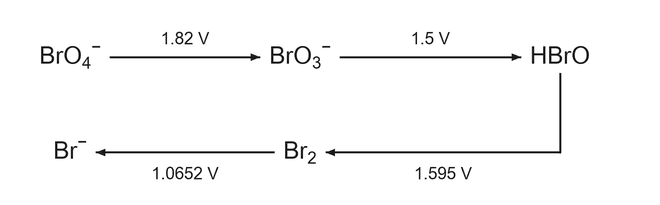
Then the species undergoing disproportionation is
- 841 mark
Question 84
The oxidation state of Cr in is
- 851 mark
Question 85
Which of the following reactions are disproportionation reaction?
P.
Q.
R.
S.
Select the correct option from the following:
- 861 mark
Question 86
The standard electrode potential (E°) values of , , and are −1.66 V, 0.80 V, −2.93 V and −0.74 V, respectively. The correct decreasing order of reducing power of the metal is
- 871 mark
Question 87
What is the change in oxidation number of carbon in the following reaction?
- 881 mark
Question 88
At 298 K, the standard electrode potentials of , , and are 0.34 V, −0.76 V, −0.44 V and 0.80 V, respectively.
On the basis of standard electrode potential, predict which of the following reaction can not occur?