
Opening your dashboard
Class 11 Chemistry Chapter 8 Equilibrium: Ionic Equilibrium: Practice Questions
155 questions on Chapter 8, each worked through on its own page with the AI tutor. Class 11 Chemistry, ICSE 2026-27.
155 questions
1–4 marks · Mixed difficulty
- 11 mark
Question 1
A student dips the same pair of electrodes, connected in series with a battery and a bulb, into three 0.10 M aqueous solutions in turn. (Hypothetical data.) With hydrochloric acid the bulb glows brightly, with ethanoic acid it glows dimly, and with glucose it does not glow at all. Which conclusion about ethanoic acid follows from these observations?
- 22 marks
Question 2
Liquid hydrogen chloride, obtained by cooling the gas below −85 °C, is a very poor conductor of electricity, but a solution of hydrogen chloride in water conducts well. Explain this difference, giving an equation.
- 33 marks
Question 3
For each of the following substances dissolved in water, write an equation for its ionisation, using a single arrow (→) or the equilibrium sign (⇌) correctly, and state whether it is a strong or a weak electrolyte.
(a) Nitric acid,
(b) Methanoic acid,
(c) Methylamine,
- 41 mark
Question 4
A 0.10 M solution of ethanoic acid is kept at a constant temperature until its conductivity no longer changes. Which statement about the solution at this stage is correct?
- 53 marks
Question 5
In a 0.10 M aqueous solution of hydrofluoric acid at 25 °C, 8.0 % of the HF molecules are ionised.
(a) Calculate the equilibrium concentrations of HF, and .
(b) Calculate the total concentration of solute particles (molecules and ions together).
(c) Using your answers, explain why 0.10 M HF conducts electricity much less well than 0.10 M HCl.
- 61 mark
Question 6
A 0.20 M solution of a weak monobasic acid HA is diluted with water to sixteen times its original volume at the same temperature. The degree of ionisation of HA stays much smaller than 1 throughout. On dilution, the degree of ionisation of HA
- 74 marks
Question 7
Nitrous acid, , has at 25 °C.
(a) Calculate the degree of ionisation of in a 0.20 M solution using the approximation , and show that the approximation is acceptable (error limit 5 %).
(b) For a 0.0050 M solution, show that the same approximation is not acceptable, and find the degree of ionisation by solving the full expression from Ostwald's dilution law.
- 81 mark
Question 8
A 0.10 M solution of propanoic acid, a weak acid, is diluted with water at a constant temperature of 298 K. Which of the following quantities stays the same after the dilution?
- 92 marks
Question 9
Ostwald's dilution law describes 0.10 M ethanoic acid well, but it cannot be applied to a 0.10 M solution of potassium chloride. Explain why.
- 103 marks
Question 10
In a 0.080 M aqueous solution of ammonia at 25 °C, 1.5 % of the molecules have reacted with water to form and ions.
(a) Calculate the base ionisation constant, , of ammonia.
(b) At what concentration would ammonia be 3.0 % ionised at the same temperature?
- 111 mark
Question 11
Hydrocyanic acid, HCN, has at 298 K, where . The base ionisation constant, , of its conjugate base, the cyanide ion , at 298 K is
- 123 marks
Question 12
At 25 °C, of ethanoic acid is and of methanoic acid is .
(a) Calculate in 0.10 M ethanoic acid.
(b) Find the concentration of methanoic acid solution that has the same . Do not assume that the methanoic acid is only slightly ionised; check this at the end.
- 132 marks
Question 13
Perchloric acid, hydrochloric acid and nitric acid all appear equally strong in dilute aqueous solution, yet in pure (glacial) ethanoic acid as the solvent they show clearly different strengths. Explain this observation.
- 143 marks
Question 14
At 25 °C, ethanoic acid () has and chloroethanoic acid () has .
(a) Which is the stronger acid? Calculate how many times larger its is. ()
(b) Explain the difference in strength in terms of the structures of the two acids.
- 151 mark
Question 15
In a solution of ammonium carbonate the following proton-transfer equilibrium is set up. Its equilibrium constant is about 12 at 25 °C.
Which conclusion about the bases in this equilibrium follows from the value of the equilibrium constant?
- 163 marks
Question 16
The hydrogensulphide ion, , is amphiprotic.
(a) Write one equation in which acts as a Brønsted–Lowry acid towards , and one in which it acts as a Brønsted–Lowry base towards .
(b) Name the conjugate base and the conjugate acid of .
(c) Which is the stronger Brønsted base, or ? Give a reason.
- 171 mark
Question 17
Which one of the following reactions is an acid–base reaction according to the Lewis concept but NOT according to the Brønsted–Lowry concept?
- 183 marks
Question 18
For each reaction below, state whether it is an acid–base reaction according to the Arrhenius concept, the Brønsted–Lowry concept and the Lewis concept. Identify the acid and the base each time by the widest concept that applies.
(a)
(b)
(c)
- 191 mark
Question 19
Consider the following statements about acid–base concepts.
P: Every Brønsted–Lowry base is also a Lewis base.
Q: Every Lewis acid is also a Brønsted–Lowry acid.
R: In water a proton does not stay free; it is held by a water molecule as the ion.
S: By the Arrhenius definition, a base is any species that is able to accept a proton.
Which of the statements are correct?
- 201 mark
Question 20
A sample of gastric juice has mol L⁻¹ at 25 °C. (Hypothetical data.) Taking , the pH of the sample is
- 213 marks
Question 21
A student dissolves 0.171 g of barium hydroxide, , in water and makes the solution up to 250 mL at 25 °C. (Hypothetical data.) Barium hydroxide is a strong base and ionises completely. Calculate the hydroxide ion concentration, the pOH and the pH of the solution. (Ba = 137, O = 16, H = 1; ; )
- 223 marks
Question 22
Aniline, , is a weak base with at 25 °C. Calculate the pH of a 0.10 M aqueous solution of aniline and the percentage of aniline molecules that are protonated. (; )
- 231 mark
Question 23
The self-ionisation of water can be written as the equilibrium below. Its ionic product, , is at 25 °C.
Taking the concentration of water as 55.5 mol L⁻¹, the value at 25 °C of the equilibrium constant is about
- 244 marks
Question 24
At body temperature, 37 °C, the ionic product of water is . Normal human blood has pH 7.40 at this temperature. (; )
(a) Calculate the pH of pure (neutral) water at 37 °C.
(b) Calculate and in blood at 37 °C.
(c) Is blood acidic, neutral or basic at 37 °C? Support your answer with the ratio .
- 251 mark
Question 25
Methyl orange is red below pH 3.1 and yellow above pH 4.4. Phenolphthalein is colourless below pH 8.3 and pink above pH 10.0. A few drops of methyl orange turn one sample of a colourless solution yellow, while a few drops of phenolphthalein leave a second sample of it colourless. Which of these could be the pH of the solution?
- 263 marks
Question 26
Methyl red is an indicator HIn with ; the HIn form is red and the form is yellow. A student adds a few drops of methyl red to each of two buffer solutions. (Hypothetical data.) Buffer X contains 0.10 M and 0.050 M ( of = 1.8 × 10⁻⁴). Buffer Y contains 0.10 M and 0.20 M ( of = 1.8 × 10⁻⁵).
(a) Calculate the pH of each buffer.
(b) Calculate the ratio in each buffer and predict the colour the student sees.
- 271 mark
Question 27
The figure shows how the pH changes when 0.100 M hydrochloric acid is added from a burette to 25.0 mL of 0.100 M aqueous ammonia.
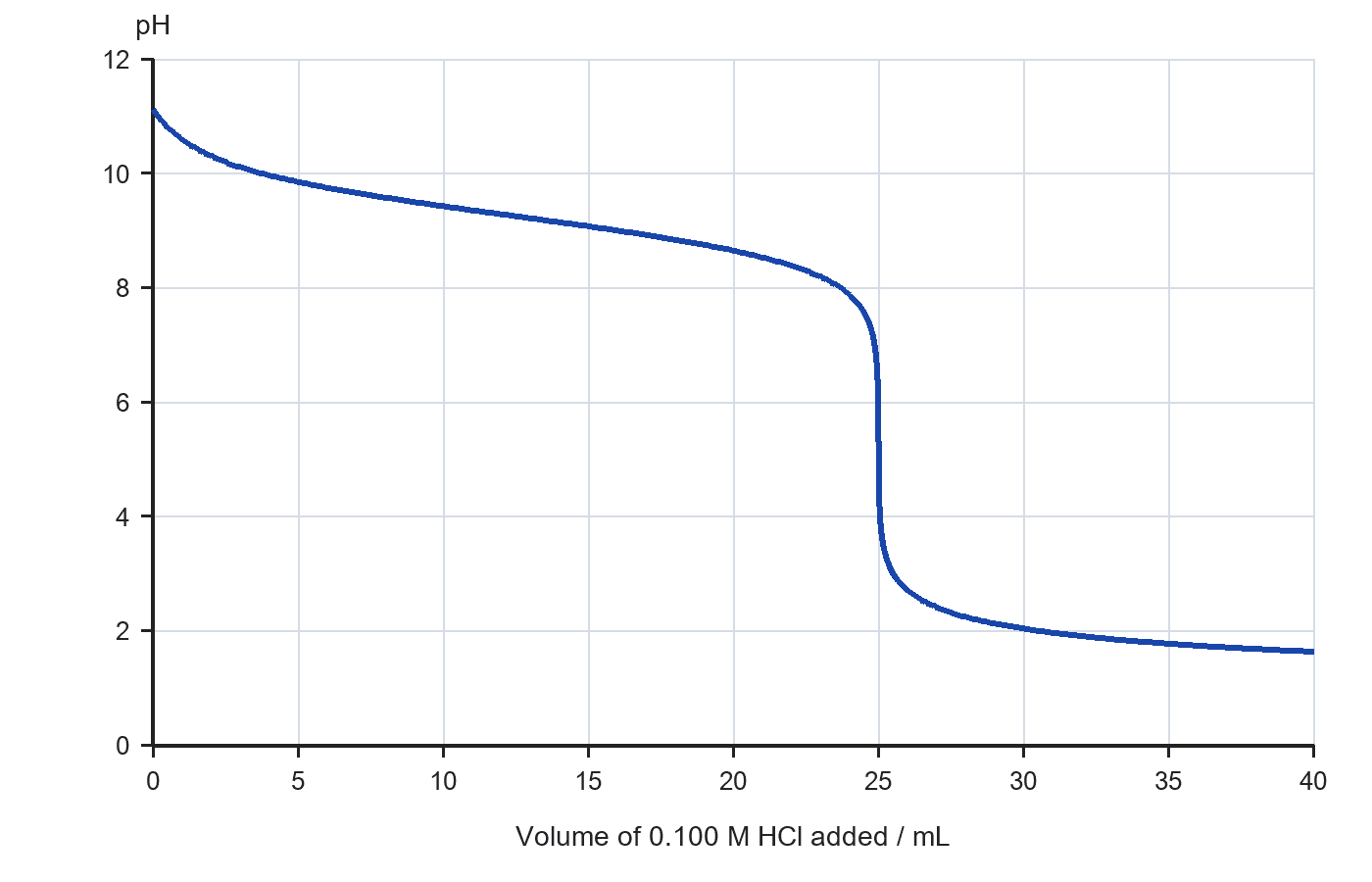
The pH ranges over which four indicators change colour are: methyl orange 3.1–4.4, bromocresol green 3.8–5.4, methyl red 4.4–6.2 and phenolphthalein 8.3–10.0. Which indicator would NOT give a correct end point for this titration?
- 282 marks
Question 28
In an acid–base titration only one or two drops of indicator solution are added to the flask. Give two reasons why adding a much larger volume of indicator, say 5 mL, would spoil the result.
- 293 marks
Question 29
A student titrates 25.0 mL of 0.10 M acetic acid with 0.10 M aqueous ammonia added from a burette. (Hypothetical data.) At 25 °C, of = 1.8 × 10⁻⁵ and of = 1.8 × 10⁻⁵.
(a) Estimate the pH after 24.0 mL and after 26.0 mL of ammonia have been added.
(b) Use your answers to explain why no common indicator gives a sharp end point in this titration.
- 301 mark
Question 30
Propanoic acid, , has = 1.3 × 10⁻⁵. What is its degree of ionisation in a solution that is 0.10 M in propanoic acid and also 0.050 M in sodium propanoate?
- 312 marks
Question 31
An analyst washes a precipitate of barium sulphate with 200 mL of liquid, which becomes saturated with as it drains through. (Hypothetical data.) of = 1.1 × 10⁻¹⁰ and its molar mass is 233 g mol⁻¹. Calculate the mass of lost when the washing liquid is (a) pure water and (b) 0.0010 M ammonium sulphate solution, and hence say why the second liquid is preferred.
- 323 marks
Question 32
A solution is 0.20 M in ammonia and also 0.050 M in sodium hydroxide. of = 1.8 × 10⁻⁵ and = 1.0 × 10⁻¹⁴.
(a) Calculate the concentration of ions in this solution.
(b) Calculate in 0.20 M ammonia alone, and find by what factor the sodium hydroxide has reduced it.
(c) Calculate the pH of the mixture.
- 331 mark
Question 33
Which of the following, added in a small amount to dilute aqueous acetic acid, would NOT lower the degree of ionisation of the acid?
- 341 mark
Question 34
Each of the following salts is dissolved in water to make a 0.10 M solution, and the solution is then diluted ten times. For which salt does the pH stay almost the same?
- 353 marks
Question 35
Calculate the pH of (a) 0.20 M sodium formate, , and (b) 0.20 M sodium phenoxide, , at 25 °C. of = 1.8 × 10⁻⁴, of phenol, = 1.0 × 10⁻¹⁰, and = 1.0 × 10⁻¹⁴. (c) Explain why the two salts give such different pH values.
- 361 mark
Question 36
A 0.10 M solution of sodium acetate in a closed flask is warmed from 25 °C to 50 °C. is 1.0 × 10⁻¹⁴ at 25 °C and 5.5 × 10⁻¹⁴ at 50 °C; of acetic acid is 1.8 × 10⁻⁵ at 25 °C and 1.6 × 10⁻⁵ at 50 °C. What happens to the degree of hydrolysis of the acetate ion?
- 372 marks
Question 37
A laboratory assistant dissolves iron(III) chloride in pure water. The yellow solution slowly turns brown and cloudy on standing. When the same salt is dissolved instead in dilute hydrochloric acid, the solution stays clear. Explain both observations, with an equation.
- 381 mark
Question 38
Four acetic acid–sodium acetate buffers are prepared. Which one resists a change in pH best when a small amount of EITHER a strong acid OR a strong base is added to it?
- 393 marks
Question 39
Blood plasma is buffered mainly by carbonic acid, , and hydrogencarbonate ions, . At body temperature (37 °C) the apparent of in blood is 6.1.
(a) Calculate the ratio in normal blood of pH 7.4.
(b) In a patient with severe acidosis the blood pH has fallen to 7.1. What is the ratio now?
(c) The normal ratio is far from 1, yet this buffer protects blood well against the acids produced in the body. Give a reason.
- 401 mark
Question 40
A buffer is usually taken to work well only while the ratio [salt]/[acid] lies between 1/10 and 10. For an acetic acid–sodium acetate buffer ( = 4.76), this corresponds to which pH range?
- 412 marks
Question 41
A student has 0.10 mol of ammonium chloride and some solid sodium hydroxide, and wants to make 1.0 L of a buffer whose pH is equal to the of . (Hypothetical data.) How many moles of NaOH should be added, and what will the pH of the buffer be? ( of = 1.8 × 10⁻⁵, = 1.0 × 10⁻¹⁴.)
- 421 mark
Question 42
Mercury(I) chloride (calomel), , is sparingly soluble in water. Mercury(I) exists in solution as the ion. If the molar solubility of is s mol L⁻¹, its solubility product is
- 431 mark
Question 43
A saturated solution of silver chloride stands over some undissolved AgCl at 25 °C. More solid AgCl is added and the mixture is stirred at the same temperature. What happens?
- 443 marks
Question 44
A groundwater sample from a hard-water area contains M ions and 1.2 mg of fluoride ion per litre. (Hypothetical data.) of at 25 °C = 3.5 × 10⁻¹¹; molar mass of F = 19 g mol⁻¹.
(a) Show by calculation whether calcium fluoride can precipitate from this water.
(b) Calculate the largest fluoride concentration, in mg per litre, that can stay dissolved in water with this calcium ion concentration.
- 452 marks
Question 45
Calcium carbonate (marble) hardly dissolves in water, but it dissolves readily in dilute hydrochloric acid. Explain this in terms of the solubility product of , using equations.
- 461 mark
Question 46
At 25 °C, the solubility product of is . At which pH, will ions start precipitating in the form of from a solution of 0.001 M ions?
- 471 mark
Question 47
Solubility product of silver bromide is . The quantity of potassium bromide (molar mass taken as 120 g mol⁻¹) to be added to 1 litre of 0.05 M solution of silver nitrate to start the precipitation of AgBr is:
- 481 mark
Question 48
The solubility of in water is moles/litre. Its solubility product is
- 491 mark
Question 49
For a concentrated solution of a weak electrolyte , the degree of dissociation is given as
- 501 mark
Question 50
The solubility product () of the following compounds are given at 25 °C
Compound AgCl AgI The most soluble and least soluble compounds are respectively
- 511 mark
Question 51
is passed into one dm³ of a solution containing 0.1 mole of and 0.01 mole of till the sulphide ion concentration reaches moles. Which one of the following statements is true?
[ of ZnS and CuS are and respectively]
- 521 mark
Question 52
The of is . The molar solubility of the compound in water is
- 531 mark
Question 53
An acid HA ionises as
The pH of 1.0 M solution is 5. Its dissociation constant would be
- 541 mark
Question 54
A buffer solution is prepared by mixing equal concentration of weak base and its salt with strong acid. For the base, is given as . The pH of the buffer solution is
- 551 mark
Question 55
The pH of the solution obtained by mixing 100 mL of a solution of pH = 3 with 400 mL of a solution of pH = 4 is
- 561 mark
Question 56
The pH of a 0.1 molar solution of the acid HQ is 3. The value of the ionization constant, of this acid is
- 571 mark
Question 57
mole of HCl is added to a buffer solution made up of 0.01 M acetic acid and 0.01 M sodium acetate. The final pH of the buffer will be (given, of acetic acid is 4.75 at 25 °C)
- 581 mark
Question 58
Two equilibria, and are simultaneously maintained in a solution with equilibrium constants, and respectively. The ratio of to in the solution is
- 591 mark
Question 59
How many litres of water must be added to 1 litre of an aqueous solution of HCl with a pH of 1 to create an aqueous solution with pH of 2?
- 601 mark
Question 60
The pH of a saturated solution of a metal hydroxide of formula is 12.0 at 298 K. What is the solubility product of the metal hydroxide at 298 K (in mol³ L⁻³)?
- 611 mark
Question 61
What will be the solubility product of if its solubility is ?
- 621 mark
Question 62
The ratio of volumes of 0.1 (N) to 0.1 (N) required to prepare a buffer solution of pH 5.74 is (given : of is 4.74)
- 631 mark
Question 63
How many times a 0.1 M strong monobasic acid solution should be diluted so that pH of the resulting solution is tripled?
- 641 mark
Question 64
In the reaction; , if the concentration of ions is decreased by times, then the equilibrium concentration of will increase by
- 651 mark
Question 65
The equilibrium constant at 298 K for a reaction.
is 100. If the initial concentration of all the four species were 1 M each, then equilibrium concentration of D (in mol L⁻¹) will be
- 661 mark
Question 66
In which of the following mixed aqueous solutions pH = at equilibrium?
(1) 100 mL of 0.1 M + 100 mL of 0.1 M
(2) 100 mL of 0.1 M + 50 mL of 0.1 M NaOH
(3) 100 mL of 0.1 M + 100 mL of 0.1 M NaOH
(4) 100 mL of 0.1 M + 100 mL of 0.1 M
(a) (1) is correct
(b) (2) is correct
(c) (3) is correct
(d) both (1) and (2) are correct
- 671 mark
Question 67
Dissolving NaCN in de-ionised water will result in a solution having
- 681 mark
Question 68
Solubility product () of saturated in water is mol³ dm⁻⁹. What is the concentration of in the solution?
- 691 mark
Question 69
of a weak acid (HA) and of a weak base (BOH) are 3.2 and 3.4, respectively. The pH of their salt (AB) solution is
- 701 mark
Question 70
Acidity of can be explained on which of the following concepts?
- 711 mark
Question 71
An aqueous solution contains 0.10 M and 0.20 M HCl. If the equilibrium constant for the formation of from is and that of from ions is , then the concentration of ions in aqueous solution is:
- 721 mark
Question 72
An aqueous solution contains an unknown concentration of . When 50 mL of a 1 M solution of is added, just begins to precipitate. The final volume is 500 mL. The solubility product of is . What is the original concentration of ?
- 731 mark
Question 73
Which of the following salt is the most basic in aqueous solution?
- 741 mark
Question 74
An alkali is titrated against an acid with methyl orange as indicator. Which of the following is a correct combination?
- 751 mark
Question 75
If of is , the molar solubility of in 0.1 M is:
- 761 mark
Question 76
In the equilibrium: , if at a given temperature the concentration of the reactants are increased, the value of equilibrium constant, will
- 771 mark
Question 77
The pH of pure water at 90°C will be
- 781 mark
Question 78
Solubility of AgCl is least in
- 791 mark
Question 79
20 mL of 0.1 M solution is added to 30 mL of 0.2 M solution. The pH of the resultant mixture is: [ of = 4.7].
- 801 mark
Question 80
For the equilibrium,
the value of at 298 K is approximately:
- 811 mark
Question 81
The molar solubility of is M in water. The expected solubility of in a buffer solution of pH = 12 is:
- 821 mark
Question 82
Consider the following statements
P. The pH of a mixture containing 400 mL of 0.1 M and 400 mL of 0.1 M NaOH will be approximately 1.3.
Q. Ionic product of water is temperature dependent.
R. A monobasic acid with has a pH = 5. The degree of dissociation of this acid is 50%.
S. The Le Chatelier's principle is not applicable to common-ion effect.
The correct statements are:
- 831 mark
Question 83
If solubility product of is denoted by and its molar solubility is denoted by , then which of the following relation between and is correct?
- 841 mark
Question 84
The pH of a 0.02 M solution will be [given and ]
- 851 mark
Question 85
What is the molar solubility of in 0.2 M NaOH solution? Given that, solubility product of .
- 861 mark
Question 86
The strength of an aqueous NaOH solution is most accurately determined by titrating:
(Note: consider that an appropriate indicator is used)
- 871 mark
Question 87
For the following Assertion and Reason, the correct option is:
Assertion: The pH of water increases with increase in temperature.
Reason: The dissociation of water into and is an exothermic reaction.
- 881 mark
Question 88
The for the following dissociation is
Which of the following choices is correct for a mixture of 300 mL of 0.134 M and 100 mL of 0.4 M NaCl?
- 891 mark
Question 89
The solubility product of at 298 K is . The concentration of hydroxide ions in a saturated solution of will be:
- 901 mark
Question 90
100 mL of 0.1 M HCl is taken in a beaker and to it 100 mL of 0.1 M NaOH is added in steps of 2 mL and the pH is continuously measured. Which of the following graph correctly depicts the change in pH?
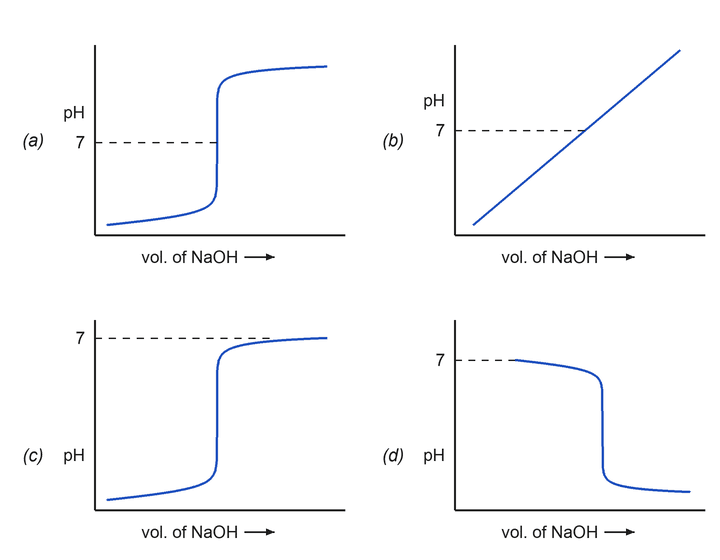
- 911 mark
Question 91
Arrange the following solutions in the decreasing order of pOH:
P. 0.01 M HCl
Q. 0.01 M NaOH
R. 0.01 M
S. 0.01 M NaCl
- 921 mark
Question 92
If the solubility product of is M³, then the solubility of in pure water is ______ mol L⁻¹. (Assuming that neither kind of ion reacts with water).
- 931 mark
Question 93
Two solutions A and B, each of 100 L were made by dissolving 4 g of NaOH and 9.8 g of in water, respectively. The pH of the resultant solution obtained from mixing 40 L of solution A and 10 L of solution B is ______.
- 941 mark
Question 94
3 g of acetic acid is added to 250 mL of 0.1 M HCl and the solution made up to 500 mL. To 20 mL of this solution, mL of M NaOH is added. The pH of the solution is ______. [Given: of acetic acid = 4.75, molar mass of acetic acid = 60 g/mol, ]
Neglect any changes in volume
- 951 mark
Question 95
5.00 mL of 0.10 M oxalic acid solution taken in a conical flask is titrated against NaOH from a burette using phenolphthalein indicator. The volume of NaOH required for the appearance of permanent faint pink colour is tabulated below for five experiments. What is the concentration, in molarity, of the NaOH solution?
The burette readings are:
Exp. No. Vol. of NaOH (mL) 1 12.5 2 10.5 3 9.0 4 9.0 5 9.0 - 961 mark
Question 96
An acidified solution of 0.05 M is saturated with 0.1 M . What is the minimum molar concentration (M) of required to prevent the precipitation of ZnS?
Use and overall dissociation constant of , .
- 971 mark
Question 97
The solubility of AgCN in a buffer solution of pH = 3 is . The value of is: [assume, no cyano complex is formed: and ]
- 981 mark
Question 98
The solubility of in water is: [Given: The solubility product of in water = ]
- 991 mark
Question 99
The exact volumes of 1 M NaOH solution required to neutralise 50 mL of 1 M solution and 100 mL of 2 M solution, respectively, are:
- 1001 mark
Question 100
The solubility product of is . The solubility of lead iodide in 0.1 molar solution of lead nitrate is mol L⁻¹. The value of is ______ (Rounded off to the nearest integer) [Given ]
- 1011 mark
Question 101
The pH of ammonium phosphate solution, if of phosphoric acid and of ammonium hydroxide are 5.23 and 4.75, respectively, is ______.
- 1021 mark
Question 102
Two salts and MX have the same value of solubility product of . The ratio of their molar solubilities i.e., = ______.
- 1031 mark
Question 103
0.01 moles of a weak acid HA () is dissolved in 1.0 L of 0.1 M HCl solution. The degree of dissociation of HA is ______ (Rounded off to the nearest integer). [Neglect volume change on adding HA. Assume degree of dissociation << 1]
- 1041 mark
Question 104
Sulphurous acid () has and . The pH of 0.588 M is ______ . (Rounded off to the nearest integer)
- 1051 mark
Question 105
In order to prepare a buffer solution of pH 5.74, sodium acetate is added to acetic acid. If the concentration of acetic acid in the buffer is 1.0 M, the concentration of sodium acetate in the buffer is ______ M. (Rounded off to the nearest integer). [Given : (acetic acid) = 4.74]
- 1061 mark
Question 106
The solubility of in water is mol L⁻¹. Its solubility in 0.01 M solution is ______ mol L⁻¹. (Rounded off to the nearest integer) (Assume that solubility is much less than 0.01 M).
- 1071 mark
Question 107
is a sparingly soluble salt of molar mass (g mol⁻¹) and solubility g L⁻¹. The solubility product satisfies . The value of is ______. (Integer answer)
- 1081 mark
Question 108
The pH of a solution obtained by mixing 50 mL of 1 M HCl and 30 mL of 1 M NaOH is . The value of is ______. (Nearest integer) []
- 1091 mark
Question 109
The of is . Then the molar solubility of is
- 1101 mark
Question 110
What is concentration of in mol/L of a solution that is 0.20 M in and 0.10 M in ? for .
- 1111 mark
Question 111
In a buffer solution containing equal concentration of and HB, the for is . The pH of buffer solution is:
- 1121 mark
Question 112
A buffer solution is prepared in which the concentration of is 0.30 M and concentration of is 0.20 M. If equilibrium constant for equals , what is the pH of the solution?
- 1131 mark
Question 113
The of an acid HA is 4.77 and of a base BOH is 4.75. The pH of 0.1 M aqueous solution of the salt AB is
- 1141 mark
Question 114
Which one of the following will decrease the pH of 50 mL of 0.01 M hydrochloric acid?
- 1151 mark
Question 115
pH of a saturated solution of is 12. The value of solubility product () of is
- 1161 mark
Question 116
Buffer solutions have constant acidity and alkalinity because
- 1171 mark
Question 117
Which of these is least likely to act as a Lewis base
- 1181 mark
Question 118
The of a weak acid HA and of a weak base BOH are 4.60 and 4.80 respectively. The pH of 0.1 M solution of the salt, BA, formed from the acid HA and base BOH is
- 1191 mark
Question 119
Which of the following salts will give highest pH in water?
- 1201 mark
Question 120
Using the Gibb's energy change, kJ, for the following reaction,
the of in water at 25°C is ( J K⁻¹ mol⁻¹)
- 1211 mark
Question 121
Which one of the following species cannot act as both Bronsted acid and base?
- 1221 mark
Question 122
The of , AgCl, AgBr and AgI are, respectively, , , , . Which one of the following salts will precipitate last if solution is added to the solution containing equal moles of NaCl, NaBr, NaI and ?
- 1231 mark
Question 123
What is the pH of the resulting solution when equal volumes of 0.1 M NaOH and 0.01 M HCl are mixed?
- 1241 mark
Question 124
Which one of the following pairs of solution is not an acidic buffer?
- 1251 mark
Question 125
MY and , two nearly insoluble salts have the same values of at room temperature. Which statement would be true in regard to MY and ?
- 1261 mark
Question 126
The percentage of pyridine () that forms pyridinium ion () in a 0.10 M aqueous pyridine solution ( for ) is
- 1271 mark
Question 127
The solubility of AgCl(s) with solubility product in 0.1 M NaCl solution would be
- 1281 mark
Question 128
The solubility of in water is g L⁻¹ at 298 K. The value of its solubility product () will be (Given molar mass of = 233 g mol⁻¹)
- 1291 mark
Question 129
Following solutions were prepared by mixing different volumes of NaOH and HCl of different concentrations:
P. 60 mL HCl + 40 mL NaOH
Q. 55 mL HCl + 45 mL NaOH
R. 75 mL HCl + 25 mL NaOH
S. 100 mL HCl + 100 mL NaOH
pH of which one of them will be equal to 1?
- 1301 mark
Question 130
pH of a saturated solution of is 9. The solubility product () of is
- 1311 mark
Question 131
Conjugate base of Bronsted acids and HF are
- 1321 mark
Question 132
Which will make basic buffer?
- 1331 mark
Question 133
Hydrolysis of sucrose is given by the following reaction.
If the equilibrium constant () is at 300 K, the value of at the same temperature will be:
- 1341 mark
Question 134
Find out the solubility of in 0.1 M NaOH. Given that the ionic product of is
- 1351 mark
Question 135
The of dimethylamine and of acetic acid are 3.27 and 4.77, respectively, at (K). The correct option for the pH of dimethylammonium acetate solution is:
- 1361 mark
Question 136
Fill in the blanks by choosing the appropriate word/words from those given in the brackets:
(increases, decreases, positive, efficient, 68, non-efficient, no -hydrogen, -hydrogen, negative, Rosenmund's, greater, Cannizzaro, 74, common-ion effect, lesser, buffer action, diamagnetic, paramagnetic)
Solubility of silver chloride ______ in the presence of sodium chloride because of ______.
- 1371 mark
Question 137
Answer the following questions:
What is the effect of temperature on the ionic product of water? How will it change the pH value of a neutral solution?
- 1381 mark
Question 138
Answer the following questions:
The aqueous solution of sodium acetate is basic. Explain.
- 1391 mark
Question 139
Calculate the concentration of ions in solution when .
- 1402 marks
Question 140
The solubility product () of is . Calculate the solubility of barium sulphate in pure water and in .
- 1412 marks
Question 141
Explain the following :
When and are added to a solution containing both, and ions, which ion is precipitated first and why?
- 1421 mark
Question 142
Explain the following :
Dissociation of is suppressed in acidic medium.
- 1431 mark
Question 143
Fill in the blanks by choosing the appropriate word/words from those given in the brackets:
(Henry's, aldol condensation, absence, do not, ohm, Raoult's, increases, common ion effect, easily, three, solubility product, , two, four, , cannizzaro, , zero, decreases, presence)
The solubility of silver chloride ______ in the presence of sodium chloride because of ______.
- 1441 mark
Question 144
Answer the following questions:
What is the pH value of a solution whose hydroxyl ion concentration is ?
- 1452 marks
Question 145
Determine the pH value of acetic acid solution if it is 2% ionised at this concentration. How can the degree of dissociation of this acetic acid solution be increased?
- 1462 marks
Question 146
The solubility product of at is . Calculate the solubility of in g/lit. at .
Atomic Weights: and
- 1472 marks
Question 147
Water acts as Bronsted acid as well as a Bronsted base. Give one example each to illustrate this statement.
- 1482 marks
Question 148
What is a buffer solution? How is it prepared? Explain the buffer action of a basic buffer with a suitable example.
- 1492 marks
Question 149
Explain the following:
(i) When is added to solution, a white precipitate is formed.
(ii) An aqueous solution of ammonium chloride is acidic in nature.
- 1501 mark
Question 150
Fill in the blanks by choosing the appropriate word/words from those given in the brackets:
(iodoform, acetaldehyde, positive, greater, acidic, acetone, disaccharide, negative, increases, glucose, decreases, chloroform, polysaccharide, lactose, lesser, basic, cationic hydrolysis, anionic hydrolysis)
An aqueous solution of is ______ due to ______.
- 1511 mark
Question 151
Complete the following statements by selecting the correct alternative from the choices given:
The conjugate acid of is:
- 1522 marks
Question 152
When ammonium chloride and ammonium hydroxide are added to a solution containing both and ions, which ion is precipitated first and why?
- 1532 marks
Question 153
A solution of potassium chloride has no effect on litmus whereas, a solution of zinc chloride turns the blue litmus red. Give a reason.
- 1542 marks
Question 154
Answer the following:
(1) What is the effect of temperature on the ionic product of water ()?
(2) What happens to the ionic product of water () if some acid is added to it?
- 1553 marks
Question 155
Name the law or principle to which the following observations confirm:
(1) When water is added to a aqueous solution of acetic acid, the number of hydrogen ion () increases.
(2) When 9650 coulombs of electricity is passed through a solution of copper sulphate, of copper is deposited on the cathode (at. wt. of ).
(3) When ammonium chloride is added to a solution of ammonium hydroxide, the concentration of hydroxyl ion decreases.