
Opening your dashboard
Class 11 Chemistry Chapter 7 Equilibrium: Chemical Equilibrium: Practice Questions
94 questions on Chapter 7, each worked through on its own page with the AI tutor. Class 11 Chemistry, ICSE 2026-27.
94 questions
1–4 marks · Mixed difficulty
- 11 mark
Question 1
Bromine vapour and chlorine are sealed in a flask kept at a constant temperature, where they react reversibly:
After some time the colour of the gas in the flask stops changing. Which statement about the flask from then on is correct?
- 21 mark
Question 2
Two equilibrium mixtures of , hydrogen and are made over an iron catalyst at the same temperature and pressure and in exactly the same amounts, one with ordinary hydrogen, , and the other with deuterium, . The two mixtures are then put together in one vessel at the same temperature and pressure. After some time the vessel contains , , and (and also HD), but the total amount of ammonia has not changed. What does this experiment show?
- 33 marks
Question 3
Some pure A is placed in a closed vessel at a constant temperature, where it reacts reversibly:
(a) Sketch, on one pair of axes, how the rate of the forward reaction and the rate of the backward reaction change with time, and mark the time at which equilibrium is reached.
(b) Explain the shape of each curve before .
(c) State what happens to the two rates after , and why the composition then stays constant.
- 43 marks
Question 4
In water, the two ring forms of glucose change into each other until an equilibrium is reached:
A freshly made solution containing only α-D-glucose at 0.500 mol L⁻¹ is kept at 25 °C, and the concentration of the α form is followed with a polarimeter. (Hypothetical data.)
Time (min) 0 20 40 80 120 160 200 240 [α-glucose] (mol L⁻¹) 0.500 0.340 0.260 0.200 0.185 0.181 0.180 0.180 (a) From the table, after about what time has the system reached equilibrium? Give the concentration of β-D-glucose at 240 min.
(b) Calculate the equilibrium constant for the change.
(c) A student says that after 240 min the glucose molecules have stopped changing their form. Explain why the student is wrong.
- 51 mark
Question 5
A beaker of water left open in a room slowly dries up. In a tightly closed bottle kept in the same room, the water level falls very slightly at first and then stays constant. Which statement explains what is happening in the closed bottle once the level is constant?
- 61 mark
Question 6
In the Deacon process, chlorine is made by oxidising hydrogen chloride over a catalyst:
Which is the correct expression for the equilibrium constant of this reaction?
- 73 marks
Question 7
Treat both the forward and the backward reaction of the following equilibrium as single-step reactions:
At a certain temperature the rate constant of the forward reaction is = 7.0 × 10³ L² mol⁻² s⁻¹ and the equilibrium constant is = 1.4 × 10⁵ L mol⁻¹. (Hypothetical data.)
(a) Use the law of mass action to write the rate of the forward and of the backward reaction, and show that .
(b) Calculate the rate constant of the backward reaction, with its unit.
(c) In one equilibrium mixture at this temperature, [NO] = 2.0 × 10⁻³ mol L⁻¹ and [O₂] = 1.0 × 10⁻² mol L⁻¹. Find [NO₂], and show that the forward and backward rates are then equal.
- 81 mark
Question 8
Hydrogen cyanide can be made from methane and ammonia at a high temperature. (Hypothetical data.)
At this temperature = 0.0400 mol² L⁻². An equilibrium mixture contains 0.100 mol L⁻¹ of , 0.100 mol L⁻¹ of and 0.0500 mol L⁻¹ of . What is the equilibrium concentration of ?
- 92 marks
Question 9
A student wrote these equilibrium-constant expressions:
(i) For :
(ii) For :
Point out the mistake in each expression, and write the correct expression with the unit of (concentrations in mol L⁻¹).
- 103 marks
Question 10
In the vapour of ethanoic acid at a fixed temperature, monomer molecules (M) join in pairs to form dimers (D):
Three equilibrium mixtures were analysed at this temperature. (Hypothetical data.)
Mixture [M] (mol L⁻¹) [D] (mol L⁻¹) 1 0.0100 0.0200 2 0.0200 0.0800 3 0.00500 0.00500 (a) Work out the ratio [D]/[M] and the ratio [D]/[M]² for each mixture.
(b) Which ratio stays constant? Explain how this agrees with the law of mass action.
(c) State the value of with its unit.
- 112 marks
Question 11
Ethanal is made by passing ethanol vapour over a heated copper catalyst:
At a certain temperature an equilibrium mixture at a total pressure of 1.60 atm contains ethanol, ethanal and hydrogen in mole fractions 0.400, 0.300 and 0.300 respectively. (Hypothetical data.)
(a) Calculate the partial pressure of each gas.
(b) Calculate for the reaction, with its unit.
- 123 marks
Question 12
For the general gaseous reaction
(a) Starting from the ideal gas equation, derive the relation , and state what Δn stands for.
(b) Use the relation to explain why for the reaction .
- 133 marks
Question 13
For the decomposition of nitrosyl bromide at 350 K, = 0.0416 atm. (Hypothetical data.)
(a) Find Δn for the reaction and calculate at 350 K (R = 0.0821 L atm K⁻¹ mol⁻¹).
(b) Express in bar (1 atm = 1.01325 bar).
(c) Show that you get the same from the value of in bar, using R = 0.08314 L bar K⁻¹ mol⁻¹.
- 141 mark
Question 14
Ethanol is made industrially by the hydration of ethene:
At 300 °C (573 K), = 4.0 × 10⁻³ atm⁻¹. (Hypothetical data.) What is the value of at this temperature? (R = 0.0821 L atm K⁻¹ mol⁻¹)
- 154 marks
Question 15
Hydrogen is made by the steam reforming of methane:
A 5.00 L steel vessel at 1000 K contains, at equilibrium, 3.20 g of , 3.60 g of , 2.80 g of CO and 0.60 g of . (Hypothetical data.) (H = 1, C = 12, O = 16; R = 0.0821 L atm K⁻¹ mol⁻¹)
(a) Calculate the equilibrium concentration of each gas.
(b) Calculate with its unit.
(c) Calculate at 1000 K.
(d) Calculate the total pressure in the vessel.
- 161 mark
Question 16
Consider these statements about the equilibrium constant of a reaction:
P: At a given temperature, the value of does not depend on the initial concentrations of the reactants.
Q: The value of changes when the volume of the reaction vessel is changed at constant temperature.
R: If every coefficient in the balanced equation is doubled, the new equilibrium constant is the square of the old one.
S: The equilibrium constant of the reverse reaction is the negative of the equilibrium constant of the forward reaction.
Which statements are correct?
- 173 marks
Question 17
Three isomerisation reactions of the type X ⇌ Y are each started with 1.00 mol L⁻¹ of X and no Y, at temperatures where their equilibrium constants are as follows. (Hypothetical data.)
Reaction 1 2 3 1.0 × 10³ 1.0 1.0 × 10⁻³ (a) For each reaction, calculate the percentage of X changed into Y at equilibrium.
(b) Use your answers to state what a large and a small value of tell us about the extent of a reaction.
(c) For reaction 3, state the value of for the reverse change Y ⇌ X, and say which direction is favoured.
- 182 marks
Question 18
Two data tables give different values of for the methanation reaction at the same temperature, 900 K. (Hypothetical data.)
Table 1: , = 3.60 × 10³ L² mol⁻²
Table 2: , = 60.0 L mol⁻¹
(a) Show that both values are correct.
(b) Explain why a value of must always be quoted together with the temperature.
- 193 marks
Question 19
At a high temperature, hydrogen and deuterium exchange atoms until an equilibrium is set up:
At this temperature = 4.00. (Hypothetical data.) Experiment 1 starts with 0.500 mol of and 0.500 mol of in a 1.00 L flask. Experiment 2 starts with 1.00 mol of pure HD in an identical flask at the same temperature.
(a) Calculate the equilibrium concentrations of , and HD in experiment 1.
(b) Calculate the equilibrium concentrations in experiment 2.
(c) Compare the results and state the characteristic of chemical equilibrium that they show.
- 201 mark
Question 20
For the reaction at 298 K, the equilibrium constant is about 10⁴⁰, yet a mixture of hydrogen and oxygen in a sealed flask at room temperature shows no detectable change for years. Which statement best explains this?
- 211 mark
Question 21
Iodine and bromine vapours combine to form iodine monobromide. (Hypothetical data.)
At 150 °C, = 120. If 0.200 mol of and 0.200 mol of are placed in a 2.00 L flask at this temperature, what is the equilibrium concentration of IBr?
- 223 marks
Question 22
In a trial of the Deacon process, 0.400 mol of and 0.100 mol of were heated in a closed 1.00 L vessel at 700 K. (Hypothetical data.) At equilibrium, 80.0 % of the hydrogen chloride had reacted:
(a) Find the equilibrium concentration of each gas.
(b) Calculate at 700 K.
(c) State the unit of for this reaction.
- 233 marks
Question 23
In the dry reforming of methane, methane and carbon dioxide are heated together in a rigid vessel:
The initial partial pressures are 0.800 atm of and 1.200 atm of , with no products. At equilibrium at a fixed temperature, the total pressure is 2.960 atm. (Hypothetical data.)
(a) Find the partial pressure of each gas at equilibrium.
(b) Calculate , with its unit.
(c) What percentage of the methane has reacted?
- 241 mark
Question 24
With a suitable catalyst at a fixed temperature, pentane vapour and its isomer 2-methylbutane (isopentane) reach an equilibrium with = 2.5. (Hypothetical data.)
If 1.00 mol of pentane is placed in a 5.00 L vessel with the catalyst, what is the equilibrium concentration of 2-methylbutane?
- 251 mark
Question 25
Silver oxide decomposes on heating in a closed container until the equilibrium below is set up at a fixed temperature.
Which one of the following changes will alter the pressure of oxygen in the container once equilibrium is re-established?
- 263 marks
Question 26
Hot iron reacts with steam in a closed vessel and the following equilibrium is set up:
At a certain temperature . (Hypothetical data.)
(a) Write the expression for of this reaction.
(b) In an equilibrium mixture at this temperature the partial pressure of steam is 0.40 atm. Calculate the partial pressure of hydrogen.
(c) State, with a reason, whether and have the same value for this reaction.
- 274 marks
Question 27
Pure sodium hydrogencarbonate is heated in an evacuated, closed flask at 363 K. It decomposes until the following equilibrium is set up, and the total pressure of gases in the flask is then 0.600 atm. (Hypothetical data.)
(R = 0.0821 L atm K⁻¹ mol⁻¹)
(a) Calculate for the reaction at 363 K.
(b) Calculate at the same temperature.
(c) With some solid still present, what happens to the total pressure if more sodium hydrogencarbonate is added to the flask at 363 K? Give a reason.
- 283 marks
Question 28
Some liquid ethanol is placed in an evacuated, closed 10.0 L flask kept at 298 K. Part of it evaporates and the equilibrium below is set up, with liquid still left in the flask. The vapour pressure of ethanol at 298 K is 7.87 kPa. (R = 8.314 J K⁻¹ mol⁻¹)
(a) Write the expression for and give its value at 298 K.
(b) Calculate the mass of ethanol present as vapour. (Molar mass of ethanol = 46.0 g mol⁻¹.)
(c) The flask volume is now doubled at 298 K, and some liquid still remains. State the new pressure of ethanol vapour and the new mass of vapour.
- 291 mark
Question 29
Solid ammonium carbamate is placed in an evacuated flask at 313 K and dissociates as shown below. At equilibrium the total pressure of the gases is 0.300 atm. (Hypothetical data.) What is the value of ?
- 303 marks
Question 30
Graphite has a density of 2.26 g cm⁻³ (molar mass of carbon = 12.0 g mol⁻¹).
(a) Calculate the molar concentration of carbon in a 6.0 g piece and in a 60.0 g piece of graphite.
(b) Use your answer to explain why the concentration of a pure solid is not written in the equilibrium constant expression of a heterogeneous reaction.
- 311 mark
Question 31
In a food factory, glucose syrup is partly converted into fructose by an enzyme (glucose isomerase) that acts as a catalyst:
glucose(aq) ⇌ fructose(aq)
The temperature is kept the same. Which quantity is changed when a more active enzyme preparation is used?
- 322 marks
Question 32
For a reversible reaction A ⇌ B, the activation energy of the forward reaction is 120 kJ mol⁻¹ and that of the backward reaction is 150 kJ mol⁻¹. A catalyst lowers each activation energy by 40 kJ mol⁻¹. (Hypothetical data.)
(a) Calculate the enthalpy change of the forward reaction without and with the catalyst.
(b) Explain why the equilibrium constant is the same with and without the catalyst.
- 331 mark
Question 33
At a high temperature, hydrogen sulphide dissociates in a cylinder fitted with a movable piston:
At constant temperature, argon is pumped in while the piston moves out to keep the total pressure constant. What happens to the equilibrium, and why?
- 342 marks
Question 34
A salesperson claims that a new catalyst raises the equilibrium yield of a gas-phase reaction from 40 % to 60 % at the same temperature and pressure. Explain whether this claim can be true. In what sense could the catalyst still give "more product" in a real plant?
- 351 mark
Question 35
The uptake of oxygen by haemoglobin (Hb) in the lungs can be shown, in simplified form, as:
A climber goes from sea level to a high mountain, where the partial pressure of oxygen in the air is much lower. According to Le Chatelier's principle, what happens?
- 363 marks
Question 36
Styrene is made industrially by dehydrogenating ethylbenzene over a catalyst at about 600 °C:
ΔH = +125 kJ mol⁻¹
(a) Using Le Chatelier's principle, state the conditions of temperature and pressure that give the highest equilibrium yield of styrene. Give a reason for each.
(b) Large amounts of steam, which takes no part in the reaction, are mixed with the ethylbenzene while the total pressure is kept close to 1 atm. Explain how this raises the equilibrium yield of styrene.
- 371 mark
Question 37
Ethyl ethanoate is made by heating ethanoic acid and ethanol in the liquid state with a little concentrated sulphuric acid:
A chemist considers four changes:
P. Using an excess of ethanol
Q. Removing water from the mixture as it is formed
R. Adding more concentrated sulphuric acid only as a catalyst
S. Raising the pressure on the liquid mixture
Which of these will increase the equilibrium yield of the ester?
- 383 marks
Question 38
Two isomers, M and N, change into each other in solution at a fixed temperature:
M(aq) ⇌ N(aq), = 1.8 (Hypothetical data.)
A 1.00 L solution at equilibrium contains 0.25 mol of M and 0.45 mol of N. Then 0.42 mol of M is dissolved in it at the same temperature, without changing the volume noticeably.
(a) Show that the solution is no longer at equilibrium and state the direction of net change.
(b) Calculate the amounts of the two forms when equilibrium is restored.
- 391 mark
Question 39
In which of the following equilibria will halving the volume of the container, at constant temperature, shift the equilibrium towards the products?
- 402 marks
Question 40
For a gas-phase reaction A(g) ⇌ B(g), the equilibrium constant is at 300 K and 2.5 at 500 K. (Hypothetical data.)
(a) Is the forward reaction exothermic or endothermic? Explain using Le Chatelier's principle.
(b) Would a manufacturer of B prefer a low or a high temperature for the best equilibrium yield? What is the drawback of that choice?
- 413 marks
Question 41
Oxygen dissolves in water as shown below. At 1 atm of air, water holds about 11.3 mg L⁻¹ of dissolved oxygen at 10 °C but only about 7.6 mg L⁻¹ at 30 °C.
(a) Use these data and Le Chatelier's principle to decide whether dissolving oxygen in water is exothermic or endothermic.
(b) A factory releases warm cooling water into a river. Explain why fish may suffer.
(c) Fish-tank pumps bubble air through the water. Using the principle, explain one way of raising the dissolved oxygen in the tank without changing its temperature.
- 421 mark
Question 42
For a reversible reaction at a fixed temperature, K = 4. A reaction mixture is found to have a reaction quotient Q = 25 at that temperature. Which statement is correct?
- 433 marks
Question 43
For the dimerisation of nitrogen dioxide at 298 K, ΔG° = −4.73 kJ mol⁻¹ (standard pressure 1 bar):
A mixture at 298 K has = 0.20 bar and = 0.80 bar. Use ΔG = ΔG° + RT ln Q and ΔG° = −RT ln K (R = 8.314 J K⁻¹ mol⁻¹).
(a) Calculate Q for this mixture.
(b) Calculate ΔG and state the direction of net change.
(c) Calculate K at 298 K and check that it agrees with your answer to (b).
- 441 mark
Question 44
A reaction has an equilibrium constant K = at 298 K. Taking R = 8.314 J K⁻¹ mol⁻¹ and ΔG° = −RT ln K, which statement about this reaction is correct?
- 452 marks
Question 45
The free energy change of a reaction mixture is related to the reaction quotient by ΔG = ΔG° + RT ln Q.
(a) Use this relation to derive the link between ΔG° and the equilibrium constant K.
(b) Explain why ΔG is zero at equilibrium while ΔG° usually is not.
- 464 marks
Question 46
For the vaporisation of liquid bromine, take ΔH° = +30.9 kJ mol⁻¹ and ΔS° = +93.2 J K⁻¹ mol⁻¹, and assume both stay constant with temperature (standard pressure 1 bar).
Use ΔG° = ΔH° − TΔS° and ΔG° = −2.303RT log K (R = 8.314 J K⁻¹ mol⁻¹).
(a) Calculate ΔG° at 298 K.
(b) Calculate K at 298 K and state what it tells you about bromine.
(c) Find the temperature at which K = 1, and state the physical meaning of this temperature.
- 471 mark
Question 47
For the gas-phase dimerisation 2A(g) ⇌ B(g), = 50 L mol⁻¹ at a certain temperature. (Hypothetical data.) At one moment a reaction vessel contains [A] = 0.10 mol L⁻¹ and [B] = 0.40 mol L⁻¹. Which statement is correct?
- 483 marks
Question 48
Silver ions form a complex with ammonia in water:
A solution at equilibrium is diluted with water to twice its volume at the same temperature.
(a) Write the expression for .
(b) Show that, just after dilution, the reaction quotient is 4 times .
(c) State the direction of net change after dilution and explain it with Le Chatelier's principle.
- 491 mark
Question 49
A vessel at 1000 K contains with a pressure of 0.5 atm. Some of the is converted into CO on the addition of graphite. If the total pressure at equilibrium is 0.8 atm, the value of is
- 501 mark
Question 50
The equilibrium constant () for the reaction at temperature is . The value of for the reaction,
at the same temperature is
- 511 mark
Question 51
For the reaction , if where the symbols have usual meaning then the value of is (assuming ideality)
- 521 mark
Question 52
For the reaction at 300 K, the value of is . The equilibrium constant value for the reaction at that temperature is ( is gas constant)
- 531 mark
Question 53
The relationship between and is . What would be the value of for the reaction?
- 541 mark
Question 54
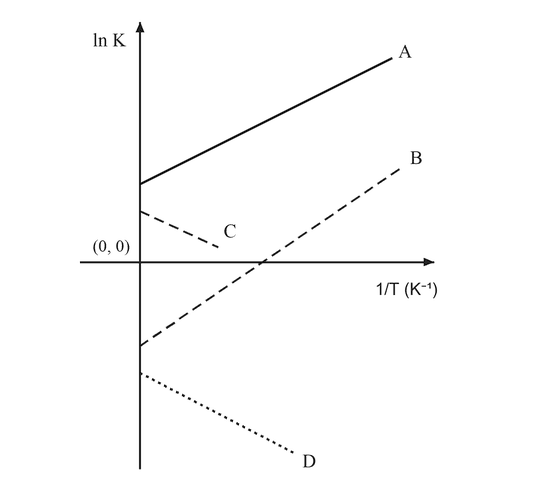
Which of the following lines correctly show the temperature dependence of equilibrium constant , for an exothermic reaction?
- 551 mark
Question 55
In a chemical reaction , the initial concentration of was 1.5 times of the concentration of , but the equilibrium concentrations of and were found to be equal. The equilibrium constant () for the aforesaid chemical reaction is
- 561 mark
Question 56
The value of for the following reactions at 300 K are respectively: (At 300 K, = 24.62 dm³ atm mol⁻¹)
- 571 mark
Question 57
5.1 g is introduced in 3.0 L evacuated flask at 327°C. 30% of the solid decomposed to and as gases. The of the reaction at 327°C is ( = 0.082 L atm mol⁻¹ K⁻¹, Molar mass of S = 32 g mol⁻¹, molar mass of N = 14 g mol⁻¹)
- 581 mark
Question 58
For the following reactions, equilibrium constants are given:
;
;
The equilibrium constant for the reaction,
is:
- 591 mark
Question 59
Two solids dissociate as follows
; atm²
; atm²
The total pressure when both the solids dissociate simultaneously is:
- 601 mark
Question 60
The value of is 64 at 800 K for the reaction:
The value of for the following reaction is:
- 611 mark
Question 61
If the equilibrium constant for is and that of is , the equilibrium constant for is
- 621 mark
Question 62
Consider the following reaction:
; = +58 kJ
For each of the following cases (P, Q), the direction which the equilibrium shifts is:
P. Temperature is decreased
Q. Pressure is increased by adding at constant V
- 631 mark
Question 63
For a reaction , 1.0 mol of , 1.5 mol of and 0.5 mol of were taken in a 1 L vessel and allowed to react. At equilibrium, the concentration of was 1.0 mol L⁻¹. The equilibrium constant of the reaction is . The value of is ________.
- 641 mark
Question 64
A homogeneous ideal gaseous reaction:
is carried out in a 25 litre flask at 27°C. The initial amount of was 1 mole and the equilibrium pressure was 1.9 atm. The value of is . The value of is ________ (Integer answer) [ = 0.08206 dm³ atm K⁻¹ mol⁻¹]
- 651 mark
Question 65
At 1990 K and 1 atm pressure, there are equal number of molecules and Cl atoms in the reaction mixture at equilibrium. The value of for the reaction under the above conditions is . The value of is ________ (Rounded off to the nearest integer).
- 661 mark
Question 66
For the reaction: at 495 K, = −9.478 kJ mol⁻¹.
If we start the reaction in a closed container at 495 K with 22 millimoles of , the amount of in the equilibrium mixture is ________ millimoles. (Rounded off to the nearest integer). [ = 8.314 J mol⁻¹ K⁻¹; ln 10 = 2.303]
- 671 mark
Question 67
Consider the reaction: . The temperature at which = 20.4 and = 600.1, is ________ K. (Rounded off to the nearest integer) [Assume all gases are ideal and = 0.0831 L bar K⁻¹ mol⁻¹]
- 681 mark
Question 68
In an equilibrium mixture, the partial pressures are = 43 kPa; = 530 Pa and = 45 kPa. The equilibrium constant = ________ . (Nearest integer)
- 691 mark
Question 69
Value of for the equilibrium reaction
at 288 K is 47.9. The for this reaction at same temperature is ________. (Nearest integer)
( = 0.083 L bar K⁻¹ mol⁻¹)
- 701 mark
Question 70
For the reaction
the value of equilibrium constant is 100 at 298 K. If the initial concentration of all the three species is 1 M each, then the equilibrium concentration of is M. The value of is ________. (Nearest integer)
- 711 mark
Question 71
When 5.1 g of solid is introduced into a two litre evacuated flask at 27°C, 20% of the solid decomposes into gaseous ammonia and hydrogen sulphide. The for the reaction at 27°C is . The value of is ________. (Integer answer) [Given = 0.082 L atm K⁻¹ mol⁻¹]
- 721 mark
Question 72
For the reaction , = 63 atm at 1000 K. If at equilibrium: , then the total pressure of the gases at equilibrium is
- 731 mark
Question 73
In the reaction at 30°C, for the dissociation equilibrium is atm. If the total pressure at equilibrium is 1 atm, then the percentage dissociation of is
- 741 mark
Question 74
The value of for the reaction is less than zero. Formation of will be favoured at
- 751 mark
Question 75
For the reaction: ; the equilibrium constant is . The equilibrium constant is for the reactions: . What is for the reaction:
- 761 mark
Question 76
For a given exothermic reaction, and are the equilibrium constants at temperatures and , respectively. Assuming that heat of reaction constant in temperature range between and , is readily observed that
- 771 mark
Question 77
For the reversible reaction,
+ heat
The equilibrium shifts in forward direction
- 781 mark
Question 78
At 800 K in a sealed vessel, for the equilibrium , the equilibrium concentrations of (g), (g) and NO(g) are, respectively, M, M and M. Then, the value of for the reaction
at 800 K is
- 791 mark
Question 79
If the equilibrium constant for is , the equilibrium constant for will be:
- 801 mark
Question 80
If the value of equilibrium constant for a particular reaction is , then at equilibrium the system will contain
- 811 mark
Question 81
In a closed cylinder of capacity 24.6 L the following reaction occurs at 27°C,
At equilibrium 1 g of (molar mass = 50 g mol⁻¹) is present. The equilibrium constant for the equilibrium in atm² unit is ( = 0.082 L atm K⁻¹ mol⁻¹)
- 821 mark
Question 82
The equilibrium pressure for the reaction
is atm at 400 K.
The for the given reaction (in atm²) is
- 831 mark
Question 83
Equilibrium constants for the following reactions at 1200 K are given:
;
;
The equilibrium constant for the reaction
at 1200 K will be
- 841 mark
Question 84
Four moles of are heated in a closed 4 dm³ container to reach equilibrium at 400 K. At equilibrium 50% of is dissociated. What is the value of for the dissociation of into and at 400 K?
- 851 mark
Question 85
Which of the following statement is not correct?
- 861 mark
Question 86
The equilibrium constants of the following reactions are:
;
;
;
The equilibrium constant () of the reaction:
, will be
- 871 mark
Question 87
A 20 litre container at 400 K contains (g) at pressure 0.4 atm and an excess of SrO (neglect the volume of solid SrO). The volume of container is now decreased by moving the movable piston fitted in the container. The maximum volume of the container, when pressure of attains its maximum value, will be:
(Given that: , = 1.6 atm)
- 881 mark
Question 88
Which one of the following conditions will favour maximum formation of the product in the reaction:
, kJ?
- 891 mark
Question 89
Consider the following reactions in which all the reactants and the products are in gaseous state.
;
;
The value of for the equilibrium
, is
- 901 mark
Question 90
The equilibrium constant for the reaction:
If, in a particular reaction, there are of and of present, calculate the concentration of at equilibrium.
- 911 mark
Question 91
State the Le Chatelier's principle.
- 922 marks
Question 92
Consider the following reaction:
How is the composition of equilibrium mixture affected by:
(i) a change in temperature
(ii) a change in pressure
(iii) a change in concentration of
(iv) the removal of from the reaction mixture
- 932 marks
Question 93
For the reaction: ;
what will happen to the concentration of if:
(1) Temperature is decreased to .
(2) Pressure is reduced.
- 941 mark
Question 94
Calculate the equilibrium constant () for the formation of in the following reaction:
At equilibrium, the concentration of , and are , and respectively.