
Opening your dashboard
Class 11 Biology Chapter 9 Anatomy of Flowering Plants: Plant Tissues: Practice Questions
163 questions on Chapter 9, each worked through on its own page with the AI tutor. Class 11 Biology, ICSE 2026-27.
163 questions
1–5 marks · Mixed difficulty
- 11 mark
Question 1
A farmer hammers a nail into the trunk of a young mango tree at a height of 1 m above the ground. Ten years later the tree is much taller and thicker, but the nail is still 1 m above the ground. Which statement best explains this?
- 23 marks
Question 2
Two onion bulbs were kept on two flasks of water so that their roots grew into the water. The average root length was measured each day. On Day 4, just before measuring, 10 mm (1 cm) was cut from the tip of every root in Flask 2. (Hypothetical data.)
Day 1 2 3 4 5 6 Flask 1, root length (mm) 8 13 18 23 28 33 Flask 2, root length (mm) 8 13 18 13 13 13 (a) Calculate the average daily increase in root length in Flask 1 from Day 1 to Day 6.
(b) Explain why the roots in Flask 2 stopped growing in length after Day 4. Name the regions of the root tip that were removed by the cut.
- 31 mark
Question 3
As a root pushes through the soil, the outer cells of its root cap are constantly rubbed off, yet the root cap never wears away completely. Which region of the root apex keeps adding new cells to the root cap?
- 41 mark
Question 4
A seedling is laid on its side, and within a day its root tip bends downwards. Cells containing starch grains, which are thought to help the root respond to gravity, are found in which part of the root tip?
- 52 marks
Question 5
A student gently pulls a young side root out of the main root of a bean seedling and looks at the place with a hand lens. The side root appears to have pushed its way out through the cortex and the epidermis of the main root, leaving a small torn opening.
Explain this observation, and state how the origin of a lateral root differs from that of a branch of the shoot.
- 63 marks
Question 6
In a diagram of the root apex, three meristematic regions are marked just behind the quiescent centre:
- X — the outermost single layer of cells;
- Y — the several layers of cells between X and the central core;
- Z — the central core of narrow, elongated cells.
Name the regions X, Y and Z, and state the permanent tissues that each gives rise to in the mature root.
- 71 mark
Question 7
The leaf stalks of the water hyacinth are swollen and spongy, and the plant floats on ponds. A section of the leaf stalk shows parenchyma cells arranged around large air-filled cavities. This tissue is
- 83 marks
Question 8
In a young sunflower stem and in leaf stalks, the strengthening tissue just below the epidermis is collenchyma, not sclerenchyma.
Give three reasons why collenchyma is better suited than sclerenchyma to strengthen such young, growing parts.
- 91 mark
Question 9
The lignified walls of sclerenchyma cells show small, thin areas called pits. These pits are
- 103 marks
Question 10
Three slides of plant tissue, stained with safranin, are observed under a microscope:
- Slide P: thin-walled, nearly isodiametric living cells, each with a distinct nucleus and a large central vacuole; small spaces between some cells.
- Slide Q: living, somewhat elongated cells with walls thickened unevenly at the corners where cells meet; many cells contain chloroplasts.
- Slide R: long, narrow cells with tapered ends and very thick walls stained deep red; no cell contents, only a very narrow empty lumen.
Identify the tissue on each slide and give one function of each.
- 111 mark
Question 11
Water moves upward through a column of xylem vessels much more freely than through a column of tracheids. The main reason is that
- 122 marks
Question 12
In the growing tip region of a stem, the first-formed xylem elements have lignin laid down only as rings or spirals on their walls. Xylem formed later, after the region has stopped growing, has lignin over most of its walls, with pits.
Explain the advantage of each kind of thickening for the stage at which it is formed.
- 131 mark
Question 13
An aphid feeding on a rose stem pushes its fine mouthparts into the stem and steadily draws out a sugary sap that flows into its mouth under pressure. The mouthparts have most probably tapped
- 144 marks
Question 14
The figure shows a longitudinal section of phloem.
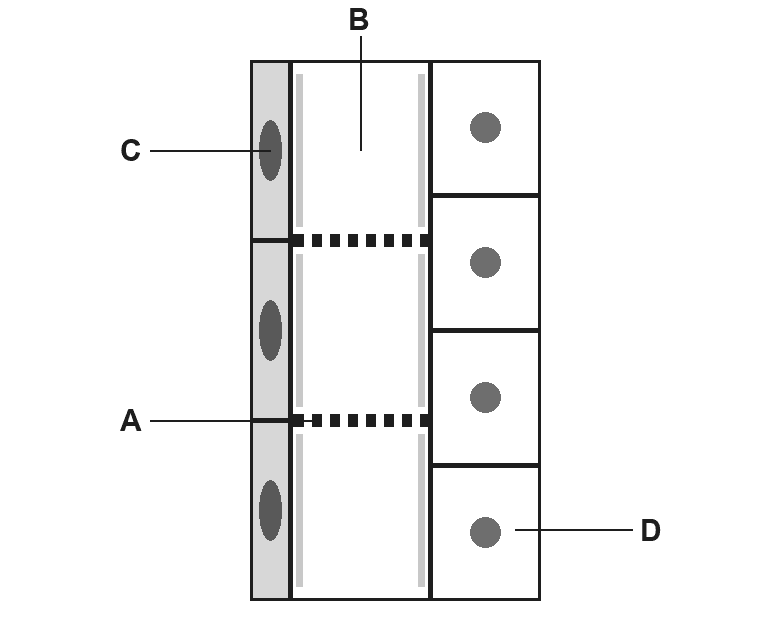
Identify the parts labelled A, B, C and D, and for each give one feature or function that shows how it is suited to its role.
- 152 marks
Question 15
A thin slice of a potato tuber is placed in dilute iodine solution and observed under a microscope. Many blue-black grains are seen inside large, thin-walled living cells.
Name (a) the tissue made of these cells, (b) the plastids that hold the grains, and state the function of this tissue in the tuber.
- 161 mark
Question 16
In a transverse section of the rhizome of sweet flag (Acorus), each vascular bundle has a central strand of phloem completely surrounded by a ring of xylem. Such a bundle is called
- 174 marks
Question 17
The figure shows simple transverse-section sketches of four vascular bundles, P, Q, R and S. In Q, R and S the top of the drawing faces the outside of the organ.
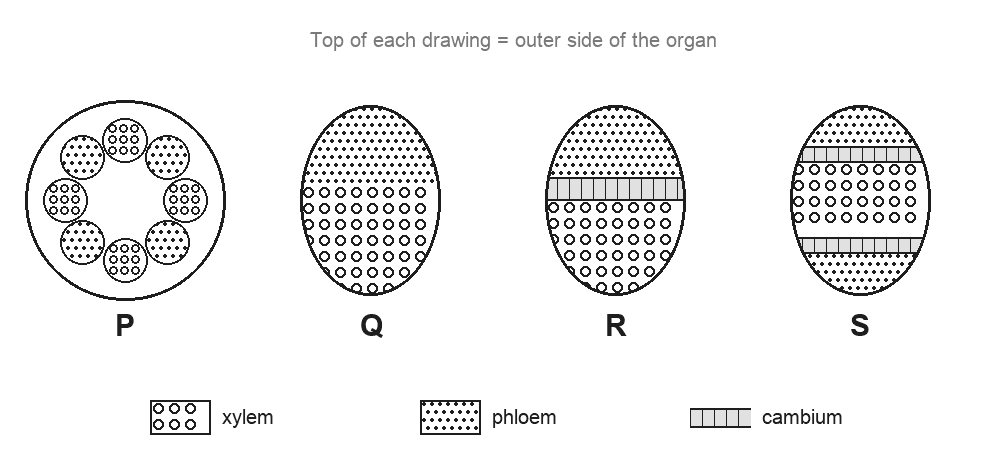
Name the type of vascular bundle shown by each of P, Q, R and S, and state one plant organ (or plant group) in which each type is found.
- 182 marks
Question 18
The epidermis of a leaf is covered by a waxy cuticle, but the epidermis of a root has no cuticle. Explain why each arrangement suits the organ.
- 191 mark
Question 19
On a leaf peel, the stomatal pore, the two guard cells around it and the specialised epidermal cells next to the guard cells are together called the
- 202 marks
Question 20
Cork, taken from the stem of the cork oak tree, is used (a) for stoppers of bottles and (b) in insulation boards. Explain which properties of cork cells make cork suitable for each use.
- 213 marks
Question 21
Sort the following into the three tissue systems of a plant, giving a reason for each group:
trichome, cortical parenchyma, xylem vessel, guard cell, pith, companion cell
- 221 mark
Question 22
Latex vessels are interconnected ducts formed by the fusion of several cells. In which of these plants would a student expect to find latex vessels?
- 232 marks
Question 23
A child brushes against a nettle plant on a school trip and soon feels a burning, itching pain on the skin. Name the secretory structures responsible, state whether they are external or internal glands, and explain how they cause the pain.
- 244 marks
Question 24
For each secretory structure below, state whether it is an external or an internal gland, and name the substance it secretes:
(a) honey glands (nectaries) in a flower
(b) oil glands in the peel of an orange
(c) resin-secreting glands (resin ducts) in the wood of Pinus
(d) glandular hairs on a tobacco leaf
- 251 mark
Question 25
When a branch of Euphorbia is broken, a white milky juice oozes out of it. This juice comes from
- 261 mark
Question 26
A lateral root is just starting inside a young root. On its way out to the soil, which tissues of the parent root must it grow through?
- 273 marks
Question 27
In an experiment, a root is placed in a solution of a dye. The dye can move freely through cell walls and intercellular spaces, but it cannot pass through suberin. After some hours the dye is seen in the walls of the epiblema and cortex but not in the walls inside the endodermis.
(a) Name the structure that stopped the dye and say where exactly it lies in the endodermal cells.
(b) Explain why the dye stopped there.
(c) What does this experiment tell us about how a root controls the entry of water and mineral salts into the xylem?
- 282 marks
Question 28
A student's slide of a young root shows three patches of xylem, with three patches of phloem lying between them.
(a) What term is used for a root with this number of xylem patches?
(b) Is the root more likely to be from a dicot or a monocot plant? Give one reason.
- 291 mark
Question 29
In the T.S. of a root, the xylem and phloem lie on different radii. What name is given to the parenchyma cells that fill the space between a xylem patch and the next phloem patch?
- 304 marks
Question 30
Study the diagram of the T.S. of the central part of a young root.
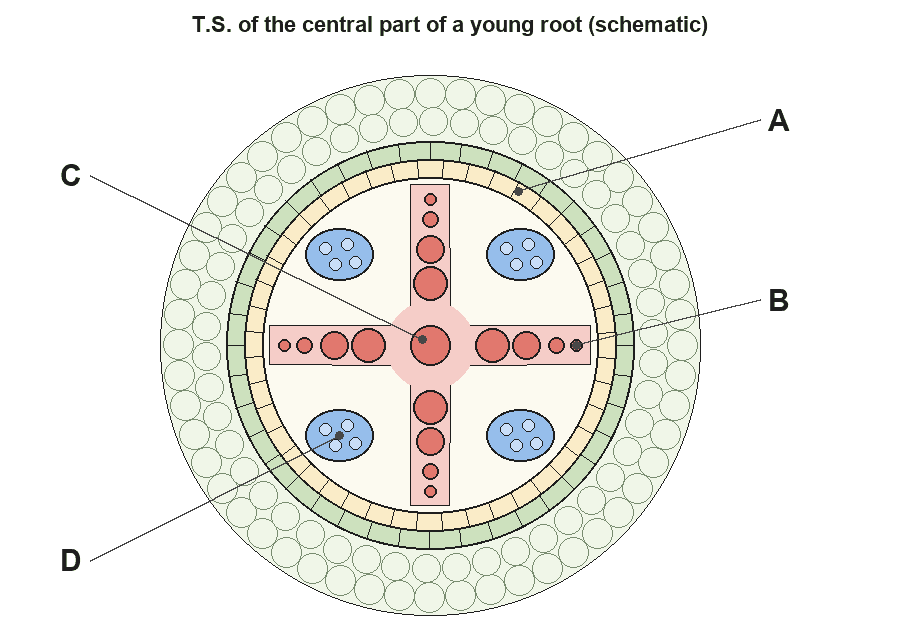
(a) Name the parts labelled A, B, C and D.
(b) Is the xylem exarch or endarch? Use the positions of B and C to explain.
(c) Name the type of vascular bundle seen here, and say whether the root is from a dicot or a monocot plant, giving one reason.
- 313 marks
Question 31
The outer layer of a young root (the epiblema) has no cuticle and bears root hairs, while the epidermis of a young dicot stem is covered by a cuticle and bears stomata. Explain how each of these outer layers suits the work of its organ.
- 321 mark
Question 32
In the T.S. of a vascular bundle of a maize stem, the xylem looks like the letter 'Y'. What are the two large vessels at the two upper arms of the 'Y'?
- 331 mark
Question 33
A student cuts a T.S. of a young stem. Its vascular bundles lie in a ring. In each bundle, phloem lies on both the outer and the inner side of the xylem, and a strip of cambium lies between the outer phloem and the xylem. Which plant could the stem be from?
- 342 marks
Question 34
The hypodermis of a young sunflower stem is made of collenchyma, while the hypodermis of a maize stem is made of sclerenchyma. State one feature of each kind of hypodermis and explain how it helps the stem.
- 353 marks
Question 35
A T.S. of a young sunflower stem is stained with iodine solution. Under the microscope a thin, wavy, blue-black ring appears just outside the ring of vascular bundles. A T.S. of a maize stem treated the same way shows no such ring.
(a) Name the layer that forms the ring and give its other name.
(b) Why does this layer turn blue-black?
(c) Why is no such ring seen in the maize stem?
- 361 mark
Question 36
Which statement correctly describes the pericycle of a young sunflower stem?
- 374 marks
Question 37
Answer these questions about a vascular bundle of a maize stem.
(a) Explain why the bundle is described as conjoint, collateral and closed.
(b) What is the lysigenous cavity, and how is it formed?
(c) Where does the protophloem lie, and what state is it in?
(d) How do the bundles near the outside of the stem differ from those near the centre?
- 381 mark
Question 38
In a vertical section through a vein of a mango leaf, where are the xylem and the phloem of the vascular bundle found?
- 393 marks
Question 39
In a dorsiventral leaf, the palisade parenchyma lies just below the upper epidermis and the spongy parenchyma lies above the lower epidermis. Explain how the structure and position of each layer suit its function.
- 403 marks
Question 40
A student counted stomata on the upper and lower surfaces of the leaves of two plants, P and Q. (Hypothetical data.)
Leaf Stomata per mm² on upper surface Stomata per mm² on lower surface P 40 280 Q 60 70 (a) For each leaf, find how many times more stomata there are on the lower surface than on the upper surface.
(b) Which leaf is most likely dorsiventral and which isobilateral? Give a reason.
(c) Which of the two leaves is more likely to be from a grass?
- 411 mark
Question 41
Which statement correctly describes the mesophyll of the isobilateral leaf of a grass?
- 422 marks
Question 42
Why does the upper surface of a mango leaf look darker green than its lower surface? Give two points.
- 431 mark
Question 43
In the trunk of a 40-year-old mango tree, which tissue makes up most of the trunk's thickness?
- 444 marks
Question 44
A core of wood was taken at breast height from a deodar tree in Himachal Pradesh in January 2026, before that year's growing season began. The core shows 48 complete annual rings.
(a) In which year was the outermost complete ring formed?
(b) In which year was the innermost ring of the core formed?
(c) A very narrow ring is the 12th ring counted from the outside. In which year was it formed?
(d) Give one reason why the true age of the tree is probably more than 48 years.
- 453 marks
Question 45
The widths of six annual rings of a pine tree in Uttarakhand were measured, from the 2015 ring to the 2020 ring. (Hypothetical data.)
Year 2015 2016 2017 2018 2019 2020 Ring width (mm) 2.4 2.6 0.8 2.2 2.5 1.0 (a) Find the total radial growth over the six years and the mean ring width.
(b) Which two years probably had the least favourable growing conditions? Explain your choice.
- 461 mark
Question 46
In secondary growth of a dicot root, the vascular cambium forms as a wavy ring. From which tissue does the part of this ring lying just outside each protoxylem patch arise?
- 473 marks
Question 47
In a dicot root, the vascular cambium is wavy when it first forms but soon becomes circular. Explain how this change happens, and state what the circular cambium then produces on each side.
- 481 mark
Question 48
Which statement about the secondary medullary rays of a woody stem is correct?
- 492 marks
Question 49
Cork from the bark of the cork oak has long been used to make bottle stoppers. Give two properties of cork tissue that suit this use, and explain what makes cork have each property.
- 501 mark
Question 50
In a shoot meristem, protoderm gives rise to
- 511 mark
Question 51
When phloem is present on both sides of the xylem, the vascular bundle is said to be
- 521 mark
Question 52
The intercalary meristem results in
- 531 mark
Question 53
Collenchyma differs from sclerenchyma in
(A) having thick cell walls
(B) having wide lumen
(C) being flexible
(D) being living at maturity
- 541 mark
Question 54
If parenchyma cells are green in colour, they are known as
- 551 mark
Question 55
Cork cells are
- 561 mark
Question 56
The living components of xylem are
- 571 mark
Question 57
Companion cells are present alongside
- 581 mark
Question 58
The conductive tissue present in gymnosperms consists of
- 591 mark
Question 59
The xylem that is formed from procambium and has lignified cell walls is known as
(A) primary xylem
(B) secondary phloem
(C) protoxylem
(D) metaxylem
- 601 mark
Question 60
The phloem formed from vascular cambium is known as
- 611 mark
Question 61
The casparian rings are found in
(A) monocot root
(B) dicot root
(C) monocot stem
(D) dicot stem
- 621 mark
Question 62
Alburnum is also called
- 631 mark
Question 63
Soft wood is associated with
- 641 mark
Question 64
The annual rings are bands of
- 651 mark
Question 65
The casparian rings are present in
- 661 mark
Question 66
The stele consists of
- 671 mark
Question 67
The fascicular cambium is present
- 681 mark
Question 68
The vascular bundles of a dicot stem are
- 691 mark
Question 69
The function of cork cambium is to produce
- 701 mark
Question 70
Pith is small or absent in
- 711 mark
Question 71
A dorsiventral leaf is identified by the presence of
- 721 mark
Question 72
A dicot root can be identified by
- 731 mark
Question 73
Which of the following are undifferentiated, actively dividing cells?
- 741 mark
Question 74
Collenchyma differ from sclerenchyma in
(A) having thick cell walls
(B) being flexible
(C) being living at maturity
(D) being strong
- 751 mark
Question 75
Cells that help in increasing the length of the plant by undergoing cell division are
- 761 mark
Question 76
Which of the following cells have thickened corners due to pectin?
- 771 mark
Question 77
Main function of the following tissue is to store food
- 781 mark
Question 78
The elongated sclerenchyma cells pointed at both the ends are called
- 791 mark
Question 79
The following tissue transports water and minerals in a plant
- 801 mark
Question 80
Which of the following is not a living component of phloem?
- 811 mark
Question 81
Which of the following tissue is mainly composed of dead cells?
- 821 mark
Question 82
Cork cambium results in the formation of cork, which becomes impermeable to water due to accumulation of
- 831 mark
Question 83
Companion cells in plants are associated with
- 841 mark
Question 84
In a plant organ which is covered by periderm and in which the stomata are absent, some gaseous exchange still takes place through
- 851 mark
Question 85
Wood is
- 861 mark
Question 86
Growth rings are formed due to activity of
- 871 mark
Question 87
Which of the following is true for heartwood
- 881 mark
Question 88
Vascular cambium of stem is
- 891 mark
Question 89
Intercalary meristem leads in
- 901 mark
Question 90
Vascular bundle is closed when
- 911 mark
Question 91
In dicot stem, vascular bundles are
- 921 mark
Question 92
Apical stem of shoot apex is
- 931 mark
Question 93
Which of the following is not a character of meristematic tissue?
- 941 mark
Question 94
Which is living mechanical tissue?
- 951 mark
Question 95
Periderm is formed by
- 961 mark
Question 96
In a woody dicotyledonous tree, which of the following parts will mainly consist of primary tissue?
(A) all parts
(B) stem and root
(C) flowers, fruits and leaves
(D) shoot tip and root tip
- 971 mark
Question 97
Fascicular, interfascicular and extrastellar cambium together constitute
- 981 mark
Question 98
Intercalary meristem is located in
- 991 mark
Question 99
The cells which help in rolling and unrolling of leaf lamina in grasses are
- 1001 mark
Question 100
Vascular bundles having phloem on periphery of outer and inner cambium are called
- 1011 mark
Question 101
Epiblema is characteristic of
(A) monocot roots
(B) dicot stems
(C) dicot roots
(D) monocot stems
- 1021 mark
Question 102
Which one of the following statements pertaining to plant structure is correct?
(A) cork lacks stomata, but lenticels carry out transpiration
(B) passage cells help in transfer of food from cortex to phloem
(C) sieve tube elements possess cytoplasm but no nuclei
(D) the shoot apical meristem has a quiescent centre
- 1031 mark
Question 103
Cork tissue arises from
- 1041 mark
Question 104
Inner, darker and harder portion of secondary xylem that cannot conduct water, in an older dicot stem, is called
- 1051 mark
Question 105
Dicot leaf differs anatomically from monocot leaf in
- 1061 mark
Question 106
Which of the following statement is true?
- 1071 mark
Question 107
A meristematic region present between xylem and phloem of open vascular bundle is called
- 1081 mark
Question 108
Opening in the core tissue which permits exchange of gas between atmosphere and internal tissue is called
- 1091 mark
Question 109
The cell walls of parenchyma are made up of _____.
- 1101 mark
Question 110
Collenchyma cells _____ intercellular spaces between them.
- 1111 mark
Question 111
_____ give hardness to the seed coat.
- 1121 mark
Question 112
Cork cells have thick walls impregnated with _____.
- 1131 mark
Question 113
_____ are the dead cells of phloem.
- 1141 mark
Question 114
When the protoxylem is present towards the centre and metaxylem towards the periphery it is called _____ arrangement.
- 1151 mark
Question 115
Jute, flax and hemp are some of the examples of _____ fibres.
- 1161 mark
Question 116
Shoot epidermis has multicellular hair called _____.
- 1171 mark
Question 117
Innermost layer of the cortex in a monocot root is _____ which is one cell thick.
- 1181 mark
Question 118
All the tissues that are present outside the vascular cambium are termed as _____.
- 1191 mark
Question 119
Xylem is a type of simple tissue.
- 1201 mark
Question 120
Collenchyma often contain chloroplasts.
- 1211 mark
Question 121
Guard cells are living and contain chloroplasts.
- 1221 mark
Question 122
Suberin is present in the cell walls of parenchyma.
- 1231 mark
Question 123
Tracheids are dead cells.
- 1241 mark
Question 124
Phloem fibres and phloem parenchyma are dead cells.
- 1251 mark
Question 125
Lateral meristems bring an increase in the length of a plant.
- 1261 mark
Question 126
In the shoot apex tunica forms the outer zone of cells.
- 1271 mark
Question 127
Calyptrogen region gives rise to pericycle and primary xylem in a root.
- 1281 mark
Question 128
Corners of the collenchyma cells are thickened by cellulose and pectin.
- 1291 mark
Question 129
Sclerides and fibres are two types of sclerenchyma cells.
- 1301 mark
Question 130
In radial vascular bundles, xylem and phloem are present on the same radius in one bundle.
- 1311 mark
Question 131
Hypodermis in a dicot stem is 4–5 layers of sclerenchyma cells.
- 1321 mark
Question 132
Ring porous woods are present in plants of temperate regions.
- 1331 mark
Question 133
Cells in the cork are filled with suberin which is impermeable to water.
- 1345 marks
Question 134
Match the following:
Column A Column B 1. Cork cambium (a) Phelloderm 2. Secondary cortex (b) Casparian strip 3. Epiblema (c) Bulliform cells 4. Endodermis (d) Phellogen 5. Isobilateral leaf (e) Piliferous layer - 1351 mark
Question 135
Vascular bundles having xylem and phloem on different radii.
- 1361 mark
Question 136
Radial rows of big, rectangular parenchymatous cells.
- 1371 mark
Question 137
The layer formed to the inside of the cork cambium.
- 1381 mark
Question 138
Aerating pores present in the cork.
- 1391 mark
Question 139
The central parenchymatous zone present in the dicot stem.
- 1401 mark
Question 140
Thickenings present in sclerenchyma cells.
- 1411 mark
Question 141
Tissue present in soft part of the plant like cortex and pith of stem.
- 1421 mark
Question 142
Waterproof layer present on the outer wall of epidermal cells.
- 1431 mark
Question 143
A component of phloem formed by end to end fusion of cells with perforated transverse walls.
- 1441 mark
Question 144
Meristematic tissue responsible for secondary growth in plants in the cortex region.
- 1451 mark
Question 145
Type of vascular bundle when xylem is placed towards inside and phloem towards outside.
- 1461 mark
Question 146
Barrel-shaped cells without any intercellular spaces forming innermost layer of cortex in monocot root.
- 1471 mark
Question 147
A layer of cells that forms a complete ring around the vascular bundles in a stele of root.
- 1481 mark
Question 148
Tightly packed parenchyma cells in mesophyll of dorsiventral leaf.
- 1491 mark
Question 149
Living wood, lightly coloured, conducts water and minerals in a plant.
- 1501 mark
Question 150
Assertion (A): Apical meristem and intercalary meristem both are primary meristems.
Reason (R): Both of these meristems appear early in life of a plant and help in the formation of the primary plant body.
- 1511 mark
Question 151
Assertion (A): The root has quiescent centre from which all the other cells are formed.
Reason (R): Quiescent centre gives rise to tunica and corpus cells at the root tip.
- 1521 mark
Question 152
Assertion (A): Cambium is a lateral meristem and causes growth in width or girth of a plant.
Reason (R): Cambium is made up of fusiform and ray initials in stem.
- 1531 mark
Question 153
Assertion (A): Sclerenchyma consists of long narrow cells with thick lignified cell walls.
Reason (R): They are usually dead and without protoplasm.
- 1541 mark
Question 154
Assertion (A): Bulliform cells are useful in the unrolling of leaf.
Reason (R): Bulliform cells in the leaves store water.
- 1551 mark
Question 155
Assertion (A): Each stoma is composed of two bean-shaped cells known as guard cells.
Reason (R): Guard cells regulate the opening and closing of stomata.
- 1561 mark
Question 156
Assertion (A): Bark constitutes all the tissues lying inside the vascular cambium.
Reason (R): Bark is made up of phellogen, phellem and phelloderm lying inside secondary phloem.
- 1571 mark
Question 157
Assertion (A): In dicot leaves, the epidermis covers both the upper surface (adaxial) and lower surface (abaxial).
Reason (R): The adaxial epidermis bears more stomata than the abaxial epidermis.
- 1581 mark
Question 158
Assertion (A): Sapwood is less durable than the heartwood.
Reason (R): Hollow tree trunks are due to the disappearance of sapwood.
- 1591 mark
Question 159
Assertion (A): Both monocot and dicot roots have radial vascular bundles.
Reason (R): Xylem and phloem occur in separate bundles and lie on different radii alternating with each other.
- 1603 marks
Question 160
Cork cambium forms tissues that form the cork. Do you agree with this statement? Explain.
- 1613 marks
Question 161
What is the significance of secondary growth in stem?
- 1623 marks
Question 162
Cut a transverse section of young stem of a plant from your school garden and observe it under the microscope. How would you ascertain whether it is a monocot stem or a dicot stem? Give reasons.
- 1633 marks
Question 163
Why are xylem and phloem called complex tissues?