
Opening your dashboard
Class 11 Biology Chapter 7 Animal Kingdom: Practice Questions
158 questions on Chapter 7, each worked through on its own page with the AI tutor. Class 11 Biology, ICSE 2026-27.
158 questions
1–13 marks · Mixed difficulty
- 13 marks
Question 1
The figure shows simplified cross-sections of three animals, X, Y and Z. The colour key shows the three germ layers.
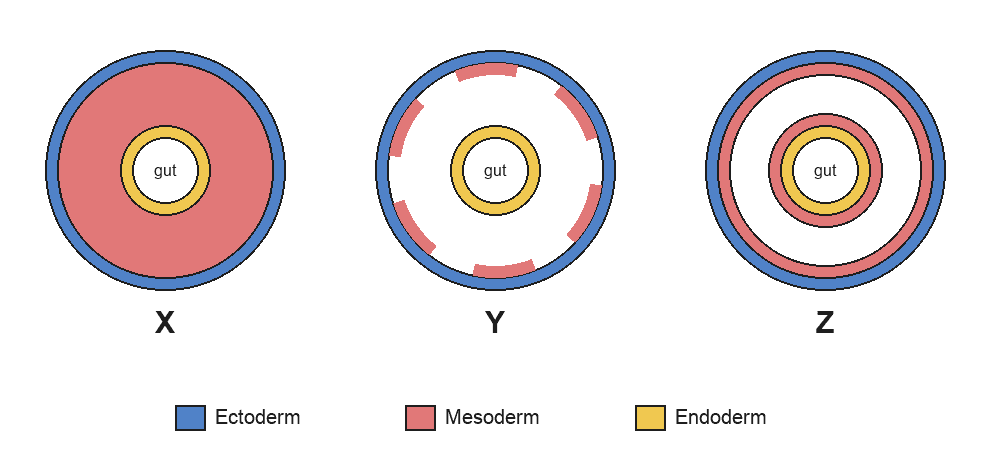
For each of X, Y and Z, name the type of body cavity shown and give one phylum that has this type.
- 21 mark
Question 2
In an earthworm, the muscles of the gut keep pushing food along while the body-wall muscles contract separately for crawling. Which function of the coelom makes this possible?
- 32 marks
Question 3
A sea anemone stays fixed to a rock, while Dugesia (a flatworm) glides forward over stones.
Explain how the body symmetry of each animal suits its way of life.
- 43 marks
Question 4
Four animals, P, Q, R and S, are described below.
Animal Germ layers Space between body wall and gut Openings of the gut Other feature P two, with jelly-like mesoglea — one stinging cells on tentacles Q three filled with mesoderm one flame cells R three cavity not lined by mesoderm all round two body unsegmented S three cavity lined by mesoderm on both sides two body in ring-like segments Arrange P, Q, R and S in order of increasing complexity. For each step up the order, name the new feature that appears.
- 51 mark
Question 5
During development, a zygote divides to form a hollow ball of cells. Further divisions turn it into a stage with an outer and an inner layer of cells. What is this two-layered stage called?
- 62 marks
Question 6
Hydra has a blind sac body plan, while Ascaris has a tube-within-a-tube body plan.
State one limitation of the blind sac plan and explain how the tube-within-a-tube plan overcomes it.
- 71 mark
Question 7
In sexual reproduction of a sponge, sperm released by one sponge enters another through the ostia. Which cell of the receiving sponge takes the sperm into its cytoplasm and passes it to the egg?
- 83 marks
Question 8
A student tests small pieces from three sponges, P, Q and R.
- P: its spicules fizz (give off a gas) when dilute hydrochloric acid is added.
- Q: its spicules do not fizz with the acid, and each spicule has six rays.
- R: it has no spicules; its skeleton is a network of soft protein fibres.
Name the class of Porifera to which each sponge belongs and give one example of each class.
- 92 marks
Question 9
A freshwater sponge, Spongilla, lives in a pond that dries up every summer, yet a new sponge appears at the same place after the rains.
Explain how gemmules make this possible.
- 101 mark
Question 10
A sponge is crushed and squeezed through a fine cloth filter. After some time, the separated cells in the filtrate come together and grow into a new sponge. What does this show?
- 111 mark
Question 11
Hydra catches a small water flea and pushes it into its coelenteron. Which endodermal cells pour their secretion onto the food to begin digesting it?
- 123 marks
Question 12
Three cnidarians, X, Y and Z, show these features.
- X: the polyp stage is dominant, the medusa is simple, and the gonads are ectodermal.
- Y: a large medusa is the dominant form, and the polyp stage is reduced.
- Z: there is only a polyp stage (no medusa), and it has a gullet lined by ectoderm.
Name the class of each and give one example of each class.
- 131 mark
Question 13
Physalia (Portuguese man of war) is a colony with different kinds of individuals. Which individuals use long tentacles with nematocysts to catch prey?
- 144 marks
Question 14
The stages in the life cycle of Obelia are given in jumbled order:
medusa, planula, polyp colony, zygote, gametes
(i) Arrange the stages in the correct order, starting with the polyp colony.
(ii) Which step in the cycle is asexual, and which is sexual?
(iii) Why does Hydra not show this kind of life cycle?
- 151 mark
Question 15
When one tentacle of a Hydra is touched, the whole body contracts, even though Hydra has no brain. Which arrangement of its nervous system allows this?
- 161 mark
Question 16
Pleurobrachia and Beroe are both comb jellies. Which feature places Beroe in class Nuda rather than class Tentaculata?
- 173 marks
Question 17
A student wrote these four statements about the comb jelly Pleurobrachia. Three of them are wrong.
- Its body bears six rows of ciliated comb plates.
- It is triploblastic, with organ level of organisation.
- It lives in freshwater ponds and lakes.
- It has two long retractable tentacles to capture prey.
Identify the correct statement, and rewrite each wrong statement correctly.
- 181 mark
Question 18
Which of the following is present in the liver fluke Fasciola but absent in the tapeworm Taenia solium?
- 193 marks
Question 19
Dugesia (planaria) is a free-living flatworm with no circulatory system.
(i) What happens if a Dugesia is cut into three pieces?
(ii) How does digested food reach all its cells without blood vessels?
(iii) How does it get rid of undigested food?
- 202 marks
Question 20
The body of Dugesia is covered by a ciliated epidermis without a cuticle, while the body of a tapeworm is covered by a thick cuticle without cilia.
Give a reason for each of these two features.
- 211 mark
Question 21
A doctor advises children in a village to wear footwear when walking on damp soil, to prevent a roundworm whose larvae live in soil and enter through the skin of the feet. Which roundworm is it?
- 223 marks
Question 22
Ascaris moves by thrashing, wave-like bends of its body, while an earthworm crawls by alternately lengthening and shortening its segments.
Explain this difference by comparing the body-wall muscles of the two animals, and state the role of setae in the earthworm.
- 233 marks
Question 23
While studying the ventral surface of an earthworm, Pheretima posthuma, a student finds:
- a single pore on the 14th segment;
- a pair of pores on the 18th segment;
- small raised structures on the 17th and 19th segments.
Identify each of these three structures and state what passes out of the two kinds of pores.
- 244 marks
Question 24
A worm collected from the sand on a sea beach has paired lateral flaps called parapodia on its segments, has no clitellum, and the sexes are separate.
(i) Name its class and give one example.
(ii) What type of fertilisation does it show?
(iii) How does its development differ from that of an earthworm?
(iv) State one other way in which its reproduction differs from that of an earthworm.
- 252 marks
Question 25
An earthworm that crawls onto a hot, dry pavement on a sunny day soon dies, even though it is not injured.
Give the reason.
- 261 mark
Question 26
In a rock pool at the seashore, a student finds an animal whose head and thorax are covered by one shield-like carapace. It has two pairs of antennae, a pair of stalked compound eyes, and it breathes through gills. To which class of Phylum Arthropoda does it belong?
- 272 marks
Question 27
Under a pile of damp, rotting leaves in a garden, a student finds a long, worm-like arthropod made of many segments. Most of its segments carry two pairs of legs. It feeds on the rotting leaves and rolls into a tight coil when touched.
(a) Name the animal and the class of arthropods it belongs to.
(b) State two ways in which it differs from a centipede.
- 283 marks
Question 28
A housefly usually escapes just before a swatter hits it, even though its compound eyes are said to give only a mosaic (rather hazy) picture.
(a) What is a compound eye made of?
(b) Why is the picture it forms called a mosaic?
(c) Explain why such an eye is still very good at detecting movement.
- 291 mark
Question 29
Which one of the following pairs of an arthropod and its respiratory organ is NOT correct?
- 303 marks
Question 30
A student's insect collection has a dragonfly, a locust and a butterfly. For each insect, state:
(i) whether it belongs to Exopterygota or Endopterygota;
(ii) whether its metamorphosis is complete or incomplete;
(iii) whether it can fold its wings when at rest.
- 311 mark
Question 31
On a river bank, a student picks up an empty shell made of two equal valves joined along one edge by a hinge ligament. The living animal that made this shell would most likely have had:
- 322 marks
Question 32
(a) Name the soft, spongy layer that covers the visceral hump of a snail and builds its shell.
(b) A pond snail and a garden snail both have a mantle cavity, but they use it differently. Explain how.
- 333 marks
Question 33
Molluscs are usually described as bilaterally symmetrical, yet the adult garden snail (Helix) is asymmetrical.
(a) What is torsion?
(b) In which class of molluscs does torsion occur?
(c) Explain how this explains the snail's lack of symmetry, and say whether a freshwater mussel shows torsion.
- 342 marks
Question 34
Pond snails kept in a school aquarium leave clean trails across the green algae growing on the glass.
(a) Name the feeding organ that makes these trails.
(b) Describe its structure and how it works.
- 354 marks
Question 35
Give reasons:
(i) A freshwater mussel has no radula, yet it gets enough food.
(ii) Cephalopods are called ‘head-footed’ molluscs.
(iii) Pila, which lives in water, and Helix, which lives on land, are placed in the same class.
(iv) A cuttlefish (Sepia) is a mollusc even though no shell can be seen from outside.
- 361 mark
Question 36
A starfish wraps its arms round a mussel, slowly pulls the two valves a little apart and soon digests the soft body of the mussel. How does the starfish digest it?
- 373 marks
Question 37
(a) The larva of a starfish is bilaterally symmetrical, but the adult has five-parted radial symmetry. What does this suggest about the ancestors of echinoderms?
(b) Echinoderms are thought to be closely related to chordates. Give two features of their early development that support this.
- 381 mark
Question 38
A diver photographs an echinoderm with a small central disc and five long, thin arms that are sharply marked off from the disc. It moves by snake-like bending of its arms, and its tube feet have no suckers. To which class does it belong?
- 393 marks
Question 39
The figure shows a marine, worm-like animal dug out of a burrow in the sand at low tide.

(a) Name the body regions labelled A, B and C.
(b) Name the excretory organ found in region A.
(c) A structure in region A was once thought to be a notochord. Name it, and name the chordate feature that this animal clearly shares with chordates.
- 401 mark
Question 40
The larva of the sea squirt Herdmania swims freely and shows the chordate features. The adult is a sac-like animal fixed to a rock and covered by a tunic. Which chordate feature does the adult still show?
- 412 marks
Question 41
Branchiostoma (Amphioxus) is a small, fish-like marine animal, a few centimetres long.
(a) Why is it placed in Subphylum Cephalochordata?
(b) Give two reasons why it is not a vertebrate.
- 424 marks
Question 42
A student records these observations on four adult animals P, Q, R and S.
Animal Notochord in the adult Pharyngeal gill slits Vertebral column Main nerve cord P Runs the whole length of the body Present in the adult Absent Dorsal and hollow Q Absent (present only in the larval tail) Present in the adult Absent Reduced in the adult (dorsal and hollow in the larva) R Absent (present only in the embryo) Present only in the embryo Present Dorsal and hollow, with a brain S Absent at every stage Absent Absent Ventral, solid and double Name the group (chordate subphylum, or non-chordate) to which each animal belongs, giving one reason for each.
- 431 mark
Question 43
A teacher shows a cross-section of an earthworm and one of a fish. Which statement correctly compares their nervous systems and other features?
- 441 mark
Question 44
A fisherman pulls up a dead fish from the deep sea floor. Inside it is a slimy, scaleless, eel-like animal with no jaws and no paired fins. It has a single nostril at the tip of its snout, sensory tentacles around its mouth and rows of slime glands. What is it most likely to be?
- 453 marks
Question 45
Bony fishes live both in the sea and in rivers and ponds.
(a) In which direction does water tend to move by osmosis between the body and the surroundings in (i) a marine bony fish and (ii) a freshwater bony fish?
(b) How do the overlapping scales on the body help each of them?
(c) Name the organs that further keep the water balance.
- 463 marks
Question 46
In the cold months, a frog stays at the bottom of a pond, resting on the mud, for many weeks without coming up to the surface to breathe air.
(a) What is this winter sleep called?
(b) Which mode of respiration keeps the frog alive at this time, and why must its skin stay moist?
(c) Why is a much smaller supply of oxygen enough for it during this period?
- 471 mark
Question 47
A cat catches a wall lizard (Hemidactylus) by the tail. The lizard breaks off its tail and escapes while the tail keeps wriggling on the floor. How does this help the lizard?
- 482 marks
Question 48
Pigeons are often seen pecking up small pebbles along with grain.
(a) Why do birds swallow such small stones?
(b) Name the chamber of the bird's digestive system in which the swallowed grain is stored and softened before it reaches the stones.
- 493 marks
Question 49
A dentist explains that human teeth, like those of most mammals, are thecodont, heterodont and diphyodont. Explain what each of these three terms means.
- 501 mark
Question 50
Which pair of animals are both odd-toed hoofed mammals?
- 511 mark
Question 51
The body cavity formed by splitting of the mesoderm is called
- 521 mark
Question 52
Pseudocoelom is found in
- 531 mark
Question 53
The body of tapeworm is said to be
- 541 mark
Question 54
Which of the following cells are found in porifera only?
- 551 mark
Question 55
Which of the following is found in sponges only?
- 561 mark
Question 56
Which of the following does not have a medusa stage?
(A) jellyfish
(B) Hydra
(C) Obelia
(D) corals
- 571 mark
Question 57
Which of the following level of organisation is found in coelenterates?
- 581 mark
Question 58
The cavity present in Hydra is called
- 591 mark
Question 59
Haemocoel is present in
- 601 mark
Question 60
Excretion in flatworms is by
- 611 mark
Question 61
A triploblastic, unsegmented animal with complete alimentary canal could be a
- 621 mark
Question 62
The alimentary canal of nematodes has
- 631 mark
Question 63
Which animal shows locomotion by setae?
- 641 mark
Question 64
Coral reef is formed by
- 651 mark
Question 65
Common name of Sepia is
- 661 mark
Question 66
Which of the following has an ink gland?
- 671 mark
Question 67
The radially symmetrical, diploblastic animals belong to phylum
- 681 mark
Question 68
Which animal has a modified mantle cavity to expel water with force?
- 691 mark
Question 69
A characteristic feature of insects is
- 701 mark
Question 70
Which of the following is an insect?
- 711 mark
Question 71
Which of the following groups do not have the antennae?
- 721 mark
Question 72
An animal that has 1 pair of jointed legs on each segment is
- 731 mark
Question 73
Locomotion in starfish is with the help of
- 741 mark
Question 74
Which of the following is a fish?
- 751 mark
Question 75
Which of the following is an echinoderm?
- 761 mark
Question 76
Which of the group is only marine?
- 771 mark
Question 77
Chordates may not have a
- 781 mark
Question 78
Which one is not a feature of Agnatha?
- 791 mark
Question 79
Which one of the following is not a bony fish?
- 801 mark
Question 80
A shark does not have
- 811 mark
Question 81
Which one of the following has a four-chambered heart?
- 821 mark
Question 82
Which one of the following has a three-chambered heart?
(A) frog
(B) snake
(C) crocodile
(D) lizard
- 831 mark
Question 83
Which one of the following is a cold-blooded animal?
- 841 mark
Question 84
Which one of the following is characteristic of mammals only?
- 851 mark
Question 85
Whale belongs to the group
- 861 mark
Question 86
The most primitive placental mammal is
- 871 mark
Question 87
The lateral line system of sense organs is found only in
- 881 mark
Question 88
Humans belong to the group
- 891 mark
Question 89
Rodents are also known as
- 901 mark
Question 90
All hoofed mammals
- 911 mark
Question 91
In molluscs, the pearl is secreted by
- 921 mark
Question 92
Petromyzon belongs to
- 931 mark
Question 93
What is true about class Insecta?
- 941 mark
Question 94
Metameric segmentation is the main feature of
- 951 mark
Question 95
Exoskeleton of insects is formed of
- 961 mark
Question 96
'Portuguese man of war' is
- 971 mark
Question 97
Which of the following is not the locomotory organ of Protozoa?
- 981 mark
Question 98
Tube feet are characteristic structures of
- 991 mark
Question 99
Which of the following animals has a notochord throughout its life?
- 1001 mark
Question 100
Which one of the following has an open circulatory system?
- 1011 mark
Question 101
Flow of water in a sponge is from ostia to canals to _____ to osculum.
- 1021 mark
Question 102
Polyp and _____ are two forms of Phylum Cnidaria.
- 1031 mark
Question 103
Body cavity of tapeworm is a _____.
- 1041 mark
Question 104
Excretion in Phylum Aschelminthes is by _____.
- 1051 mark
Question 105
Locomotion of earthworm is by _____.
- 1061 mark
Question 106
Phylum _____ has animals with a haemocoel and jointed legs.
- 1071 mark
Question 107
Respiration of molluscs is by gills called _____.
- 1081 mark
Question 108
Sea urchin and sea cucumber belong to Phylum _____.
- 1091 mark
Question 109
_____ is a unique system found in echinoderms.
- 1101 mark
Question 110
Hemichordata resembles chordates in having _____.
- 1111 mark
Question 111
Cyclostomates have _____ fins at the back and a tail fin that helps in swimming.
- 1121 mark
Question 112
Chondrichthyes have _____ tail fin, mouth on the _____ side and do not have _____.
- 1131 mark
Question 113
_____ is a _____ fish in which male has a brood pouch where female lays eggs.
- 1141 mark
Question 114
_____ have two-chambered heart and scaly skin, while _____ have three-chambered heart with smooth and moist skin.
- 1151 mark
Question 115
Reptiles have large yolk-filled eggs having a special third membrane called _____.
- 1161 mark
Question 116
Birds are oviparous and disappearance of _____ and _____ reduces weight and is an adaptation for flight.
- 1171 mark
Question 117
Protozoans are single-celled animals.
- 1181 mark
Question 118
Hydra is a diploblastic animal.
- 1191 mark
Question 119
Tapeworm has a true segmented body.
- 1201 mark
Question 120
Annelida have a true body cavity.
- 1211 mark
Question 121
Haemocoel is present in group arthropoda.
- 1221 mark
Question 122
Sharks have ventral mouth.
- 1231 mark
Question 123
Frog has two-chambered heart.
- 1241 mark
Question 124
Birds are warm-blooded animals.
- 1251 mark
Question 125
Excretory organs of phylum annelida are protonephridia.
- 1261 mark
Question 126
Amphibians have dry scaly skin.
- 12710 marks
Question 127
Match the following:
Column I Column II 1. Choanocytes (a) Reptilia 2. Amniotic egg (b) Platyhelminthes 3. 2-chambered heart (c) Echinodermata 4. Flame cells (d) Arthropoda 5. Haemocoel (e) Aves 6. Nephridia (f) Sponge 7. Water vascular system (g) Fish 8. Warm-blooded (h) Mammals 9. Seven cervical vertebrae (i) Aschelminthes 10. Pseudocoelom (j) Annelida - 12813 marks
Question 128
Match the following:
Column I Column II 1. Porifera (a) Tube feet 2. Cnidaria (b) Cnidoblasts 3. Annelida (c) Placoid scales 4. Mollusca (d) Setae 5. Echinodermata (e) Osculum 6. Hemichordata (f) Tunicata 7. Urochordata (g) Visceral mass 8. Cyclostomata (h) Lamprey 9. Chondrichthyes (i) Frog 10. Osteichthyes (j) Chameleon 11. Amphibia (k) Balanoglossus 12. Reptilia (l) Pinna 13. Mammals (m) Bony fish - 1291 mark
Question 129
An animal that locates objects by echo.
- 1301 mark
Question 130
A group of mammals having long incisors.
- 1311 mark
Question 131
The giant reptiles of olden times.
- 1321 mark
Question 132
A jawless vertebrate attached to a fish.
- 1331 mark
Question 133
An animal with one pair of legs on each segment.
- 1341 mark
Question 134
An animal that releases a compound hirudin.
- 1351 mark
Question 135
Diploblastic, multicellular animals with coelenteron.
- 1361 mark
Question 136
Triploblastic, unsegmented with pseudocoelom.
- 1371 mark
Question 137
Jointed legs, exoskeleton of chitin, haemocoel.
- 1381 mark
Question 138
Spiny skinned, radially symmetrical, have tube feet.
- 1391 mark
Question 139
Jawless mouth, slimy skin without scales, two-chambered heart.
- 1401 mark
Question 140
Anterior mouth, gills in operculum, two-chambered heart.
- 1411 mark
Question 141
Dry scaly skin, 3-chambered heart with partial septum.
- 1421 mark
Question 142
Unsegmented, worm-like animals with proboscis, collar and trunk.
- 1431 mark
Question 143
Segmented, bilateral, symmetrical, coelomate, locomotion by setae or parapodia.
- 1441 mark
Question 144
Assertion (A): Phylum Porifera has simple multicellular animals with cellular differentiation only.
Reason (R): Poriferans have a cavity in the centre called spongocoel.
- 1451 mark
Question 145
Assertion (A): Cnidoblasts are present on the tentacles and the body in cnidarians.
Reason (R): Cnidoblasts are present in the endodermal layer and help in contraction of cnidarians.
- 1461 mark
Question 146
Assertion (A): Aschelminthes are known as pseudo-coelomates.
Reason (R): In aschelminthes, mesoderm is present as scattered pouches in between ectoderm and endoderm.
- 1471 mark
Question 147
Assertion (A): Excretion in arthropods is by a number of interconnected nephridia.
Reason (R): Arthropods have a closed circulatory system.
- 1481 mark
Question 148
Assertion (A): Fishes have a lateral line system which consists of series of pits all along the lateral side of the body.
Reason (R): Lateral line system contains nerve cells which act as sense organs to detect vibrations and electric fields.
- 1491 mark
Question 149
Assertion (A): Water vascular system is the characteristic feature of echinoderms.
Reason (R): Main function of water vascular system is locomotion.
- 1501 mark
Question 150
Assertion (A): A shark can stay at a desired level in water without swimming.
Reason (R): It has a buoyancy-regulating organ called as the swim bladder.
- 1511 mark
Question 151
Assertion (A): Birds have one ovary.
Reason (R): This reduces the body weight for flight.
- 1521 mark
Question 152
Assertion (A): The duck-billed Platypus and the spiny anteater, both are egg-laying animals yet they are grouped under mammals.
Reason (R): Both of them have 7 cervical vertebrae and 12 pairs of cranial nerves.
- 1531 mark
Question 153
Assertion (A): Amphibians undergo summer sleep called aestivation.
Reason (R): Their heart is three-chambered with a partial septum in the ventricles.
- 1542 marks
Question 154
How useful is the study of the nature of body cavity and coelom in the classification of animals?
- 1552 marks
Question 155
Distinguish between intracellular and extracellular digestion.
- 1562 marks
Question 156
What is the difference between direct and indirect development?
- 1572 marks
Question 157
How important is the presence of air bladder in Pisces?
- 1582 marks
Question 158
Could the number of eggs or young ones produced by an oviparous and viviparous mother be equal? Why?