
Opening your dashboard
Class 11 Biology Chapter 28 Neural Control and Coordination: Practice Questions
165 questions on Chapter 28, each worked through on its own page with the AI tutor. Class 11 Biology, ICSE 2026-27.
165 questions
1–4 marks · Mixed difficulty
- 11 mark
Question 1
A batter facing a fast ball must react within a fraction of a second, using particular muscles of the arms and legs. Which coordinating system suits this task, and why?
- 23 marks
Question 2
A driver sees a traffic light turn red and presses the brake pedal with the right foot. For this response, name:
(a) the receptor and the effector;
(b) the pathway that carries impulses from the receptor to the central nervous system, and the pathway that carries impulses from the central nervous system to the effector;
(c) the part of the nervous system that interprets the signal and decides on the response.
- 32 marks
Question 3
For each activity below, name the division of the peripheral nervous system that carries the motor commands (voluntary or autonomic), and give one reason.
(a) Writing a letter with a pen.
(b) The wave-like movements of the intestine wall that push food along.
- 43 marks
Question 4
On a very hot day, signals about the rising body temperature reach the hypothalamus. Within seconds the hypothalamus sends nerve impulses that start sweating. It also controls the release of pituitary hormones, which help the body to save water over the following hours.
(a) Why is the hypothalamus described as part of a neuroendocrine system?
(b) Using this example, compare nervous and endocrine control in speed and spread of action.
(c) Why does the body need both systems to keep its internal conditions steady?
- 51 mark
Question 5
During a lumbar puncture, a doctor passes a fine needle between two vertebrae in the lower back into the space between the arachnoid and the pia mater, and draws out a few drops of a clear fluid. Which statement about this fluid is correct?
- 63 marks
Question 6
(Hypothetical case.) A stroke damages part of the cerebral cortex in the frontal lobe of a man's left cerebral hemisphere, just in front of the sensory area. Afterwards he cannot move his right arm and right leg at will, but he can still feel a light touch on them.
(a) Which functional area of the cerebral cortex has been damaged?
(b) Why are the right limbs affected when the damage is on the left side of the brain?
(c) Why has he not lost the sense of touch in these limbs?
- 74 marks
Question 7
(Hypothetical cases.) Each of four patients has damage limited to one part of the brain.
(a) Patient W walks unsteadily, sways while standing and cannot make smooth, well-coordinated movements, although the muscles are strong.
(b) Patient X has irregular breathing, an unsteady heart rate and changing blood pressure.
(c) Patient Y cannot keep a steady body temperature and feels abnormal thirst and hunger.
(d) Patient Z remembers events from many years ago but cannot form new long-term memories of what happened today.
Name the part of the brain most likely damaged in each patient, giving a reason.
- 81 mark
Question 8
A small tumour presses on the structure at the centre of the forebrain through which sensory signals pass on their way to the cerebral cortex, and which sends each signal on to the right area of the cortex. The structure affected is the
- 91 mark
Question 9
The centres that control breathing, heart rate and blood pressure lie in the brainstem. Which of the following is NOT a part of the brainstem?
- 101 mark
Question 10
The polio virus can destroy the cell bodies of motor neurons that lie in the ventral horns of the grey matter of the spinal cord. In a leg affected in this way, which result is expected?
- 112 marks
Question 11
The surface of each human cerebral hemisphere is thrown into many folds.
(a) What are the ridges and the grooves between them called?
(b) Explain the advantage of this folding for the cerebral cortex.
- 121 mark
Question 12
Human spinal nerves arise in pairs: 8 cervical, 12 thoracic, 5 lumbar, 5 sacral and 1 coccygeal pair. There are also 12 pairs of cranial nerves. How many individual nerves (counting the left and right nerve of each pair separately) arise directly from the brain and spinal cord together?
- 133 marks
Question 13
(Hypothetical case.) An accident cuts only the dorsal root of one spinal nerve, which supplies a small patch of skin and a few muscles of the thigh. The ventral root of the same nerve is undamaged.
(a) Will the person feel a pin prick on that patch of skin?
(b) Will a pin prick there cause a reflex withdrawal of the thigh?
(c) Can the person still move those thigh muscles at will?
Give a reason for each answer.
- 144 marks
Question 14
(Hypothetical data.) A student sat calmly while readings were taken, and the readings were taken again one minute after a sudden loud crash gave the student a fright.
Reading Sitting calmly One minute after the fright Heart rate (beats per minute) 72 108 Arterial blood pressure (mm Hg) 116/76 138/88 Diameter of pupil (mm) 3 6 (a) Which division of the autonomic nervous system caused these changes?
(b) Explain how each of the three changes helps the body in an emergency.
(c) Which division brings the readings back to normal once the student calms down, and which neurotransmitter is released at the endings of its postganglionic fibres?
(d) Calculate the percentage rise in the student's heart rate.
- 151 mark
Question 15
Most postganglionic sympathetic fibres are adrenergic. The postganglionic sympathetic fibres that end on sweat glands are an exception. At their endings these fibres release
- 161 mark
Question 16
After a large lunch, a person relaxes in an armchair. Which set of changes is typical of the autonomic division that dominates at such a time?
- 173 marks
Question 17
During a check-up after a head injury, a doctor asks the patient to:
(a) follow a moving pen with the eyes, without turning the head;
(b) push the tongue out and move it from side to side;
(c) name the smell of coffee held under the nose, with the eyes closed.
Name the cranial nerve or nerves tested in each case, and state whether each is sensory, motor or mixed.
- 182 marks
Question 18
The preganglionic sympathetic fibres that supply the adrenal medulla pass through the sympathetic chain without forming a synapse and end directly on the cells of the adrenal medulla. These cells then release adrenaline and noradrenaline into the blood.
(a) In what way do the cells of the adrenal medulla take the place of postganglionic neurons?
(b) Why does this arrangement spread the effect of sympathetic stimulation through the whole body?
- 194 marks
Question 19
Draw a neat, labelled diagram of a myelinated multipolar neuron. Label the dendrites, cell body, nucleus, Nissl's granules, axon, myelin sheath, node of Ranvier, axon terminals and a synaptic knob, and mark the direction in which the nerve impulse travels.
- 201 mark
Question 20
A student studies a neuron from a dorsal root ganglion. A single short process leaves its cell body and then divides into two long branches: one runs towards the skin and the other into the spinal cord. This neuron is
- 211 mark
Question 21
A dye that stains RNA colours many dark, angular granules in the cell body and dendrites of a neuron, but none in its axon. These granules are
- 223 marks
Question 22
The human brain contains about 86 billion neurons, and current estimates put the number of glial (neuroglial) cells at roughly the same number.
(a) Estimate the total number of neurons and glial cells in the brain together.
(b) Glial cells do not conduct nerve impulses. State two functions they do perform.
(c) Unlike most mature neurons, many glial cells can divide. Why is this useful after an injury to the brain?
- 233 marks
Question 23
A thin transverse section of a nerve from the arm is examined under a microscope. It shows many nerve fibres grouped into bundles, all inside an outer covering. Name the connective tissue covering:
(a) the whole nerve;
(b) each bundle (fascicle) of nerve fibres;
(c) each individual nerve fibre.
- 242 marks
Question 24
In multiple sclerosis, the body's own immune system damages the myelin sheaths around axons in the brain and spinal cord.
(a) Which glial cells make these myelin sheaths?
(b) Explain why the nerve fibres outside the brain and spinal cord are not myelinated by the same cells.
- 251 mark
Question 25
Which statement correctly compares the dendrons (dendrites) with the axon of a typical multipolar neuron?
- 264 marks
Question 26
(Hypothetical data.) A fine electrode inside an axon records the membrane potential before and after a single threshold stimulus is applied at 1.0 ms.
Time (ms) 0 1.0 1.4 1.8 2.2 2.6 3.0 4.0 Membrane potential (mV) −70 −70 −50 +35 0 −72 −78 −70 (a) What is the resting membrane potential of this axon, and what does its negative sign show?
(b) Between which two recorded times does depolarisation take place, and which ion movement causes it?
(c) Between which two recorded times does repolarisation take place, and which ion movement causes it?
(d) Name the state of the membrane at 3.0 ms, and explain how the resting value is restored by 4.0 ms.
- 271 mark
Question 27
(Hypothetical data.) In the set-up shown, a stimulus applied at S starts an impulse in the axon. The impulse reaches recording electrode R₁ 1.2 ms after the stimulus and reaches recording electrode R₂ 2.0 ms after the stimulus. R₁ and R₂ are 40 mm apart.
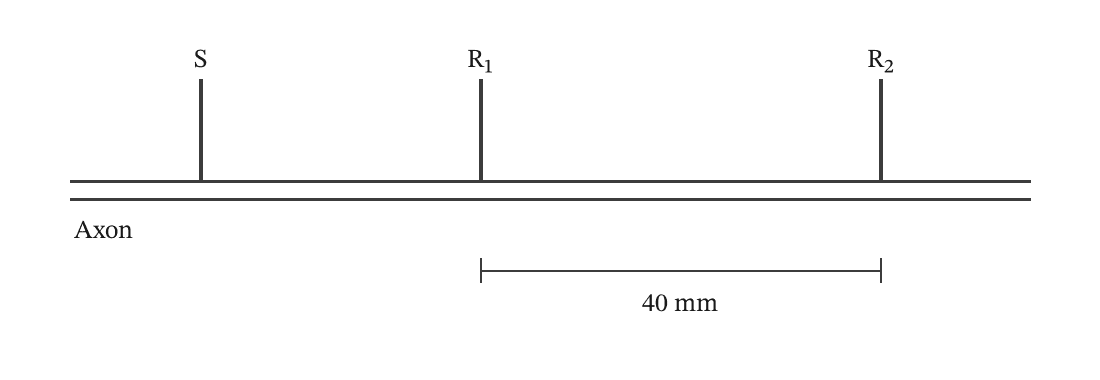
What is the conduction speed of the impulse between R₁ and R₂?
- 284 marks
Question 28
(Hypothetical data.) The table gives typical values for three nerve fibres.
Fibre Myelin sheath Diameter (µm) Conduction speed (m/s) P Present 10 60 Q Absent 1 1 R (squid giant axon) Absent 500 25 (a) Compare fibres Q and R. What do they show about the effect of axon diameter on conduction speed?
(b) Fibre P is only one-fiftieth as wide as fibre R, yet it conducts faster. Explain how its myelin sheath makes this possible.
(c) Calculate the time an impulse takes to travel 0.9 m (from a toe to the spinal cord) along fibre P and along fibre Q.
(d) Suggest why the human body depends on myelinated fibres rather than giant axons for fast conduction.
- 292 marks
Question 29
(Hypothetical data.) The threshold stimulus of a nerve fibre is 2.0 units. Single stimuli of 1.0, 2.0, 3.0 and 6.0 units are applied one at a time, with a rest between them. With the 2.0-unit stimulus, the membrane potential at the peak of the response is +35 mV.
(a) Predict the peak membrane potential for each of the other three stimuli.
(b) Name and state the law that explains your prediction.
- 301 mark
Question 30
Tetrodotoxin, a poison found in puffer fish, blocks the voltage-gated Na⁺ channels of axon membranes. An axon treated with it is given a strong stimulus. What is the most likely result?
- 312 marks
Question 31
(Hypothetical data.) In each cycle the sodium–potassium pump moves 3 Na⁺ ions out of an axon and 2 K⁺ ions into it. The pumps in a small patch of membrane complete 500 cycles in one second.
(a) How many Na⁺ ions and how many K⁺ ions are moved in one second, and what is the net number of positive charges moved out of the axon?
(b) Why is this pump described as electrogenic?
- 322 marks
Question 32
In a myelinated axon, the ion channels and the Na⁺–K⁺ pumps are concentrated at the nodes of Ranvier. Explain why a myelinated axon uses much less energy (ATP) than a non-myelinated axon to carry an impulse over the same length.
- 331 mark
Question 33
(Hypothetical experiment.) A nerve–muscle preparation is kept in a salt solution that contains no calcium ions. When the nerve is stimulated, action potentials still travel along the axon to its endings, but the muscle does not respond. The best explanation is that, without Ca²⁺,
- 343 marks
Question 34
At the junction between a motor neuron and a skeletal muscle fibre, the neurotransmitter is acetylcholine (ACh). Two drugs act at this junction:
- Drug X blocks the enzyme that normally breaks down ACh in the synaptic cleft.
- Drug Y attaches to the ACh receptor molecules on the muscle membrane and blocks them, without stimulating the muscle.
(a) Predict the effect of drug X on the muscle, giving a reason.
(b) Predict the effect of drug Y on the muscle, giving a reason.
(c) Why is the quick removal of ACh from the cleft important for normal control of the muscle?
- 351 mark
Question 35
Between some cells of the retina, a signal passes from one cell to the next with almost no delay. Which feature of the junction between them explains this?
- 362 marks
Question 36
Explain why, at a chemical synapse, a nerve impulse can pass only from the presynaptic neuron to the postsynaptic cell and not in the reverse direction.
- 371 mark
Question 37
At a chemical synapse, the action potential does not jump straight across to the postsynaptic cell. Which statement explains this?
- 384 marks
Question 38
(Hypothetical data.) In a reaction-time test, a partner holds a ruler vertically and drops it without warning, and a student catches it between thumb and finger. The distance (in metres) that the ruler falls before it is caught gives the reaction time (in seconds) from the formula , where . In five trials the ruler fell 21 cm, 19 cm, 20 cm, 22 cm and 18 cm.
(a) Find the mean distance fallen and the student's mean reaction time.
(b) Explain why catching the ruler is not a reflex action.
(c) A knee jerk is completed in a few hundredths of a second. Explain why it is so much faster than catching the ruler.
- 391 mark
Question 39
In the knee-jerk reflex, the sensory neuron from the stretch receptors in the thigh muscle synapses directly with the motor neuron inside the spinal cord. How many neuron-to-neuron synapses does this reflex arc have?
- 403 marks
Question 40
(Hypothetical data.) In a withdrawal reflex of the hand, the impulse travels 0.75 m along sensory fibres from the fingertip to the spinal cord and 0.75 m back along motor fibres to the arm muscles. Both kinds of fibre conduct at 60 m/s. The arc has two synapses inside the spinal cord, and the impulse also crosses the junction between the motor neuron and the muscle; each of these three junctions delays the impulse by about 1 ms. Ignore the time taken in the receptor and in the very short intermediate neuron.
(a) Calculate the total time from the stimulus to the start of the muscle's response.
(b) What percentage of this time is taken up at the junctions?
(c) Explain why the hand is often pulled away before the person feels any pain.
- 411 mark
Question 41
Which one of the following is NOT a reflex action?
- 423 marks
Question 42
(Hypothetical case.) After a fall, a patient's spinal cord is badly damaged in the upper back (thoracic region), well above the part of the cord that serves the legs. Some weeks later, when a doctor taps the tendon below the patient's knee cap, the leg kicks forward. However, the patient cannot feel the tap and cannot move the legs when trying to.
(a) Why does the knee jerk still occur?
(b) Why can the patient not feel the tap?
(c) Why can the patient not move the legs at will?
- 433 marks
Question 43
(Hypothetical data.) A person walks from bright sunshine into a dark room. The faintest light the person can see is measured at intervals.
Time in the dark (min) 0 2 5 8 10 15 20 30 Faintest light seen (relative units) 1000 300 120 100 40 6 2 1 (a) By how many times has the sensitivity of the person's eyes to light increased after 30 minutes?
(b) The values level off between 5 and 8 minutes and then fall again. Explain which photoreceptor cells are responsible for each part of the change.
(c) Why does a person with a deficiency of vitamin A see poorly in a dark room even after waiting a long time?
- 441 mark
Question 44
In a colour-vision test chart, a boy cannot pick out a red number printed among green dots, although he sees well in dim light and reads small print easily. The most likely cause is
- 453 marks
Question 45
(Hypothetical case.) A man has worked for 15 years beside very loud machines in a textile mill without ear protection. A hearing test shows that he has lost much of his ability to hear high-pitched sounds, although his ear drum and ear ossicles are normal.
(a) Which cells of the ear have most likely been damaged, and where are they found?
(b) Why does damage to these cells cause hearing loss even though sound vibrations still reach the inner ear?
(c) Suggest one way in which his co-workers can protect their hearing.
- 461 mark
Question 46
A girl reading a book in a car on a winding hill road begins to feel sick. Her eyes, fixed on the page, signal that she is still, while receptors in her inner ear signal that her head is turning one way and then the other. Which receptors detect this turning (rotation) of the head?
- 473 marks
Question 47
(Hypothetical data.) In a typical adult ear, the vibrating area of the ear drum is about 55 mm² and the area of the oval window is about 3.2 mm². The lever action of the three ear ossicles increases the force about 1.3 times.
(a) By how many times is the pressure increased because the force collected by the large ear drum is delivered onto the small oval window?
(b) Estimate the total increase in pressure at the oval window.
(c) Why must sound vibrations be strengthened in this way before they enter the inner ear?
- 481 mark
Question 48
On a dark night, a faint star may seem to disappear when you look straight at it, but you can see it when you look slightly to one side of it. Why?
- 491 mark
Question 49
With eyes closed and nose pinched, a volunteer has a drop of sugar solution placed on the side of the tongue, well away from the tip. The volunteer tastes it clearly as sweet. Which statement best explains this?
- 503 marks
Question 50
(Hypothetical data.) The table shows typical values of the near point (the nearest distance at which the eye can see an object clearly) at different ages.
Age (years) 10 20 30 40 50 60 Near point (cm) 7 10 14 22 40 100 (a) Describe how the near point changes with age, and state between which two recorded ages it first moves beyond the usual reading distance of 25 cm.
(b) Explain the cause of this change in terms of the lens and the ciliary muscles.
(c) Name this defect and state how it is corrected.
- 511 mark
Question 51
Which one of the following is an inner-most membrane that covers the brain?
- 521 mark
Question 52
Which one of the following is mainly associated with the maintenance of the posture?
- 531 mark
Question 53
Which one of the following butterfly-shaped mass is present in the spinal cord?
- 541 mark
Question 54
Nerve fibres that carry sensory impulse from spinal cord to brain are present in
- 551 mark
Question 55
The spinal nerves are
- 561 mark
Question 56
Number of cranial nerves in humans is
- 571 mark
Question 57
The ventral root of spinal cord carries the
- 581 mark
Question 58
A simple reflex arc has the following sequence
- 591 mark
Question 59
What is true of resting potential?
- 601 mark
Question 60
Saltatory conduction occurs in
- 611 mark
Question 61
Adrenergic nerve fibres release the following chemical at synapse
- 621 mark
Question 62
Postganglionic fibres are adrenergic in
- 631 mark
Question 63
Which one of the following forms the pigmented layer in eye?
- 641 mark
Question 64
The size of pupil is controlled by the
- 651 mark
Question 65
The region where an image is sharpest is known as
- 661 mark
Question 66
Aqueous humour is present between
- 671 mark
Question 67
Which of the following helps us to distinguish colours?
- 681 mark
Question 68
The organ in ear that helps to maintain equilibrium is
- 691 mark
Question 69
The organ that helps in hearing is
- 701 mark
Question 70
Perilymph is present in the
- 711 mark
Question 71
Olfactory nerve helps the animal to
- 721 mark
Question 72
The auditory receptors are present
- 731 mark
Question 73
Gustatory receptor cells are present in
- 741 mark
Question 74
Tip of the tongue carries the following taste
(i) sweet
(ii) sour
(iii) bitter
(iv) salt
- 751 mark
Question 75
Bipolar nerve cells are found in the
- 761 mark
Question 76
The cranial nerve that goes far down to the abdominal organs is
- 771 mark
Question 77
Corpus callosum is a band of
- 781 mark
Question 78
A depolarised membrane is
- 791 mark
Question 79
In myopia, the image is formed
- 801 mark
Question 80
Colour of the eye like blue or black is due to
- 811 mark
Question 81
The region of vertebrate eye, where the optic nerve passes out of the retina, is called
- 821 mark
Question 82
During accommodation for near vision
- 831 mark
Question 83
The all-or-none principle states that
- 841 mark
Question 84
The loss of positive ions from the interior of a neuron produces
- 851 mark
Question 85
Which statement about the autonomic nervous system is true?
- 861 mark
Question 86
Injury to vagus nerve in humans is not likely to affect
- 871 mark
Question 87
The point in the eye of mammals from where optic nerve and blood vessels leave the eye is
- 881 mark
Question 88
The primary visual area is located in which part of brain?
- 891 mark
Question 89
Choroid plexus is a network of
- 901 mark
Question 90
In the resting state of neural membrane, diffusion due to concentration gradients would drive
- 911 mark
Question 91
Olfactory receptors are for
- 921 mark
Question 92
Which of the following cranial nerves is not a motor nerve?
- 931 mark
Question 93
Which of the following is a mixed nerve?
- 941 mark
Question 94
Organ of Corti rests on
- 951 mark
Question 95
Which of the following is released by parasympathetic nervous system?
- 961 mark
Question 96
Internal ear is filled with
- 971 mark
Question 97
Rods and cones are modified
- 981 mark
Question 98
Sense of smell is perceived by
(i) pituitary
(ii) hypothalamus
(iii) olfactory lobes
(iv) cerebrum
- 991 mark
Question 99
Corpus callosum is formed between two
- 1001 mark
Question 100
Which part of human brain has centre for controlling breathing?
- 1011 mark
Question 101
Which part of nervous system controls the reflex activity of the body?
- 1021 mark
Question 102
Human ear ossicles are
- 1031 mark
Question 103
Which set of ions is necessary for the nerve impulse conduction?
- 1041 mark
Question 104
Which of the following has H-shaped grey matter?
- 1051 mark
Question 105
Reflex action is controlled by
- 1061 mark
Question 106
Nissl's granules are present in
- 1071 mark
Question 107
Post-ganglionic nerve fibres of sympathetic nerve system are
- 1081 mark
Question 108
Supporting and nutritive cells found in the brain are
- 1091 mark
Question 109
Correct sequence of meninges of brain from outside to inside is
- 1101 mark
Question 110
Sequence of ear ossicles from outside to inside is
- 1111 mark
Question 111
Static equilibrium is maintained by
- 1121 mark
Question 112
Bony labyrinth contains a fluid called
- 1131 mark
Question 113
Myelin sheath is derived from
(i) neuroglial cells
(ii) schwann cells
(iii) nerve cells
(iv) all of these
- 1141 mark
Question 114
Aqueous humour and vitreous humour are divided by
- 1151 mark
Question 115
Autonomic nervous system affects on
- 1161 mark
Question 116
Reflex arc consists of
- 1171 mark
Question 117
Sympathetic nerves ______ the pupil while parasympathetic nerves ______ it.
- 1181 mark
Question 118
Junction between two neurons is called a ______ while the junction between a neuron and a muscle fibre is called a ______ .
- 1191 mark
Question 119
Grasp reflex by a newborn body is ______ while smell of food causing salivation is a ______ reflex.
- 1201 mark
Question 120
A spinal nerve is a ______ nerve while the olfactory nerve is a ______ nerve.
- 1211 mark
Question 121
Sympathetic nerve fibres ______ the heart rate while parasympathetic nerve fibres ______ the heart rate.
- 1221 mark
Question 122
We see colour with the help of ______ cells while vision in dim light depends on ______ cells of the retina.
- 1231 mark
Question 123
Preganglionic sympathetic fibres are generally ______ than postganglionic sympathetic fibres while preganglionic parasympathetic fibres are ______ than postganglionic parasympathetic fibres.
- 1241 mark
Question 124
Space between cornea and lens is filled with ______ while that between the lens and retina is filled by ______ .
- 1251 mark
Question 125
Contraction of ciliary muscles ______ the curvature of lens while their relaxation ______ the curvature.
- 1261 mark
Question 126
______ is hammer shaped while ______ is stirrup like bone in middle ear.
- 1271 mark
Question 127
Rods are photoreceptor cells that are sensitive to bright light.
- 1281 mark
Question 128
Shortening of eyeball from front to back may lead to myopia.
- 1291 mark
Question 129
Hypermetropia can be corrected by using a lens that is convex.
- 1301 mark
Question 130
Meninges form protective covering of brain.
- 1311 mark
Question 131
Cochlea of ear helps in balancing of the body.
- 1321 mark
Question 132
Cerebrum has grey matter towards the outside.
- 1331 mark
Question 133
Voluntary muscular actions are controlled by cerebellum.
- 1341 mark
Question 134
Cerebral hemispheres are connected by corpus luteum.
- 1351 mark
Question 135
Optic nerve is present in cochlea of ear.
- 1361 mark
Question 136
Axon of a neuron contains a nucleus.
- 1371 mark
Question 137
Cells that secrete fatty insulating layer called myelin sheath around the axons.
- 1381 mark
Question 138
Non-nervous special cells that fill the most of interneuron space in central nervous system.
- 1391 mark
Question 139
Membrane potential that occurs in a nerve membrane on stimulation of a nerve fibre.
- 1401 mark
Question 140
A narrow fluid-filled intercellular space that separates the membrane of axon terminal end and the target cell.
- 1411 mark
Question 141
Scientific term for membranes that cover the central nervous system.
- 1421 mark
Question 142
Extracellular fluid present in the sub-arachnoid space.
- 1431 mark
Question 143
A thick band of nerve fibres that joins the two cerebral hemispheres.
- 1441 mark
Question 144
Fluid present in the anterior part of eye in front of the lens.
- 1451 mark
Question 145
Internal layer of eye where image is formed.
- 1461 mark
Question 146
A tube that connects middle ear to pharynx.
- 1471 mark
Question 147
Mark the odd one out: Eustachian tube; basilar membrane; taste buds; auditory ossicles
- 1481 mark
Question 148
Mark the odd one out: Ciliary muscles; choroid; fovea; gustatory cells
- 1491 mark
Question 149
Mark the odd one out: Dorsal root ganglion; preganglionic sympathetic neuron; lateral chain ganglia; postganglionic sympathetic neuron
- 1501 mark
Question 150
Mark the odd one out: Sodium pump; polarised membrane; resting membrane potential; threshold stimulus
- 1511 mark
Question 151
Mark the odd one out: Non-myelinated nerve fibre; saltatory conduction; node of Ranvier; myelin sheath
- 1521 mark
Question 152
Assertion (A): Transmission of nerve impulse across a synapse is accomplished by neurotransmitters.
Reason (R): Transmission across a synapse usually requires neurotransmitters because there is a small space, i.e., synaptic cleft that separates one neuron from another.
- 1531 mark
Question 153
Assertion (A): The axolemma of a neuron is more permeable to sodium ion (Na⁺) and nearly impermeable to potassium (K⁺).
Reason (R): In a resting state, neuron conducts impulses.
- 1541 mark
Question 154
Assertion (A): Myelinated nerve fibres are present in spinal and cranial nerves.
Reason (R): Myelinated nerves conduct impulses more rapidly than unmyelinated nerves.
- 1551 mark
Question 155
Assertion (A): All motor neurons are efferent neurons.
Reason (R): The motor neurons carry nerve impulses from the spinal cord to brain.
- 1561 mark
Question 156
Assertion (A): The presynaptic neuron transmits an impulse (action potential) across the synaptic cleft to the postsynaptic neuron.
Reason (R): The transmission of impulses at synapse occurs by the chemicals called neurotransmitters.
- 1571 mark
Question 157
Assertion (A): The association areas of forebrain are neither clearly sensory nor motor in function.
Reason (R): The association areas are responsible for complex functions like inter-sensory associations, memory and communication.
- 1581 mark
Question 158
Assertion (A): Cerebellum is related to the skillful voluntary movement and involuntary activity like body balance and equilibrium.
Reason (R): Cerebellum is a part of hind brain and is situated behind the pons.
- 1591 mark
Question 159
Assertion (A): Iris muscles show both dilation as well as constriction of pupil.
Reason (R): It is because the sympathetic and parasympathetic nervous system have antagonistic functions.
- 1601 mark
Question 160
Assertion (A): Vestibular apparatus of inner ear helps us in maintaining balance of body and posture.
Reason (R): Due to the arrangement of semi-circular canals of vestibular apparatus, movement of head in any direction will stimulate sensory cells to maintain dynamic equilibrium.
- 1611 mark
Question 161
Assertion (A): Astigmatism is due to uneven curvature of lens.
Reason (R): It can be corrected by wearing cylindrical lenses.
- 1623 marks
Question 162
Answer briefly:
(i) How do you perceive the colour of an object?
(ii) Which part of our body helps us in maintaining the body balance?
(iii) How does the eye regulate the amount of light that falls on the retina?
- 1633 marks
Question 163
Answer the following:
(i) Which part of the ear determines the pitch of a sound?
(ii) Which part of the human brain is the most developed?
(iii) Which part of our central neural system acts as a master clock?
- 1641 mark
Question 164
The region of the vertebrate eye, where the optic nerve passes out of the retina, is called the
- 1651 mark
Question 165
Which of the following structures or regions is incorrectly paired with its functions?