
Opening your dashboard
Class 11 Biology Chapter 27 Locomotion and Movement: Practice Questions
138 questions on Chapter 27, each worked through on its own page with the AI tutor. Class 11 Biology, ICSE 2026-27.
138 questions
1–6 marks · Mixed difficulty
- 11 mark
Question 1
A macrophage in the lining of an air sac pushes out finger-like projections of its cytoplasm, flows towards a dust particle and engulfs it. Which type of movement is the macrophage showing?
- 21 mark
Question 2
Chemicals in cigarette smoke slowly paralyse the cilia lining a smoker's trachea and bronchi. Which change is the most direct result of this damage?
- 32 marks
Question 3
An adult sponge stays fixed to a rock for the whole of its life, yet biologists say that a sponge shows movement.
(a) Name the cells whose movement drives water through the sponge's canal system, and the structure they use.
(b) Explain why this movement is not called locomotion.
- 44 marks
Question 4
Name the type of movement (amoeboid, ciliary, flagellar or muscular) in each case below, and give the reason for your choice.
(a) An ovum is carried along the oviduct towards the uterus.
(b) An Amoeba creeps forward across a film of pond water on a slide.
(c) Food is pushed along the small intestine.
(d) A human sperm swims through the female reproductive tract.
- 51 mark
Question 5
Which of the following is NOT an example of locomotion?
- 61 mark
Question 6
The figure is a simple sketch made from an X-ray of a girl's right forearm, taken with the arm straight and the palm facing forward. The thumb is marked. Bone X shows a fracture.
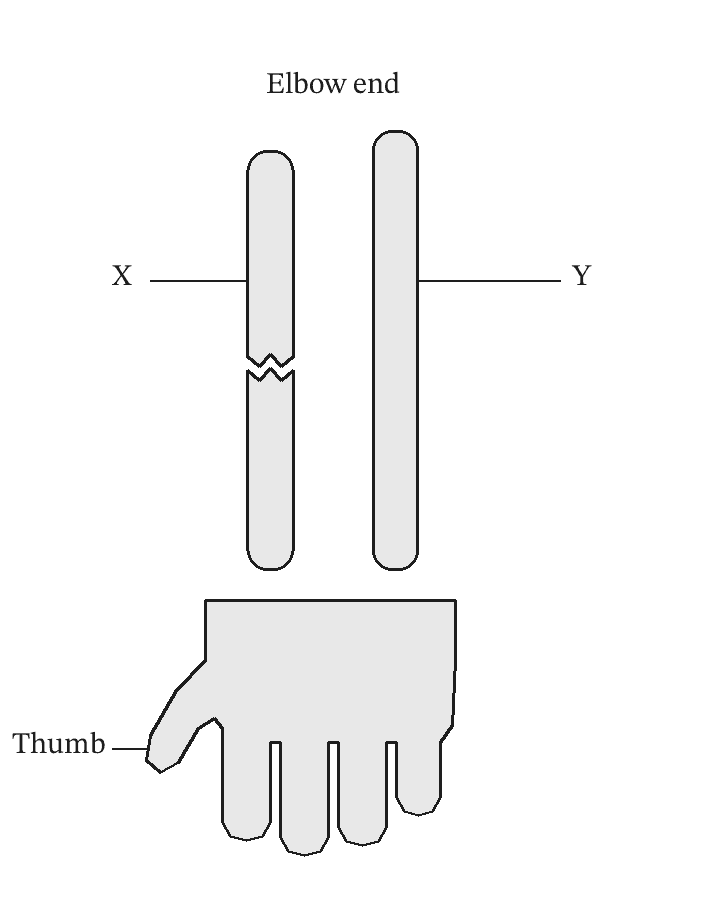
Which bone is fractured?
- 73 marks
Question 7
(Hypothetical data.) A teaching skeleton of an adult human is checked bone by bone. The counts are:
Part Bones counted Skull 29 Vertebral column 26 Sternum 1 Ribs 23 Pectoral girdles (both sides) 4 Pelvic girdle (both hip bones) 2 Right upper limb 30 Left upper limb 30 Right lower limb 30 Left lower limb 29 (a) How many bones does this skeleton have?
(b) How many bones are missing, and from which two parts?
(c) Does each missing bone belong to the axial or the appendicular skeleton?
- 81 mark
Question 8
A child's vertebral column has more separate vertebrae than an adult's. How many more, and why?
- 93 marks
Question 9
The vertebral column carries the weight of the head and trunk and still lets us bend.
(a) Name the region of vertebrae in the lower back, and state two features of these vertebrae that suit them to carry the weight of the upper body.
(b) How do the intervertebral discs protect the body when a person lands from a jump?
(c) Explain why a column of 26 separate bones is better for daily activities, such as bending to tie a shoelace, than one long solid bone would be.
- 101 mark
Question 10
A footballer is kicked on the lower side of the chest, and an X-ray shows a crack in the player's left 11th rib. Which statement about this rib is correct?
- 112 marks
Question 11
When sound makes the eardrum vibrate, the vibrations reach the oval window of the inner ear through a chain of three tiny bones in the middle ear.
(a) Name the three bones in the order in which the vibrations pass through them.
(b) State the everyday object that each bone is shaped like.
- 121 mark
Question 12
To find out why a patient is short of red blood cells, a doctor takes a small sample of red bone marrow from the patient's sternum. Which function of the skeletal system is the doctor checking?
- 133 marks
Question 13
A student is given three bones in a practical test and their descriptions. Identify each bone and name the cavity or joint mentioned.
(a) A long bone whose rounded head fits into a deep cup of the hip bone, and whose lower end meets the tibia.
(b) A flat bone at the back of the shoulder with a shallow cavity that receives the head of the upper-arm bone.
(c) A small, round bone lying in front of the knee joint, held in place by tendons.
- 142 marks
Question 14
Bones are grouped by their shape as long, short, flat, round or irregular. Place each of these bones in its group, giving one feature that decides it: (a) patella, (b) a tarsal bone, (c) parietal bone, (d) a vertebra.
- 154 marks
Question 15
The wrist has 8 carpals but the ankle has only 7 tarsals, yet the upper limb and the lower limb each contain 30 bones.
(a) How many bones are there in one hand (wrist, palm and fingers)?
(b) How many bones are there in one foot (ankle, sole and toes)?
(c) Show by counting that each limb has 30 bones, and explain why the lower limb is not one bone short.
(d) How many bones are there in all four limbs together?
- 162 marks
Question 16
At the base of a skull specimen, a student finds a large hole with a smooth, rounded knob on each side of it.
(a) Name the hole and state what passes through it.
(b) Name the knobs and the bone they articulate with.
- 171 mark
Question 17
Before releasing the ball, a bowler swings a straight arm through a full circle at the shoulder. Which type of joint makes this movement possible?
- 183 marks
Question 18
Name the type of synovial joint that allows each movement below, and state where the joint is.
(a) Shaking the head from side to side to say "no".
(b) Bending the fingers at the joints within each finger to grip a cricket bat.
(c) Swinging the thumb across the palm so that its tip touches the tip of the little finger.
- 191 mark
Question 19
In a rugby tackle, a player's shoulder is dislocated: the head of the humerus is pushed out of its socket. The hip is also a ball and socket joint, yet hip dislocations are much rarer. Which is the best reason?
- 203 marks
Question 20
The vertebrae are joined to one another by cartilaginous joints.
(a) Why would fibrous joints, like the sutures of the skull, be unsuitable between vertebrae?
(b) Why would freely movable synovial joints, like the knee, also be unsuitable there?
(c) Name one other cartilaginous joint in the body.
- 212 marks
Question 21
A newborn baby's skull can change shape slightly as the baby passes through the birth canal, but an adult's skull cannot change its shape at all. Explain both observations.
- 224 marks
Question 22
An X-ray of an athlete's knee shows the femur, the tibia and the patella; the fibula is seen beside the tibia but does not reach the joint.
(a) Name the type of joint at the knee and the movement it allows.
(b) Which bones articulate at the knee joint?
(c) State the role of the patella.
(d) Name one movement that is possible at the hip but not at the knee, and explain why.
- 231 mark
Question 23
Late in pregnancy, the joint at the front of the pelvis where the two hip bones meet loosens and widens by a few millimetres, helping the birth canal widen. Which joint is this?
- 242 marks
Question 24
After a sports injury, a doctor tells a student that the hyaline cartilage covering the ends of the bones in the student's knee will repair itself only very slowly.
(a) Using the structure of this cartilage, explain why it heals so slowly.
(b) Since the cartilage has no blood supply, how do its cells obtain food and oxygen?
- 251 mark
Question 25
When a dancer points the toes downward and then pulls them up, the foot moves up and down mainly in one plane at the joint between the lower-leg bones and the ankle bone (talus). What type of joint is this?
- 261 mark
Question 26
The breast meat of a farm chicken is pale, while its leg meat is darker. Farm chickens seldom fly but stand and walk all day. Which statement best explains the difference?
- 273 marks
Question 27
(Hypothetical data.) Two samples of calf muscle, P and Q, were taken from two athletes: one a marathon runner and the other a 100 m sprinter.
Feature Sample P Sample Q Colour dark red pale Mitochondria (per cent of fibre volume) 8 3 Capillaries around each fibre 4 2 Time to fatigue in a repeated-contraction test (minutes) 30 2 (a) Which sample is rich in red muscle fibres? Give two pieces of evidence from the table.
(b) Which athlete did each sample most likely come from? Give a reason.
(c) Explain how more capillaries and more mitochondria let a muscle keep working for longer.
- 281 mark
Question 28
When you push a heavy door open with your palm, the triceps straightens your elbow. Its tendon pulls on the olecranon process of the ulna, which sticks out behind the elbow joint, while the load acts at the hand. Taking the elbow joint as the fulcrum, what kind of lever is the forearm in this movement?
- 293 marks
Question 29
(Hypothetical data.) A student holds a 20 N ball in one hand with the forearm horizontal. The biceps tendon is attached to the forearm 4 cm from the elbow joint, and the ball is 32 cm from the elbow joint. Ignore the weight of the forearm. For a lever in balance, effort × its distance from the fulcrum = load × its distance from the fulcrum.
(a) Which class of lever is the forearm here?
(b) Calculate the pull the biceps must exert.
(c) The biceps pulls much harder than the weight it holds. Explain what advantage the body gains from this arrangement.
- 301 mark
Question 30
Thin cross-sections cut at different levels of a relaxed myofibril are viewed with an electron microscope. Section 1 shows only thick filaments. Section 2 shows thick filaments with thin filaments around each of them. Section 3 shows only thin filaments. Where was Section 1 cut?
- 312 marks
Question 31
A student writes: "A muscle fibre and a myofibril are two names for the same thing." Correct the statement, explaining how the two are related.
- 323 marks
Question 32
The quadriceps on the front of the thigh straightens the leg at the knee, while the hamstrings at the back of the thigh bend it.
(a) Why can one muscle not both bend and straighten the knee?
(b) What must the hamstrings do while the quadriceps contracts to kick a football?
(c) What name is given to such a pair of muscles? Give one example of such a pair in the arm.
- 332 marks
Question 33
Food keeps moving along your intestine even while you are asleep, and you cannot stop it by wanting to; your arm, on the other hand, moves only when you decide to move it.
(a) Name the type of muscle that moves each of them.
(b) State one difference between the cells of the two types that you would see under a microscope.
- 344 marks
Question 34
(Hypothetical data.) The figure shows one sarcomere of a relaxed myofibril, drawn to scale. Each thick filament is 1.6 µm long and each thin filament runs 1.0 µm from its Z line. Filaments do not change their length during contraction.
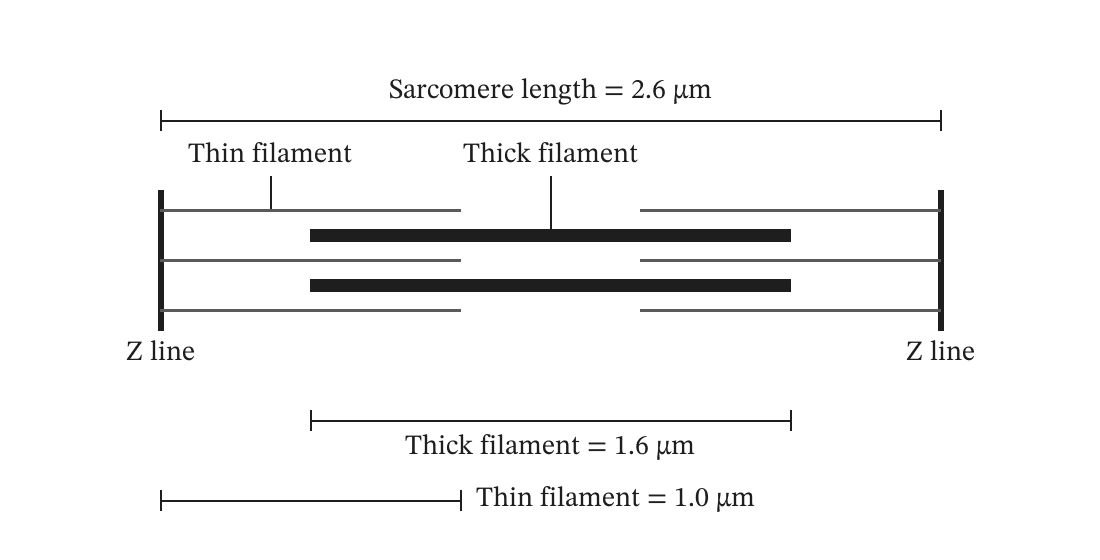
(a) Calculate the width of the A band, of the I band (the two half I bands inside this sarcomere taken together) and of the H zone in the relaxed sarcomere.
(b) After contraction the sarcomere is 2.2 µm long. Calculate the same three widths again.
(c) Which band keeps its width, and why?
(d) At what sarcomere length would the H zone just disappear?
- 351 mark
Question 35
(Hypothetical data.) The outer membranes of some rabbit muscle fibres were removed so that solutions could reach the filaments directly. In a solution containing ATP and Mg²⁺ plus a substance that removes all free Ca²⁺, the fibres stayed relaxed. When Ca²⁺ was added to the same solution, the fibres contracted strongly. What does this experiment show?
- 363 marks
Question 36
(Hypothetical data.) Two hours after a person has died, the body is still limp. By about twelve hours the muscles of the jaw and limbs have become rigid, and after about two days the stiffness has passed off again.
(a) Why do the muscles not stiffen immediately after death?
(b) Explain, in terms of cross bridges, why the muscles become rigid.
(c) Suggest why the stiffness later passes off.
- 371 mark
Question 37
In a physiology laboratory, an isolated frog calf muscle is stimulated electrically. One shock gives a single twitch; shocks given 2 times a second give separate twitches; shocks given 50 times a second give one smooth, sustained contraction that is much stronger than a twitch. What is the response at 50 shocks a second called?
- 383 marks
Question 38
(Hypothetical data.) Electrical stimuli of increasing strength were applied first to a single muscle fibre and then to a whole muscle. The force of contraction was recorded.
Stimulus strength (V) 0.2 0.4 0.6 0.8 1.0 1.2 Single fibre: force (mN) 0 0 2.0 2.0 2.0 2.0 Whole muscle: force (N) 0 1.5 4.0 7.0 9.0 9.0 (a) Between which two tested strengths does the threshold stimulus of the single fibre lie?
(b) Why does the force of the single fibre stay at 2.0 mN for every stimulus from 0.6 V to 1.2 V?
(c) Explain why the force of the whole muscle rises from 0.4 V to 1.0 V and then stops rising.
- 391 mark
Question 39
Curare, a plant poison once used on arrow tips in South America, attaches to the acetylcholine receptors on the motor end plate and blocks them. What happens to the skeletal muscles of an animal hit by such an arrow?
- 403 marks
Question 40
(Hypothetical data.) The amounts of ATP and creatine phosphate (CP) in a sprinter's thigh muscle were measured just before and just after a 10-second sprint.
Substance (mmol per kg of muscle) Before After ATP 5.0 4.5 Creatine phosphate 20.0 6.0 (a) Calculate the percentage fall in ATP and in creatine phosphate.
(b) Explain why the ATP level hardly changes while creatine phosphate falls sharply. Write the reaction involved.
(c) How is the creatine phosphate restored after the sprint?
- 411 mark
Question 41
Before the sliding filament theory, some scientists thought a muscle shortens because its protein filaments themselves fold up and shorten. Which observation on contracting sarcomeres best shows that the filaments slide instead?
- 423 marks
Question 42
After a 400 m race, an athlete goes on breathing deeply and quickly for several minutes although the athlete is now standing still.
(a) Why did the athlete's leg muscles respire partly without oxygen during the race?
(b) Why does the athlete go on taking in extra oxygen after the race?
(c) Where in the body is part of the lactic acid formed during the race turned back into glucose, and what is this cycle called?
- 431 mark
Question 43
(Hypothetical data.) A single electric shock is given to a frog muscle at time 0 s. The muscle begins to contract at 0.01 s, reaches its peak tension at 0.05 s and is fully relaxed again at 0.10 s. How long does the contraction phase of this twitch last?
- 443 marks
Question 44
(Hypothetical data.) A muscle fibre gives a single twitch lasting 0.10 s after a stimulus, and its refractory period is the first 0.005 s after a stimulus. A second stimulus of the same strength is given (a) 0.002 s, (b) 0.03 s and (c) 0.20 s after the first. Describe and explain the response of the fibre in each case.
- 451 mark
Question 45
A few days after neck surgery in which her parathyroid glands were accidentally damaged, a woman develops painful cramps and twitching of the muscles in her hands and face. A blood test shows a low level of calcium ions. Which condition is this?
- 463 marks
Question 46
(Hypothetical data.) A 52-year-old man wakes at night with sudden, severe pain, redness and swelling at the base of his big toe. His blood uric acid level is 9.2 mg/dL; the upper limit of the normal range for men is about 7 mg/dL.
(a) Name the disorder.
(b) Explain why the joint becomes painful and swollen.
(c) Suggest two changes in diet or drinking habits that would help him.
- 471 mark
Question 47
A 30-year-old woman notices that her eyelids droop by evening and her arms tire quickly while combing her hair, but rest helps. Tests show antibodies made by her own body against the acetylcholine receptors at her neuromuscular junctions. Which disorder does she have?
- 483 marks
Question 48
(Hypothetical data.) Bone density is often reported as a T-score. A T-score of −2.5 or lower indicates osteoporosis. Three women had their bone density measured:
Woman Age (years) Notes T-score P 28 — −0.4 Q 60 five years after menopause −2.8 R 64 — −1.6 (a) Which woman has osteoporosis by this rule?
(b) Suggest why Q is at much greater risk than P.
(c) State two measures that R can take to slow down further bone loss.
- 493 marks
Question 49
Two patients attend an orthopaedic clinic.
Patient P: a 35-year-old woman whose small joints of both hands are swollen and stiff each morning; a blood test shows rheumatoid factor.
Patient Q: a 70-year-old man whose knee aches after long walks; an X-ray shows that the gap between the bones has narrowed because the cartilage has worn away.
(a) Name the type of arthritis in each patient.
(b) Which part of P's joints is inflamed, and how does this damage the joint?
(c) Why does Q's knee hurt and move stiffly?
- 501 mark
Question 50
A 6-year-old boy has growing difficulty climbing stairs and getting up from the floor. A muscle sample shows that his skeletal muscle fibres are breaking down and being replaced by fat and fibrous tissue. His mother's brother had the same illness. Which disorder is most likely?
- 511 mark
Question 51
Human skeleton consists of
- 521 mark
Question 52
Red and white blood cells are produced in the
- 531 mark
Question 53
Synovial joints are found in the
- 541 mark
Question 54
Hinge joint is found at the
(i) ankle
(ii) knee
(iii) shoulder
(iv) hip
- 551 mark
Question 55
The joint between atlas and axis vertebrae that allows movement of head from side to side is
- 561 mark
Question 56
Tropomyosin is present in
- 571 mark
Question 57
The Z line is located
- 581 mark
Question 58
Red skeletal muscles contain the pigment
- 591 mark
Question 59
During contraction of a muscle fibre, the length of sarcomere decreases due to decrease in length of
- 601 mark
Question 60
The cross bridges are present on the
- 611 mark
Question 61
Function of creatine phosphate is to convert
- 621 mark
Question 62
Axial skeleton is made up of
- 631 mark
Question 63
Appendicular skeleton is made up of
- 641 mark
Question 64
Only bone that does not articulate with another bone in the body is
- 651 mark
Question 65
Atlas and axis vertebrae are a part of
- 661 mark
Question 66
Number of sacral vertebrae in children are
- 671 mark
Question 67
Ribs that are not attached to sternum are called
- 681 mark
Question 68
Another name for collar bone is
- 691 mark
Question 69
Humerus articulates with the
- 701 mark
Question 70
Total number of bones found in right upper limb is
- 711 mark
Question 71
Ribs attached to sternum are
- 721 mark
Question 72
The joint of radio-ulna with the upper arm is a type of
- 731 mark
Question 73
Number of cervical vertebrae in mammals are
- 741 mark
Question 74
Which of the following pairs is correctly matched?
- 751 mark
Question 75
Knee joint is
- 761 mark
Question 76
Which of the following is important for muscle contraction and nerve impulse transmission?
- 771 mark
Question 77
During strenuous exercise, glucose is converted into
- 781 mark
Question 78
The muscle fatigue is due to
- 791 mark
Question 79
The muscle band which remains unchanged during contraction and relaxation of skeletal muscle is
- 801 mark
Question 80
The contractile protein of skeletal muscle involving ATPase activity is
- 811 mark
Question 81
Articulation of femur with pelvic girdle is an example of
- 821 mark
Question 82
ATPase enzyme needed for muscle contraction is located in
- 831 mark
Question 83
Glenoid cavity is found in
- 841 mark
Question 84
Bones become fragile due to
- 851 mark
Question 85
Hinge joint is present between
- 861 mark
Question 86
The following connects muscle to bone
- 871 mark
Question 87
Which of the following is important for muscle contraction?
- 881 mark
Question 88
The skull bones are joined at the sutures by ______ tissue while the bodies of vertebrae are joined by ______ tissue.
- 891 mark
Question 89
Cardiac muscles are innervated by ______ .
- 901 mark
Question 90
______ muscle fibres store much oxygen in combination with ______ .
- 911 mark
Question 91
______ and ______ are contractile proteins of muscles.
- 921 mark
Question 92
Cranium consists of ______ flattened bones.
- 931 mark
Question 93
______ acts as a lubricant in a synovial joint.
- 941 mark
Question 94
Hip joint is an example of ______ joint.
- 951 mark
Question 95
In a fully contracted muscle, a thicker line called ______ appears in a sarcomere.
- 961 mark
Question 96
Myosin ATPase gets activated in the presence of ______ ions.
- 971 mark
Question 97
Troponin is a part of ______ filament.
- 981 mark
Question 98
Head of ______ filament has ATPase activity.
- 991 mark
Question 99
Humerus, radius and ______ bones are found in the forearm.
- 1001 mark
Question 100
Acetabulum is present in the ______ girdle.
- 1011 mark
Question 101
______ and ______ are ball and socket joints.
- 1021 mark
Question 102
Gout is caused by deposition of ______ in the joint cavity.
- 1031 mark
Question 103
Actin is present in thin filaments.
- 1041 mark
Question 104
H-zone of striated muscle fibre represents both thick and thin filaments.
- 1051 mark
Question 105
Human skeleton has 207 bones.
- 1061 mark
Question 106
There are 11 pairs of ribs in man.
- 1071 mark
Question 107
Sternum is present on ventral side of the body.
- 1081 mark
Question 108
Axial skeleton is made up of skull, vertebral column and limbs.
- 1091 mark
Question 109
Ribs that are not attached to the sternum are called false ribs.
- 1101 mark
Question 110
Actin filament has two accessory protein called troponin and tropomyosin.
- 1111 mark
Question 111
Calcium ions released from endoplasmic reticulum bind to the specific sites on troponin of actin filaments.
- 1121 mark
Question 112
Ligaments hold the bones together in position.
- 1131 mark
Question 113
The area between two Z lines in a muscle.
- 1141 mark
Question 114
Protein component that forms the tail of the myosin filament.
- 1151 mark
Question 115
An energy-rich compound that helps reconvert ADP back to ATP in muscles.
- 1161 mark
Question 116
Enzyme needed to hydrolyse ATP to ADP in muscles.
- 1171 mark
Question 117
Contractile protein present in I band.
- 1181 mark
Question 118
Ribs attached to the vertebral column at the back and not in front.
- 1191 mark
Question 119
The longest and strongest bone in human body.
- 1201 mark
Question 120
Bones that form fingers of the hand.
- 1211 mark
Question 121
Type of joints present between the bones of the skull.
- 1221 mark
Question 122
A bone disorder that leads to weakening of bones due to decrease in bone mass.
- 1231 mark
Question 123
Mark the odd one out: Sarcomere; actin filaments; myosin filaments; sarcoplasmic reticulum.
- 1241 mark
Question 124
Mark the odd one out: Hip joint; knee joint; ankle joint; elbow joint.
- 1251 mark
Question 125
Mark the odd one out: Shoulder joint; toe joint; ankle joint; intervertebral joint.
- 1261 mark
Question 126
Mark the odd one out: Fast acting; lactic acid; white muscles; myoglobin.
- 1271 mark
Question 127
Assertion (A): The part of myofibril between two successive 'Z' lines is called sarcomere. It is a functional contractile unit of myofibril.
Reason (R): During contraction, length of 'I' band reduces whereas that of 'A' band remains the same. This causes shortening of a sarcomere.
- 1281 mark
Question 128
Assertion (A): Fatigue is inability of muscle to relax.
Reason (R): It is due to lactic acid accumulation by repeated contractions.
- 1291 mark
Question 129
Assertion (A): The muscle contraction occurs when myosin binds and releases actin.
Reason (R): Muscle contraction is initiated by a signal from the peripheral nervous system via motor neuron.
- 1301 mark
Question 130
Assertion (A): On stimulation, a muscle cell releases calcium ions (Ca²⁺) from sarcoplasmic reticulum.
Reason (R): By reacting with a protein complex, Ca²⁺ uncover active sites on the actin filaments.
- 1311 mark
Question 131
Assertion (A): First seven pairs of ribs are called true ribs.
Reason (R): These ribs are not connected ventrally to the sternum.
- 1321 mark
Question 132
Assertion (A): Arthritis is caused by the inflammation of a skeletal joint which may become stiff and painful.
Reason (R): It may be due to the deposition of uric acid crystals in the joint cavity and ossification of articular cartilage.
- 1331 mark
Question 133
Assertion (A): Fibrous joints play a significant role in locomotion.
Reason (R): Fibrous joints have fluid-filled cavity between the articulating surfaces of the two bones.
- 1341 mark
Question 134
Assertion (A): Ball and socket joint is a type of synovial joint.
Reason (R): The spheroid ball-like end of one bone fits into the cup-like socket of another bone.
- 1355 marks
Question 135
Write true or false. If false change the statement so that it is true.
(i) Actin is present in thin filament.
(ii) H-zone of striated muscle fibre represents both thick and thin filaments.
(iii) Human skeleton has 206 bones.
(iv) There are 11 pairs of ribs in man.
(v) Sternum is present on the ventral side of the body.
- 1364 marks
Question 136
Match Column I with Column II:
Column A Column B 1. Smooth muscle (a) Myoglobin 2. Tropomyosin (b) Thin filament 3. Red muscle (c) Sutures 4. Skull (d) Involuntary - 1376 marks
Question 137
Name the types of joints between the following:
(i) atlas/axis
(ii) carpal/metacarpal of thumb
(iii) between phalanges
(iv) femur/acetabulum
(v) between cranial bones
(vi) between pubic bones in the pelvic girdle
- 1386 marks
Question 138
Fill in the blank spaces:
(i) All mammals (except a few) have __________ cervical vertebra.
(ii) The number of phalanges in each limb of human is __________.
(iii) Thin filament of myofibril contains 2 'F' actins and two other proteins namely __________ and __________.
(iv) In a muscle fibre, Ca²⁺ is stored in __________.
(v) __________ and __________ pairs of ribs are called floating ribs.
(vi) The human cranium is made of __________ bones.