
Opening your dashboard
Class 11 Biology Chapter 25 Body Fluids and Circulation: Practice Questions
154 questions on Chapter 25, each worked through on its own page with the AI tutor. Class 11 Biology, ICSE 2026-27.
154 questions
1–4 marks · Mixed difficulty
- 11 mark
Question 1
A student compares a cockroach and an earthworm in the laboratory. Both animals have a pumping organ and blood vessels. Which one feature, found in the cockroach but not in the earthworm, places the cockroach's circulation in the open type?
- 23 marks
Question 2
Snails and mussels are molluscs with an open circulatory system, but squids and octopuses (the cephalopod molluscs) have a closed circulatory system. Squids are fast-swimming hunters.
Using the differences between open and closed systems, explain three ways in which a closed system suits the squid's active way of life.
- 33 marks
Question 3
Two cube-shaped blocks of jelly are used as models of living organisms. Block P has sides of 1 mm and block Q has sides of 10 mm.
(a) Calculate the surface area to volume ratio of each block.
(b) Use your answers to explain why an Amoeba manages without a circulatory system, while a large animal needs one.
- 41 mark
Question 4
During a sprint, lactic acid builds up in a runner's leg muscles. The blood carries this lactic acid to the liver, where it is processed further. Which function of the circulatory system does this example show?
- 52 marks
Question 5
In a cockroach, glucose reaches a muscle cell directly from the blood (haemolymph) that bathes it. In a human, it does not. Trace the path by which glucose in human blood reaches a muscle cell, and explain why this extra step is needed.
- 63 marks
Question 6
Part of a blood test report of a 34-year-old woman is shown below, with the laboratory's reference ranges. (Hypothetical data.)
Test Result Reference range Haemoglobin 9.2 g per 100 mL 12–16 g per 100 mL Red blood cell count 3.6 million per mm³ 4.2–5.4 million per mm³ White blood cell count 14,800 per mm³ 4,000–11,000 per mm³ Neutrophils 84% of white cells 40–75% of white cells Platelet count 2.6 lakh per mm³ 1.5–4.5 lakh per mm³ (a) List the results that lie outside the reference range, saying whether each is high or low.
(b) What do the white cell results suggest is happening in her body? Give a reason.
(c) Explain why she may feel tired and breathless when climbing stairs.
- 71 mark
Question 7
A healthy adult has about 5 litres of blood. Roughly what volume of this blood is plasma?
- 81 mark
Question 8
A child who has eaten far too little protein for a long time has puffy, swollen feet and hands. A fall in which plasma protein mainly explains this swelling?
- 93 marks
Question 9
About 2 million red blood cells are destroyed in the human body every second.
(a) How many red blood cells is this per day?
(b) Each red blood cell lives for about 120 days. Explain why the red blood cell count of a healthy adult still stays steady.
(c) Name the organs where old red blood cells are removed from the blood.
- 103 marks
Question 10
A blood report gives a total white blood cell count of 8,000 per mm³ and this differential count: neutrophils 62%, lymphocytes 28%, monocytes 6%, eosinophils 3%, basophils 1%. (Hypothetical data.)
(a) Calculate the number per mm³ of the most common and of the least common type of white blood cell.
(b) Which two of these types are agranulocytes? Calculate their combined number per mm³.
- 111 mark
Question 11
During heart surgery, a surgeon finds that some of the chordae tendineae attached to the cusps of the bicuspid (mitral) valve have torn. What is most likely to happen each time the ventricles contract?
- 123 marks
Question 12
Before birth, an opening called the foramen ovale in the wall between the two atria lets blood pass from one atrium to the other. It normally closes after birth. In a hypothetical adult patient, a large opening has stayed open. The pressure in the left atrium is normally slightly higher than in the right atrium.
(a) What structure marks the closed foramen ovale in a normal adult heart?
(b) In which direction will blood mostly flow through the opening in this patient, and what kind of blood is it?
(c) Why does this make the right side of the heart and the lungs do extra work?
- 133 marks
Question 13
After a heart transplant, the new heart has no nerve connections with the patient's brain, yet it beats on its own. Its resting rate is often about 95–100 beats per minute instead of the usual 70–75.
(a) Why can the transplanted heart beat without any nerve supply?
(b) Suggest why its resting rate is higher than normal.
(c) During exercise its rate still rises, though more slowly than in a normal heart. Suggest how.
- 141 mark
Question 14
The chambers of the heart are always full of blood, yet the heart muscle (myocardium) has its own coronary arteries. Which statement gives the best reason?
- 152 marks
Question 15
The wall of the heart is made of cardiac muscle fibres that branch and cross-connect with one another to form a net-like arrangement. Explain how this arrangement helps the heart to pump blood well.
- 164 marks
Question 16
Two students of the same age and body size took part in a fitness study. One is untrained; the other is a trained long-distance runner. (Hypothetical data.)
Student Heart rate at rest (beats/min) Stroke volume at rest (mL) Heart rate in hardest exercise (beats/min) Stroke volume in hardest exercise (mL) Untrained 72 70 180 110 Runner 50 100 180 170 (a) Calculate the cardiac output at rest of each student.
(b) Calculate the cardiac output of each student during the hardest exercise.
(c) By how many times does the runner's cardiac output rise from rest to the hardest exercise?
(d) Explain how the runner manages the same resting cardiac output with a much lower heart rate.
- 171 mark
Question 17
At 75 beats per minute one cardiac cycle lasts 0.8 s: atrial systole 0.1 s, ventricular systole 0.3 s and joint diastole 0.4 s. During exercise the rate rises to 120 beats per minute. Assuming, for simplicity, that the two systoles keep their resting lengths, how long will joint diastole now last?
- 184 marks
Question 18
The table gives the blood pressures (in mm Hg) in the left atrium, the left ventricle and the aorta at three moments, P, Q and R, during one cardiac cycle. (Hypothetical data.)
Moment Left atrium Left ventricle Aorta P 8 6 82 Q 7 50 80 R 5 118 115 A heart valve is pushed open when the pressure behind it is greater than the pressure in front of it, and is pushed shut when the pressure in front is greater.
(a) State whether the bicuspid (mitral) valve and the aortic semilunar valve are open or closed at moment P.
(b) Do the same for moment Q.
(c) Do the same for moment R.
(d) Which moment comes just after the first heart sound, lub? Give a reason.
- 191 mark
Question 19
A resting adult has a cardiac output of 4.8 litres per minute and a heart rate of 64 beats per minute. What is the stroke volume?
- 202 marks
Question 20
In some heart conditions the atria only quiver and do not contract properly, but the ventricles go on contracting. Even so, the ventricles still receive most of their blood. Explain how.
- 213 marks
Question 21
The bar chart shows the mean blood pressure in the different kinds of blood vessel through which blood passes, from the aorta back to the venae cavae. (Hypothetical data.)
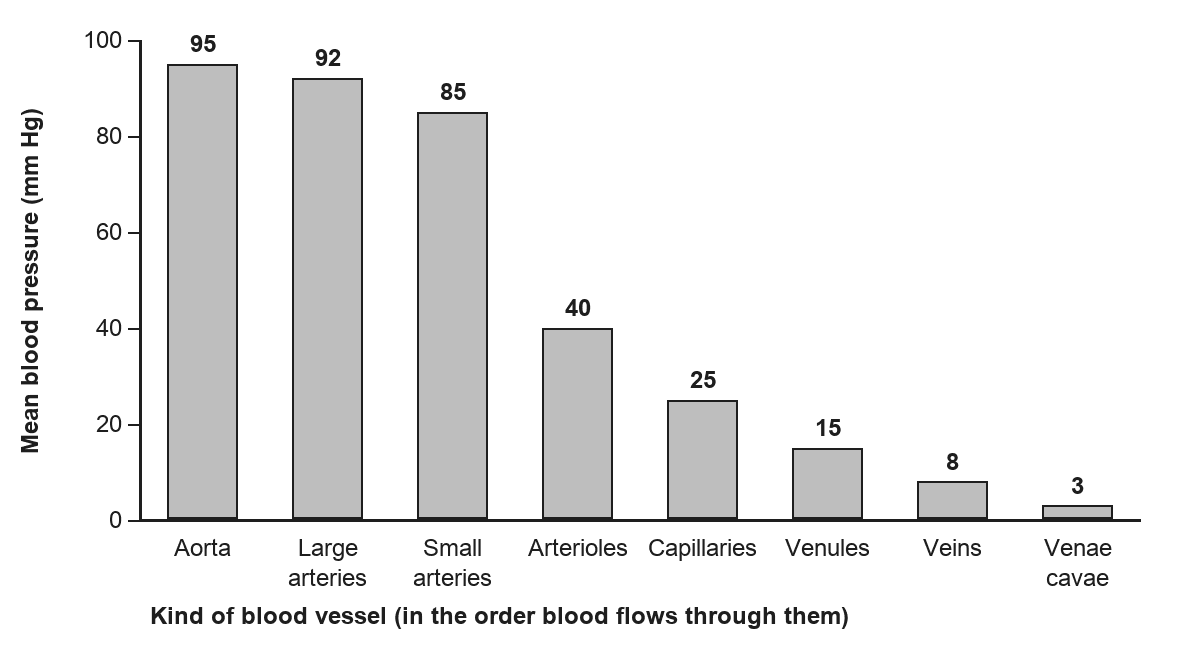
(a) Between which two neighbouring kinds of vessel does the pressure fall the most, and by how much?
(b) Using the structure of the vessels named in (a), explain why the fall is so large there.
(c) The pressure in the veins is only about 8 mm Hg. Give two features that still help blood in the leg veins to return to the heart.
- 221 mark
Question 22
A shopkeeper who stands for long hours every day develops swollen, twisted veins in the legs. Tests show that the valves in these veins have become leaky. What is the most direct effect of the leaky valves?
- 233 marks
Question 23
Blood samples were taken from three vessels connected to the liver of an animal about one hour after a meal rich in starch. The vessels were the hepatic artery, the hepatic portal vein and the hepatic vein. (Hypothetical data.)
Sample Glucose (mg per 100 mL) Oxygen content X 120 high Y 180 low Z 130 low Identify the vessel from which each sample, X, Y and Z, was taken. Give a reason for each.
- 241 mark
Question 24
A pulse can be felt in the radial artery at the wrist, but not in the veins on the back of the hand. Which statement best explains this?
- 252 marks
Question 25
After a heavy meal, more blood flows to the capillaries of the stomach and intestine, while less flows to the capillaries of the resting leg muscles. Explain how the arterioles and the sphincter muscles at the start of the capillaries bring about this change.
- 263 marks
Question 26
The ECG strip below was recorded at the standard paper speed of 25 mm per second. Each small square is 1 mm wide and each large square is 5 mm wide. The waves of the first beat are lettered.
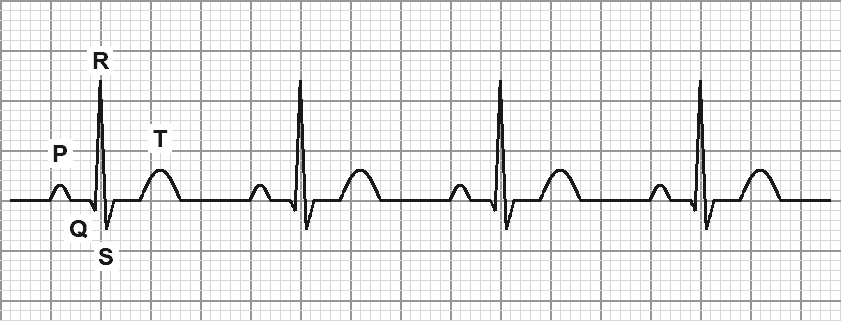
(a) Find the R–R interval (the time from one R peak to the next) in seconds.
(b) Calculate the heart rate in beats per minute.
(c) Measure the P–R interval (from the start of the P wave to the start of the QRS complex) in seconds, and state what it represents.
- 271 mark
Question 27
On an ECG recorded at 25 mm per second, the R peaks of a patient's heartbeats are 15 mm apart. What is the patient's heart rate?
- 281 mark
Question 28
A patient's ECG shows regular QRS complexes at 45 per minute, with no P waves anywhere on the strip. Which interpretation fits this record best?
- 292 marks
Question 29
A man's resting ECG is normal, but his doctor still asks for a stress ECG, recorded while he walks fast on a treadmill. Explain why a stress ECG can reveal narrowed coronary arteries that a resting ECG may miss.
- 303 marks
Question 30
A 70-year-old woman faints often. Her ECG shows regular P waves at 75 per minute and regular QRS complexes at only 38 per minute, with no fixed link between the two.
(a) In which part of the conducting system has the impulse failed? Give a reason.
(b) Why do her ventricles still beat, though slowly?
(c) Explain how an artificial pacemaker, with its lead fixed in the right ventricle, would help her.
- 311 mark
Question 31
Which change in a patient's ECG most strongly suggests that an acute heart attack (myocardial infarction) is taking place?
- 323 marks
Question 32
In a resting adult, about 20 litres of fluid filter out of the blood capillaries into the tissues each day, and about 17 litres of it are taken back into the capillaries. (Hypothetical data.)
(a) How much fluid must the lymphatic system return to the blood each day?
(b) After an operation in which the lymph vessels and nodes of one arm were removed, a patient's arm stays swollen. Explain why.
(c) Her doctor advises her to keep moving the muscles of that arm. Suggest how this helps.
- 331 mark
Question 33
Which of the following is NOT a function of the lymphatic system?
- 341 mark
Question 34
A girl has an infected cut on her finger. Two days later a tender, swollen lump appears in her armpit on the same side. What is the lump most likely to be?
- 353 marks
Question 35
Three fluid samples, J, K and L, were taken from the same healthy person: one is blood, one is lymph from the thoracic duct after a fatty meal, and one is tissue fluid from between muscle cells. (Hypothetical data.)
Sample Red blood cells White cells Protein (g per 100 mL) Appearance J present, many present 7 red K absent many lymphocytes 3.5 milky L absent very few 1.5 clear, colourless Identify each sample and give one reason for each.
- 362 marks
Question 36
Glucose absorbed from the intestine first passes through the liver, but most absorbed fat does not. Trace the route by which absorbed fat reaches the blood, and say why it does not go first to the liver.
- 372 marks
Question 37
A sample of lymph collected from the thoracic duct and left in a test tube forms a soft clot, but only slowly. A sample of blood forms a firm clot much faster. Explain both observations.
- 383 marks
Question 38
In a school laboratory, a drop of blood from each of three volunteers, X, Y and Z, was mixed on a slide with anti-A serum, anti-B serum and anti-D (anti-Rh) serum. In the drawing, a drop with a few large clumps shows agglutination; a drop with evenly spread fine dots shows no agglutination.
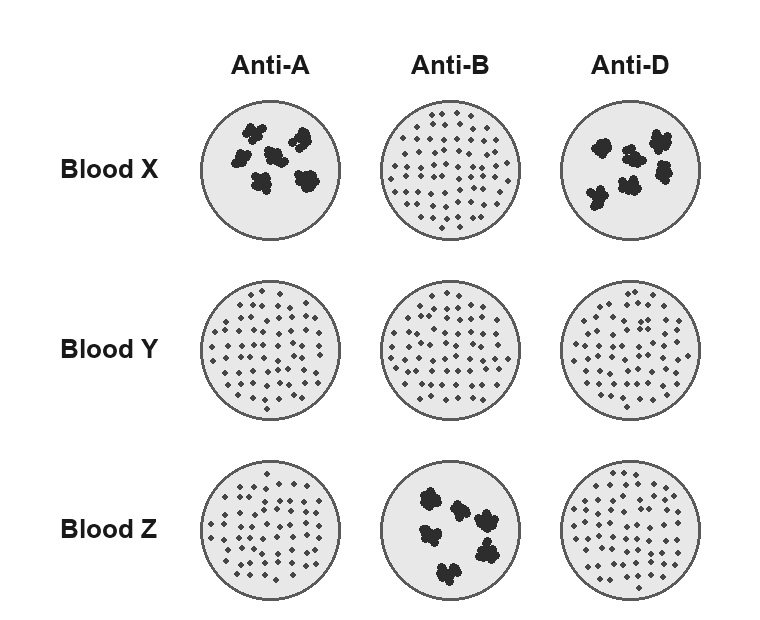
(a) Write the ABO and Rh blood group of X, Y and Z.
(b) Name the antibodies of the ABO system present in the plasma of each of X, Y and Z.
- 394 marks
Question 39
A woman with blood group A, Rh negative (A⁻) needs a transfusion of red blood cells. Five donors are available:
Donor P Q R S T Blood group A⁺ O⁻ AB⁻ A⁻ O⁺ (a) Which donors' red cells can she safely receive?
(b) For each of the other donors, give the reason why his or her red cells should not be given to her.
- 404 marks
Question 40
Decide, with a reason, whether the baby is at risk of erythroblastosis foetalis in each pregnancy below. "Already sensitised" means that the mother has already made anti-Rh antibodies during an earlier pregnancy.
(a) Rh⁺ mother, first pregnancy, Rh⁻ baby
(b) Rh⁻ mother, first pregnancy, Rh⁺ baby
(c) Rh⁻ mother, already sensitised, second pregnancy, Rh⁻ baby
(d) Rh⁻ mother, already sensitised, second pregnancy, Rh⁺ baby
- 411 mark
Question 41
Blood collected in a tube containing potassium oxalate stays liquid. When calcium chloride solution is added in excess, the blood clots within minutes. Which statement explains this?
- 421 mark
Question 42
A badly injured woman must be given red blood cells before there is time to find her blood group. Red cells of which group carry the least risk for her?
- 432 marks
Question 43
During a severe viral fever, a patient's platelet count fell from 2.5 lakh per mm³ to 40,000 per mm³. (Hypothetical data.)
(a) Calculate the percentage fall in the platelet count.
(b) Explain why the doctor warned that the patient could bleed easily.
- 441 mark
Question 44
A drug blocks the action of the enzyme thrombin in a sample of blood. Which reaction can no longer take place?
- 451 mark
Question 45
In a person with uncontrolled high blood pressure for many years, the wall of the left ventricle becomes thicker. Which statement explains this?
- 463 marks
Question 46
The average blood pressure of three adults, measured on three different days, is given below. (Hypothetical data.) Take hypertension to mean that the upper (systolic) value is 140 mm Hg or more, or the lower (diastolic) value is 90 mm Hg or more.
Person Average blood pressure (mm Hg) Anil 118/78 Bina 142/88 Charu 132/94 (a) Which of them have hypertension? Give the reason in each case.
(b) Why is hypertension called a "silent killer"?
(c) Name two organs, other than the heart, that long-term hypertension can damage, and state one harm to each.
- 474 marks
Question 47
Read the three short case notes.
Case 1: For several months a 68-year-old man has felt breathless on walking and his ankles swell; tests show that his heart is not pumping out enough blood for the body's needs.
Case 2: A 55-year-old woman suddenly feels a crushing pain in the chest; tests show that a clot has blocked one of her coronary arteries, and part of her heart muscle is being damaged.
Case 3: A 40-year-old man collapses at a bus stop; he does not respond, is not breathing normally and his heart has stopped beating.
(a) Name the condition in each case.
(b) What should a bystander do at once in Case 3?
- 481 mark
Question 48
A 58-year-old man feels a tight pain in the chest whenever he climbs stairs quickly; the pain goes away within a few minutes of rest. What is the most likely cause?
- 493 marks
Question 49
A fatty plaque narrows the lumen of a coronary artery so that its radius falls from 2.0 mm to 1.0 mm. (Hypothetical data.)
(a) By what percentage has the area of the lumen (a circle) been reduced?
(b) Why do blood clots tend to form on such a plaque?
(c) What happens to the heart if a clot then blocks this artery completely?
- 502 marks
Question 50
A 45-year-old man has mild hypertension. Suggest two changes to his daily habits that can help lower his blood pressure, and explain how each helps.
- 511 mark
Question 51
Blood flows through sinuses in
- 521 mark
Question 52
Which of the following blood vessels has a thick middle layer of smooth muscles and elastic fibres?
- 531 mark
Question 53
Which one of the following consists of a thin layer of endothelium only?
- 541 mark
Question 54
Semilunar valve is present in
(A) arteries
(B) veins
(C) right auricle
(D) left ventricle
- 551 mark
Question 55
Bicuspid valve is present between
- 561 mark
Question 56
Coronary sulcus is present between
- 571 mark
Question 57
Blood is poured into the left atrium through
- 581 mark
Question 58
Which one of the following blood vessels carries only deoxygenated blood?
- 591 mark
Question 59
In hepatic portal system, the following blood vessel collects the blood laden with food from the intestine
- 601 mark
Question 60
Bicuspid and tricuspid valves are closed during
- 611 mark
Question 61
The atrial systole normally precedes the ventricular systole because the impulse takes time to pass from
- 621 mark
Question 62
SA node is called the pacemaker of the heart because
- 631 mark
Question 63
AV bundle is essential for the conduction of cardiac impulse because
- 641 mark
Question 64
The left ventricle possesses a thicker wall than right ventricle because
- 651 mark
Question 65
The function of vagus nerve innervating the heart is to
- 661 mark
Question 66
Arteriosclerosis refers to
- 671 mark
Question 67
If the blood pressure is measured as 120/80 mm Hg, the term 120 refers to
- 681 mark
Question 68
The valve present between the right atrium and right ventricle is called
- 691 mark
Question 69
High carboxyhaemoglobin content indicates that the patient has inhaled excess of
- 701 mark
Question 70
A person with blood group A has
- 711 mark
Question 71
Serum is
- 721 mark
Question 72
The instrument by which blood pressure is determined
(A) ultrasound
(B) BP meter
(C) stethoscope
(D) sphygmomanometer
- 731 mark
Question 73
Cardiac output is determined by
- 741 mark
Question 74
'Bundle of His' is a group of
- 751 mark
Question 75
In which one of the following pair of terms both represent one and same thing?
- 761 mark
Question 76
Systolic pressure in adult human is
- 771 mark
Question 77
Pacemaker of heart is
- 781 mark
Question 78
The first heart sound is produced when
- 791 mark
Question 79
Which of the following substances, if introduced into bloodstream, would cause coagulation at the site of introduction?
- 801 mark
Question 80
Left atrium receives oxygenated blood through
- 811 mark
Question 81
Find the incorrect statement from the following
- 821 mark
Question 82
How many times a red blood corpuscle will have to pass through the heart in its journey from hepatic artery to the aorta?
- 831 mark
Question 83
Which of the following has the thickest wall?
- 841 mark
Question 84
In adult man, normal blood pressure is
- 851 mark
Question 85
SA node is located in
- 861 mark
Question 86
Lymphoid tissue is found in
- 871 mark
Question 87
Heartbeat initiates from
- 881 mark
Question 88
Artery is a blood vessel which carries blood
- 891 mark
Question 89
The cardiac pacemaker in a patient fails to function normally. The doctors find that an artificial pacemaker is to be grafted in him. It is likely that it will be grafted at the site of
- 901 mark
Question 90
The opening of right atrium into right ventricle of human heart is guarded by
- 911 mark
Question 91
In human beings, the duration of cardiac cycle is
- 921 mark
Question 92
Two auricles are separated by an _______ in the heart of mammals.
- 931 mark
Question 93
AV valves are supported by _______ which are attached to the muscles of heart.
- 941 mark
Question 94
The cardiac impulse originates from the _____ and is passed on to the AV node.
- 951 mark
Question 95
Left atrium gets ______ blood from _______ .
- 961 mark
Question 96
The _____ and _______ valves close shortly after the start of ventricular systole.
- 971 mark
Question 97
Joint diastole lasts for about _______ .
- 981 mark
Question 98
Vena cava drains the blood into _______ atrium while pulmonary veins drain the blood into ______.
- 991 mark
Question 99
The right side of the heart (right atria and right ventricles) contains only ______ blood.
- 1001 mark
Question 100
The heart sound dub is produced by closing of_______.
- 1011 mark
Question 101
The mitral valve has ______ cusps while the aortic valve possesses ______ cusps.
- 1021 mark
Question 102
Higher the metabolic rate of the animal, higher is its ______.
- 1031 mark
Question 103
Sympathetic nerves _______ the heart activity.
- 1041 mark
Question 104
Pulmonary artery carries _______ blood.
- 1051 mark
Question 105
_______ collects the blood through capillaries from the intestine to liver.
- 1061 mark
Question 106
Hardening of the arteries is also called _______.
- 1071 mark
Question 107
Bicuspid valve is present between the right atrium and the right ventricle.
- 1081 mark
Question 108
Veins have a large lumen and arteries have a smaller lumen.
- 1091 mark
Question 109
Coronary circulation refers to the circulation of blood in the heart.
- 1101 mark
Question 110
The first heart sound results from the closure of semilunar valves.
- 1111 mark
Question 111
Vagus nerve reduces the heart beat rate.
- 1121 mark
Question 112
The AV node is a natural pacemaker and initiates the cardiac impulse.
- 1131 mark
Question 113
Semilunar valves open during ventricular diastole.
- 1141 mark
Question 114
Right ventricle pumps out the blood through pulmonary artery to lungs.
- 1151 mark
Question 115
Normal diastolic and systolic pressure of humans is 120 and 60 mm Hg respectively.
- 1161 mark
Question 116
Coronary sulcus is a transverse groove present between atria and ventricles.
- 1171 mark
Question 117
Capillaries are the thinnest blood vessels.
- 1181 mark
Question 118
Hepatic portal vein takes the blood from liver to inferior vena cava.
- 1191 mark
Question 119
Atherosclerosis leads to narrowing of the arteries due to deposition of cholesterol.
- 1201 mark
Question 120
Tachycardia refers to an abnormal increase in heart beat rate.
- 1211 mark
Question 121
Ventricular systole lasts for about 0.4 seconds.
- 1221 mark
Question 122
A blood group which is a universal recipient.
- 1231 mark
Question 123
Enzyme released by the damaged blood platelets.
- 1241 mark
Question 124
Blood vessel near the heart, where whole of lymph of the body is poured into.
- 1251 mark
Question 125
A chamber of heart which pumps out blood to the body through aorta.
- 1261 mark
Question 126
Kind of heart in which the heart beat originates in the specialised muscle fibres.
- 1271 mark
Question 127
A network of muscle fibres through which cardiac impulse travels to both the ventricles.
- 1281 mark
Question 128
Circulation of blood between the heart and the lungs.
- 1291 mark
Question 129
Term that refers to volume of blood pumped out by each ventricle per minute.
- 1301 mark
Question 130
Blood vessels that arise from arterioles and branch into capillaries.
- 1311 mark
Question 131
A record of the changes in electric potential across the heart in one cardiac cycle.
- 1321 mark
Question 132
Mark the odd one in the series: Purkinje fibres; AV bundle; AV valve; SA node.
- 1331 mark
Question 133
Mark the odd one in the series: Mitral valve; tricuspid valve; semilunar valve; venous valve.
- 1341 mark
Question 134
Mark the odd one in the series: Thoracic duct; aorta; pulmonary vein; venae cavae.
- 1351 mark
Question 135
Mark the odd one in the series: Eosinophils; neutrophils; monocytes; thrombocytes.
- 1361 mark
Question 136
Mark the odd one in the series: Arterioles; venules; capillaries; endothelium.
- 1371 mark
Question 137
Assertion (A): Individuals with blood group 'O' are called universal donors.
Reason (R): RBCs of 'O' blood group have both 'A' and 'B' surface antigens.
- 1381 mark
Question 138
Assertion (A): Blood coagulates in undamaged blood vessels.
Reason (R): Undamaged blood vessels release an anticoagulant heparin.
- 1391 mark
Question 139
Assertion (A): Enzyme thrombin acts on the soluble plasma protein called fibrinogen and changes it into insoluble fibrin.
Reason (R): Blood plasma without fibrinogen and blood corpuscles is called serum.
- 1401 mark
Question 140
Assertion (A): Left atrium possesses the thickest muscles.
Reason (R): Left atrium receives blood from the lungs.
- 1411 mark
Question 141
Assertion (A): Heart of fish pumps only deoxygenated blood.
Reason (R): Oxygenated blood does not return back to the heart in fishes.
- 1421 mark
Question 142
Assertion (A): Smaller the organism, higher is the rate of metabolism and higher is the heart beat rate per minute.
Reason (R): The heart rate of a six month old baby is much higher than that of an old person.
- 1431 mark
Question 143
Assertion (A): An artificial pacemaker can replace the sino-atrial node of heart.
Reason (R): An artificial pacemaker is capable of stimulating the heart electrically to maintain its beats.
- 1441 mark
Question 144
Assertion (A): Lub is a heart sound which is produced during each cardiac cycle.
Reason (R): It is associated with the closure of the tricuspid and bicuspid valves.
- 1451 mark
Question 145
Assertion (A): Atherosclerosis is a disease caused by the thickening of arterial walls.
Reason (R): Deposition of cholesterol and triglycerides in the arterial walls causes atherosclerosis.
- 1461 mark
Question 146
Assertion (A): In human heart, there is no mixing of oxygenated and deoxygenated blood.
Reason (R): Presence of valves in the heart allow the movement of blood in one direction only.
- 1473 marks
Question 147
Name the components of the formed elements in the blood and mention one major function of each of them.
- 1483 marks
Question 148
What is the importance of plasma proteins?
- 1493 marks
Question 149
Match Column I with Column II
Column I Column II 1. Eosinophils (a) Coagulation 2. RBC (b) Universal recipient 3. AB Group (c) Resist infections 4. Platelets (d) Contraction of heart 5. Systole (e) Gas transport - 1502 marks
Question 150
Why do we consider blood as a connective tissue?
- 1512 marks
Question 151
Why do we call our heart myogenic?
- 1522 marks
Question 152
Sino-atrial node is called the pacemaker of our heart. Why?
- 1533 marks
Question 153
What is the significance of atrio-ventricular node and atrio-ventricular bundle in the functioning of heart?
- 1542 marks
Question 154
Explain heart sounds.