
Opening your dashboard
Class 11 Biology Chapter 23 Digestion and Absorption: Practice Questions
148 questions on Chapter 23, each worked through on its own page with the AI tutor. Class 11 Biology, ICSE 2026-27.
148 questions
1–4 marks · Mixed difficulty
- 11 mark
Question 1
A dentist examines a healthy 4-year-old child who has a complete set of milk teeth and no permanent teeth yet. Which record of the teeth in each half of each jaw is correct?
- 23 marks
Question 2
A 30-year-old woman has a full set of permanent teeth except that all four of her third molars (wisdom teeth) have never come through.
(a) Write her dental formula.
(b) Calculate the total number of teeth in her mouth.
(c) Which type of tooth in her adult set was completely absent from her milk set, and which milk teeth used to stand in those positions?
- 34 marks
Question 3
The figure shows a vertical section of a human molar tooth.
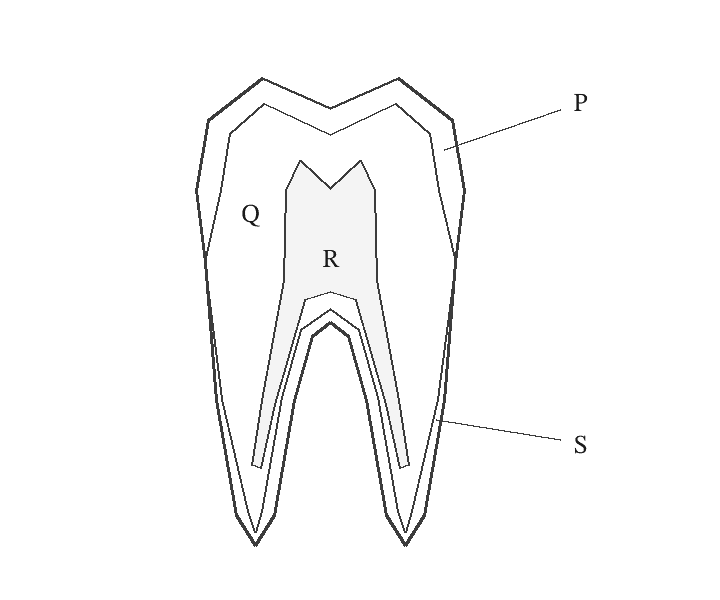
Identify the parts labelled P, Q, R and S, and give one role of each.
- 41 mark
Question 4
A boy laughs while drinking water. Some water goes into his windpipe and he coughs hard to bring it out. Which structure failed to close the entrance to the windpipe in time?
- 52 marks
Question 5
Astronauts living in a space station, where food does not 'fall' downwards, can still swallow food and get it into the stomach. Explain how food is moved down the oesophagus.
- 61 mark
Question 6
A drug that stops smooth muscle from contracting was given to a patient. Afterwards, food was no longer mixed or pushed along the intestine, although its enzymes and its absorbing cells were working normally. Which layer of the intestinal wall did the drug mainly affect?
- 73 marks
Question 7
A rabbit, which eats only plants, has a very large caecum, while a human has a small caecum with a narrow vermiform appendix.
(a) Explain why a large caecum is useful to the rabbit.
(b) Why does a human not need a large caecum?
(c) Why is the human vermiform appendix described as a vestigial organ?
- 81 mark
Question 8
A woman's gall bladder is removed in an operation. Which change in her digestion is expected afterwards?
- 92 marks
Question 9
A child with mumps has painful swellings on both sides of the face, just in front of and below the ears, and finds chewing painful. Which salivary glands are swollen, and where do their ducts open?
- 103 marks
Question 10
Soon after a heavy meal, a man lies down flat and feels a burning pain behind his breastbone. A doctor explains that some acid from his stomach has moved back up into the oesophagus.
(a) Which structure normally stops stomach contents from moving back into the oesophagus?
(b) Why does the acid damage the oesophagus, although the same acid does not harm the stomach lining?
(c) Why is this more likely when he lies down straight after a large meal?
- 114 marks
Question 11
A student set up four test tubes. Each held 2 mL of 1% starch solution and was kept at 37 °C for 15 minutes, after which a drop of iodine solution was added. (Hypothetical data.)
Tube Added to the starch Colour with iodine A 1 mL fresh saliva, buffered at pH 6.8 brownish-yellow B 1 mL boiled and cooled saliva, pH 6.8 blue-black C 1 mL fresh saliva with dilute HCl, pH 2 blue-black D 1 mL distilled water, pH 6.8 blue-black (a) In which tube was the starch digested? Name the enzyme responsible and its main product.
(b) Explain the result in tube B.
(c) Explain the result in tube C, and say what it tells us about the fate of this enzyme in the stomach.
(d) Why was tube D set up?
- 121 mark
Question 12
A tube of starch solution with fresh saliva at pH 6.8 was kept in ice at about 2 °C for 15 minutes and still turned blue-black with iodine. A second, identical tube was kept in ice for 15 minutes and then at 37 °C for 15 minutes, and iodine stayed brownish-yellow. (Hypothetical data.) What do these results show?
- 133 marks
Question 13
The bar chart shows the pH of the contents at three sites, W, X and Y, of the human alimentary canal while a meal is being digested. (Hypothetical data.)
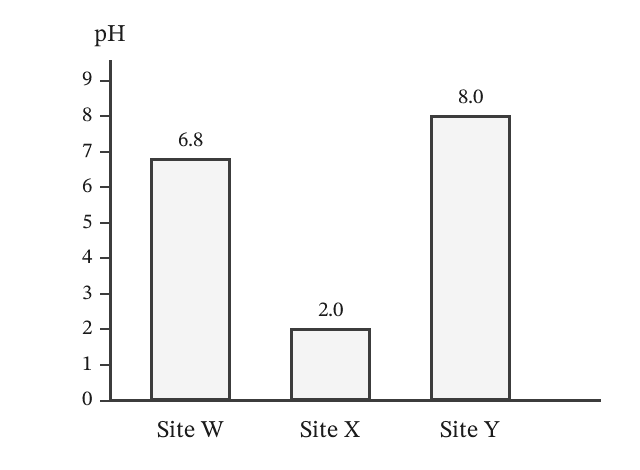
(a) Identify W, X and Y from these sites: mouth, stomach, duodenum after pancreatic juice and bile have mixed with the chyme.
(b) Name one digestive enzyme that works best at each of the sites W, X and Y.
(c) Name the secretions that raise the pH from that at X to that at Y.
- 141 mark
Question 14
Pepsinogen was mixed with dilute HCl at 37 °C. Active pepsin appeared slowly at first and then much faster, although no more acid was added. (Hypothetical data.) What is the best explanation for the speeding up?
- 153 marks
Question 15
A baby is born unable to make enterokinase (enteropeptidase) in the lining of the small intestine, although the pancreas works normally and secretes trypsinogen, chymotrypsinogen and procarboxypeptidase. Explain why protein digestion in the small intestine is badly affected.
- 161 mark
Question 16
A plate of plain boiled rice is fully digested in the human small intestine. Which sugar or sugars are finally produced from its starch, ready for absorption?
- 172 marks
Question 17
A student chews a small piece of plain bread for about two minutes without swallowing it and notices that it begins to taste slightly sweet. Explain this observation.
- 182 marks
Question 18
Fluid taken from the lumen of the jejunum digested maltose only very slowly, but a liquid made by grinding up cells scraped from the lining of the jejunum digested maltose quickly. (Hypothetical data.) Explain these results.
- 191 mark
Question 19
Nucleic acids in food are digested in three steps: nucleases change them into nucleotides, nucleotidase changes nucleotides into nucleosides, and nucleosidase changes nucleosides into sugars and nitrogenous bases. If a drug blocked only nucleotidase in the small intestine, which substance would build up?
- 202 marks
Question 20
A student wrote: 'Human gastric juice contains plenty of rennin, which curdles milk. Rennin is the same enzyme as renin, which is made in the kidney.' Point out the two errors in this statement.
- 214 marks
Question 21
A person eats a meal of puris fried in oil with potato curry, a meal rich in fat.
(a) Which gastrointestinal hormone is released first, from where, and what does it do?
(b) As acid chyme enters the duodenum, which hormone is released in response to the acid, and what is its action?
(c) Which duodenal hormone is released in response to the fats and digested proteins in the chyme, and what are its actions?
(d) Which hormone is released from the duodenum when fats and sugars arrive, and what is now known to be its main action?
- 221 mark
Question 22
In an experiment on an anaesthetised animal, all the nerves supplying the duodenum and pancreas were cut. Dilute acid was then placed in the duodenum, and the pancreas still poured out a juice rich in bicarbonate. What does this show?
- 231 mark
Question 23
A drug blocks the action of cholecystokinin (CCK). After a meal rich in ghee, which effect is most likely?
- 242 marks
Question 24
Say whether each response below is controlled mainly by nerves or mainly by hormones, giving a reason.
(a) The sight and smell of food make a hungry person's mouth water before eating.
(b) Half an hour after a meal, acid chyme entering the duodenum makes the pancreas release a bicarbonate-rich juice.
- 253 marks
Question 25
A rare tumour in a patient releases large amounts of gastrin into the blood all the time.
(a) Predict the effect on the secretion of gastric juice.
(b) Explain why the patient may develop ulcers in the duodenum as well as in the stomach.
(c) Which duodenal hormone would you expect to be released in larger amounts than normal, and why?
- 261 mark
Question 26
Pieces of small intestine were bathed in a glucose or a fructose solution, either containing normal Na⁺ or with no Na⁺, and the uptake of sugar by the epithelial cells was measured. (Hypothetical data.)

Which conclusion do the results support?
- 273 marks
Question 27
Treat the absorbing part of the small intestine as a smooth tube 6 m long and 2.5 cm (0.025 m) across. Suppose the villi increase its inner surface 6 times and the microvilli then increase it a further 15 times. (Hypothetical data.) Take .
(a) Calculate the inner surface area of the smooth tube, using area .
(b) Calculate the surface area once the villi and microvilli are included.
(c) Explain why such a large area is important.
- 281 mark
Question 28
A volunteer eats a meal containing a fat whose long-chain fatty acids carry a harmless tracer. (Hypothetical data.) Soon after absorption, in which form and in which vessels is most of the tracer first found?
- 292 marks
Question 29
After a fatty meal, the long-chain fatty acids and monoglycerides taken into the intestinal cells are made back into triglycerides, packed into chylomicrons, and passed into the lacteals rather than the blood capillaries. Give two reasons for this route.
- 301 mark
Question 30
Which of the following events is an example of assimilation rather than absorption?
- 312 marks
Question 31
A heart patient is told to put a small tablet under the tongue and let it dissolve, rather than swallow it, during an attack of chest pain. Using what you know about absorption, explain why the medicine acts quickly this way.
- 321 mark
Question 32
The intestinal lining has no pump that moves water molecules themselves, yet several litres of water are absorbed from the gut every day. How is this water mainly absorbed?
- 333 marks
Question 33
Trace the path of a molecule of an amino acid from the lumen of the ileum to the liver. Name the structures it passes through, and state how it crosses the first membrane it meets.
- 342 marks
Question 34
A person whose fat digestion and absorption are poor often also becomes short of vitamins A, D, E and K, even when the diet contains enough of them. Explain why.
- 354 marks
Question 35
The label on a packet of biscuits gives these values for every 100 g: carbohydrate 66 g, protein 7 g, fat 20 g. The remaining 7 g (water, salts and fibre) is taken as giving no energy. (Hypothetical data.)
Use the physiological fuel values: carbohydrate 4 kcal/g (17 kJ/g), protein 4 kcal/g (17 kJ/g), fat 9 kcal/g (38 kJ/g).
(a) Calculate the energy, in kcal, supplied by 100 g of the biscuits.
(b) What percentage of this energy comes from fat?
(c) Calculate the energy in kJ using the kJ values.
(d) Why does a gram of fat give more than twice the energy of a gram of carbohydrate?
- 361 mark
Question 36
A heaped serving spoon of ghee, which is almost pure fat, supplies 180 kcal of energy in the body. Taking the physiological fuel value of fat as 9 kcal/g (38 kJ/g), what is the mass of ghee in the spoon?
- 373 marks
Question 37
1 g of protein releases 5.6 kcal when burnt completely in a bomb calorimeter, but only about 4 kcal when oxidised in the body. A person eats 60 g of protein in a day.
(a) How much energy would this protein release in a bomb calorimeter?
(b) How much energy does it supply in the body?
(c) Find the difference and explain why the body gets less energy from protein than the calorimeter.
- 381 mark
Question 38
5 g of glucose is oxidised in the body. Taking the fuel value of carbohydrate as 4 kcal/g, and supposing all the energy released were used to heat water, what mass of water could it warm by 10 °C? (1 kcal raises the temperature of 1 kg of water by 1 °C.)
- 392 marks
Question 39
A girl recovering from a fever ate almost nothing for two days, yet she still passed a small amount of faeces. Using what faeces are made of, explain where this material came from.
- 402 marks
Question 40
Explain why faeces become hard and dry when they stay in the colon for a long time, and how eating more fibre-rich food and drinking enough water helps to prevent this.
- 411 mark
Question 41
In a patient whose colon has been removed by surgery, the end of the small intestine is joined to an opening on the abdomen. Compared with normal faeces, the material passed is most likely to be:
- 423 marks
Question 42
A trekker needs an extra 900 kcal of energy each day and wants to carry it as food. Use the fuel values: fat 9 kcal/g, carbohydrate 4 kcal/g.
(a) What mass of pure fat would supply 900 kcal?
(b) What mass of pure carbohydrate would supply the same energy?
(c) Use your answers to explain why the body stores most of its long-term energy reserve as fat.
- 434 marks
Question 43
The figure shows the ducts that carry bile and pancreatic juice to the duodenum. A gallstone may get stuck at P, Q or R.
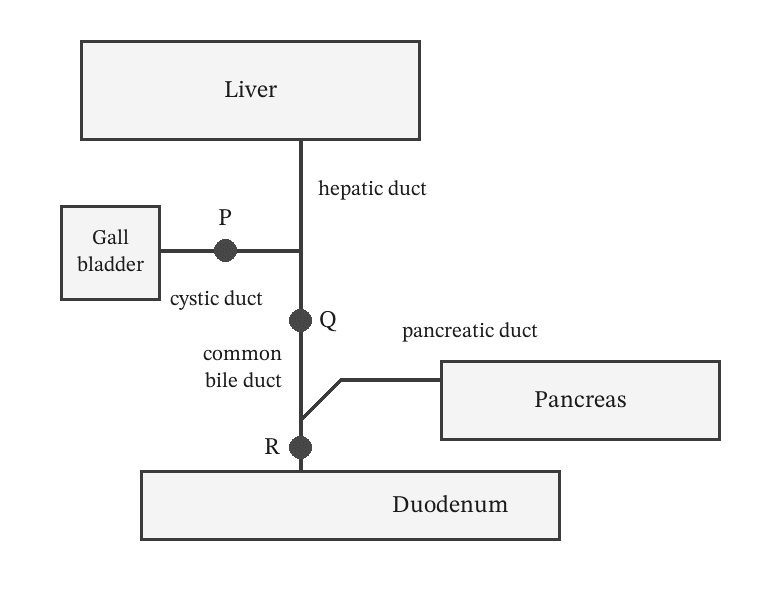
(a) If the stone is at P, can bile and pancreatic juice still reach the duodenum?
(b) If the stone is at Q, which of the two juices can still reach the duodenum?
(c) If the stone is at R, what happens to both juices, and how does this affect digestion?
(d) At which of these positions is the person likely to develop jaundice? Explain.
- 442 marks
Question 44
A student writes: 'Jaundice and hepatitis are two names for the same disease.' Explain why this statement is incorrect.
- 451 mark
Question 45
A 3-year-old has passed watery stools five times since morning but is alert and drinking well. What is the best first step at home while watching for danger signs?
- 463 marks
Question 46
Anil, aged 20, gets bloating, gas and loose stools about an hour after drinking a large glass of milk, but he eats curd without much trouble. A doctor says he has lactose intolerance.
(a) Which enzyme is low in Anil, and where does it normally act?
(b) Explain why undigested lactose causes loose stools and gas.
(c) Suggest why curd causes him less trouble than milk.
- 473 marks
Question 47
A health worker plans to treat a 2-year-old child with kwashiorkor by adding only a protein powder to the child's usual, small meals. Give three reasons why this is a poor plan.
- 481 mark
Question 48
A man with long-standing damage to his pancreas (chronic pancreatitis) passes bulky, greasy, foul-smelling stools that float. A shortage of which enzyme mainly explains the greasy stools?
- 492 marks
Question 49
Explain why repeated vomiting over a whole day can lead to dehydration and to a loss of acid from the body.
- 501 mark
Question 50
A man who takes painkillers such as aspirin every day develops a burning pain in the upper abdomen, and a doctor finds a peptic ulcer in his stomach. Which change in his stomach most directly led to the ulcer?
- 511 mark
Question 51
Enzymes involved in digestion of food are
- 521 mark
Question 52
Which of the following hormones is released by duodenum and acts on gall bladder?
- 531 mark
Question 53
The hardest substance present in a tooth is
- 541 mark
Question 54
Bile is secreted by
- 551 mark
Question 55
Which of the following cells release pepsinogen in stomach?
- 561 mark
Question 56
Pancreatic juice contains the following enzyme
- 571 mark
Question 57
Fats are absorbed by
- 581 mark
Question 58
Which of the following hormones helps in secretion of HCl from stomach?
- 591 mark
Question 59
Trypsin acts on
- 601 mark
Question 60
Bile juice contains
- 611 mark
Question 61
The innermost layer in the wall of alimentary canal is
- 621 mark
Question 62
Amino acids are absorbed by
- 631 mark
Question 63
Pancreatic juice digests
- 641 mark
Question 64
Chymotrypsin acts on
- 651 mark
Question 65
HCl acts on the following to convert it into an active form
- 661 mark
Question 66
Gall bladder stores
- 671 mark
Question 67
Pyloric sphincter is present between
- 681 mark
Question 68
Enterokinase activates
- 691 mark
Question 69
Duodenum has characteristic Brunner's glands which secrete two hormones called
- 701 mark
Question 70
Just as HCl is for the pepsinogen, so is the
- 711 mark
Question 71
Enzyme that hydrolyses triglycerides to fatty acids and glycerol
- 721 mark
Question 72
Lacteals are found in
- 731 mark
Question 73
Crypts of Lieberkuhn are present in
(A) small intestine
(B) large intestine
(C) stomach
(D) oesophagus
- 741 mark
Question 74
How many teeth appear twice during the life span of an individual?
- 751 mark
Question 75
Secretin and cholecystokinin are digestive hormones. These are secreted by
- 761 mark
Question 76
Oxyntic cells secrete
- 771 mark
Question 77
Crown of teeth is covered by
- 781 mark
Question 78
Gastric juice contains protein-splitting enzymes namely
- 791 mark
Question 79
Salivary amylase is also known as
- 801 mark
Question 80
Maltase converts
- 811 mark
Question 81
HCl is secreted by
- 821 mark
Question 82
Wisdom teeth are
- 831 mark
Question 83
Cholecystokinin stimulates
(A) pancreas
(B) gall bladder
(C) secrete bile
(D) none of these
- 841 mark
Question 84
For the absorption of digestive material, structures present in epithelium of cells are
- 851 mark
Question 85
pH of saliva is
- 861 mark
Question 86
Yellow colour of faeces is due to
(A) yellow foods
(B) bile pigments
(C) degradation products of haemoglobin
(D) excessive diet of turmeric
- 871 mark
Question 87
Pepsinogen is secreted by
- 881 mark
Question 88
Digestive enzymes are
- 891 mark
Question 89
Which of the following enzymes digests proteins in stomach?
- 901 mark
Question 90
Medium in which pepsin is active
- 911 mark
Question 91
Succus entericus is secreted by
- 921 mark
Question 92
Bile secretion is proportional to the concentration of
- 931 mark
Question 93
Secretion of pancreatic juice is stimulated by
- 941 mark
Question 94
Main function of enterokinase is
- 951 mark
Question 95
pH of gastric juice is
- 961 mark
Question 96
Pepsin and trypsin both are protein digesting enzymes. Pepsin acts in ____________ medium and trypsin in ____________ medium.
- 971 mark
Question 97
____________ allows only small amount of food to pass from stomach to duodenum.
- 981 mark
Question 98
The secretions of liver are stored in ____________ .
- 991 mark
Question 99
The rhythmic waves of contraction and expansion that allow the food to pass through oesophagus are called ____________ .
- 1001 mark
Question 100
Fats are present as ____________ in the lacteals.
- 1011 mark
Question 101
Zymogen cells in stomach secrete the enzyme ____________ .
- 1021 mark
Question 102
Intestinal epithelial cells have infoldings on the free surface called ____________ that increase the surface area.
- 1031 mark
Question 103
____________ cells secrete HCl while ____________ cells secrete pepsinogen.
- 1041 mark
Question 104
____________ hormone is released from stomach while ____________ is released from duodenum.
- 1051 mark
Question 105
Trypsinogen is activated by ____________ released by the intestinal lining.
- 1061 mark
Question 106
Pancreatic amylase digests proteins to amino acids.
- 1071 mark
Question 107
Mucosa is the innermost lining of alimentary canal lining the lumen.
- 1081 mark
Question 108
Enteropeptidase activates pepsinogen to pepsin.
- 1091 mark
Question 109
Trypsin digests proteins to peptides.
- 1101 mark
Question 110
Fats get absorbed in the blood and glucose by the lacteals.
- 1111 mark
Question 111
Brunner's glands secrete the enterocytes.
- 1121 mark
Question 112
Bile juice contains lipases that emulsify fats.
- 1131 mark
Question 113
Digestion of proteins begins from the mouth cavity and continues till small intestine.
- 1141 mark
Question 114
Pancreatic juice contains enzymes to digest proteins, carbohydrates and fats.
- 1151 mark
Question 115
Gastrin hormone is released from stomach and stimulates secretion of HCl and pepsinogen.
- 1161 mark
Question 116
The organ that produces bile juice in the body.
- 1171 mark
Question 117
Finger-like projections in the lining of small intestine that increase the surface area.
- 1181 mark
Question 118
A disorder when there is high amount of bilirubin in the blood and body gives a yellowish tint.
- 1191 mark
Question 119
An enzyme that activates trypsinogen in the small intestine.
- 1201 mark
Question 120
A hormone that stimulates gall bladder to release bile.
- 1211 mark
Question 121
Part of alimentary canal that receives pancreatic as well as bile juice.
- 1221 mark
Question 122
Glandular cells of stomach that secrete HCl.
- 1231 mark
Question 123
Enzyme that acts on proteins in the stomach.
- 1241 mark
Question 124
Enzyme that digests starch in pancreas.
- 1251 mark
Question 125
Lipoprotein droplets absorbed by lacteals.
- 1261 mark
Question 126
Mark the odd one in the series: Pepsin; lipase; trypsin; chymotrypsin
- 1271 mark
Question 127
Mark the odd one in the series: Bile salts; bile pigments; gall bladder; gastric juice
- 1281 mark
Question 128
Mark the odd one in the series: Maltase; lactase; aminopeptidase; sucrase
- 1291 mark
Question 129
Mark the odd one in the series: Pepsin; secretin; trypsin; lipase
- 1301 mark
Question 130
Mark the odd one in the series: Bile juice; succus entericus; gastric juice; pepsinogen
- 1311 mark
Question 131
Assertion (A): Presence of HCl in stomach is necessary for the process of digestion.
Reason (R): HCl kills and inhibits the growth of bacteria in stomach.
- 1321 mark
Question 132
Assertion (A): Bile juice has lipase which help in the emulsification of fats.
Reason (R): Lipases can break large fat droplets into smaller ones.
- 1331 mark
Question 133
Assertion (A): Pancreas is a dual gland as it has exocrine and endocrine functions.
Reason (R): Exocrine part of pancreas produces enzymes while endocrine part produces hormones.
- 1341 mark
Question 134
Assertion (A): Starch is hydrolysed by ptyalin or salivary amylase to maltose.
Reason (R): Sucrase hydrolyses sucrose to lactose.
- 1351 mark
Question 135
Assertion (A): At the base of villi are present the invaginations called the Crypts of Lieberkuhn.
Reason (R): They contain special secretory cells that produce intestinal juice.
- 1361 mark
Question 136
Assertion (A): The amino acid glycine is a non-essential amino acid.
Reason (R): This is because it cannot be synthesised in the body.
- 1371 mark
Question 137
Assertion (A): Trypsinogen is activated by enterokinase into active trypsin which in turn activates other enzymes in the pancreatic juice.
Reason (R): The pancreatic juice contains inactive enzymes which are activated by intestinal juices.
- 1381 mark
Question 138
Assertion (A): Bile helps in emulsification of fat.
Reason (R): Bile salts help in incorporating fatty acids and glycerol into water-soluble droplets called chylomicrons.
- 1391 mark
Question 139
Assertion (A): Marasmus is due to deficiency of proteins and carbohydrates.
Reason (R): In this disease, the skin of the child becomes dry and wrinkled.
- 1401 mark
Question 140
Assertion (A): Major part of the digested food is absorbed in the ileum part of the small intestine.
Reason (R): The lining of ileum has numerous finger-like projections called villi.
- 1414 marks
Question 141
Answer briefly:
(i) Why are villi present in the intestine and not in the stomach?
(ii) How does pepsinogen change into its active form?
(iii) What are the basic layers of the wall of alimentary canal?
(iv) How does bile help in the digestion of fats?
- 1422 marks
Question 142
Give the dental formula of human beings.
- 1432 marks
Question 143
Bile juice contains no digestive enzymes, yet it is important for digestion. Why?
- 1442 marks
Question 144
Describe the digestive role of chymotrypsin. Which two other digestive enzymes of the same category are secreted by its source gland?
- 1452 marks
Question 145
What would happen if HCl were not secreted in the stomach?
- 1462 marks
Question 146
Explain the term thecodont and diphyodont.
- 1472 marks
Question 147
Name different types of teeth and their number in an adult human.
- 1483 marks
Question 148
What are the functions of liver?